
Parking Task Force Agenda item 6A
Parking Occupancy Field Work and Initial Mapping, results
Parking Improvements Task Force, Wednesday, May 13, 2026
Download these 4 pages, 777 KB Whole packet, 27 pages, 1.9 MB
Page 9
Text of page 9
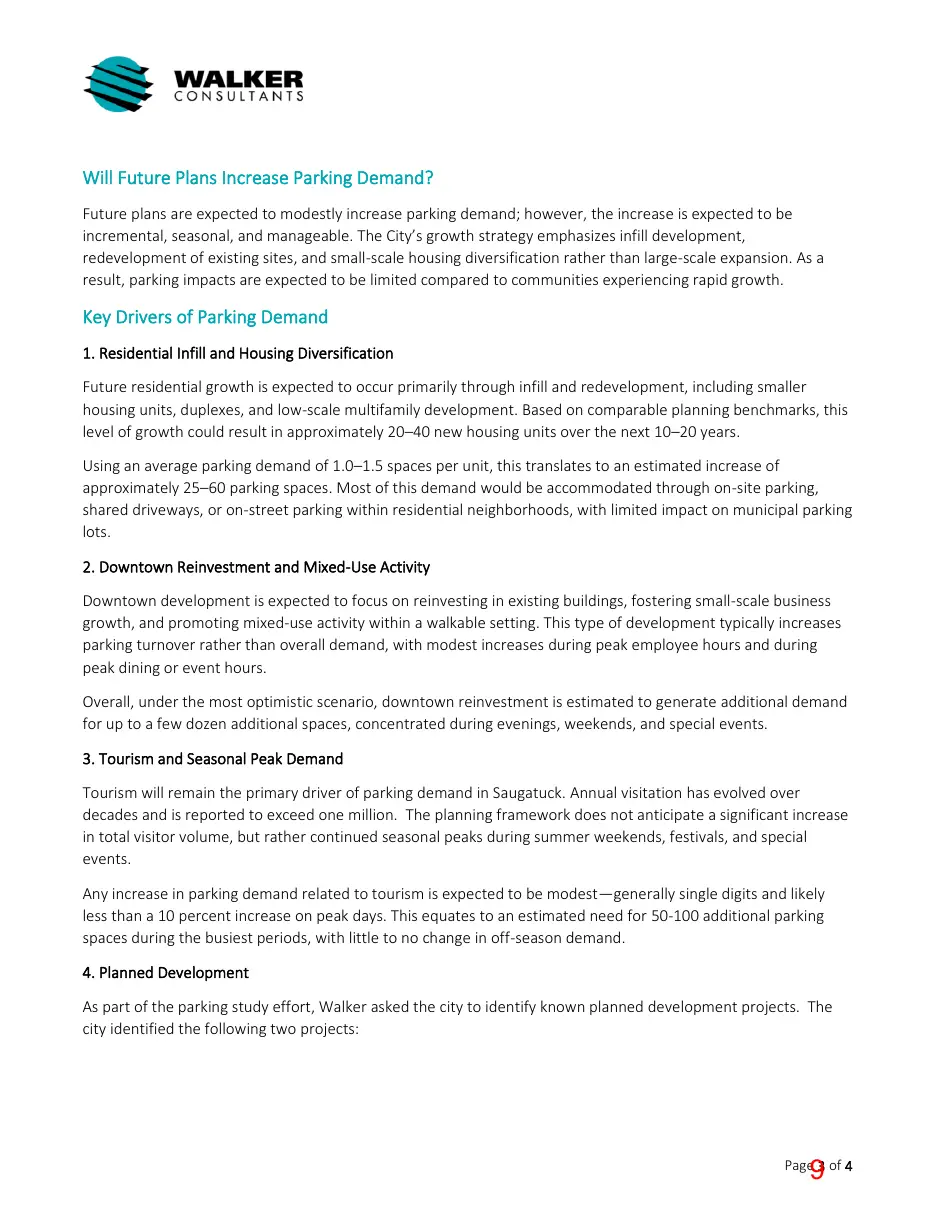
Will Future Plans Increase Parking Demand? Future plans are expected to modestly increase parking demand; however, the increase is expected to be incremental, seasonal, and manageable. The City’s growth strategy emphasizes infill development, redevelopment of existing sites, and small-scale housing diversification rather than large-scale expansion. As a result, parking impacts are expected to be limited compared to communities experiencing rapid growth.
Key Drivers of Parking Demand 1. Residential Infill and Housing Diversification Future residential growth is expected to occur primarily through infill and redevelopment, including smaller housing units, duplexes, and low-scale multifamily development. Based on comparable planning benchmarks, this level of growth could result in approximately 20–40 new housing units over the next 10–20 years. Using an average parking demand of 1.0–1.5 spaces per unit, this translates to an estimated increase of approximately 25–60 parking spaces. Most of this demand would be accommodated through on-site parking, shared driveways, or on-street parking within residential neighborhoods, with limited impact on municipal parking lots. 2. Downtown Reinvestment and Mixed-Use Activity Downtown development is expected to focus on reinvesting in existing buildings, fostering small-scale business growth, and promoting mixed-use activity within a walkable setting. This type of development typically increases parking turnover rather than overall demand, with modest increases during peak employee hours and during peak dining or event hours. Overall, under the most optimistic scenario, downtown reinvestment is estimated to generate additional demand for up to a few dozen additional spaces, concentrated during evenings, weekends, and special events. 3. Tourism and Seasonal Peak Demand Tourism will remain the primary driver of parking demand in Saugatuck. Annual visitation has evolved over decades and is reported to exceed one million. The planning framework does not anticipate a significant increase in total visitor volume, but rather continued seasonal peaks during summer weekends, festivals, and special events. Any increase in parking demand related to tourism is expected to be modest—generally single digits and likely less than a 10 percent increase on peak days. This equates to an estimated need for 50-100 additional parking spaces during the busiest periods, with little to no change in off-season demand. 4. Planned Development As part of the parking study effort, Walker asked the city to identify known planned development projects. The city identified the following two projects:
Page 3 of 4
Page 10
Text of page 10
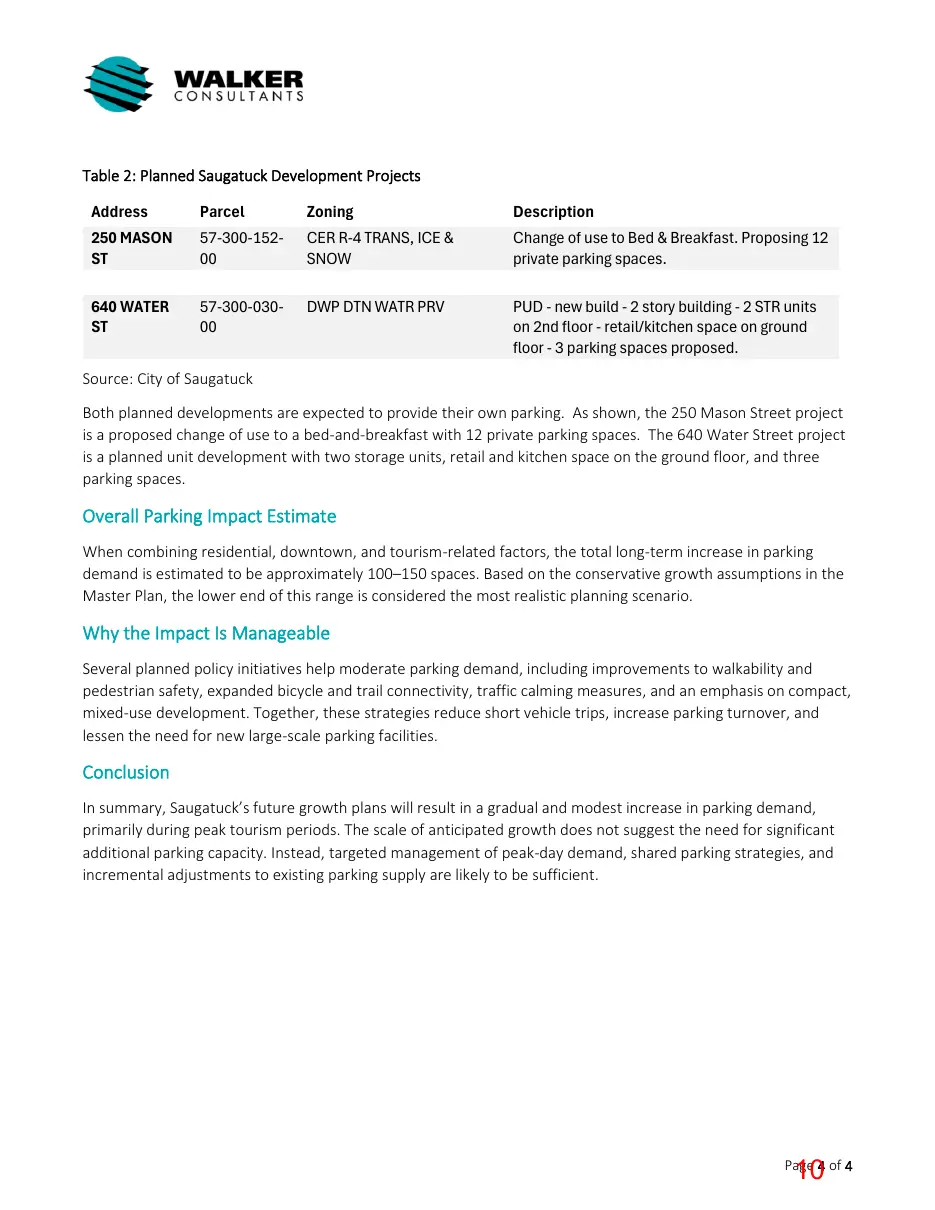
Table 2: Planned Saugatuck Development Projects Address
Parcel
Zoning
Description
250 MASON ST
57-300-15200
CER R-4 TRANS, ICE & SNOW
Change of use to Bed & Breakfast. Proposing 12 private parking spaces.
640 WATER ST
57-300-03000
DWP DTN WATR PRV
PUD - new build - 2 story building - 2 STR units on 2nd floor - retail/kitchen space on ground floor - 3 parking spaces proposed.
Source: City of Saugatuck Both planned developments are expected to provide their own parking. As shown, the 250 Mason Street project is a proposed change of use to a bed-and-breakfast with 12 private parking spaces. The 640 Water Street project is a planned unit development with two storage units, retail and kitchen space on the ground floor, and three parking spaces.
Overall Parking Impact Estimate When combining residential, downtown, and tourism-related factors, the total long-term increase in parking demand is estimated to be approximately 100–150 spaces. Based on the conservative growth assumptions in the Master Plan, the lower end of this range is considered the most realistic planning scenario.
Why the Impact Is Manageable Several planned policy initiatives help moderate parking demand, including improvements to walkability and pedestrian safety, expanded bicycle and trail connectivity, traffic calming measures, and an emphasis on compact, mixed-use development. Together, these strategies reduce short vehicle trips, increase parking turnover, and lessen the need for new large-scale parking facilities.
Conclusion In summary, Saugatuck’s future growth plans will result in a gradual and modest increase in parking demand, primarily during peak tourism periods. The scale of anticipated growth does not suggest the need for significant additional parking capacity. Instead, targeted management of peak-day demand, shared parking strategies, and incremental adjustments to existing parking supply are likely to be sufficient.
Page 4 of 4
Page 11
Text of page 11
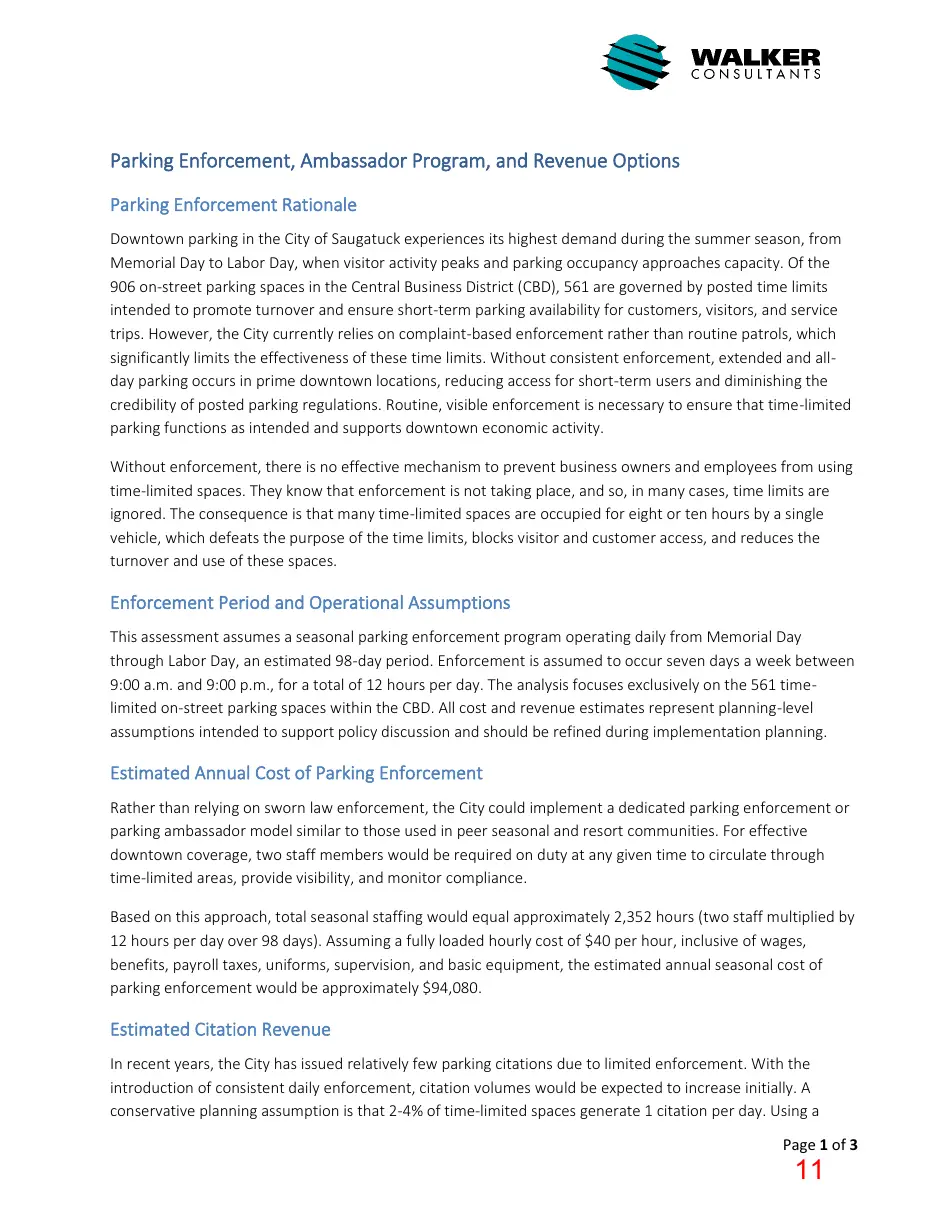
Parking Enforcement, Ambassador Program, and Revenue Options Parking Enforcement Rationale Downtown parking in the City of Saugatuck experiences its highest demand during the summer season, from Memorial Day to Labor Day, when visitor activity peaks and parking occupancy approaches capacity. Of the 906 on-street parking spaces in the Central Business District (CBD), 561 are governed by posted time limits intended to promote turnover and ensure short-term parking availability for customers, visitors, and service trips. However, the City currently relies on complaint-based enforcement rather than routine patrols, which significantly limits the effectiveness of these time limits. Without consistent enforcement, extended and allday parking occurs in prime downtown locations, reducing access for short-term users and diminishing the credibility of posted parking regulations. Routine, visible enforcement is necessary to ensure that time-limited parking functions as intended and supports downtown economic activity. Without enforcement, there is no effective mechanism to prevent business owners and employees from using time-limited spaces. They know that enforcement is not taking place, and so, in many cases, time limits are ignored. The consequence is that many time-limited spaces are occupied for eight or ten hours by a single vehicle, which defeats the purpose of the time limits, blocks visitor and customer access, and reduces the turnover and use of these spaces.
Enforcement Period and Operational Assumptions This assessment assumes a seasonal parking enforcement program operating daily from Memorial Day through Labor Day, an estimated 98-day period. Enforcement is assumed to occur seven days a week between 9:00 a.m. and 9:00 p.m., for a total of 12 hours per day. The analysis focuses exclusively on the 561 timelimited on-street parking spaces within the CBD. All cost and revenue estimates represent planning-level assumptions intended to support policy discussion and should be refined during implementation planning.
Estimated Annual Cost of Parking Enforcement Rather than relying on sworn law enforcement, the City could implement a dedicated parking enforcement or parking ambassador model similar to those used in peer seasonal and resort communities. For effective downtown coverage, two staff members would be required on duty at any given time to circulate through time-limited areas, provide visibility, and monitor compliance. Based on this approach, total seasonal staffing would equal approximately 2,352 hours (two staff multiplied by 12 hours per day over 98 days). Assuming a fully loaded hourly cost of $40 per hour, inclusive of wages, benefits, payroll taxes, uniforms, supervision, and basic equipment, the estimated annual seasonal cost of parking enforcement would be approximately $94,080.
Estimated Citation Revenue In recent years, the City has issued relatively few parking citations due to limited enforcement. With the introduction of consistent daily enforcement, citation volumes would be expected to increase initially. A conservative planning assumption is that 2-4% of time-limited spaces generate 1 citation per day. Using a Page 1 of 3
Page 12
Text of page 12
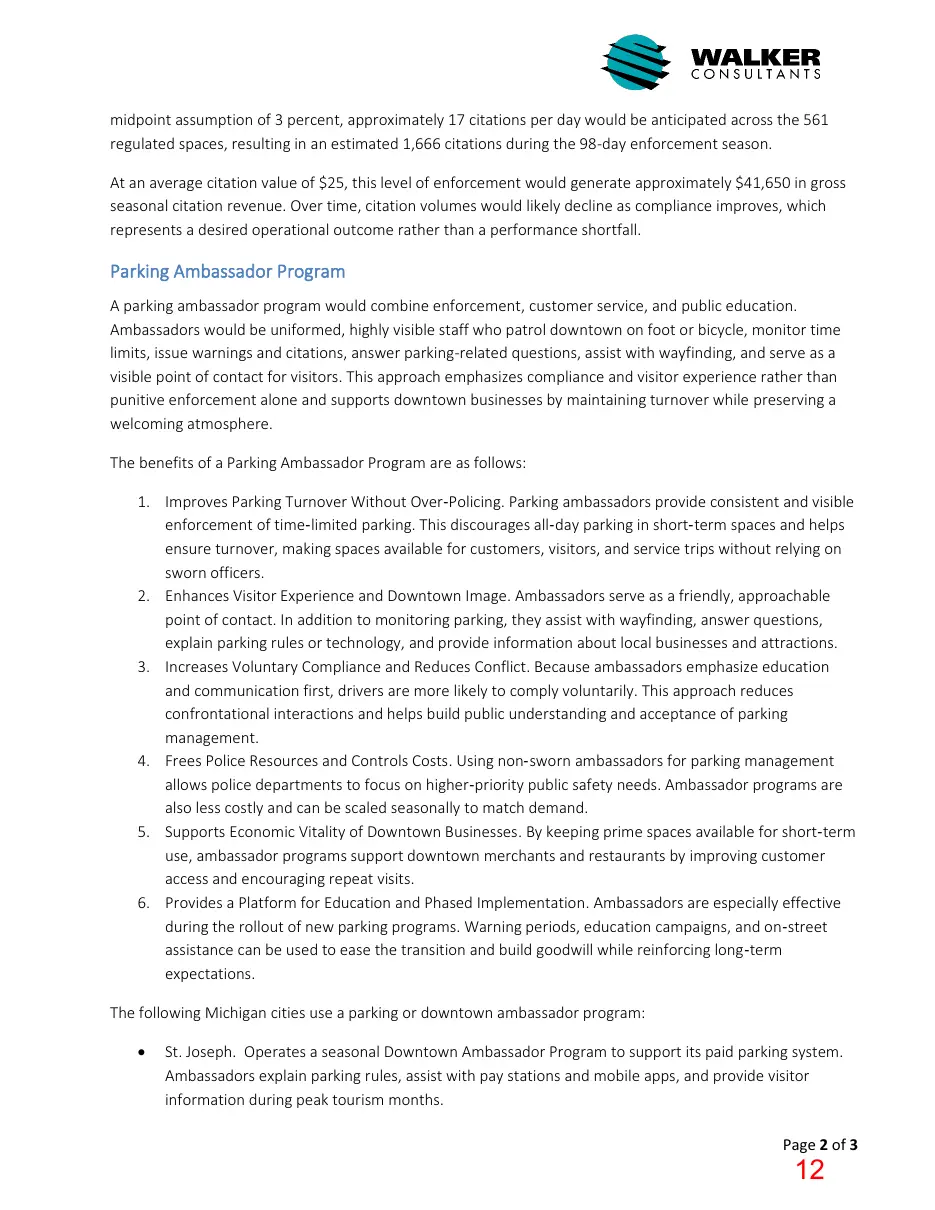
midpoint assumption of 3 percent, approximately 17 citations per day would be anticipated across the 561 regulated spaces, resulting in an estimated 1,666 citations during the 98-day enforcement season. At an average citation value of $25, this level of enforcement would generate approximately $41,650 in gross seasonal citation revenue. Over time, citation volumes would likely decline as compliance improves, which represents a desired operational outcome rather than a performance shortfall.
Parking Ambassador Program A parking ambassador program would combine enforcement, customer service, and public education. Ambassadors would be uniformed, highly visible staff who patrol downtown on foot or bicycle, monitor time limits, issue warnings and citations, answer parking-related questions, assist with wayfinding, and serve as a visible point of contact for visitors. This approach emphasizes compliance and visitor experience rather than punitive enforcement alone and supports downtown businesses by maintaining turnover while preserving a welcoming atmosphere. The benefits of a Parking Ambassador Program are as follows: 1. Improves Parking Turnover Without Over‑Policing. Parking ambassadors provide consistent and visible enforcement of time‑limited parking. This discourages all‑day parking in short‑term spaces and helps ensure turnover, making spaces available for customers, visitors, and service trips without relying on sworn officers. 2. Enhances Visitor Experience and Downtown Image. Ambassadors serve as a friendly, approachable point of contact. In addition to monitoring parking, they assist with wayfinding, answer questions, explain parking rules or technology, and provide information about local businesses and attractions. 3. Increases Voluntary Compliance and Reduces Conflict. Because ambassadors emphasize education and communication first, drivers are more likely to comply voluntarily. This approach reduces confrontational interactions and helps build public understanding and acceptance of parking management. 4. Frees Police Resources and Controls Costs. Using non‑sworn ambassadors for parking management allows police departments to focus on higher‑priority public safety needs. Ambassador programs are also less costly and can be scaled seasonally to match demand. 5. Supports Economic Vitality of Downtown Businesses. By keeping prime spaces available for short‑term use, ambassador programs support downtown merchants and restaurants by improving customer access and encouraging repeat visits. 6. Provides a Platform for Education and Phased Implementation. Ambassadors are especially effective during the rollout of new parking programs. Warning periods, education campaigns, and on‑street assistance can be used to ease the transition and build goodwill while reinforcing long‑term expectations. The following Michigan cities use a parking or downtown ambassador program: •
St. Joseph. Operates a seasonal Downtown Ambassador Program to support its paid parking system. Ambassadors explain parking rules, assist with pay stations and mobile apps, and provide visitor information during peak tourism months. Page 2 of 3