
Workshop Agenda item 6D
Proposed Housing Bills in Legislature
City Council Workshop, Wednesday, March 4, 2026
Download these 24 pages, 2.9 MB Whole packet, 83 pages, 18.2 MB
Page 60
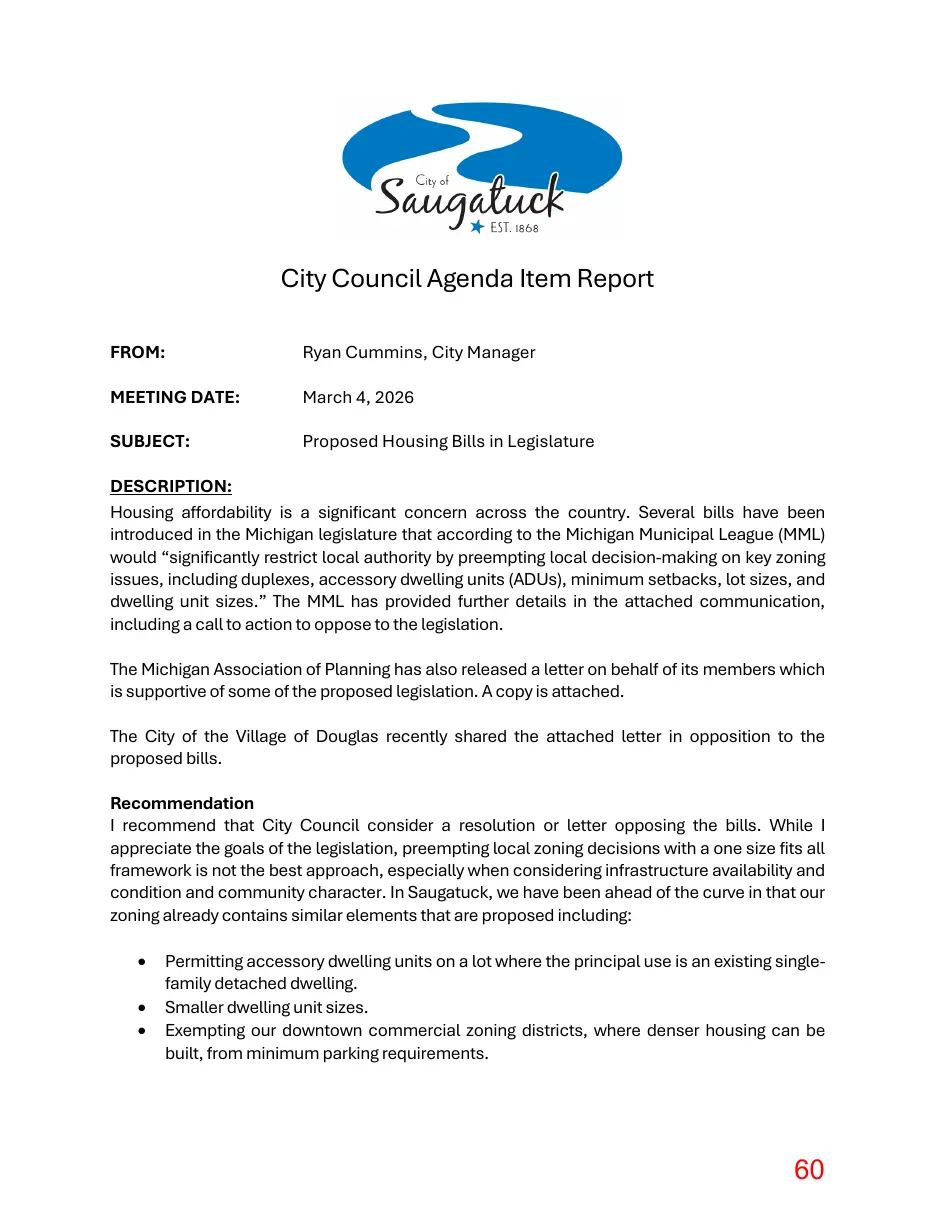
Text of page 60
City Council Agenda Item Report FROM:
Ryan Cummins, City Manager
MEETING DATE:
March 4, 2026
SUBJECT:
Proposed Housing Bills in Legislature
DESCRIPTION: Housing affordability is a significant concern across the country. Several bills have been introduced in the Michigan legislature that according to the Michigan Municipal League (MML) would “significantly restrict local authority by preempting local decision-making on key zoning issues, including duplexes, accessory dwelling units (ADUs), minimum setbacks, lot sizes, and dwelling unit sizes.” The MML has provided further details in the attached communication, including a call to action to oppose to the legislation. The Michigan Association of Planning has also released a letter on behalf of its members which is supportive of some of the proposed legislation. A copy is attached. The City of the Village of Douglas recently shared the attached letter in opposition to the proposed bills. Recommendation I recommend that City Council consider a resolution or letter opposing the bills. While I appreciate the goals of the legislation, preempting local zoning decisions with a one size fits all framework is not the best approach, especially when considering infrastructure availability and condition and community character. In Saugatuck, we have been ahead of the curve in that our zoning already contains similar elements that are proposed including: • • •
Permitting accessory dwelling units on a lot where the principal use is an existing singlefamily detached dwelling. Smaller dwelling unit sizes. Exempting our downtown commercial zoning districts, where denser housing can be built, from minimum parking requirements.
Page 61
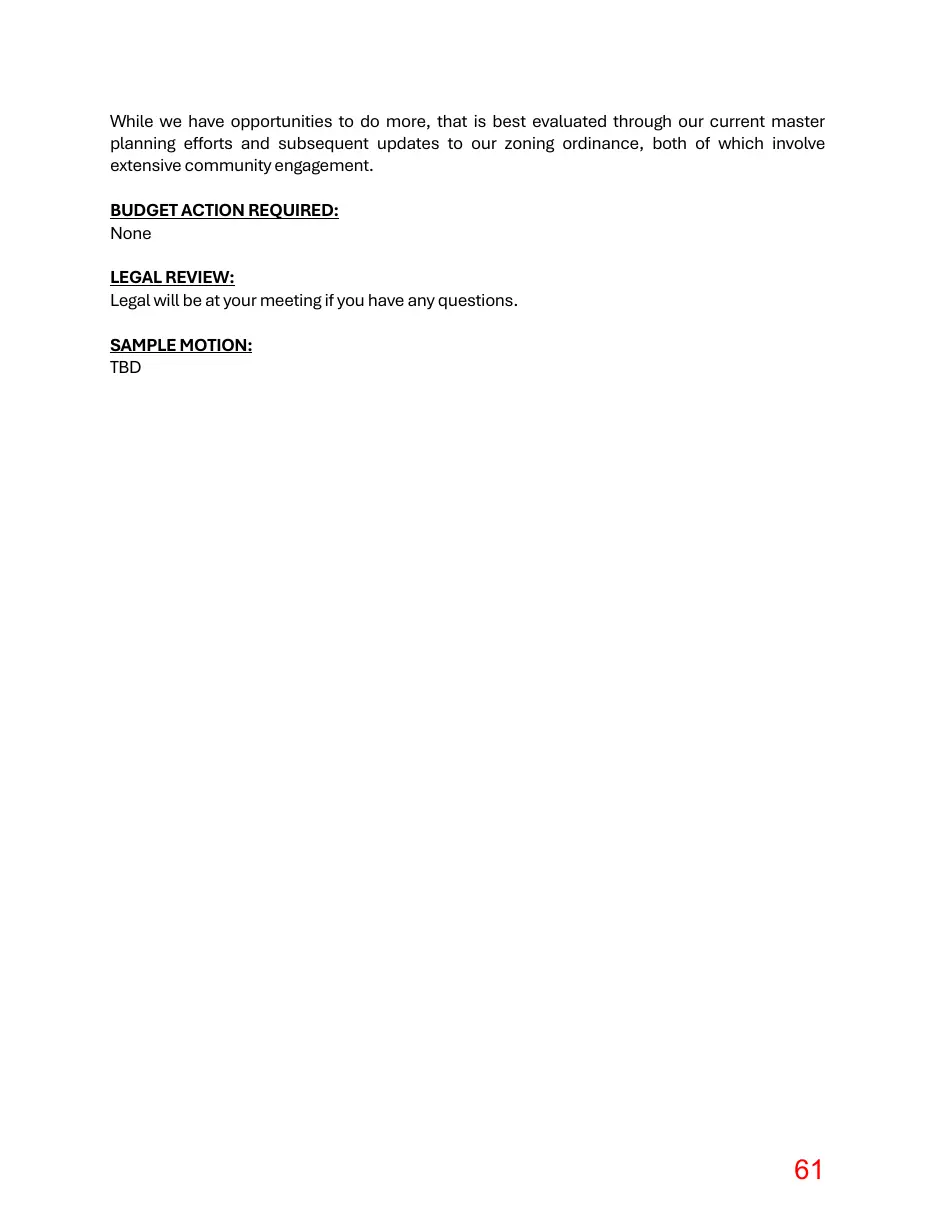
Text of page 61
While we have opportunities to do more, that is best evaluated through our current master planning efforts and subsequent updates to our zoning ordinance, both of which involve extensive community engagement. BUDGET ACTION REQUIRED: None LEGAL REVIEW: Legal will be at your meeting if you have any questions. SAMPLE MOTION: TBD
Page 62
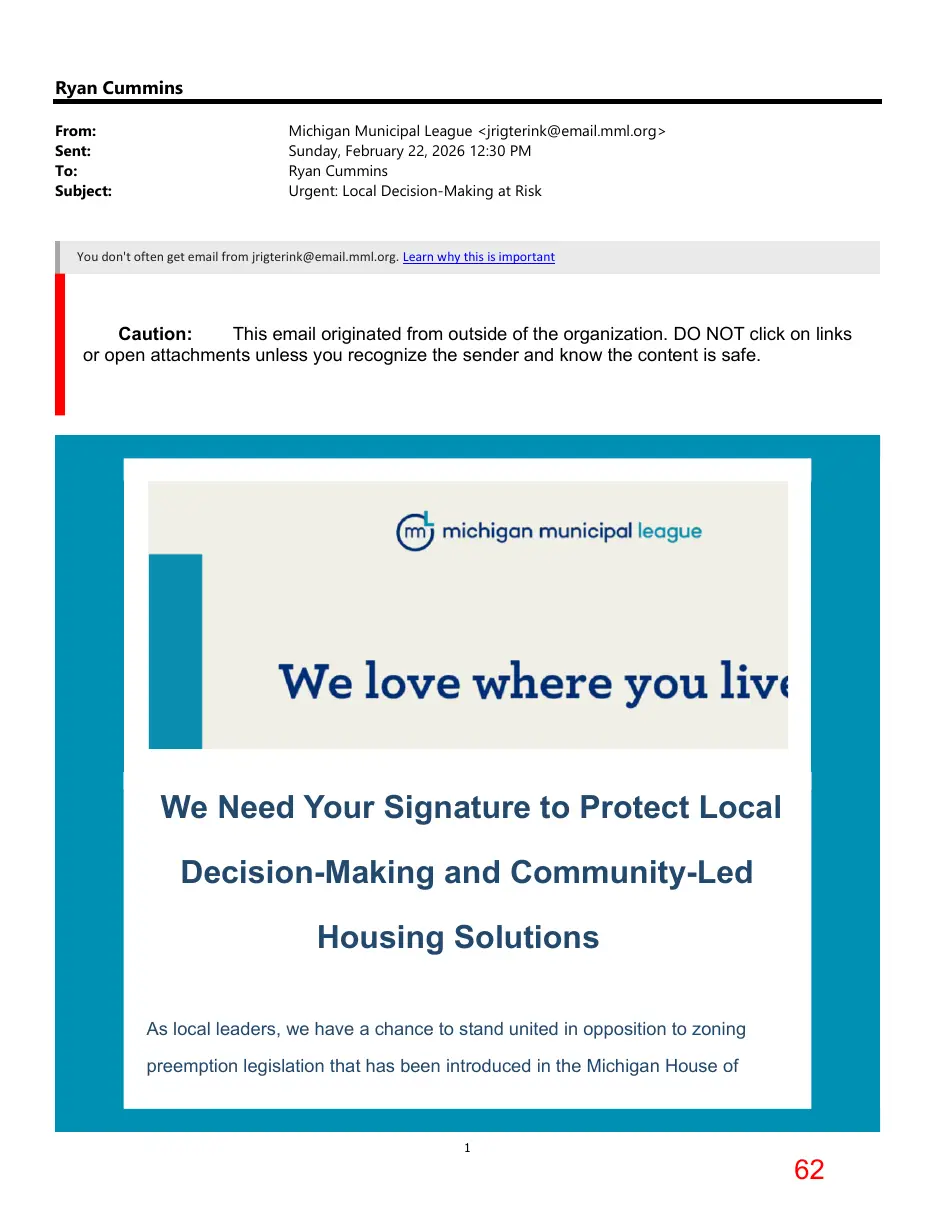
Text of page 62
Ryan Cummins From: Sent: To: Subject:
Michigan Municipal League <jrigterink@email.mml.org> Sunday, February 22, 2026 12:30 PM Ryan Cummins Urgent: Local Decision-Making at Risk
You don't often get email from jrigterink@email.mml.org. Learn why this is important
Caution: This email originated from outside of the organization. DO NOT click on links or open attachments unless you recognize the sender and know the content is safe.
We Need Your Signature to Protect Local Decision-Making and Community-Led Housing Solutions As local leaders, we have a chance to stand united in opposition to zoning preemption legislation that has been introduced in the Michigan House of
Page 63
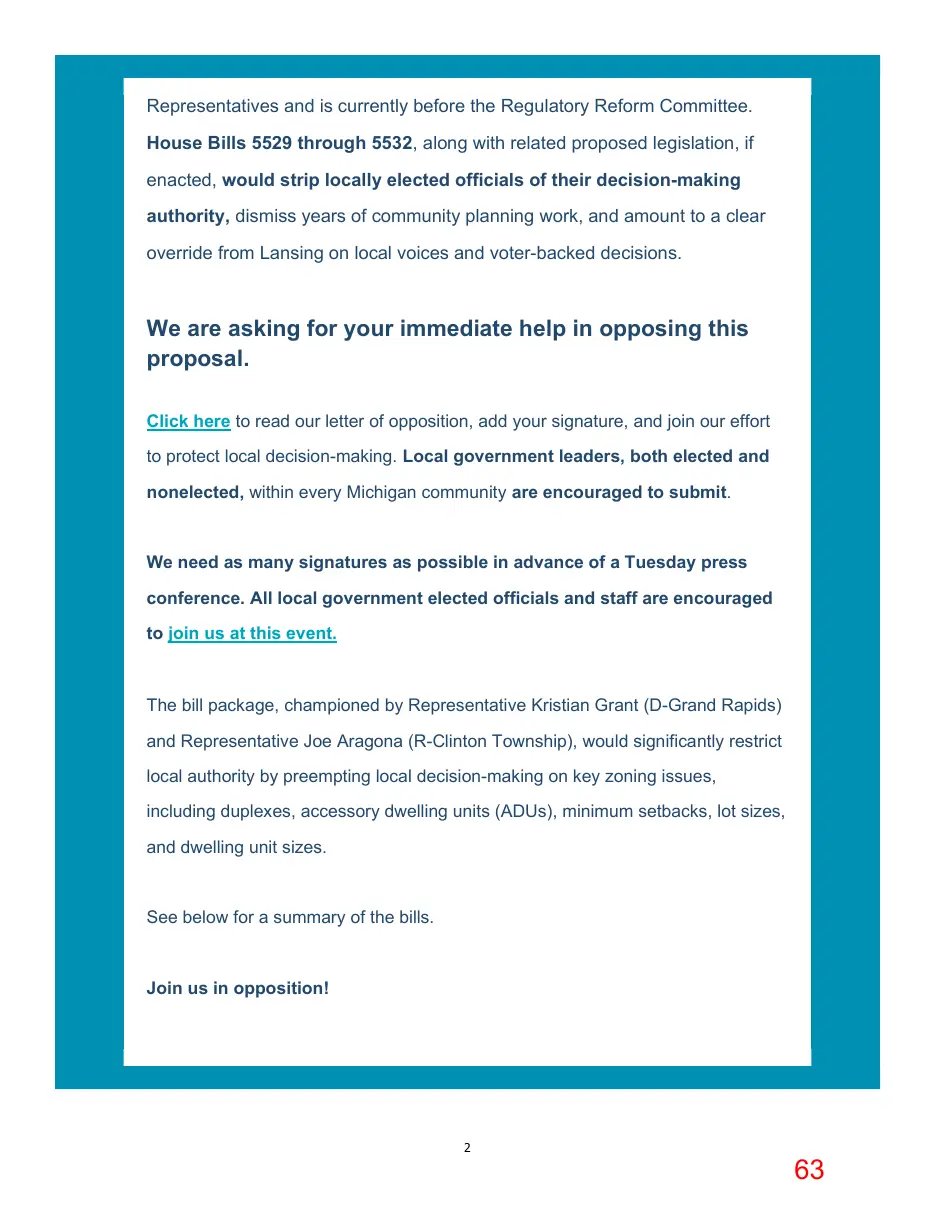
Text of page 63
Representatives and is currently before the Regulatory Reform Committee. House Bills 5529 through 5532, along with related proposed legislation, if enacted, would strip locally elected officials of their decision-making authority, dismiss years of community planning work, and amount to a clear override from Lansing on local voices and voter-backed decisions.
We are asking for your immediate help in opposing this proposal. Click here to read our letter of opposition, add your signature, and join our effort to protect local decision-making. Local government leaders, both elected and nonelected, within every Michigan community are encouraged to submit.
We need as many signatures as possible in advance of a Tuesday press conference. All local government elected officials and staff are encouraged to join us at this event.
The bill package, championed by Representative Kristian Grant (D-Grand Rapids) and Representative Joe Aragona (R-Clinton Township), would significantly restrict local authority by preempting local decision-making on key zoning issues, including duplexes, accessory dwelling units (ADUs), minimum setbacks, lot sizes, and dwelling unit sizes.
See below for a summary of the bills.
Join us in opposition!
Page 64
Text of page 64
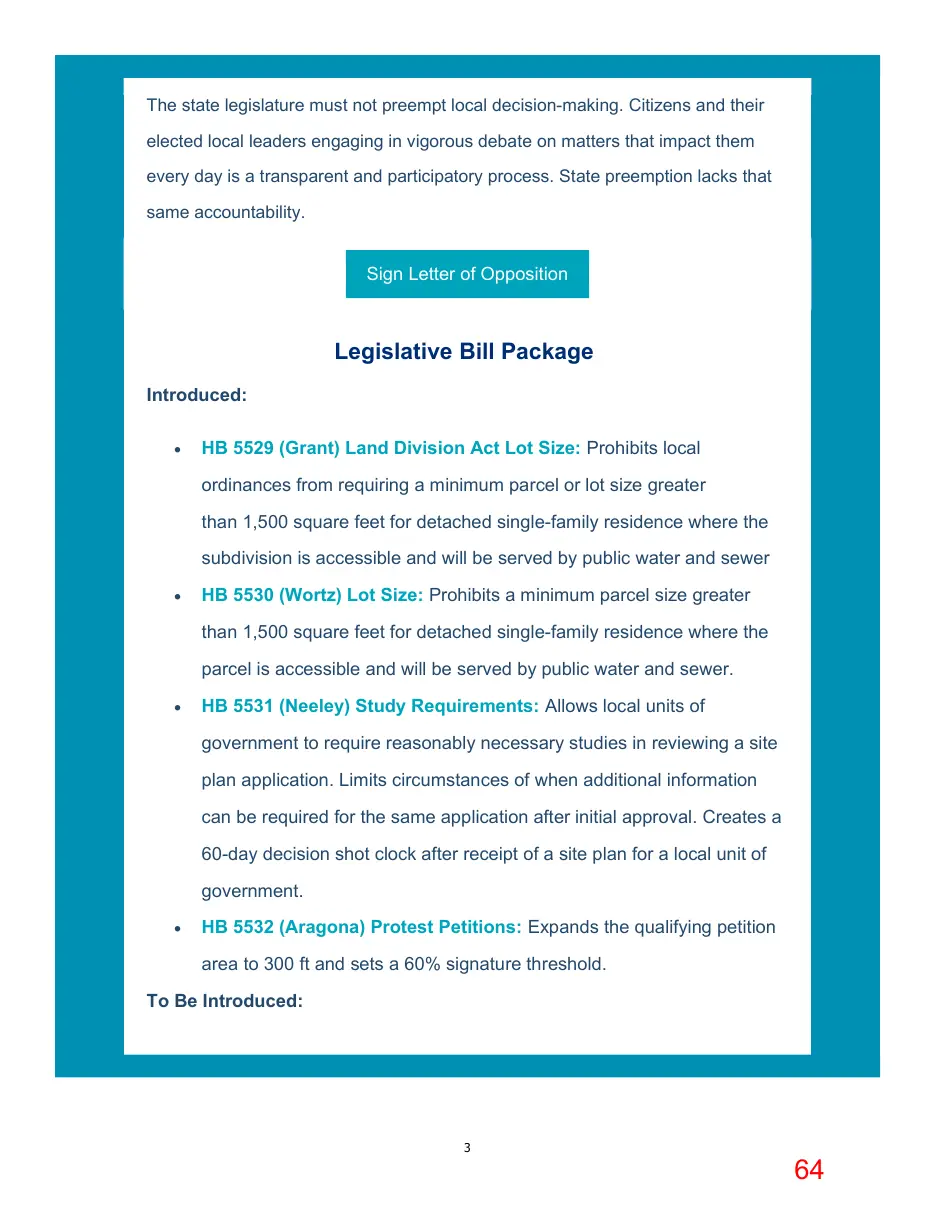
The state legislature must not preempt local decision-making. Citizens and their elected local leaders engaging in vigorous debate on matters that impact them every day is a transparent and participatory process. State preemption lacks that same accountability.
Sign Letter of Opposition
Legislative Bill Package Introduced:
HB 5529 (Grant) Land Division Act Lot Size: Prohibits local ordinances from requiring a minimum parcel or lot size greater than 1,500 square feet for detached single-family residence where the subdivision is accessible and will be served by public water and sewer
HB 5530 (Wortz) Lot Size: Prohibits a minimum parcel size greater than 1,500 square feet for detached single-family residence where the parcel is accessible and will be served by public water and sewer.
HB 5531 (Neeley) Study Requirements: Allows local units of government to require reasonably necessary studies in reviewing a site plan application. Limits circumstances of when additional information can be required for the same application after initial approval. Creates a 60-day decision shot clock after receipt of a site plan for a local unit of government.
HB 5532 (Aragona) Protest Petitions: Expands the qualifying petition area to 300 ft and sets a 60% signature threshold.
To Be Introduced:
Page 65
Text of page 65
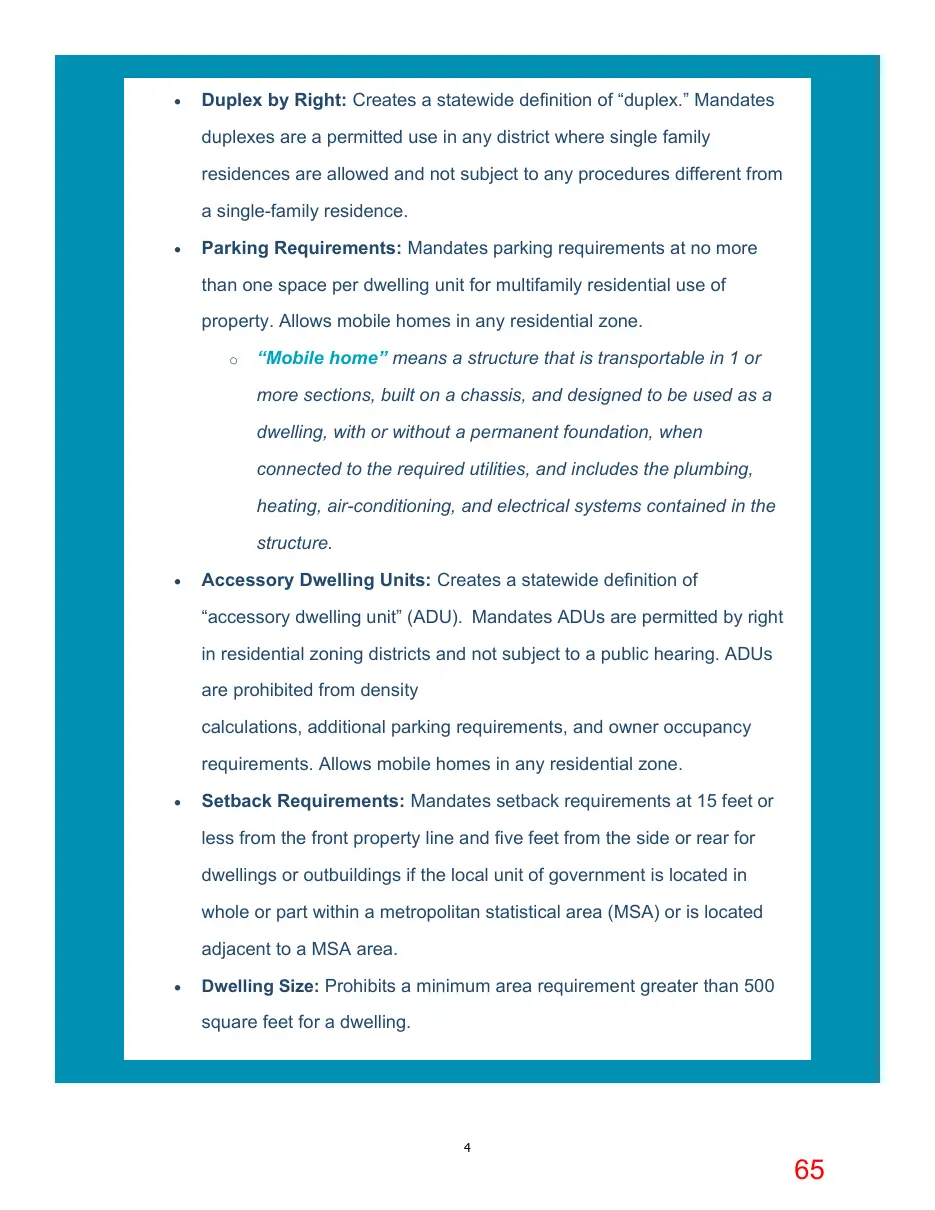
Duplex by Right: Creates a statewide definition of “duplex.” Mandates duplexes are a permitted use in any district where single family residences are allowed and not subject to any procedures different from a single-family residence.
Parking Requirements: Mandates parking requirements at no more than one space per dwelling unit for multifamily residential use of property. Allows mobile homes in any residential zone. o
“Mobile home” means a structure that is transportable in 1 or more sections, built on a chassis, and designed to be used as a dwelling, with or without a permanent foundation, when connected to the required utilities, and includes the plumbing, heating, air-conditioning, and electrical systems contained in the structure.
Accessory Dwelling Units: Creates a statewide definition of “accessory dwelling unit” (ADU). Mandates ADUs are permitted by right in residential zoning districts and not subject to a public hearing. ADUs are prohibited from density calculations, additional parking requirements, and owner occupancy requirements. Allows mobile homes in any residential zone.
Setback Requirements: Mandates setback requirements at 15 feet or less from the front property line and five feet from the side or rear for dwellings or outbuildings if the local unit of government is located in whole or part within a metropolitan statistical area (MSA) or is located adjacent to a MSA area.
Dwelling Size: Prohibits a minimum area requirement greater than 500
square feet for a dwelling.
Page 66

Text of page 66
Supporters of preemption often point to declining permits, rising home prices, and regulatory costs as justification for statewide mandates. While these pressures are real, they are driven by broader economic forces including the housing crash, rising labor and material costs, high interest rates, and complex market dynamics that go far beyond local zoning. Sweeping mandates oversimplify the problem and ignore the unique needs and circumstances of Michigan’s diverse communities.
Thank you for taking the time to advocate for your community by voicing your opposition. Your engagement will lead to our success. If you have any questions, please do not hesitate to reach out to Jen Rigterink at jrigterink@mml.org or John LaMacchia at jlamacchia@mml.org.
Join us on social!
Michigan Municipal League, 1675 Green Road, Ann Arbor, MI 48105, USA, 734-662-3246 Unsubscribe Manage preferences
Page 67
Text of page 67
February 24, 2026 Re: Proposed Bills on Housing Supply and Affordability To Members of the Michigan Association of Planning: The Michigan Association of Planning (MAP) is pleased to offer comments on several draft bills currently under consideration to ease housing construction throughout Michigan. We strongly support efforts to facilitate housing production across our state. Thank you for your leadership on these efforts.
About MAP
As a 501(c)(3) membership-based nonprofit professional association and chapter of the American Planning Association (APA), MAP is dedicated to improving planning and zoning practices in Michigan. Our 4,000-plus members include professional planners in the public and private sectors, elected leaders, appointed officials such as, planning commissioners and zoning board of appeals members, and zoning administrators and building officials. We are the “Go-To” source for planningand zoning-related resources and solutions, and the only organization in Michigan solely focused on these issues. Our Government Relations and Law committees actively work on policy and legislative initiatives, conducting research, drafting bills, and collaborating with legislators to advance policies that foster vital, economically prosperous, equitable, and sustainable communities, which are critical to Michigan's goal of attracting and maintaining a diverse and successful resident and business base.
Our Support for Expanding Housing Supply
These proposed bills address critical aspects of land use and development, directly affecting housing availability and affordability throughout Michigan. Our comments are informed by MAP’s board-adopted housing platform, which emphasizes the need for thoughtful regulatory reforms to address Michigan’s housing challenges. Our housing platform advocates for several key strategies to encourage housing construction. One of our strategies—planning for realistic housing needs—was the subject of HB 5557, passed during the 2024 session. We also support allowing more accessory dwelling units (ADUs), encouraging medium-density housing types, from duplexes to
Page 68
Text of page 68
townhomes, promoting mixed-use development of housing in commercial areas, and using incentives to encourage the production of income-restricted affordable housing. MAP continues to advocate at the local and state levels for zoning reforms to allow more housing and increase transparency and predictability in development. This includes providing technical assistance to local governments and supporting state legislation that encourages housing planning. Two years ago, we launched the MSHDA-funded Zoning Reform for Housing Supply and Choice Toolkit. The zoning reforms in our guidebook are helping local governments make changes to expand housing supply. Nevertheless, legislative reforms are needed to facilitate adequate construction of new housing. To date, local zoning reforms have been neither broad nor deep enough to meaningfully address Michigan’s housing needs.
The Need for State Legislation – And Flexibility
In addition to supporting local reforms, we support state-level legislation to address Michigan’s housing challenges. The widespread and severe undersupply of both marketrate and affordable housing units, as well as a limited variety of housing types (such as attached and multi-family dwellings), stems in part from existing zoning and building laws in some communities that prohibit, limit, or delay the construction of such units. MAP’s research, including through the Michigan Zoning Atlas, our development of the Zoning Reform Toolkit, and the stories and testimony of our members, suggests that, although some local units in Michigan are proactively reforming their zoning laws to accommodate more housing, many are not, and some are actively opposed to doing so. Therefore, while we firmly believe in the importance of local control, the breadth and severity of the current housing shortage make it unlikely to be resolved effectively through a patchwork of disparate local regulations that are slowly and inconsistently adopted. Consistent with APA’s priorities, MAP supports state legislation that advances housing construction and builds upon planners' expertise in facilitating it. MAP members have deep experience preparing housing plans and drafting, administering, and enforcing zoning regulations. We also support clear and consistent application and enforcement of zoning laws, aligning with planners’ ethical obligations to provide accurate information and treat all participants fairly. Furthermore, we support legislation that establishes consistent requirements for communities to allow a broader range of affordable housing types. This approach enables statewide progress while providing opportunities for innovative planning solutions at the local level. The proposed bill package represents a targeted incursion on local control, not a complete displacement. We additionally recognize that streamlining onerous and outdated zoning regulations is but one important element in increasing housing supply and improving affordability. These measures must be buttressed by statewide efforts to address high materials and labor costs, moderate and equalize property tax burdens, and provide incentives to
Page 69
Text of page 69
builders and local governments to aid housing construction. We support any and all efforts, from the MI Home Program proposed by the Michigan Municipal League (MML) to stemming the negative effects of Proposal A, to address our state’s housing needs. While each of these measures is necessary, none is independently sufficient to solve our crisis— an “all of the above” approach is needed. Although we support many of the proposed bills as outlined below, as an overarching matter, we suggest offering local governments flexibility to exempt themselves from the duplex, minimum lot size, and setback bills discussed below if they zone sufficient land for by-right construction of medium-density housing, including multi-family residential units at certain dwelling unit density standards. Alternatively, we recommend broader changes that would require local governments with water and sewer infrastructure to prepare housing needs plans based on local conditions and zone in accordance with those plans, with state-level oversight. We would be happy to further discuss these ideas at your convenience.
Specific Comments
We have reviewed the following draft bills and offer our comments below.
Page 70
Text of page 70
1. ADUs This bill would amend Section 102 and add Section 516 to the Michigan Zoning Enabling Act (MZEA), defining ADUs, permitting them by right on properties where residential uses are allowed and single-family dwellings have been established, and establishing regulations for their treatment, including excluding them from dwelling unit density calculations, setback and dimensional requirements relative to the principal dwelling, and exempting them from parking requirements. It also allows for retroactive approval of previously constructed ADUs. We support this legislation, subject to the following conditions: •
Add a definition of the term “dwelling unit” to avoid any possible confusion about this term. One suggested definition is: “One or more rooms constituting a unit for permanent occupancy, having no more than one primary kitchen together with facilities for sleeping, bathing, and which unit occupies a structure or a portion of a structure used as a single-family dwelling.”
Limit this proposal to cities, villages, and charter townships wholly or partly located within a metropolitan statistical area (MSA), which have public sewer and water systems, and exempt areas in charter townships not served by public water and sewer systems. MAP supports housing construction in a fiscally responsible manner in places where infrastructure and services—including, for example, public water and sanitary sewer service and sufficient transportation infrastructure—are already available to serve such housing. While some Michigan communities have experienced population growth, the state has experienced a decline in population density per housing unit, meaning that existing infrastructure is, in many places, underutilized. Furthermore, we are concerned that allowing ADUs throughout the state will inadvertently lead to “density sprawl,” where new housing is constructed in places without adequate infrastructure or services. Importantly, this suggestion would not prevent local governments outside of MSAs or general law townships in MSAs from choosing to permit ADUs.
In section 516(1)(a), we recommend changing the word “less” to “more,” such that small ADUs, rather than larger ones, are permitted by right.
Page 71
Text of page 71
2. Duplexes By Right We support state legislation allowing middle housing in more areas of the state, but recommend the following changes to this bill: •
Limit this proposal to cities, villages, and charter townships which have public sewer and water systems, wholly or partly located within an MSA, and exempt areas in charter townships not served by public water and sewer systems. MAP supports housing construction in a fiscally responsible manner in places where infrastructure and services—including, for example, water and sanitary sewer service and sufficient transportation infrastructure—are already available to serve such housing. While some Michigan communities have experienced population growth, the state has experienced a decline in population density per housing unit, meaning that existing infrastructure is, in many places, underutilized. Furthermore, we are concerned that allowing multi-unit development throughout the state will inadvertently lead to “density sprawl,” where new housing is constructed in places without adequate infrastructure or services.
Broaden the proposal to allow, or at least strongly encourage, other types of middle housing—including, for example, triplexes, fourplexes, townhouses, and cottage clusters—in single-family districts and elsewhere. Where they have been permitted in other states and cities, duplexes have been slow to materialize, limiting their effectiveness in easing the housing crisis. Builders face significant structural hurdles in producing duplexes due to high transaction costs, low scalability, and insufficient financing options. MAP supports facilitating the construction of financially feasible housing types that are easy to construct, including allowing mediumand higher-density multi-family housing in zoning districts served by public sewer and water, that allow commercial uses and at least four units per residential lot.
Change the term “single-family residence” as used throughout this bill to “single-family dwelling unit” or “dwelling unit” as used throughout the remainder of the MZEA.
Page 72
Text of page 72
3. Dwelling Size Requirements This bill proposes to amend Section 205d of the Michigan Zoning Enabling Act to prohibit a zoning ordinance from imposing a minimum floor area requirement of greater than 500 square feet for a dwelling. Minimum dwelling size requirements can be a significant barrier to the development of smaller, more affordable housing units, such as studios or onebedroom apartments, which are critical for diverse housing needs. Limiting these minimums to no more than 500 square feet allows for a wider range of housing types and price points, contributing to housing attainability and addressing the needs of single individuals, young professionals, and seniors. This aligns directly with our platform’s focus on increasing housing options. We support this legislation, subject to the following conditions: •
Limit this proposal to cities, villages, and charter townships wholly or partly located within an MSA, which have public water and sewer systems, and exempt areas in charter townships not served by public water and sewer systems. MAP supports housing construction in a fiscally responsible manner in places where infrastructure and services—including, for example, water and sanitary sewer service and sufficient transportation infrastructure—are already available to serve such housing. While some Michigan communities have experienced population growth, the state has experienced a decline in population density per housing unit, meaning that existing infrastructure is, in many places, underutilized. Furthermore, we are concerned that encouraging small-unit development throughout the state will inadvertently lead to “density sprawl,” where new housing is constructed in places without adequate infrastructure or services.
Change the term “single-family residence” as used throughout this bill to “single-family dwelling unit” or “dwelling unit” as used throughout the remainder of the MZEA.
Page 73
Text of page 73
4. Lot Size Requirements HB 5530 proposes to amend Section 205d of the MZEA to prohibit a zoning ordinance from imposing a minimum lot or parcel size of more than 1,500 square feet on land zoned for a detached single-family residence if public water and sewer services are available or planned for the subject parcel. A related bill, HB 5529, proposes a corresponding Land Division Act amendment. Large minimum lot sizes contribute to urban sprawl, increase infrastructure costs, and make housing less affordable by requiring larger land purchases. We support HB 5530, subject to the following conditions: •
Make this proposal applicable to cities, villages, and charter townships wholly or partly located within a metropolitan statistical area, which have public water and sewer systems, and exempt areas in charter townships not served by public water and sewer systems. MAP supports housing construction in a fiscally responsible manner in places where infrastructure and services—including, for example, water and sanitary sewer service and sufficient transportation infrastructure—are already available to serve such housing. Although we appreciate that the proposal provides for a cap on minimum lot sizes in areas served or proposed to be served by water and sewer—an important infrastructure consideration—we recommend that the proposal apply only in the jurisdictions discussed above. While some Michigan communities have experienced population growth, the state has experienced a decline in population density per housing unit, meaning that existing infrastructure is, in many places, underutilized. Furthermore, we are concerned that allowing dense development throughout the state will inadvertently lead to “density sprawl,” where new housing is constructed in places without adequate infrastructure or services.
Clarify in the bill that the minimum lot size established in the bill will not supersede rules concerning environmental protection.
Clarify the relationship between the rules proposed in these bills and Section 506 of the MZEA, which requires local units to maintain certain rules regarding open space preservation.
We do not support HB 5529 in its present form. It should be clarified to ensure that subdivided lots may be larger than 1,500 square feet where appropriate, particularly where they are encumbered by environmental conditions.
Page 74
Text of page 74
5. Setback Requirements This bill proposes to amend Section 205d of the MZEA to preempt setback requirements greater than 25 feet on a dwelling or outbuilding if the local unit of government is located in whole or part within, or adjacent to, an MSA. Based on the proposed language, it appears to apply to all dwellings, not just single-family detached residences. We are neutral on this proposal. We support state legislation allowing more housing types, smaller lot sizes, reduced parking requirements, and other rules that facilitate housing development. Although we are not aware of any widespread use of onerous setback rules by communities interested in preventing housing construction, the proposed maximum 25-foot setback rule affords communities flexibility in establishing setbacks. Setback rules are an important planning tool used to provide space for public utilities and landscaping, ensure building access and safety, and establish the aesthetic character of neighborhoods. In particular, larger setbacks may be appropriate along major arterial roadways or highways. We note that, even if onerous setback rules are adopted, landowners have recourse through the variance process and judicial review. 6. Parking Minimums This bill proposes to amend Section 205d of the MZEA to prohibit a zoning ordinance from requiring the provision of more than 1 parking space per dwelling unit for a residential use of property. We support this legislation. However, we would prefer that it eliminate all vehicle parking requirements for new housing. MAP notes that this bill will not prevent builders from providing vehicle parking as market conditions merit. It is MAP’s position that builders and owners of housing are best positioned to determine how much parking to provide.
Page 75
Text of page 75
7. Revise Study Requirements (HB 5531) This bill proposes to amend Section 501 of the MZEA by limiting when a local unit of government may require additional or revised studies or documents from an applicant for a site plan approval, and clarifying site plan approval criteria. Increasing certainty for all participants in the planning and development process and avoiding procedural abuses concerning development applications, while ensuring full review and evaluation of relevant information concerning a development proposal and its prospective impact, is consistent with good planning practice. We support this legislation, subject to the following conditions: •
Not all local governments use a multi-step site plan review process, and the language “initial site plan approval” is thus confusing. We recommend changing the defined term in section 501(6) from “initial site plan approval” to “initial site plan review,” with corresponding edits to the definition.
We suggest including a provision in section 501(5) allowing applicants to extend the 60-day deadline, particularly in the case of large or otherwise complex projects.
8. Petition Process Changes (HB 5532) This bill proposes to amend Section 403 of the MZEA, modifying protest petition requirements for zoning ordinance amendments, including increased signature thresholds for amendments that increase the authorized number of dwelling units. We support this legislation; however, we recommend completely eliminating protest petition rights in Michigan. If protest petition rights are not fully eliminated, we recommend increasing the petitioning threshold for all amendments to local zoning ordinances, rather than just those that increase the authorized number of dwelling units. Conclusion and Future Work In conclusion, MAP is encouraged by most of these proposed bills, as they are consistent with MAP’s platform and APA’s policy positions on housing. Nevertheless, we believe these bills are just a starting point for important policy discussions—involving all stakeholders, from local governments to housing builders and other advocacy organizations—to determine how Michigan can best add needed housing supply and encourage strategic economic growth while respecting individual communities’ needs. This type of dialogue and exchange is critically important to the successful passage of any housing-related legislation and its durability in the future. We look forward to working with you and your colleagues, as well as diverse stakeholders, as we continue these efforts.
Page 76
Text of page 76
We appreciate the opportunity to provide these comments and stand ready to assist the Legislature with our expertise as these important bills move forward. Please do not hesitate to contact us for further discussion or clarification. Sincerely,
Michigan Association of Planning Andrea Brown, AICP, Executive Director
Page 77
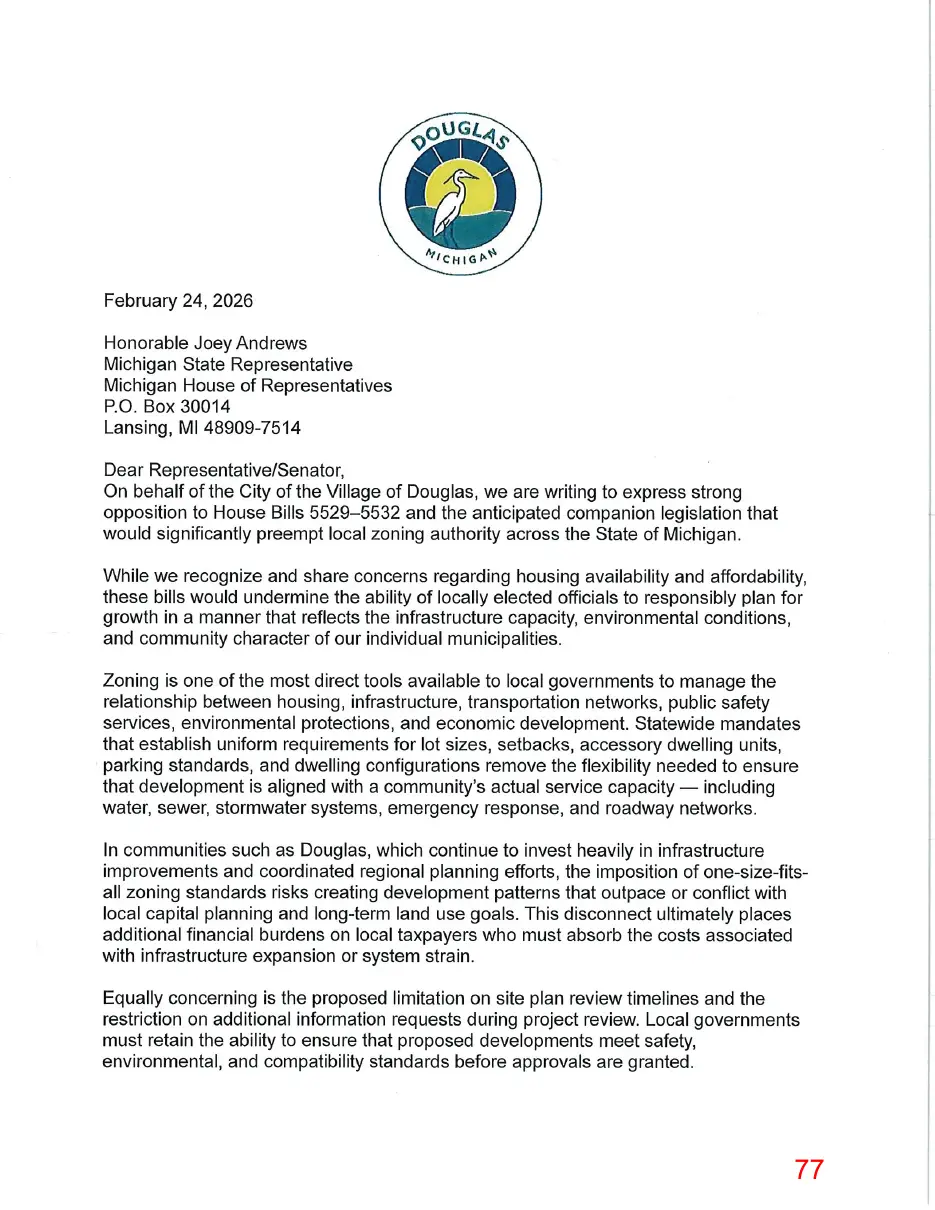
This page is a scanned image with no text layer. The PDF of these pages has it at full resolution.
Page 78
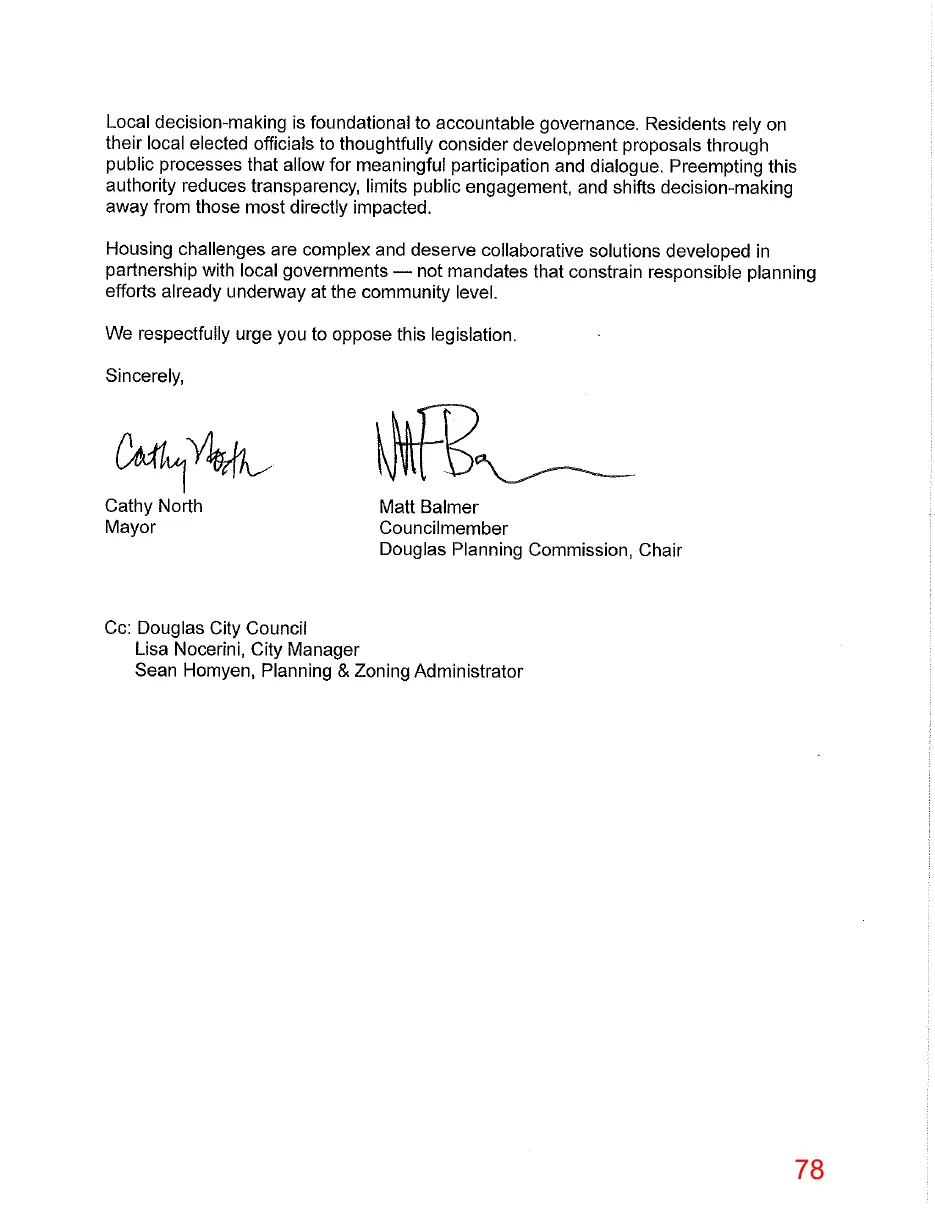
This page is a scanned image with no text layer. The PDF of these pages has it at full resolution.
Page 79
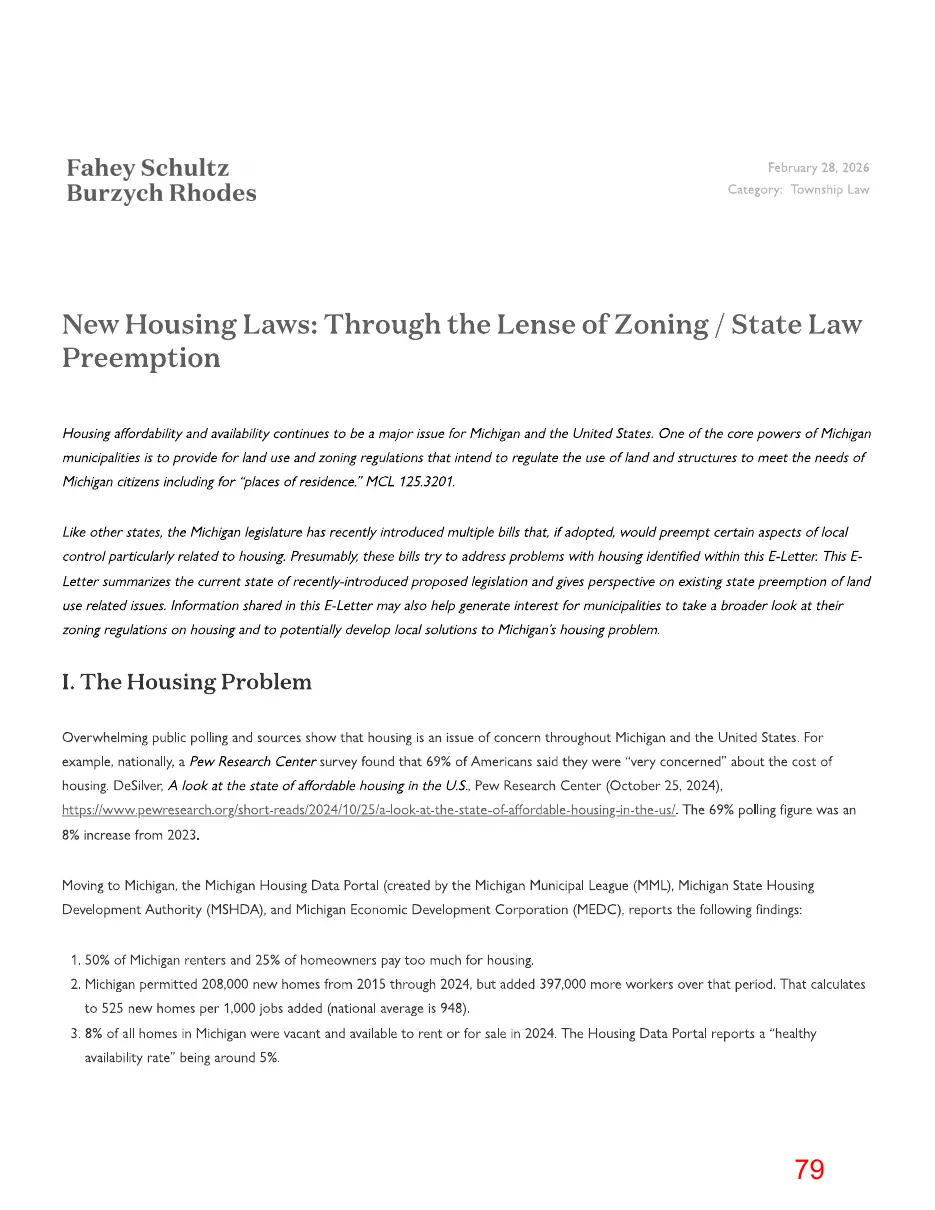
This page is a scanned image with no text layer. The PDF of these pages has it at full resolution.
Page 80
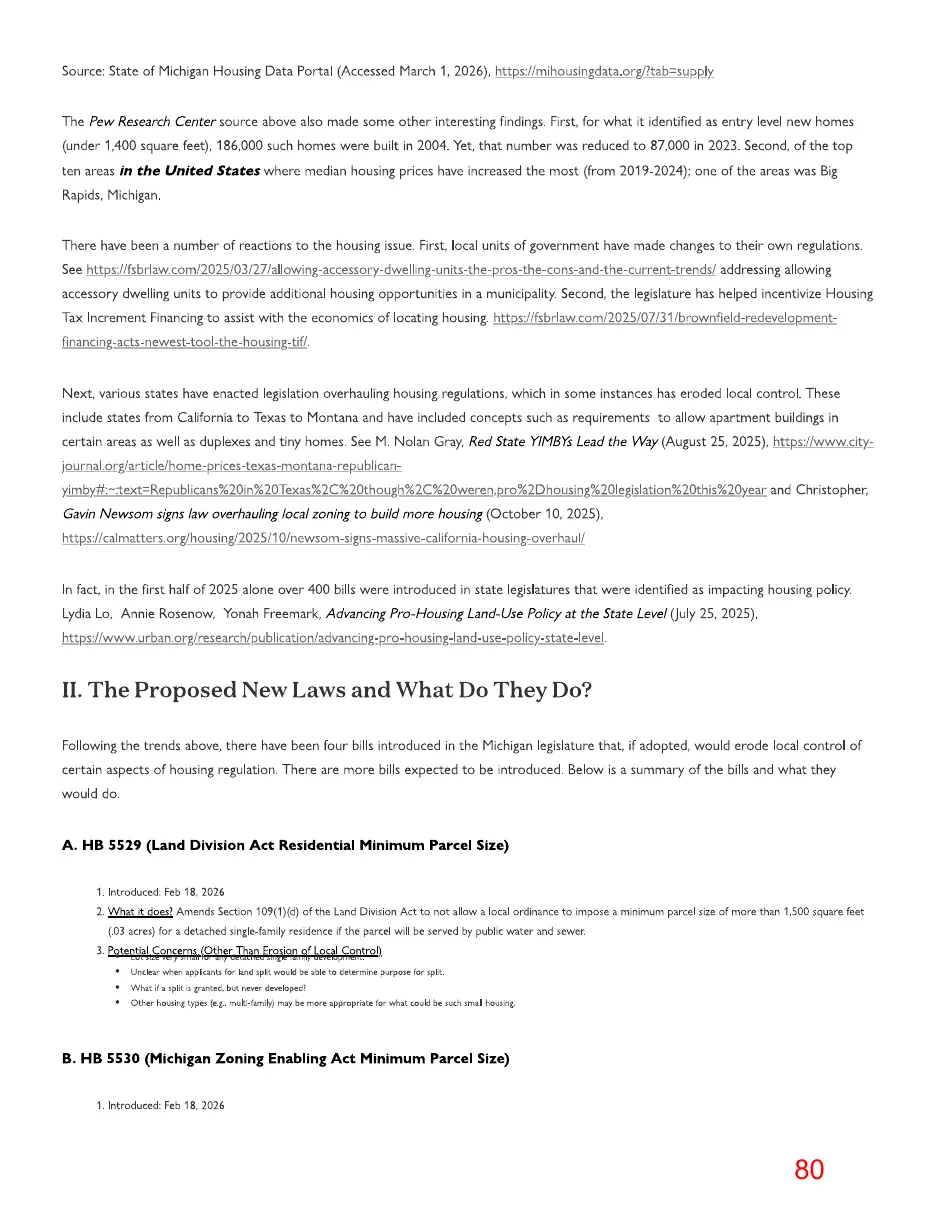
This page is a scanned image with no text layer. The PDF of these pages has it at full resolution.
Page 81
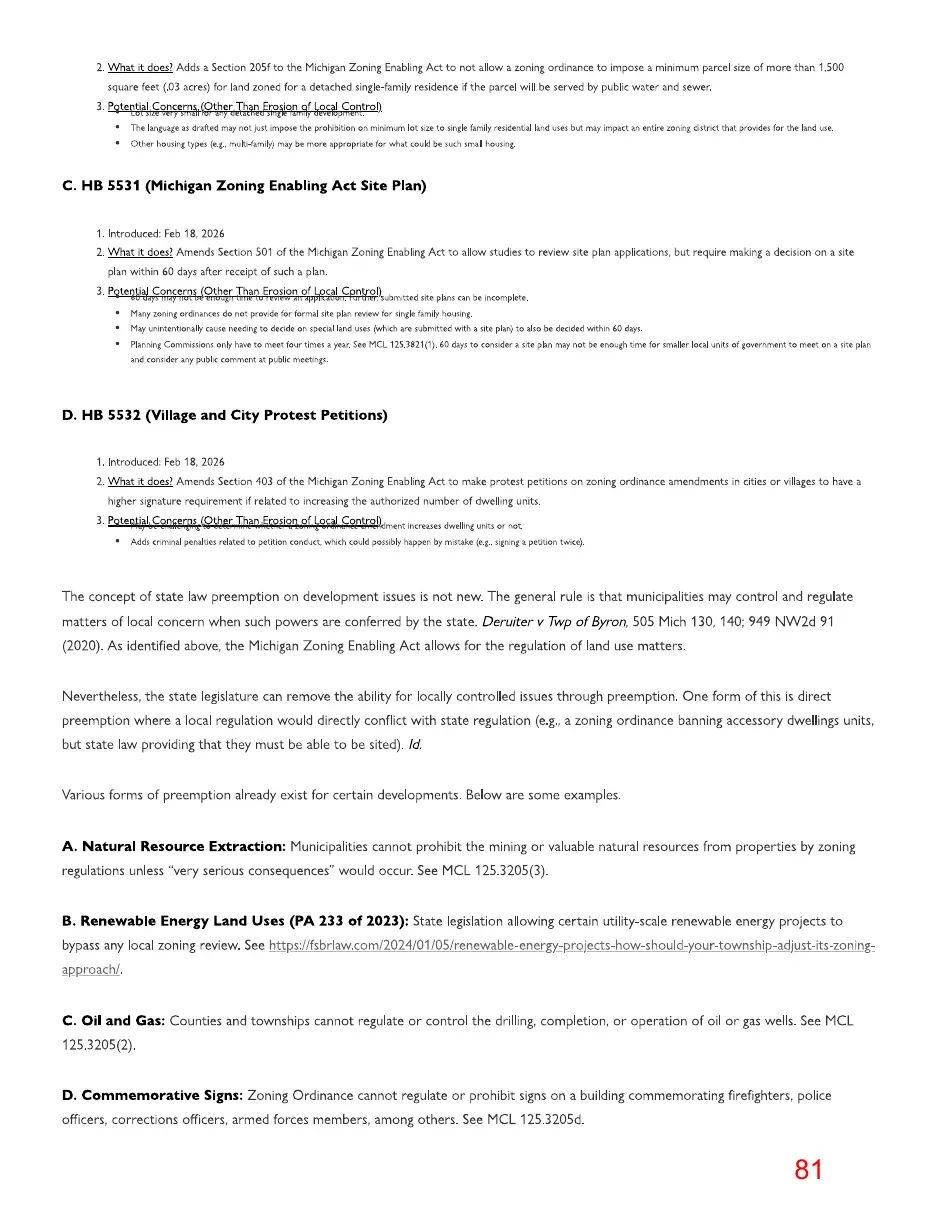
This page is a scanned image with no text layer. The PDF of these pages has it at full resolution.
Page 82
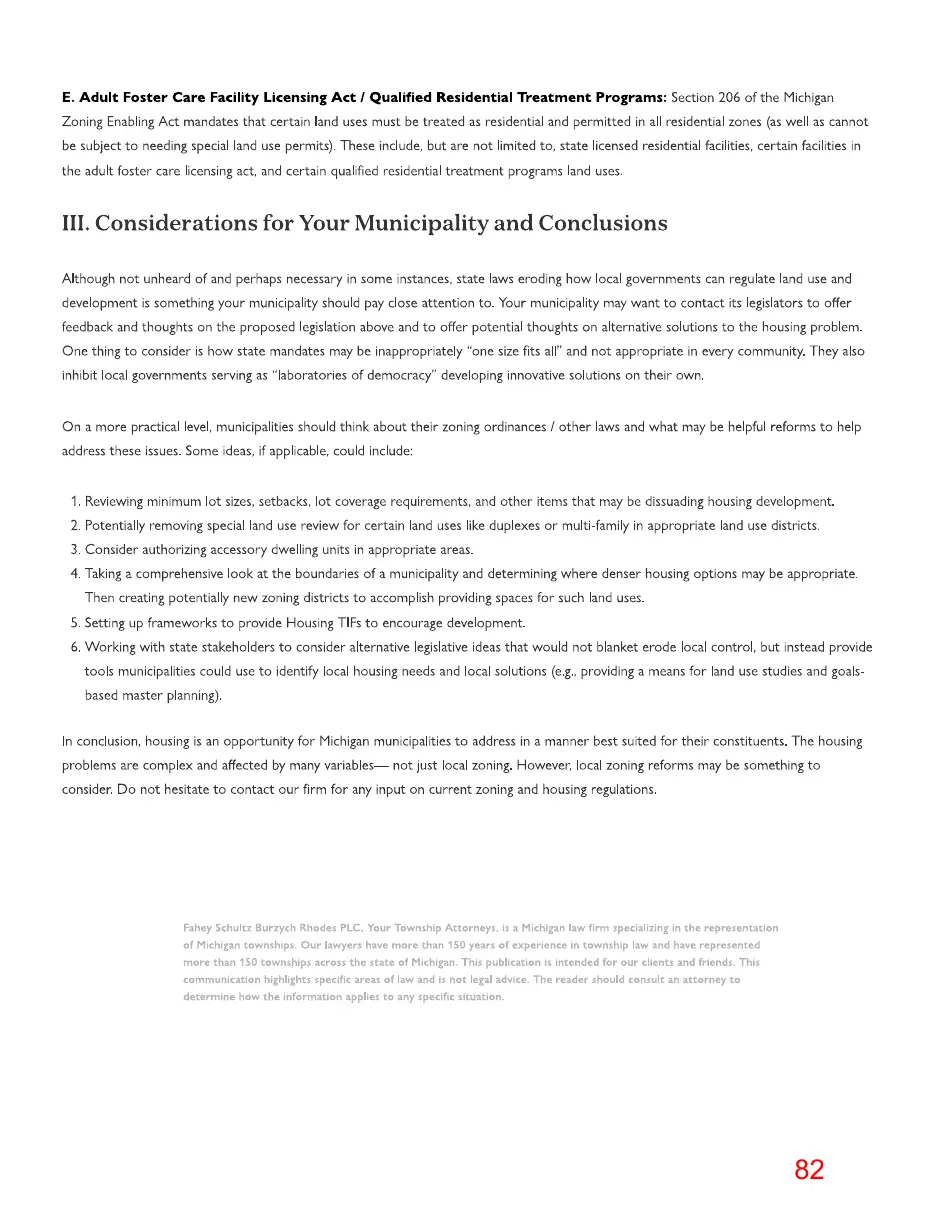
This page is a scanned image with no text layer. The PDF of these pages has it at full resolution.
Page 83

This page is a scanned image with no text layer. The PDF of these pages has it at full resolution.