
Workshop Agenda item 6B
Water Distribution System Materials Inventory
City Council Workshop, Wednesday, October 8, 2025
Download these 18 pages, 1.6 MB Whole packet, 201 pages, 38.5 MB
Page 25
Text of page 25
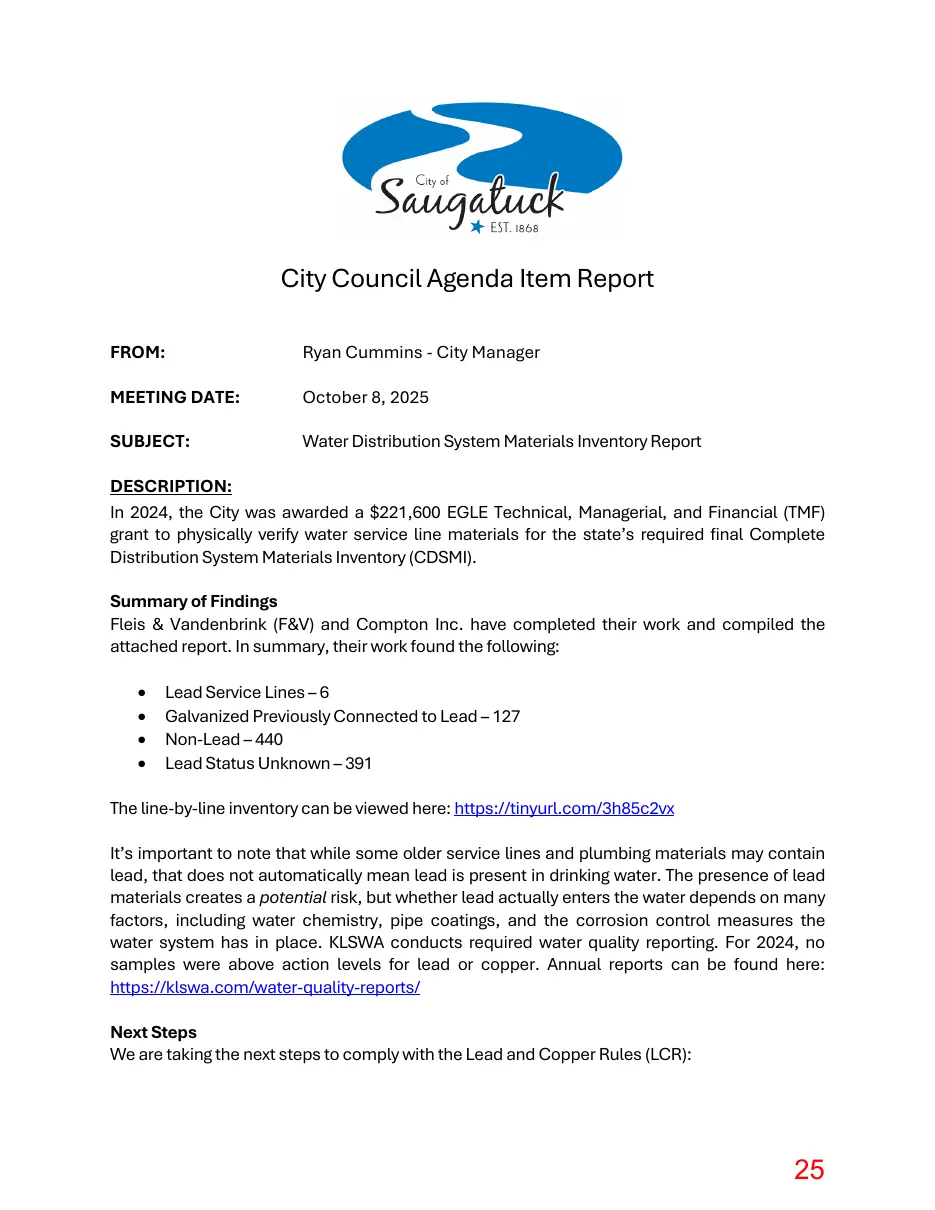
City Council Agenda Item Report FROM:
Ryan Cummins - City Manager
MEETING DATE:
October 8, 2025
SUBJECT:
Water Distribution System Materials Inventory Report
DESCRIPTION: In 2024, the City was awarded a $221,600 EGLE Technical, Managerial, and Financial (TMF) grant to physically verify water service line materials for the state’s required final Complete Distribution System Materials Inventory (CDSMI). Summary of Findings Fleis & Vandenbrink (F&V) and Compton Inc. have completed their work and compiled the attached report. In summary, their work found the following: • • • •
Lead Service Lines – 6 Galvanized Previously Connected to Lead – 127 Non-Lead – 440 Lead Status Unknown – 391
The line-by-line inventory can be viewed here: https://tinyurl.com/3h85c2vx It’s important to note that while some older service lines and plumbing materials may contain lead, that does not automatically mean lead is present in drinking water. The presence of lead materials creates a potential risk, but whether lead actually enters the water depends on many factors, including water chemistry, pipe coatings, and the corrosion control measures the water system has in place. KLSWA conducts required water quality reporting. For 2024, no samples were above action levels for lead or copper. Annual reports can be found here: https://klswa.com/water-quality-reports/ Next Steps We are taking the next steps to comply with the Lead and Copper Rules (LCR):
Page 26
Text of page 26
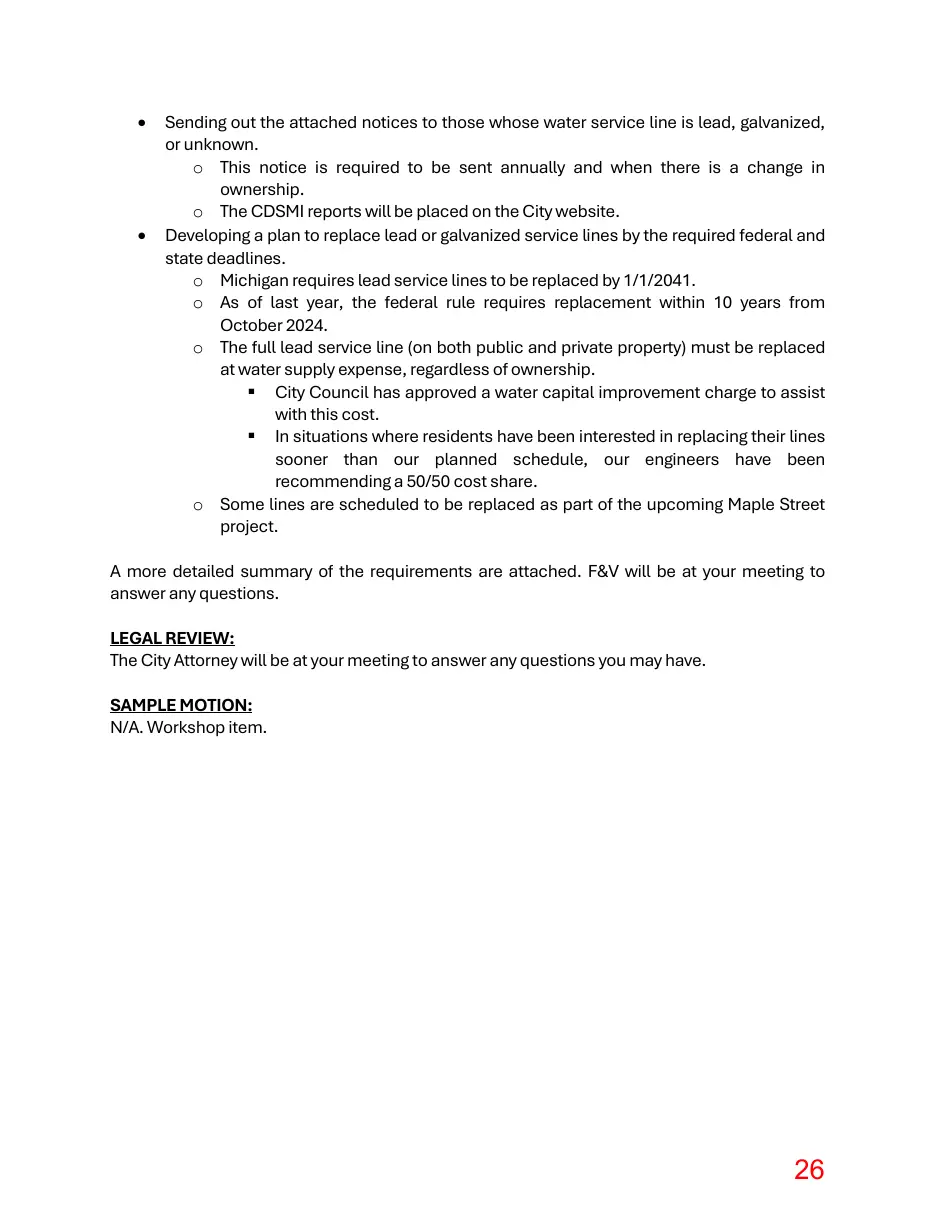
Sending out the attached notices to those whose water service line is lead, galvanized, or unknown. o This notice is required to be sent annually and when there is a change in ownership. o The CDSMI reports will be placed on the City website. Developing a plan to replace lead or galvanized service lines by the required federal and state deadlines. o Michigan requires lead service lines to be replaced by 1/1/2041. o As of last year, the federal rule requires replacement within 10 years from October 2024. o The full lead service line (on both public and private property) must be replaced at water supply expense, regardless of ownership. City Council has approved a water capital improvement charge to assist with this cost. In situations where residents have been interested in replacing their lines sooner than our planned schedule, our engineers have been recommending a 50/50 cost share. o Some lines are scheduled to be replaced as part of the upcoming Maple Street project.
A more detailed summary of the requirements are attached. F&V will be at your meeting to answer any questions. LEGAL REVIEW: The City Attorney will be at your meeting to answer any questions you may have. SAMPLE MOTION: N/A. Workshop item.
Page 27
Text of page 27
MICHIGAN DEPARTMENT OF ENVIRONMENT, GREAT LAKES, AND ENERGY DRINKING WATER AND ENVIRONMENTAL HEALTH DIVISION
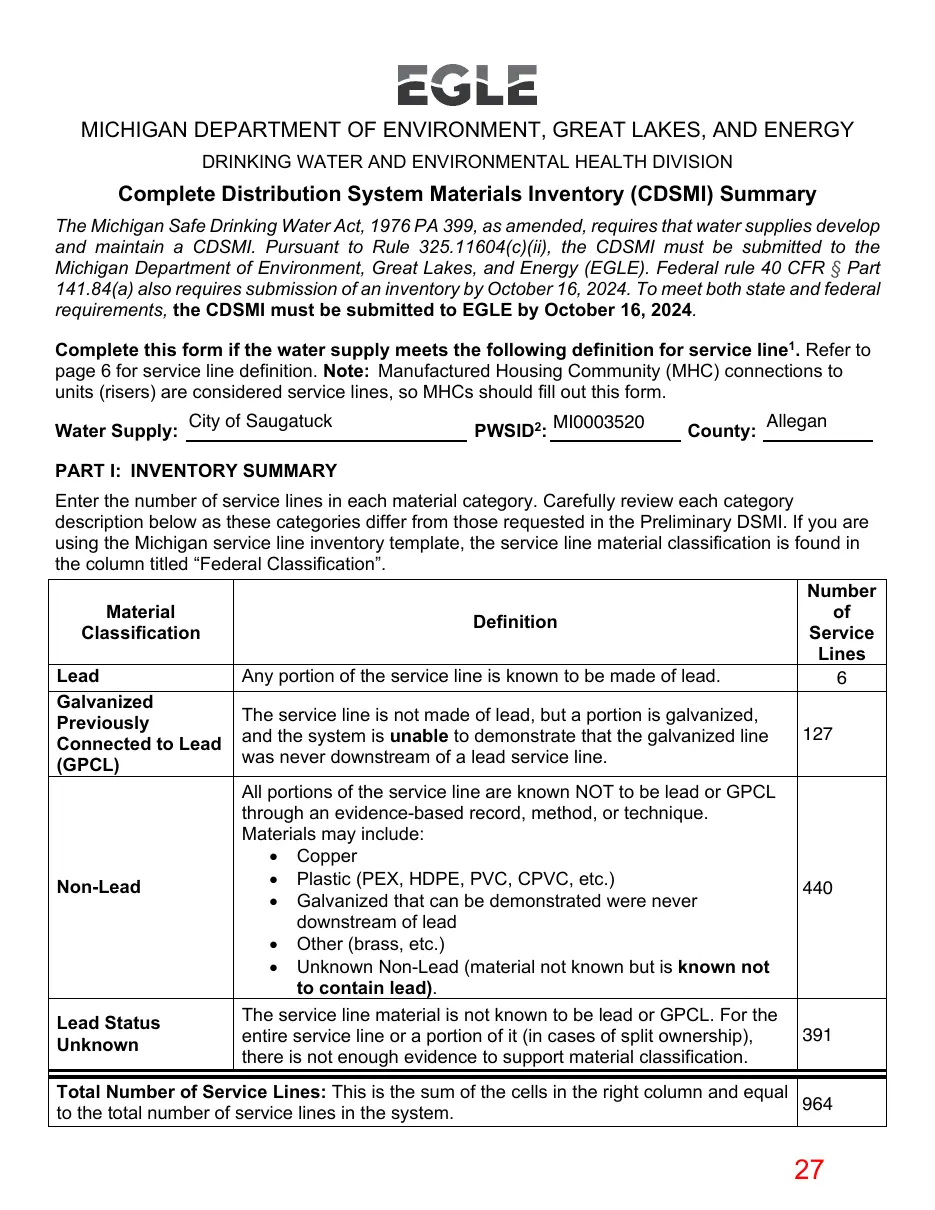
Complete Distribution System Materials Inventory (CDSMI) Summary The Michigan Safe Drinking Water Act, 1976 PA 399, as amended, requires that water supplies develop and maintain a CDSMI. Pursuant to Rule 325.11604(c)(ii), the CDSMI must be submitted to the Michigan Department of Environment, Great Lakes, and Energy (EGLE). Federal rule 40 CFR § Part 141.84(a) also requires submission of an inventory by October 16, 2024. To meet both state and federal requirements, the CDSMI must be submitted to EGLE by October 16, 2024. Complete this form if the water supply meets the following definition for service line1. Refer to page 6 for service line definition. Note: Manufactured Housing Community (MHC) connections to units (risers) are considered service lines, so MHCs should fill out this form. Water Supply:
City of Saugatuck
PWSID2:
MI0003520
County:
Allegan
PART I: INVENTORY SUMMARY Enter the number of service lines in each material category. Carefully review each category description below as these categories differ from those requested in the Preliminary DSMI. If you are using the Michigan service line inventory template, the service line material classification is found in the column titled “Federal Classification”. Number Material of Definition Classification Service Lines Lead Any portion of the service line is known to be made of lead. 6 Galvanized The service line is not made of lead, but a portion is galvanized, Previously 127 Connected to Lead and the system is unable to demonstrate that the galvanized line was never downstream of a lead service line. (GPCL) All portions of the service line are known NOT to be lead or GPCL through an evidence-based record, method, or technique. Materials may include: • Copper • Plastic (PEX, HDPE, PVC, CPVC, etc.) Non-Lead 440 • Galvanized that can be demonstrated were never downstream of lead • Other (brass, etc.) • Unknown Non-Lead (material not known but is known not to contain lead). The service line material is not known to be lead or GPCL. For the Lead Status 391 entire service line or a portion of it (in cases of split ownership), Unknown there is not enough evidence to support material classification. Total Number of Service Lines: This is the sum of the cells in the right column and equal 964 to the total number of service lines in the system.
Page 28
Text of page 28
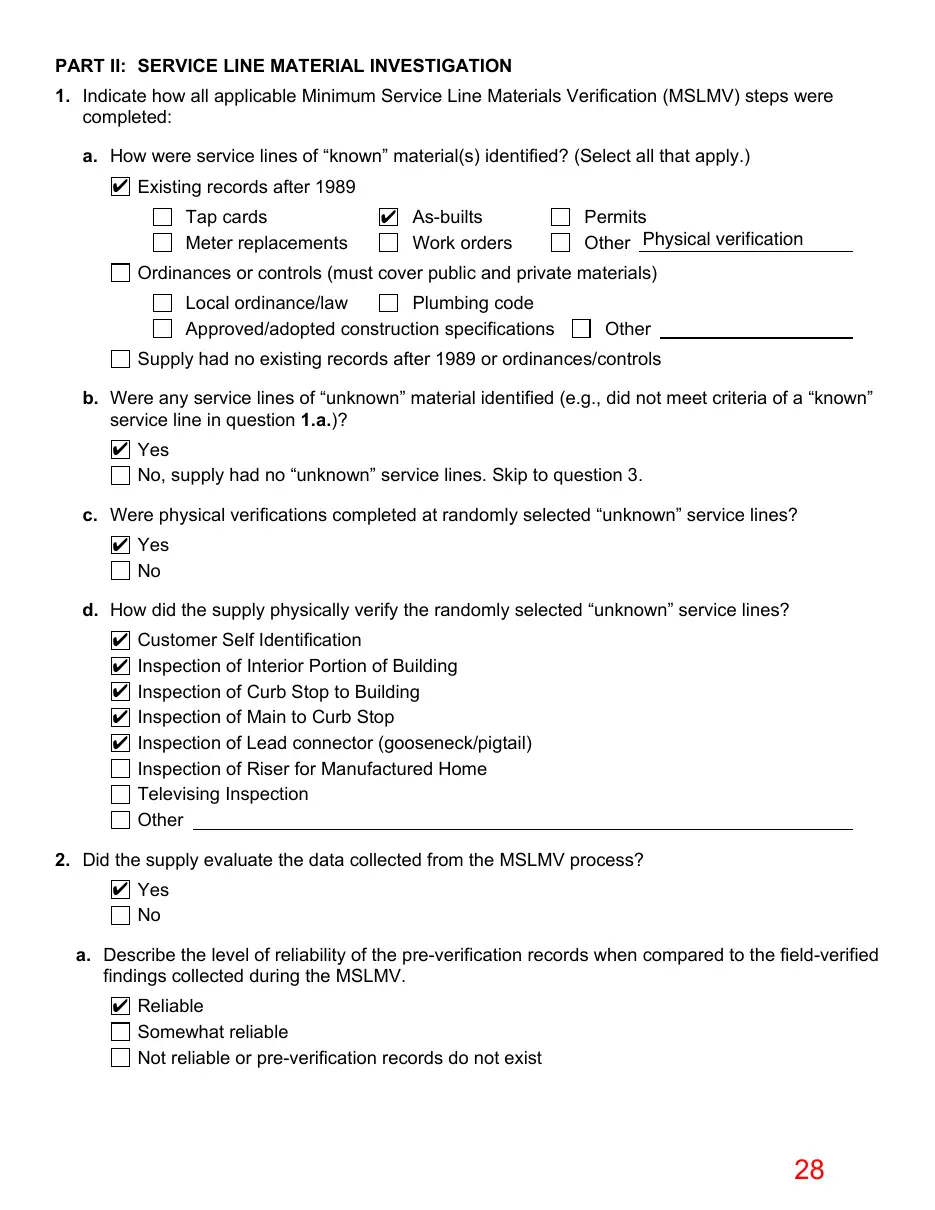
PART II: SERVICE LINE MATERIAL INVESTIGATION 1. Indicate how all applicable Minimum Service Line Materials Verification (MSLMV) steps were completed: a. How were service lines of “known” material(s) identified? (Select all that apply.) ✔ Existing records after 1989
Tap cards Meter replacements
✔ As-builts Work orders
Permits Other Physical verification
Ordinances or controls (must cover public and private materials) Local ordinance/law Plumbing code Approved/adopted construction specifications
Other
Supply had no existing records after 1989 or ordinances/controls b. Were any service lines of “unknown” material identified (e.g., did not meet criteria of a “known” service line in question 1.a.)?
✔ Yes No, supply had no “unknown” service lines. Skip to question 3. c. Were physical verifications completed at randomly selected “unknown” service lines?
✔ Yes No d. How did the supply physically verify the randomly selected “unknown” service lines?
✔ Customer Self Identification ✔ Inspection of Interior Portion of Building ✔ Inspection of Curb Stop to Building ✔ Inspection of Main to Curb Stop ✔ Inspection of Lead connector (gooseneck/pigtail) Inspection of Riser for Manufactured Home Televising Inspection Other 2. Did the supply evaluate the data collected from the MSLMV process? ✔ Yes No
a. Describe the level of reliability of the pre-verification records when compared to the field-verified findings collected during the MSLMV.
✔ Reliable Somewhat reliable Not reliable or pre-verification records do not exist
Page 29
Text of page 29
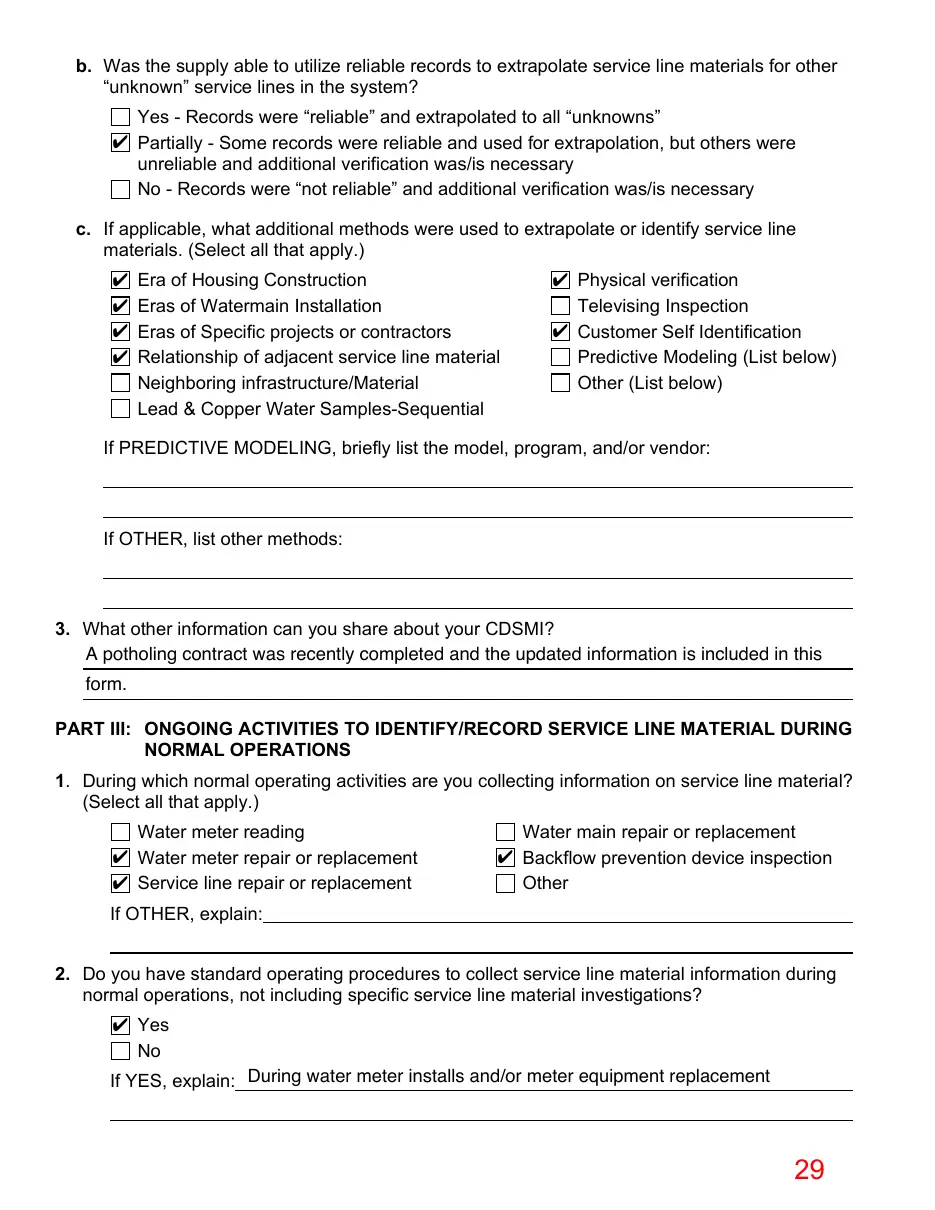
b. Was the supply able to utilize reliable records to extrapolate service line materials for other “unknown” service lines in the system? Yes - Records were “reliable” and extrapolated to all “unknowns” ✔ Partially - Some records were reliable and used for extrapolation, but others were unreliable and additional verification was/is necessary No - Records were “not reliable” and additional verification was/is necessary c. If applicable, what additional methods were used to extrapolate or identify service line materials. (Select all that apply.) ✔ Era of Housing Construction ✔ Eras of Watermain Installation ✔ Eras of Specific projects or contractors ✔ Relationship of adjacent service line material Neighboring infrastructure/Material Lead & Copper Water Samples-Sequential
✔ Physical verification Televising Inspection ✔ Customer Self Identification Predictive Modeling (List below) Other (List below)
If PREDICTIVE MODELING, briefly list the model, program, and/or vendor:
If OTHER, list other methods:
3. What other information can you share about your CDSMI? A potholing contract was recently completed and the updated information is included in this
form. PART III: ONGOING ACTIVITIES TO IDENTIFY/RECORD SERVICE LINE MATERIAL DURING NORMAL OPERATIONS 1. During which normal operating activities are you collecting information on service line material? (Select all that apply.) Water meter reading ✔ Water meter repair or replacement ✔ Service line repair or replacement
Water main repair or replacement ✔ Backflow prevention device inspection Other
If OTHER, explain: 2. Do you have standard operating procedures to collect service line material information during normal operations, not including specific service line material investigations?
✔ Yes No If YES, explain: During water meter installs and/or meter equipment replacement
Page 30
Text of page 30
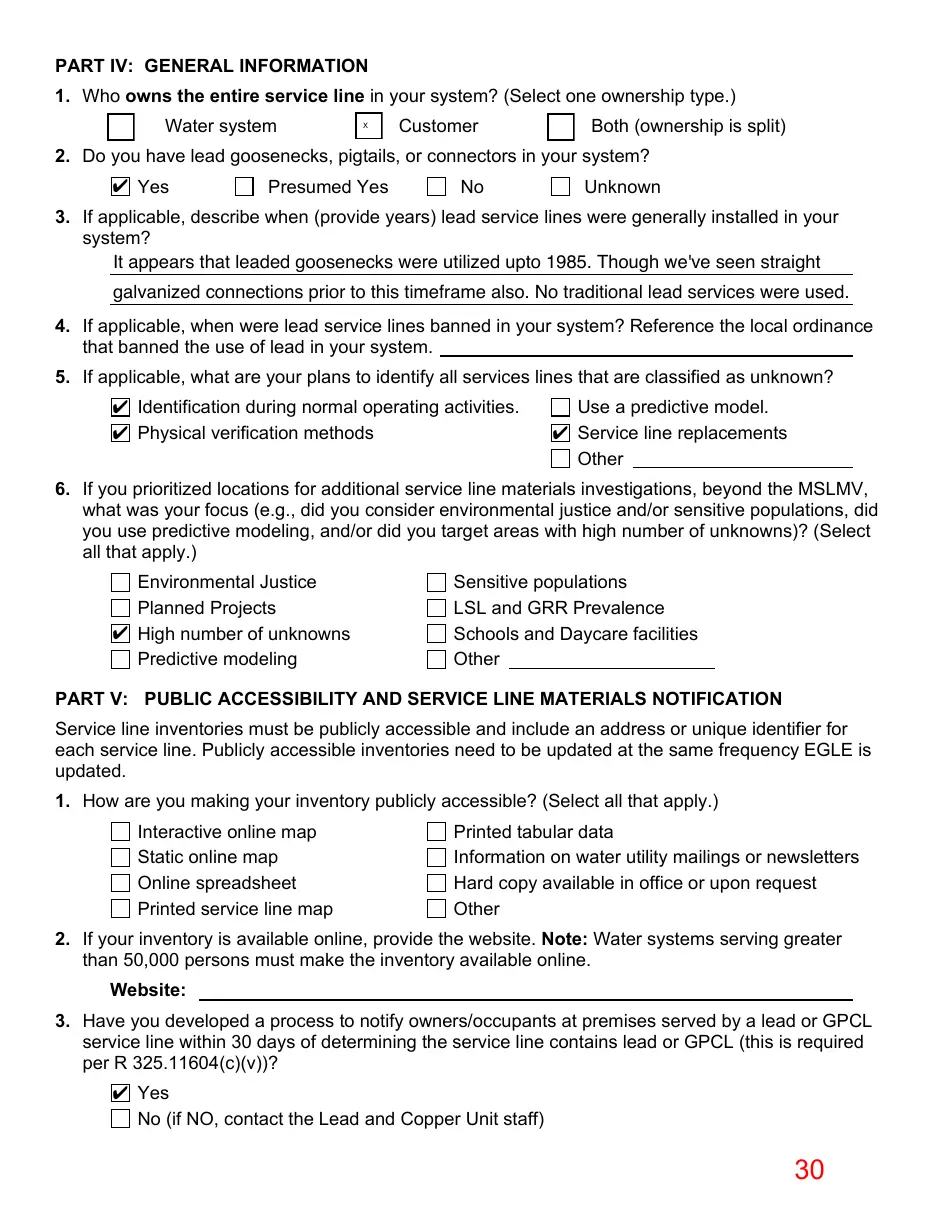
PART IV: GENERAL INFORMATION 1. Who owns the entire service line in your system? (Select one ownership type.) Water system
Customer
Both (ownership is split)
2. Do you have lead goosenecks, pigtails, or connectors in your system? ✔ Yes
Presumed Yes
No
Unknown
3. If applicable, describe when (provide years) lead service lines were generally installed in your system? It appears that leaded goosenecks were utilized upto 1985. Though we've seen straight galvanized connections prior to this timeframe also. No traditional lead services were used.
4. If applicable, when were lead service lines banned in your system? Reference the local ordinance that banned the use of lead in your system. 5. If applicable, what are your plans to identify all services lines that are classified as unknown?
✔ Identification during normal operating activities. ✔ Physical verification methods
Use a predictive model. ✔ Service line replacements Other
6. If you prioritized locations for additional service line materials investigations, beyond the MSLMV, what was your focus (e.g., did you consider environmental justice and/or sensitive populations, did you use predictive modeling, and/or did you target areas with high number of unknowns)? (Select all that apply.) Environmental Justice Planned Projects ✔ High number of unknowns Predictive modeling
Sensitive populations LSL and GRR Prevalence Schools and Daycare facilities Other
PART V: PUBLIC ACCESSIBILITY AND SERVICE LINE MATERIALS NOTIFICATION Service line inventories must be publicly accessible and include an address or unique identifier for each service line. Publicly accessible inventories need to be updated at the same frequency EGLE is updated. 1. How are you making your inventory publicly accessible? (Select all that apply.) Interactive online map Static online map Online spreadsheet Printed service line map
Printed tabular data Information on water utility mailings or newsletters Hard copy available in office or upon request Other
2. If your inventory is available online, provide the website. Note: Water systems serving greater than 50,000 persons must make the inventory available online. Website: 3. Have you developed a process to notify owners/occupants at premises served by a lead or GPCL service line within 30 days of determining the service line contains lead or GPCL (this is required per R 325.11604(c)(v))? ✔ Yes No (if NO, contact the Lead and Copper Unit staff)
Page 31
Text of page 31
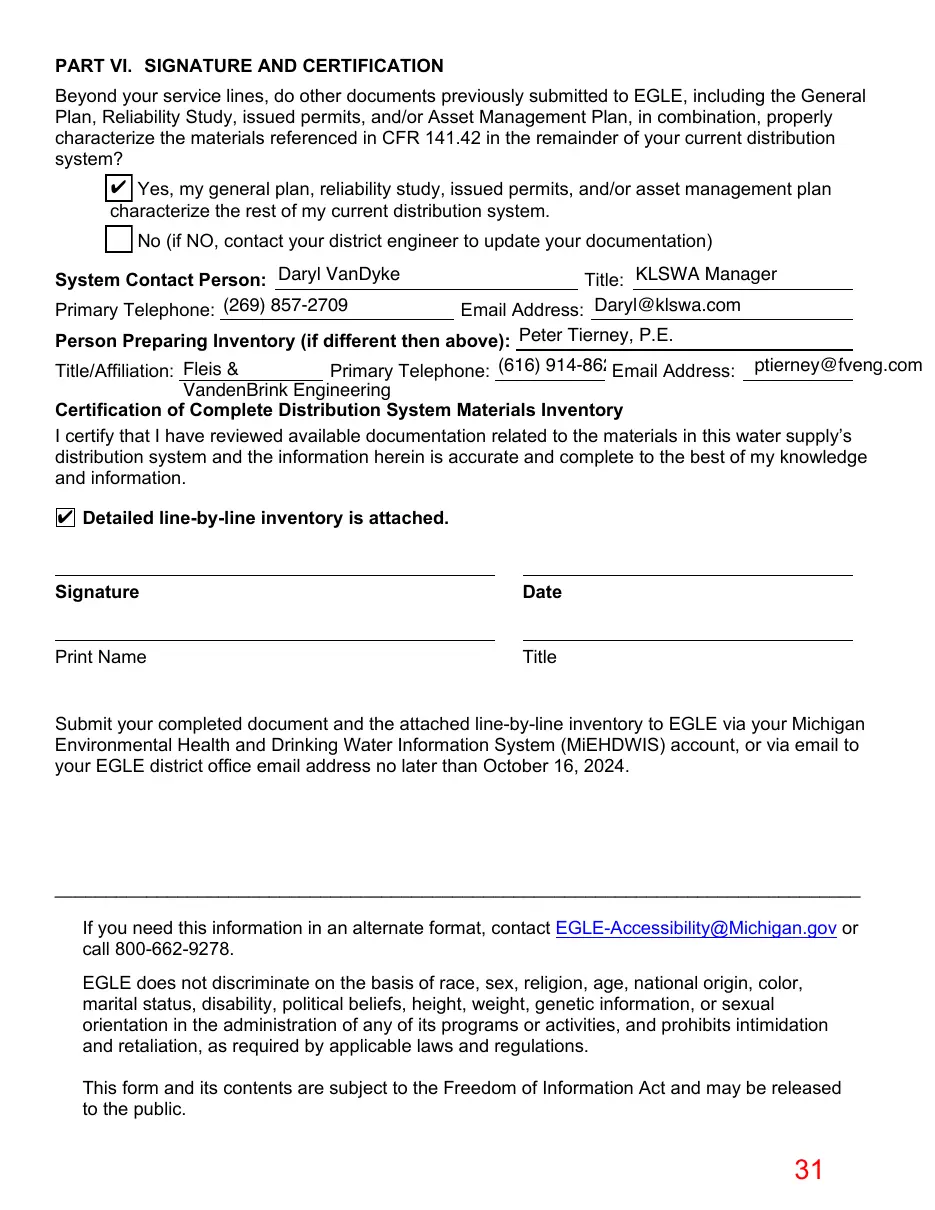
PART VI. SIGNATURE AND CERTIFICATION Beyond your service lines, do other documents previously submitted to EGLE, including the General Plan, Reliability Study, issued permits, and/or Asset Management Plan, in combination, properly characterize the materials referenced in CFR 141.42 in the remainder of your current distribution system? ✔ Yes, my general plan, reliability study, issued permits, and/or asset management plan characterize the rest of my current distribution system. No (if NO, contact your district engineer to update your documentation) System Contact Person: Daryl VanDyke Primary Telephone: (269) 857-2709
Title: KLSWA Manager Email Address: Daryl@klswa.com
Person Preparing Inventory (if different then above): Peter Tierney, P.E. Title/Affiliation: Fleis & Primary Telephone: (616) 914-8621 Email Address: ptierney@fveng.com VandenBrink Engineering Certification of Complete Distribution System Materials Inventory I certify that I have reviewed available documentation related to the materials in this water supply’s distribution system and the information herein is accurate and complete to the best of my knowledge and information.
✔ Detailed line-by-line inventory is attached.
Signature
Date
Print Name
Title
Submit your completed document and the attached line-by-line inventory to EGLE via your Michigan Environmental Health and Drinking Water Information System (MiEHDWIS) account, or via email to your EGLE district office email address no later than October 16, 2024.
_______________________________________________________________________________ If you need this information in an alternate format, contact EGLE-Accessibility@Michigan.gov or call 800-662-9278. EGLE does not discriminate on the basis of race, sex, religion, age, national origin, color, marital status, disability, political beliefs, height, weight, genetic information, or sexual orientation in the administration of any of its programs or activities, and prohibits intimidation and retaliation, as required by applicable laws and regulations. This form and its contents are subject to the Freedom of Information Act and may be released to the public.
Page 32
Text of page 32
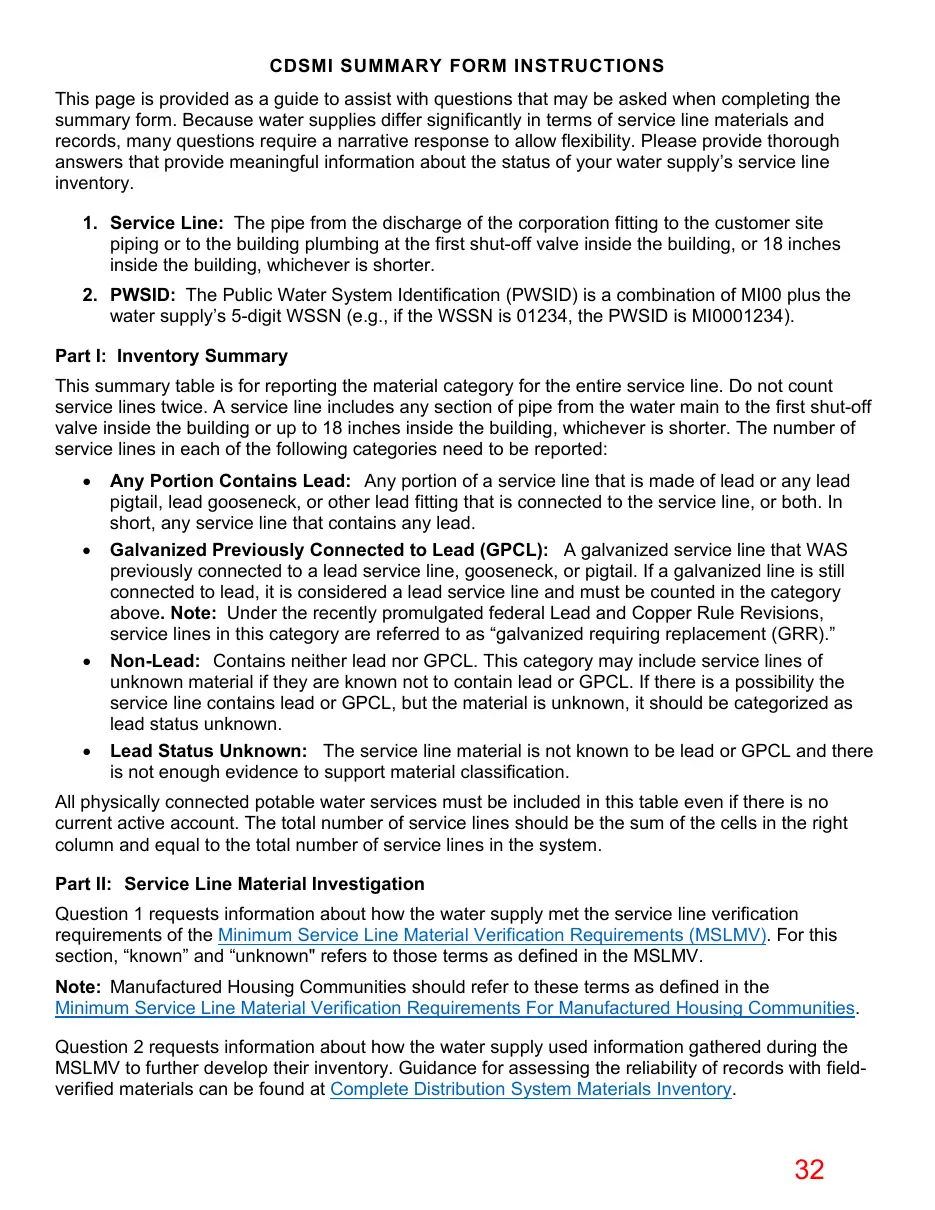
CDSMI SUMMARY FORM INSTRUCTIONS This page is provided as a guide to assist with questions that may be asked when completing the summary form. Because water supplies differ significantly in terms of service line materials and records, many questions require a narrative response to allow flexibility. Please provide thorough answers that provide meaningful information about the status of your water supply’s service line inventory. 1. Service Line: The pipe from the discharge of the corporation fitting to the customer site piping or to the building plumbing at the first shut-off valve inside the building, or 18 inches inside the building, whichever is shorter. 2. PWSID: The Public Water System Identification (PWSID) is a combination of MI00 plus the water supply’s 5-digit WSSN (e.g., if the WSSN is 01234, the PWSID is MI0001234). Part I: Inventory Summary This summary table is for reporting the material category for the entire service line. Do not count service lines twice. A service line includes any section of pipe from the water main to the first shut-off valve inside the building or up to 18 inches inside the building, whichever is shorter. The number of service lines in each of the following categories need to be reported: •
Any Portion Contains Lead: Any portion of a service line that is made of lead or any lead pigtail, lead gooseneck, or other lead fitting that is connected to the service line, or both. In short, any service line that contains any lead. Galvanized Previously Connected to Lead (GPCL): A galvanized service line that WAS previously connected to a lead service line, gooseneck, or pigtail. If a galvanized line is still connected to lead, it is considered a lead service line and must be counted in the category above. Note: Under the recently promulgated federal Lead and Copper Rule Revisions, service lines in this category are referred to as “galvanized requiring replacement (GRR).” Non-Lead: Contains neither lead nor GPCL. This category may include service lines of unknown material if they are known not to contain lead or GPCL. If there is a possibility the service line contains lead or GPCL, but the material is unknown, it should be categorized as lead status unknown. Lead Status Unknown: The service line material is not known to be lead or GPCL and there is not enough evidence to support material classification.
All physically connected potable water services must be included in this table even if there is no current active account. The total number of service lines should be the sum of the cells in the right column and equal to the total number of service lines in the system. Part II: Service Line Material Investigation Question 1 requests information about how the water supply met the service line verification requirements of the Minimum Service Line Material Verification Requirements (MSLMV). For this section, “known” and “unknown" refers to those terms as defined in the MSLMV. Note: Manufactured Housing Communities should refer to these terms as defined in the Minimum Service Line Material Verification Requirements For Manufactured Housing Communities. Question 2 requests information about how the water supply used information gathered during the MSLMV to further develop their inventory. Guidance for assessing the reliability of records with fieldverified materials can be found at Complete Distribution System Materials Inventory.
Page 33
Text of page 33
September 22, 2025 [Service Address] SUBJECT:
Notification that some or all of your water service line is made of lead
Dear Water Customer: It has been determined that some or all of your water service line is made of lead. People living in homes with a lead service line have an increased risk of exposure to lead from their drinking water. This letter serves to notify you of this risk and provides information to help you reduce your risk of lead exposure. Please share this information with anyone who drinks and/or cooks using water at this property. Health effects of lead Exposure to lead in drinking water can cause serious health effects in all age groups. Infants and children can have decreases in IQ and attention span. Lead exposure can lead to new learning and behavior problems or exacerbate existing learning and behavior problems. The children of persons who are exposed to lead before or during pregnancy can have increased risk of these adverse health effects. Adults can have increased risks of heart disease, high blood pressure, kidney or nervous system problems. Steps you can take to reduce your exposure to lead in your water Below are recommended actions you may take, separately or in combination, to reduce your exposure to lead in your drinking water. The list also includes where you may find more information and is not intended to be a complete list or to imply that all actions equally reduce lead in drinking water. •
Consider using a lead-reducing filter. The Michigan Department of Health and Human Services (MDHHS) recommends Michigan households use a certified lead-reducing drinking water filter if your home has or if you are uncertain if it has a source of lead, such as one of the following: A lead service line carrying water from the street to your residence. Lead or galvanized plumbing. Copper plumbing with lead solder before 1988 (EGLE recommendation). Old faucets and fittings that were sold before 2014.
Page 34
Text of page 34
o Use the filter until you are able to remove sources of household lead plumbing, such as: Replace pre-2014 faucets. Get a lead inspection and replace needed plumbing. o Look for filters that are tested and certified to NSF/ANSI Standard 53 for lead reduction and NSF/ANSI Standard 42 for particulate reduction (Class I). o For filters to work properly, follow the manufacturer’s instructions. •
Run your water to flush out lead-containing water. The more time water has been sitting in your home’s pipes, the more lead it may contain. Therefore, if your water has not been used for several hours, run the water before using it for drinking or cooking. This flushes leadcontaining water from the pipes. Because your home has a lead service line, run the water for at least five minutes to flush water from your home or building’s plumbing and the lead service line.
Use cold water for drinking and cooking. Do not cook with or drink water from the hot water tap; lead dissolves more easily into hot water.
Boiling water does not remove lead from water. Filter cold water, then boil the filtered water as necessary.
Clean your aerator. The aerator on the end of your faucet is a screen that will catch debris. This debris could include particulate lead. The aerator should be removed at least every six months to rinse out any debris.
Check for other sources of lead. In addition to your service line, other plumbing in your home may contain lead and could increase the levels of lead in your drinking water. These may include faucets, valves, and soldered joints. It is recommended that homeowners contact a licensed plumber and have a plumbing assessment done to determine if your in-home plumbing is a source of lead in your drinking water.
Test your water for lead. If you wish to get your drinking water tested, call your water supply or use a certified lab. To find a certified lab, go to Michigan.gov/EGLElab and click on “Certifications.”
Learn about construction in your neighborhood. Construction may cause more lead to be released from a lead service line or galvanized service line if present. Contact us to find out about any construction or maintenance work that may disturb your service line.
Learn about your drinking water. Read your water supply’s Annual Water Quality Report (Consumer Confidence Report) that is mailed to you each year or find it at your local water utility’s website.
Get your child tested to determine lead levels in their blood. A family doctor or pediatrician can perform a blood test for lead and provide information about the health effects of lead. State, city, or county departments of health can also provide information about how you can have your child's blood tested for lead. The Centers for Disease Control (CDC) and Prevention recommends public health actions when the level of lead in a child’s blood is 3.5 micrograms per deciliter (µg/dL) or more. For more information and links to CDC’s website, please visit https://www.epa.gov/ground-water-and-drinking-water/basic-information-about-lead-drinking-water.
Page 35
Text of page 35
Replacing lead service lines All water supplies in Michigan are actively identifying and replacing service lines that contain lead and galvanized previously connected to lead. All portions of the service line that contain lead and galvanized previously connected to lead that the water system owns, as well as the homeowner’s portion, must be replaced at the water supply’s expense. The City of Saugatuck is preparing a service line replacement plan and timeline. Partial replacement of service lines, where there is still lead or galvanized previously connected to lead materials remaining when service is restored, are banned due to increased lead exposure and potential health risks, except in the case of emergencies like a leak or loss of pressure. If you have an issue with your side of the service line (generally, from the curb stop to the inside of your home), contact the City first to coordinate efforts and fully replace the service line. If an emergency repair is necessary, take additional precautionary measures to reduce potential exposure to lead during replacement or construction. Contact us Please contact the City of Saugatuck at (269) 857-2603 if you have questions regarding this letter or disagree with the material determination. For additional information about our water system or a copy of Kalamazoo Lake Sewer & Water Authority’s Annual Water Quality Report, visit https://klswa.com/ or contact Kaz Bajc at (269) 857-2709. Sincerely,
Ryan Cummins City Manager
Page 36
Text of page 36
September 30, 2025 [Service Address] SUBJECT:
Notification that your water service line material is unknown and may contain lead
Dear Water Customer: Your drinking water service line material is unknown, but we are working toward identifying service line materials throughout the water supply. Because your service line material is unknown, there is the potential that some or all of the line could be made of lead or galvanized pipe that was previously connected to lead. People living in homes with a lead, or galvanized pipe previously connected to lead, service line have an increased risk of exposure to lead from their drinking water. This letter serves to notify you of this risk and provides information to help you reduce your risk of lead exposure. Please share this information with anyone who drinks and/or cooks using water at this property. Health effects of lead Exposure to lead in drinking water can cause serious health effects in all age groups. Infants and children can have decreases in IQ and attention span. Lead exposure can lead to new learning and behavior problems or exacerbate existing learning and behavior problems. The children of persons who are exposed to lead before or during pregnancy can have increased risk of these adverse health effects. Adults can have increased risks of heart disease, high blood pressure, kidney or nervous system problems. Steps you can take to reduce your exposure to lead in your water Below are recommended actions you may take, separately or in combination, to reduce your exposure to lead in your drinking water. The list also includes where you may find more information and is not intended to be a complete list or to imply that all actions equally reduce lead in drinking water. •
Consider using a lead-reducing filter. The Michigan Department of Health and Human Services (MDHHS) recommends Michigan households use a certified lead-reducing drinking water filter if your home has or if you are uncertain if it has a source of lead, such as one of the following: A lead service line, or galvanized service line previously connected to lead, carrying water from the street to your residence. Lead or galvanized plumbing. Copper plumbing with lead solder before 1988 (EGLE recommendation). Old faucets and fittings that were sold before 2014.
Page 37
Text of page 37
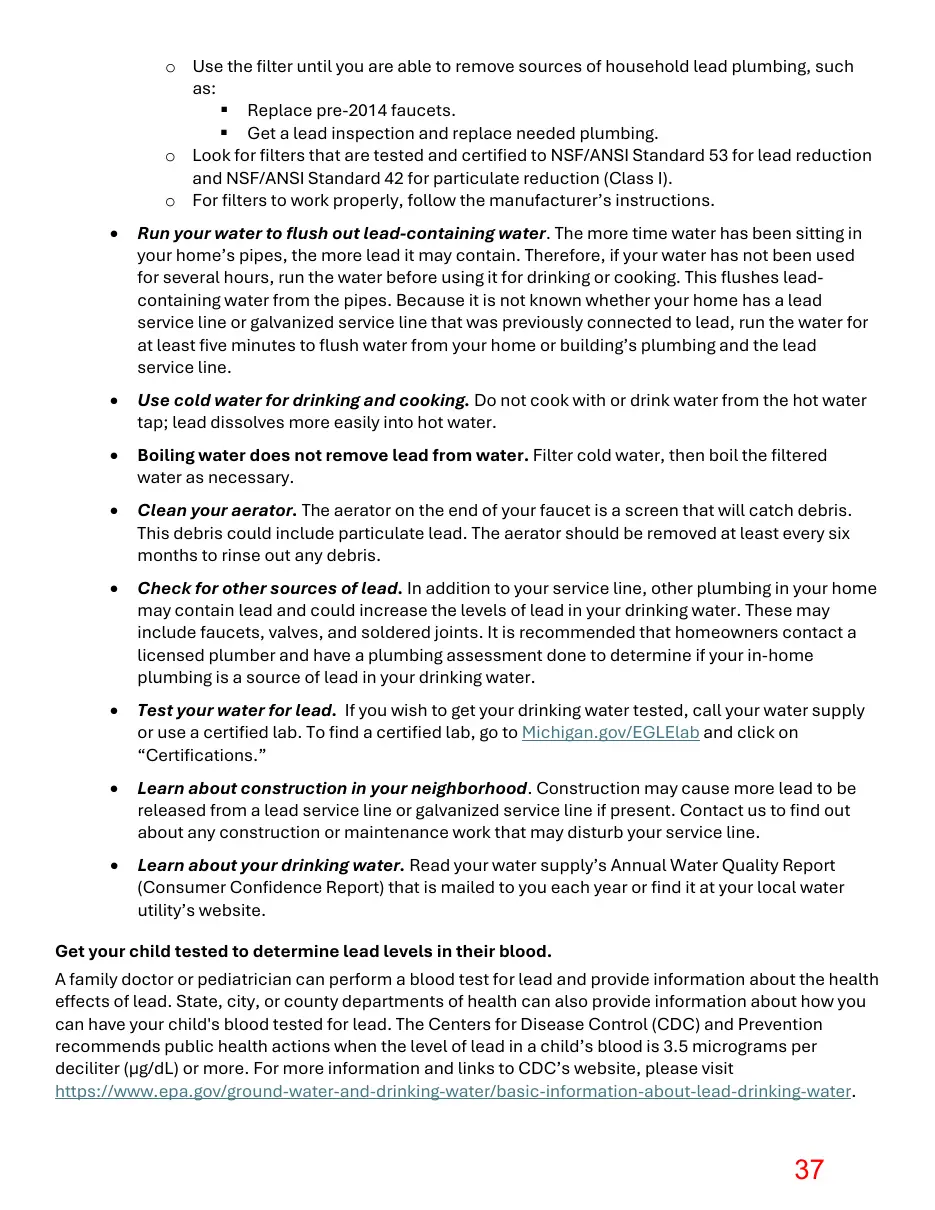
o Use the filter until you are able to remove sources of household lead plumbing, such as: Replace pre-2014 faucets. Get a lead inspection and replace needed plumbing. o Look for filters that are tested and certified to NSF/ANSI Standard 53 for lead reduction and NSF/ANSI Standard 42 for particulate reduction (Class I). o For filters to work properly, follow the manufacturer’s instructions. •
Run your water to flush out lead-containing water. The more time water has been sitting in your home’s pipes, the more lead it may contain. Therefore, if your water has not been used for several hours, run the water before using it for drinking or cooking. This flushes leadcontaining water from the pipes. Because it is not known whether your home has a lead service line or galvanized service line that was previously connected to lead, run the water for at least five minutes to flush water from your home or building’s plumbing and the lead service line.
Use cold water for drinking and cooking. Do not cook with or drink water from the hot water tap; lead dissolves more easily into hot water.
Boiling water does not remove lead from water. Filter cold water, then boil the filtered water as necessary.
Clean your aerator. The aerator on the end of your faucet is a screen that will catch debris. This debris could include particulate lead. The aerator should be removed at least every six months to rinse out any debris.
Check for other sources of lead. In addition to your service line, other plumbing in your home may contain lead and could increase the levels of lead in your drinking water. These may include faucets, valves, and soldered joints. It is recommended that homeowners contact a licensed plumber and have a plumbing assessment done to determine if your in-home plumbing is a source of lead in your drinking water.
Test your water for lead. If you wish to get your drinking water tested, call your water supply or use a certified lab. To find a certified lab, go to Michigan.gov/EGLElab and click on “Certifications.”
Learn about construction in your neighborhood. Construction may cause more lead to be released from a lead service line or galvanized service line if present. Contact us to find out about any construction or maintenance work that may disturb your service line.
Learn about your drinking water. Read your water supply’s Annual Water Quality Report (Consumer Confidence Report) that is mailed to you each year or find it at your local water utility’s website.
Get your child tested to determine lead levels in their blood. A family doctor or pediatrician can perform a blood test for lead and provide information about the health effects of lead. State, city, or county departments of health can also provide information about how you can have your child's blood tested for lead. The Centers for Disease Control (CDC) and Prevention recommends public health actions when the level of lead in a child’s blood is 3.5 micrograms per deciliter (µg/dL) or more. For more information and links to CDC’s website, please visit https://www.epa.gov/ground-water-and-drinking-water/basic-information-about-lead-drinking-water.
Page 38
Text of page 38
Contact us Please contact the City of Saugatuck at (269) 857-2603 for information about getting your service line material identified or if you have questions regarding this letter. For additional information about our water system or a copy of Kalamazoo Lake Sewer & Water Authority’s Annual Water Quality Report, visit https://klswa.com/ or contact Kaz Bajc at (269) 857-2709. Sincerely,
Ryan Cummins City Manager
Page 39
Text of page 39
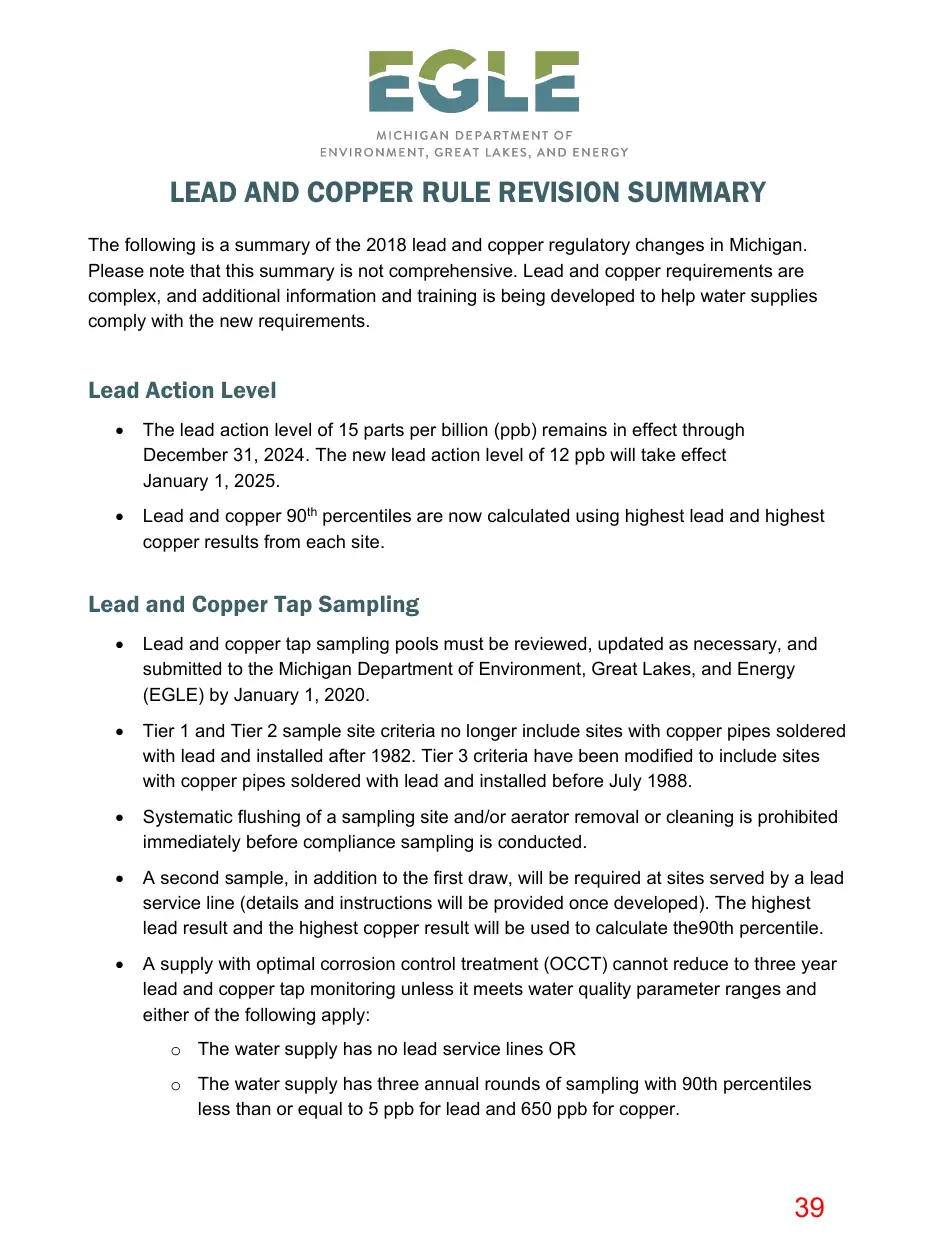
LEAD AND COPPER RULE REVISION SUMMARY The following is a summary of the 2018 lead and copper regulatory changes in Michigan. Please note that this summary is not comprehensive. Lead and copper requirements are complex, and additional information and training is being developed to help water supplies comply with the new requirements.
Lead Action Level •
The lead action level of 15 parts per billion (ppb) remains in effect through December 31, 2024. The new lead action level of 12 ppb will take effect January 1, 2025.
Lead and copper 90th percentiles are now calculated using highest lead and highest copper results from each site.
Lead and Copper Tap Sampling •
Lead and copper tap sampling pools must be reviewed, updated as necessary, and submitted to the Michigan Department of Environment, Great Lakes, and Energy (EGLE) by January 1, 2020.
Tier 1 and Tier 2 sample site criteria no longer include sites with copper pipes soldered with lead and installed after 1982. Tier 3 criteria have been modified to include sites with copper pipes soldered with lead and installed before July 1988.
Systematic flushing of a sampling site and/or aerator removal or cleaning is prohibited immediately before compliance sampling is conducted.
A second sample, in addition to the first draw, will be required at sites served by a lead service line (details and instructions will be provided once developed). The highest lead result and the highest copper result will be used to calculate the90th percentile.
A supply with optimal corrosion control treatment (OCCT) cannot reduce to three year lead and copper tap monitoring unless it meets water quality parameter ranges and either of the following apply: o The water supply has no lead service lines OR o The water supply has three annual rounds of sampling with 90th percentiles less than or equal to 5 ppb for lead and 650 ppb for copper.
Page 40
Text of page 40
Distribution System Materials Inventory (DSMI) To ensure distribution system components and service lines are properly identified and effectively inventoried, the following requirements apply: •
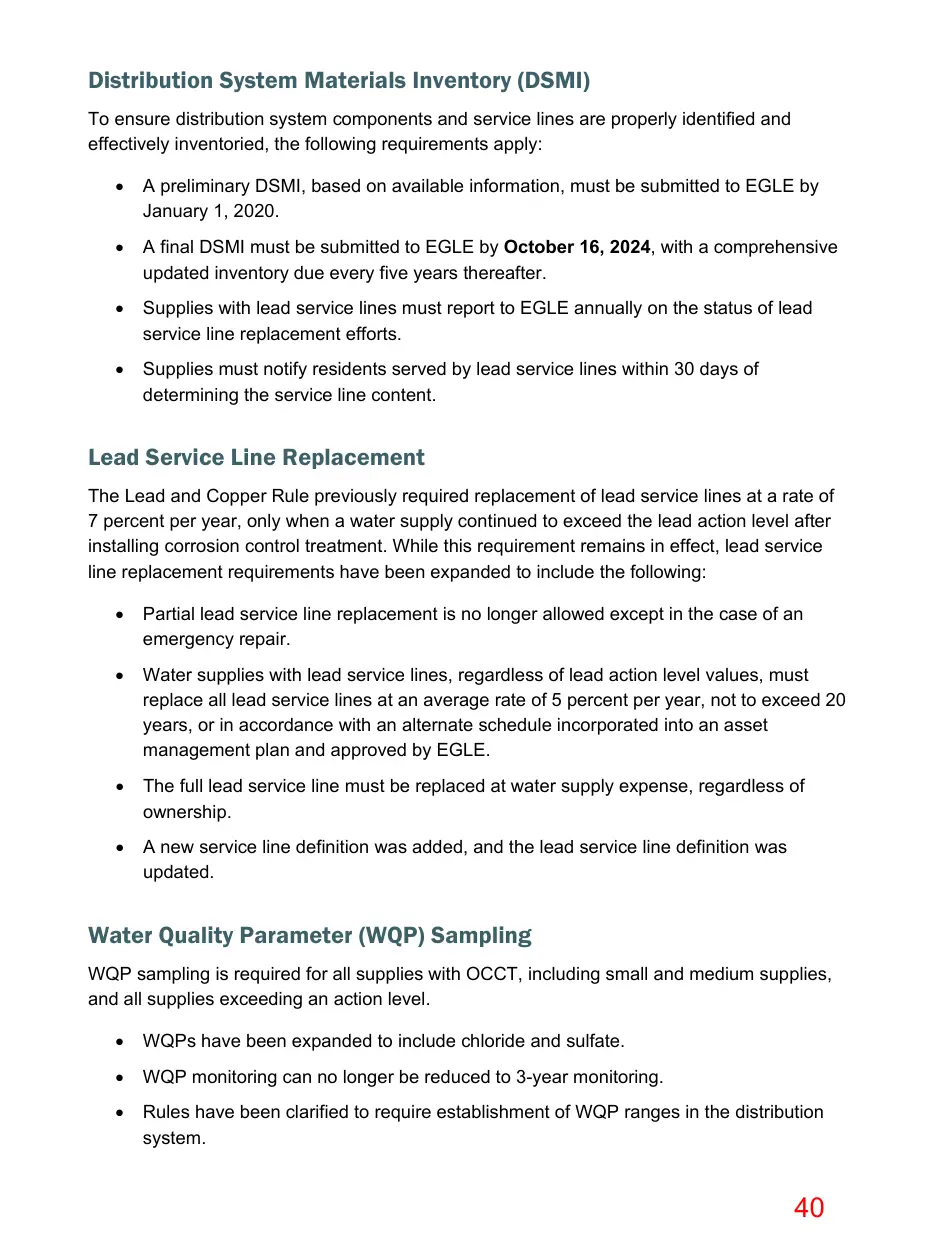
A preliminary DSMI, based on available information, must be submitted to EGLE by January 1, 2020.
A final DSMI must be submitted to EGLE by October 16, 2024, with a comprehensive updated inventory due every five years thereafter.
Supplies with lead service lines must report to EGLE annually on the status of lead service line replacement efforts.
Supplies must notify residents served by lead service lines within 30 days of determining the service line content.
Lead Service Line Replacement The Lead and Copper Rule previously required replacement of lead service lines at a rate of 7 percent per year, only when a water supply continued to exceed the lead action level after installing corrosion control treatment. While this requirement remains in effect, lead service line replacement requirements have been expanded to include the following: •
Partial lead service line replacement is no longer allowed except in the case of an emergency repair.
Water supplies with lead service lines, regardless of lead action level values, must replace all lead service lines at an average rate of 5 percent per year, not to exceed 20 years, or in accordance with an alternate schedule incorporated into an asset management plan and approved by EGLE.
The full lead service line must be replaced at water supply expense, regardless of ownership.
A new service line definition was added, and the lead service line definition was updated.
Water Quality Parameter (WQP) Sampling WQP sampling is required for all supplies with OCCT, including small and medium supplies, and all supplies exceeding an action level. •
WQPs have been expanded to include chloride and sulfate.
WQP monitoring can no longer be reduced to 3-year monitoring.
Rules have been clarified to require establishment of WQP ranges in the distribution system.
Page 41
Text of page 41
Continuity of Sources and Treatment •
Clarification that supplies purchasing water from a supply with OCCT must also maintain OCCT.
Clarification that EGLE may require new or updated corrosion control studies when a supply changes source or treatment, or at any other time as appropriate.
Enhanced Transparency •
The consumer notice of results (the results information provided to residents of sampled sites) must now include copper.
Additional content and delivery requirements for lead public education following a lead action level exceedance have been added.
Additional Consumer Confidence Report content for lead and copper reporting and lead service line reporting have been added.
A statewide advisory council will be created to assist with development of public awareness campaign materials.
Supplies serving 50,000 people or more must establish a community advisory council to assist with development of public awareness campaign materials.
EGLE does not discriminate on the basis of race, sex, religion, age, national origin, color, marital status, disability, political beliefs, height, weight, genetic information, or sexual orientation in the administration of any of its programs or activities, and prohibits intimidation and retaliation, as required by applicable laws and regulations. To request this material in an alternative format, contact EGLE-Accessibility@Michigan.gov or call 800-662-9278.
Page 42
Text of page 42
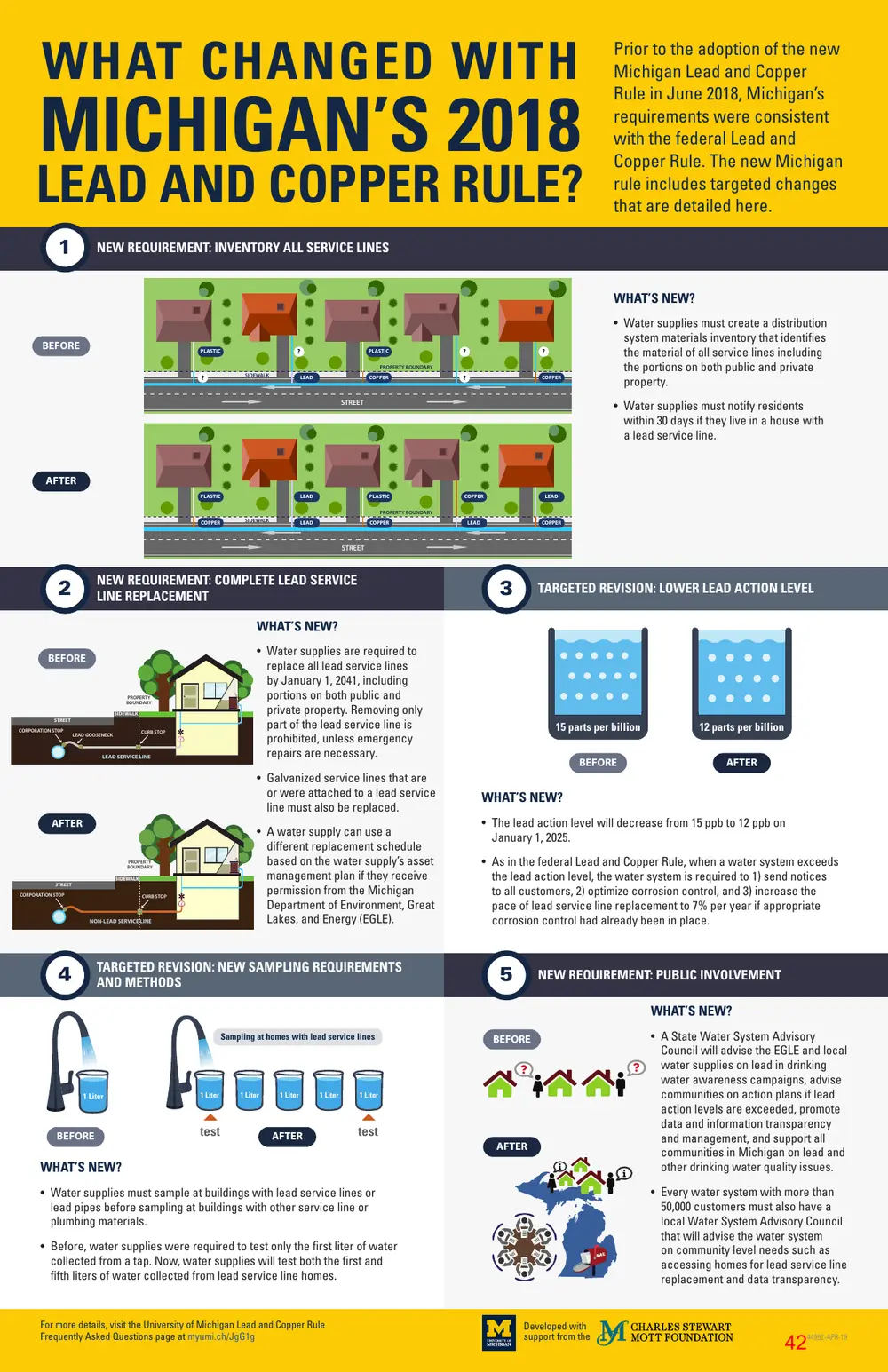
WHAT CHANGED WITH
MICHIGAN’S 2018
LEAD AND COPPER RULE? 1
Prior to the adoption of the new Michigan Lead and Copper Rule in June 2018, Michigan’s requirements were consistent with the federal Lead and Copper Rule. The new Michigan rule includes targeted changes that are detailed here.
NEW REQUIREMENT: INVENTORY ALL SERVICE LINES
WHAT’S NEW? BEFORE
PLASTIC
PLASTIC
COPPER
• Water supplies must create a distribution system materials inventory that identifies the material of all service lines including the portions on both public and private property.
PROPERTY BOUNDARY SIDEWALK
LEAD
COPPER
STREET
• Water supplies must notify residents within 30 days if they live in a house with a lead service line.
AFTER PLASTIC
LEAD
PLASTIC
COPPER
LEAD
LEAD
COPPER
PROPERTY BOUNDARY SIDEWALK
COPPER
LEAD
COPPER
STREET
NEW REQUIREMENT: COMPLETE LEAD SERVICE LINE REPLACEMENT
TARGETED REVISION: LOWER LEAD ACTION LEVEL
WHAT’S NEW? BEFORE
PROPERTY BOUNDARY SIDEWALK
STREET CORPORATION STOP
INTERNAL PLUMBING CURB STOP
LEAD GOOSENECK
SHUT-OFF VALVE WATER METER
LEAD SERVICE LINE
• Water supplies are required to replace all lead service lines by January 1, 2041, including portions on both public and private property. Removing only part of the lead service line is prohibited, unless emergency repairs are necessary. • Galvanized service lines that are or were attached to a lead service line must also be replaced.
AFTER
PROPERTY BOUNDARY SIDEWALK
STREET CORPORATION STOP
INTERNAL PLUMBING CURB STOP
SHUT-OFF VALVE WATER METER
NON-LEAD SERVICE LINE
• A water supply can use a different replacement schedule based on the water supply’s asset management plan if they receive permission from the Michigan Department of Environment, Great Lakes, and Energy (EGLE).
TARGETED REVISION: NEW SAMPLING REQUIREMENTS AND METHODS
15 parts per billion
12 parts per billion
BEFORE
AFTER
WHAT’S NEW? • The lead action level will decrease from 15 ppb to 12 ppb on January 1, 2025. • As in the federal Lead and Copper Rule, when a water system exceeds the lead action level, the water system is required to 1) send notices to all customers, 2) optimize corrosion control, and 3) increase the pace of lead service line replacement to 7% per year if appropriate corrosion control had already been in place.
NEW REQUIREMENT: PUBLIC INVOLVEMENT WHAT’S NEW?
Sampling at homes with lead service lines
1 Liter
BEFORE
1 Liter
test
1 Liter
1 Liter
1 Liter
AFTER
BEFORE
1 Liter
test AFTER
WHAT’S NEW?
• Every water system with more than 50,000 customers must also have a local Water System Advisory Council that will advise the water system on community level needs such as accessing homes for lead service line replacement and data transparency.
• Water supplies must sample at buildings with lead service lines or lead pipes before sampling at buildings with other service line or plumbing materials. • Before, water supplies were required to test only the first liter of water collected from a tap. Now, water supplies will test both the first and fifth liters of water collected from lead service line homes.
For more details, visit the University of Michigan Lead and Copper Rule Frequently Asked Questions page at myumi.ch/JgG1g
• A State Water System Advisory Council will advise the EGLE and local water supplies on lead in drinking water awareness campaigns, advise communities on action plans if lead action levels are exceeded, promote data and information transparency and management, and support all communities in Michigan on lead and other drinking water quality issues.
Developed with support from the
44992-APR-19