
Workshop Agenda item 6E
No Wake Zone Request for Kalamazoo Lake
City Council Workshop, Wednesday, March 5, 2025
Download these 8 pages, 1007 KB Whole packet, 98 pages, 35.7 MB
Page 47
Text of page 47
City Council Agenda Item Report FROM:
Ryan Cummins, City Manager
MEETING DATE:
March 5, 2025
SUBJECT:
No Wake Zone Request for Kalamazoo Lake
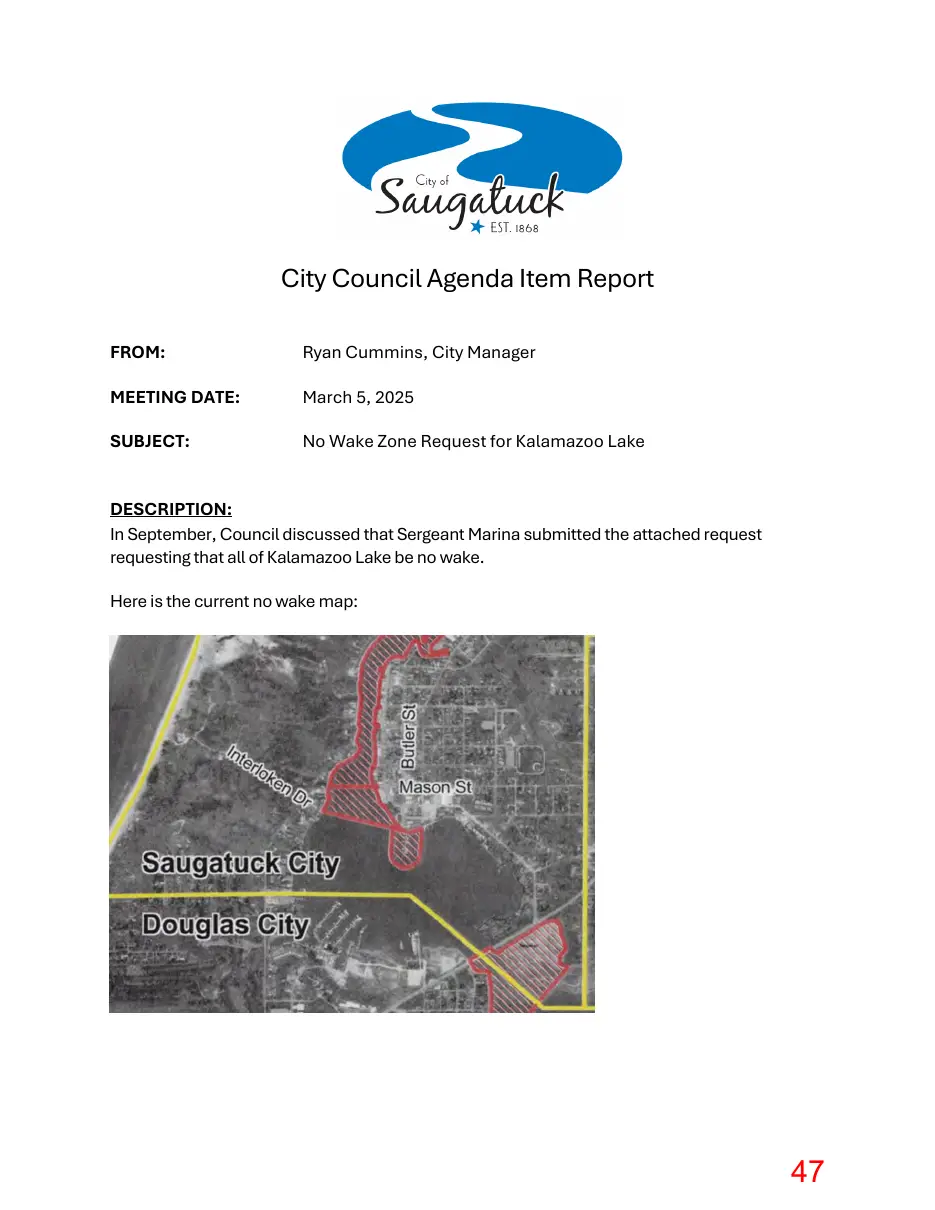
DESCRIPTION: In September, Council discussed that Sergeant Marina submitted the attached request requesting that all of Kalamazoo Lake be no wake. Here is the current no wake map:
Page 48
Text of page 48
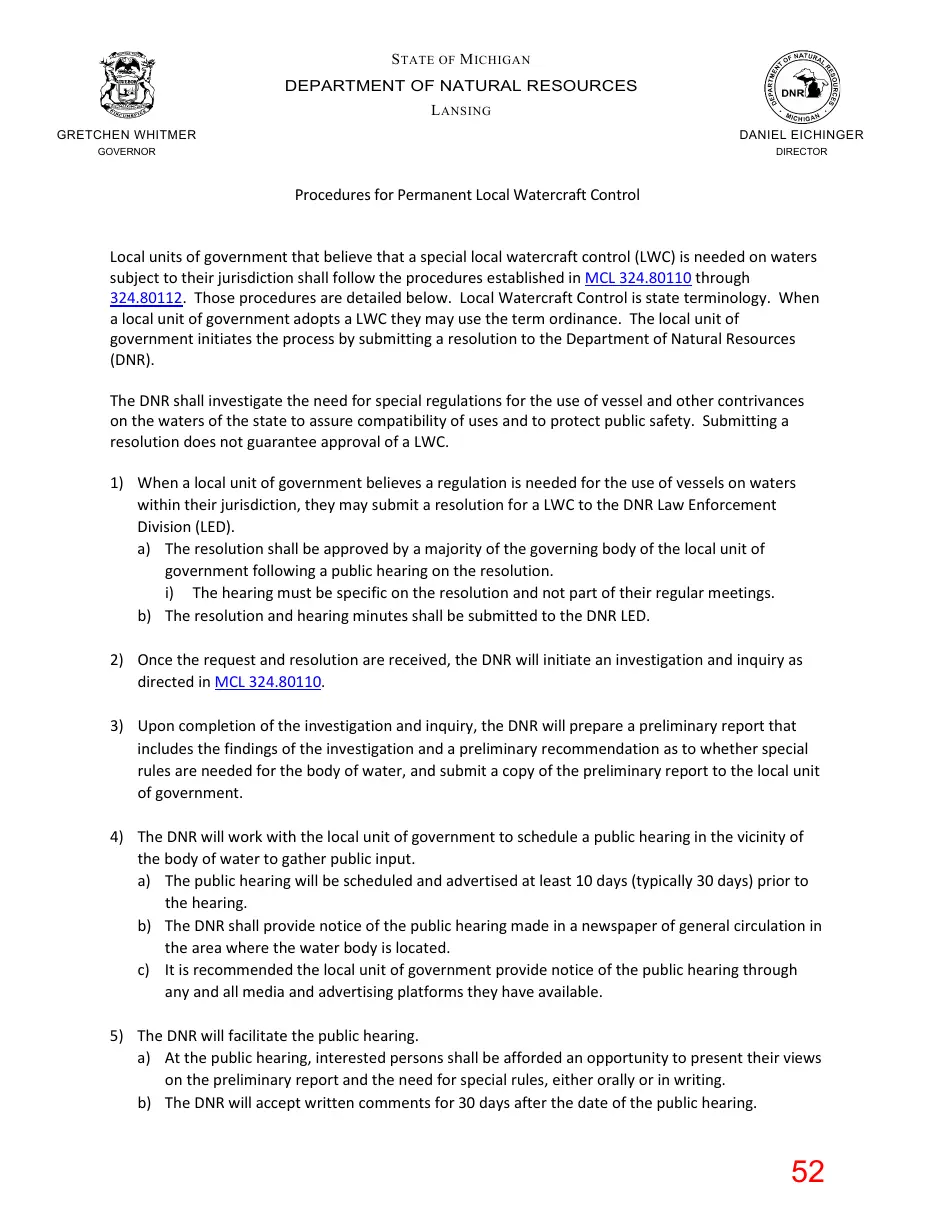
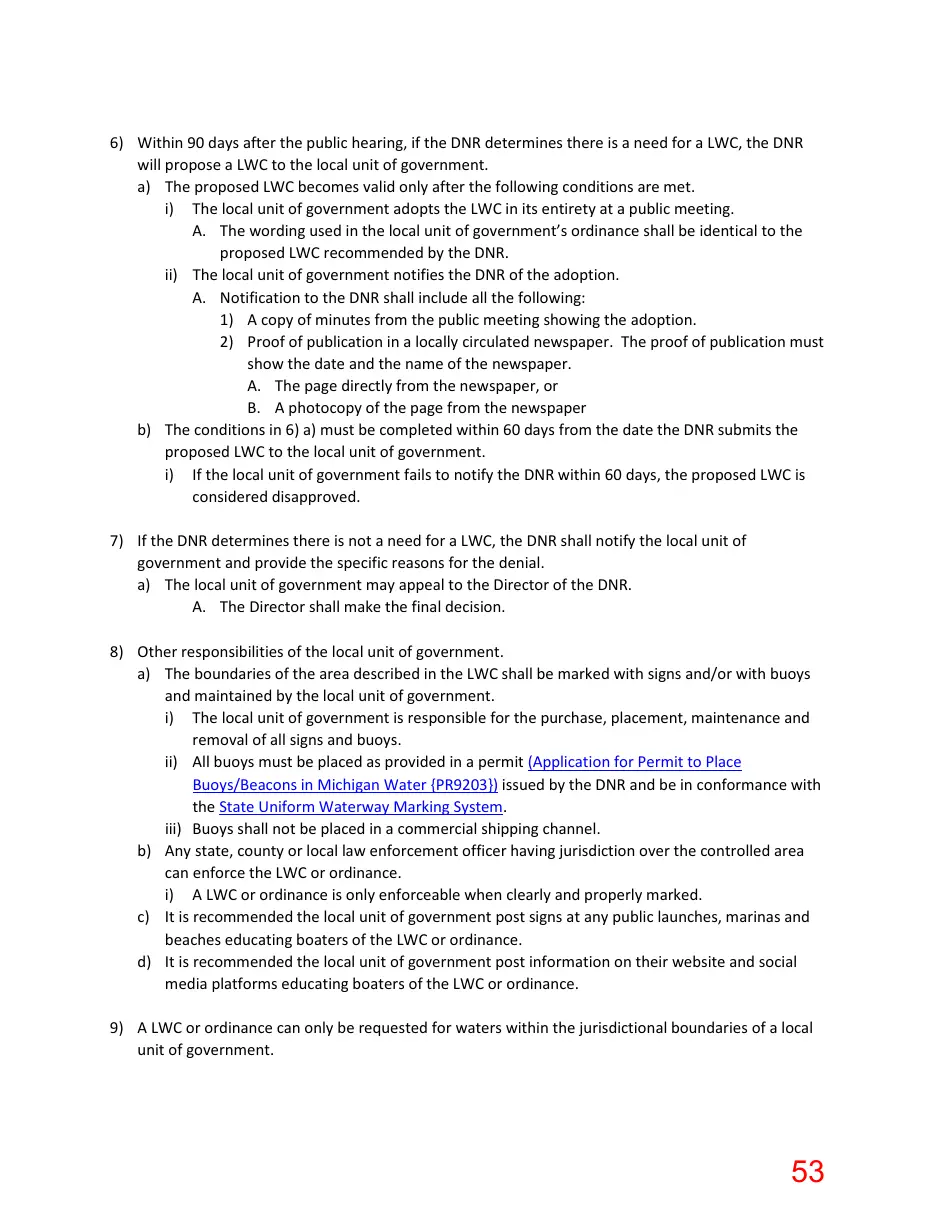
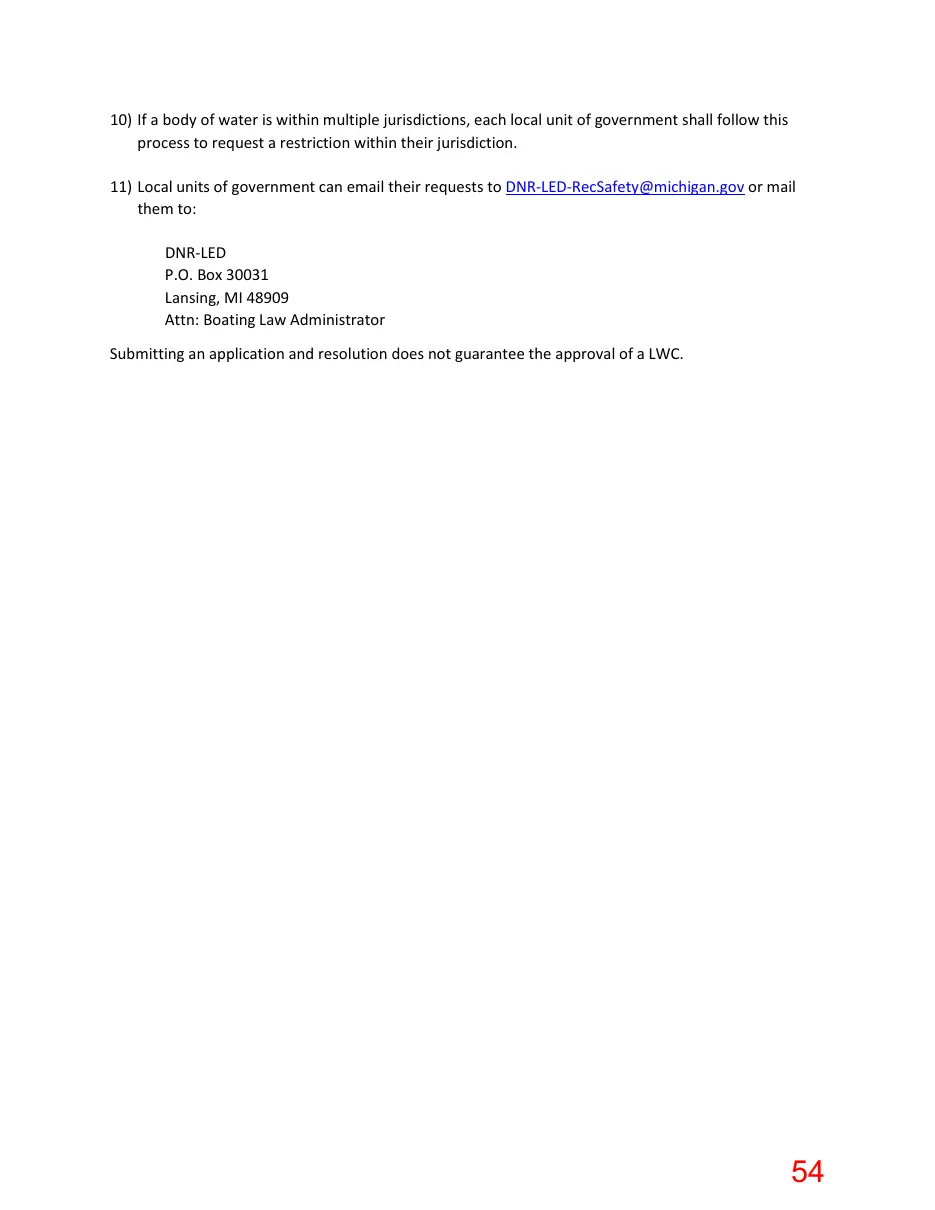
There are several steps involved in creating a no wake zone, which is a local watercraft control. The Department of Natural Resources (DNR) has provided the attached procedures for permanent local watercraft controls. • •
If the City Council desires to consider the no wake request from Sergeant Marina, the first step will include drafting a resolution requesting a local watercraft control and hold a public hearing on the resolution. After a public hearing, the Council would then make a decision on whether to approve the resolution and send it to the DNR for investigation, preparation of a report, and additional public hearing. If the DNR determines there is a need for a local watercraft control, the DNR will propose a local watercraft control ordinance for the City to consider adopting. If the DNR determines there is not a need, the City will be notified and provided specific reasons for denial.
It is important to note that the City can only request a no wake zone within our jurisdictional boundaries. I previously advised Sergeant Marina that they must make the same request for portions of the lake that are within the City of the Village of Douglas. They have since done that. Follow Up from Workshop Meeting At the September workshop, Council requested that staff reach out to the fire department, sheriff’s office, and other marinas in the City to gather initial feedback on the request. The feedback was mixed. The following is a summary of the feedback: •
Sheriff’s Office Marine Unit Administrator, Sgt. Todd Wagner - He advised there is a historical lack of significant wake-related damage reports, with most complaints being about boat rocking rather than actual property damage. He reviewed boating accident reports from 2024 back to 2004. Only one report of boat damage as it relates to the Kalamazoo Lake and the Slow No-Wake Zone surrounding both Sergeant’s Marina and Singapore Yacht Club. He advised there were other incidents, but they related to operator errors and were not related to boat wakes. The existing SNW zone near Sergeant’s Marina extends 240 feet in all directions, and an option to extend it to 500 feet could be considered to help mitigate wake energy. He pointed out a few key considerations. The presence of vessel training and sailboat races at Saugatuck Yacht Club, which could be affected by a full-lake SNW designation. The impact on recreational activities such as tubing and skiing, which draw visitors to Saugatuck. Concerns about extending travel time for boaters, potentially increasing violations due to impatience. He noted limited marine enforcement resources, as the county’s marine division is funded through a $75,000-$80,000 DNR grant that must cover patrols across the entire county, including Lake Michigan. They can do more enforcement if additional funding were provided by the cities or marinas. He warned that implementing a local watercraft control is much easier than removing one, as such regulations tend to be permanent.
Page 49
Text of page 49
DNR Conservation Officer, Carter Woodwyk - Acknowledged the concerns behind making Kalamazoo Lake a Slow No Wake (SNW) zone but questions how widespread the issue is. Proposed an alternative approach: restricting SNW to vessels over 26 feet, similar to regulations in other nearby waterways. This would allow smaller boats launching from public ramps to reach speed without a prolonged slow crawl. Expressed concerns that a SNW designation could limit boaters from easily navigating the lake for short trips. Highlighted the limited local options for tubing and skiing, suggesting this should be considered. While he acknowledged occasional rough wake conditions, he believes it is not a frequent problem and encouraged broader discussions to account for the interests of all boaters.
Fire Chief Janik - Acknowledged the polarized discussions on making Kalamazoo Lake a No Wake zone and supports revisiting the issue from a safety and risk reduction perspective. The Singapore Yacht Club has long raised concerns about property damage and boater injuries caused by wakes. While injuries have been reported, many boaters do not call 911 for property damage since identifying responsible vessels is difficult. He outlined several factors supporting a No Wake zone, including increased boat traffic, the location of Sergeants Marina resulting in increased wake, rising popularity of kayaks and paddleboards, larger and faster boats, and more rental boat operators.
Deputy Fire Chief Mantels – He acknowledged a few medical calls over 20 years related to falls on vessels due to wakes but no recorded reports of vessel or dock damage. Believes the main issue is a lack of compliance with Slow No Wake (SNW) rules when law enforcement is off duty. Many boaters learn the patrol schedule and ignore SNW rules during the week. Suggested enforcing SNW more consistently, possibly by funding a mid-week marine deputy or an additional patrol boat on busy weekends, could be beneficial. Rental boat operators also contribute to violations due to lack of education. The biggest wake issues come from boats tubing in circles near SNW buoys rather than those crossing the lake at higher speeds. Recommended exploring multiple solutions, including making all of Kalamazoo Lake SNW or prohibiting tubing/water skiing in certain areas.
Singapore Yacht Club - Supports making Kalamazoo Lake a no-wake zone. SYC members have experienced significant issues due to wakes from boats, including damage to vessels, docks, and potential harm to individuals. They described how unexpected rocking can cause injuries and damage to property. SYC acknowledges the need for a public hearing and supports a resolution to the DNR for further review. They also express interest in attending hearings to testify about the safety and damage concerns caused by wakes.
Coral Gables Marina – Does not believe there is a wake problem in the area.
Page 50
Text of page 50
Saugatuck Yacht Club – No response.
Doulgas City ManagerAdvised they received a similar request and will be reviewing. Raised concern about ability to enforce the no wake zone.
Next Steps Staff seeks direction from City Council on how you would like to proceed. Options include: • •
Not pursue changes at this time. Direct staff to draft a resolution requesting a local watercraft control and hold a public hearing on the resolution. Options for a local watercraft control include: o Make the lake within the City no wake o Expand the no wake zone around Sergeant Marina o Make the areas in the City no wake for vessels over 26 feet o Restrict skiing and tubing hours
BOARD/COMMISSION REVIEW: None at this time. BUDGET ACTION: N/A. LEGAL REVIEW: N/A at this time. SAMPLE MOTION: N/A. Workshop item only at this time.
Page 51
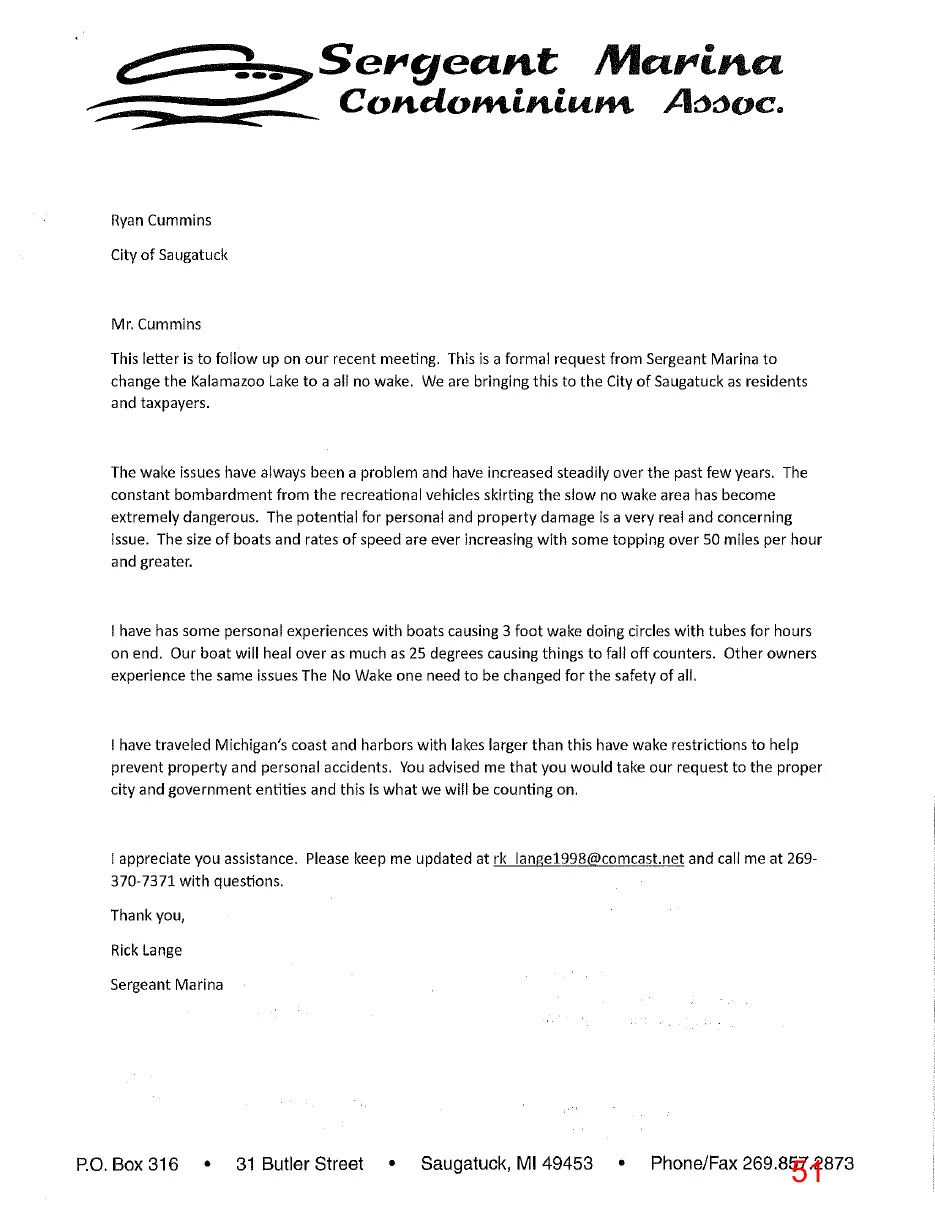
This page is a scanned image with no text layer. The PDF of these pages has it at full resolution.
Page 52
Text of page 52
S TATE OF M ICHIGAN DEPARTMENT OF NATURAL RESOURCES L ANSING GRETCHEN WHITMER
DANIEL EICHINGER
GOVERNOR
DIRECTOR
Procedures for Permanent Local Watercraft Control Local units of government that believe that a special local watercraft control (LWC) is needed on waters subject to their jurisdiction shall follow the procedures established in MCL 324.80110 through 324.80112. Those procedures are detailed below. Local Watercraft Control is state terminology. When a local unit of government adopts a LWC they may use the term ordinance. The local unit of government initiates the process by submitting a resolution to the Department of Natural Resources (DNR). The DNR shall investigate the need for special regulations for the use of vessel and other contrivances on the waters of the state to assure compatibility of uses and to protect public safety. Submitting a resolution does not guarantee approval of a LWC. 1) When a local unit of government believes a regulation is needed for the use of vessels on waters within their jurisdiction, they may submit a resolution for a LWC to the DNR Law Enforcement Division (LED). a) The resolution shall be approved by a majority of the governing body of the local unit of government following a public hearing on the resolution. i) The hearing must be specific on the resolution and not part of their regular meetings. b) The resolution and hearing minutes shall be submitted to the DNR LED. 2) Once the request and resolution are received, the DNR will initiate an investigation and inquiry as directed in MCL 324.80110. 3) Upon completion of the investigation and inquiry, the DNR will prepare a preliminary report that includes the findings of the investigation and a preliminary recommendation as to whether special rules are needed for the body of water, and submit a copy of the preliminary report to the local unit of government. 4) The DNR will work with the local unit of government to schedule a public hearing in the vicinity of the body of water to gather public input. a) The public hearing will be scheduled and advertised at least 10 days (typically 30 days) prior to the hearing. b) The DNR shall provide notice of the public hearing made in a newspaper of general circulation in the area where the water body is located. c) It is recommended the local unit of government provide notice of the public hearing through any and all media and advertising platforms they have available. 5) The DNR will facilitate the public hearing. a) At the public hearing, interested persons shall be afforded an opportunity to present their views on the preliminary report and the need for special rules, either orally or in writing. b) The DNR will accept written comments for 30 days after the date of the public hearing.
Page 53
Text of page 53
6) Within 90 days after the public hearing, if the DNR determines there is a need for a LWC, the DNR will propose a LWC to the local unit of government. a) The proposed LWC becomes valid only after the following conditions are met. i) The local unit of government adopts the LWC in its entirety at a public meeting. A. The wording used in the local unit of government’s ordinance shall be identical to the proposed LWC recommended by the DNR. ii) The local unit of government notifies the DNR of the adoption. A. Notification to the DNR shall include all the following: 1) A copy of minutes from the public meeting showing the adoption. 2) Proof of publication in a locally circulated newspaper. The proof of publication must show the date and the name of the newspaper. A. The page directly from the newspaper, or B. A photocopy of the page from the newspaper b) The conditions in 6) a) must be completed within 60 days from the date the DNR submits the proposed LWC to the local unit of government. i) If the local unit of government fails to notify the DNR within 60 days, the proposed LWC is considered disapproved. 7) If the DNR determines there is not a need for a LWC, the DNR shall notify the local unit of government and provide the specific reasons for the denial. a) The local unit of government may appeal to the Director of the DNR. A. The Director shall make the final decision. 8) Other responsibilities of the local unit of government. a) The boundaries of the area described in the LWC shall be marked with signs and/or with buoys and maintained by the local unit of government. i) The local unit of government is responsible for the purchase, placement, maintenance and removal of all signs and buoys. ii) All buoys must be placed as provided in a permit (Application for Permit to Place Buoys/Beacons in Michigan Water {PR9203}) issued by the DNR and be in conformance with the State Uniform Waterway Marking System. iii) Buoys shall not be placed in a commercial shipping channel. b) Any state, county or local law enforcement officer having jurisdiction over the controlled area can enforce the LWC or ordinance. i) A LWC or ordinance is only enforceable when clearly and properly marked. c) It is recommended the local unit of government post signs at any public launches, marinas and beaches educating boaters of the LWC or ordinance. d) It is recommended the local unit of government post information on their website and social media platforms educating boaters of the LWC or ordinance. 9) A LWC or ordinance can only be requested for waters within the jurisdictional boundaries of a local unit of government.
Page 54
Text of page 54
10) If a body of water is within multiple jurisdictions, each local unit of government shall follow this process to request a restriction within their jurisdiction. 11) Local units of government can email their requests to DNR-LED-RecSafety@michigan.gov or mail them to: DNR-LED P.O. Box 30031 Lansing, MI 48909 Attn: Boating Law Administrator Submitting an application and resolution does not guarantee the approval of a LWC.