
Workshop Agenda item 6B
Short-Term Rental Implementation and Enforcement Report
City Council Workshop, Wednesday, March 5, 2025
Download these 17 pages, 921 KB Whole packet, 98 pages, 35.7 MB
Page 8
Text of page 8
City Council Agenda Item Report FROM:
Ryan Cummins, City Manager Luke Thompson, Director of Planning and Zoning
MEETING DATE:
March 5, 2025
SUBJECT:
Short-Term Rental Implementation and Enforcement Report
DESCRIPTION: After several months of meetings, the City’s Short-Term Rental Task Force submitted a comprehensive report to the Planning Commission and City Council in 2023. Since that time, the Planning Commission and City Council have taken several steps to implement the Task Force recommendations. Status Report Attached is a status update on the recommendations, including implementation of the short-term rental enforcement plan. Implementation As staff have implemented the new STR regulations, various issues and questions have been raised to the City that the Council may wish to discuss and consider. A full report from legal counsel on transfers, late applications, and appeals is attached. Lottery In August, City Council approved a lottery policy for the issuance of available short-term rental licenses. The policy requires notice of available licenses at least annually. In January, staff published notice of 2 available STR licenses in the Peninsula South (R-1) zoning district and 2 licenses available in Peninsula North Riverside (R-1) zoning district. The application period closed on February 27 and no applications were received. No other districts have available licenses. Enforcement
Page 9
Text of page 9
In 2024, the City had the following code enforcement activity involving short-term rentals. These include complaints via hotline, to City staff, or initiated by contracted code enforcement. •
Total - 26 o Unregistered rentals, nuisances, parking issues, etc. - 21 Staff are working to implement separate tracking by category. o Garbage Out Day After – 5 Citations – 0 o Staff, code enforcement, and hotline were able to get compliance in addressing violations without issuing citations.
Hotline The 1-800 hotline went live at the end of October 2024, which was after the main portion of the season was complete. Since going live, the City has received 9 hotline complaints as follows: • • • • •
Trash - 2 Snow Removal - 3 Unregistered Rental - 1 Parking – 2 Wrong Jurisdiction – 1
LEGAL REVIEW: The City Attorney prepared the attached public report and will be at your meeting for any questions. SAMPLE MOTION: N/A. Workshop item only at this time.
Page 10
Text of page 10
March 3, 2025 Via Electronic Mail Ryan Cummins, City Manager City of Saugatuck 102 Butler St PO Box 86 Saugatuck, MI 49453 Dear Manager Cummins, Re: Public Report Regarding STR Licensing Matters OVERVIEW The City has requested our office to provide a public report regarding various issues related to the City’s regulations on short-term rentals (“STRs”). 1 The City’s STR regulations underwent comprehensive changes in the past year. STRs were previously subject to minimal regulation under the Zoning Ordinance, which required a property owner to obtain an STR Certificate, valid for three years, to lawfully operate an STR in the City. In February of 2024, the City adopted a new regulatory scheme for STRs, transitioning to regulating STRs primarily through a police-power licensing ordinance (the “STR Ordinance”), which requires a property owner to acquire an STR License, valid for one year, to operate an STR. To facilitate the transition from STR Certificates to STR Licenses, the STR Ordinance provided for the “grandfathering” of STR Certificates by allowing persons with STR Certificates to continue operating under the City’s old STR regulations until their STR Certificate expired, at which point they would be required to obtain an STR License under the City’s new licensing scheme. STR Ordinance, Section 99.59. The City’s STR regulations were again amended in August of 2024 to impose maximum limits on the number of STR Licenses that would be permitted in certain zoning districts. When the number of licenses in a given district exceeds the maximum limit imposed, the City is prohibited from issuing
As a public report, nothing herein should be construed as a waiver of attorney-client privilege.
Page 11
Text of page 11
any additional licenses to properties within that district. However, STR owners with valid STR Licenses and STR Certificates are permitted to continue to operate subject to those approvals, as long as the license/certificate is not revoked or voided. The maximum limits on STR Licenses have been in place for approximately six months now, and the STR Ordinance has been in place for roughly a year. During this time, various issues and questions have been raised to the City that the Council may wish to discuss and consider addressing. TRANSFERS Under both the City’s current and previous STR regulations, STR Licenses and Certificates are and always have been non-transferable. The City’s previous regulations provided: “A short term rental certificate shall be valid for three seasons (January 1 through December 31) unless there is a change of ownership for the subject parcel,” also requiring all STR Certificate holders to “notify the city of any changes to the approved application.” In the past, City staff administered these provisions to mean that a change in ownership of the subject parcel renders the STR Certificate void, requiring a subsequent owner to apply for an receive a new STR Certificate before STR operations could continue at that property. The City’s current STR Ordinance defines transfers in detail and provides that any conveyance of interest in an STR License, property that is licensed as an STR, or an entity that holds an STR License constitutes a transfer of interest that will render an STR License void. STR Ordinance, Section 99.63. This limitation works in conjunction with the maximum limit to accelerate the amelioration of STR Licenses in capped zoning districts over time, as license holders may continue to operate indefinitely under the STR License but cannot transfer the license or the subject property to another person or entity. In processing applications for STR Licenses from individuals who had been issued STR Certificates under the City’s old regulations, City staff has encountered instances where the subject parcel had been transferred at some point (in some cases, the transfer was simply between an individual and their LLC), which would render the STR Certificate void. However, while in the past the remedy for an unauthorized transfer was simply to apply for a new STR Certificate, when this occurs in a district that is subject to a maximum limit on STR Licenses, it means that the property owner is now unable to use their property as an STR unless and until the number of STR Licenses in that district falls below the maximum limit, as there is nothing in the City’s STR regulations that would allow the City to excuse such a transfer.
Page 12
Text of page 12
If determined to be appropriate and advisable, the Council has the option, but not the obligation, to carve out exceptions for certain types of transfers. This is ultimately a policy decision with competing interests on both sides, which are briefly discussed below. POSSIBLE REASONS TRANSFERS
AGAINST
MAKING
AN
EXCEPTION
FOR
On one hand, City’s regulations have always clearly prohibited transfers of ownership and required the property owner to inform the City of any changes to their STR application. Moreover, it is generally the responsibility of individuals to know and comply with the law (hence the old maxim “ignorance of the law is no excuse”). If an STR Certificate holder would have notified the City of a transfer of their property prior to the maximum limits taking effect, they could have applied for a new STR Certificate/License and continued using their property for an STR. Only individuals who made an unauthorized transfer of their property without taking the appropriate action under the City’s ordinances would be affected by City’s transfer prohibitions, which could be considered a problem of their own making. The City can lawfully revoke approvals when the conditions applicable to such approvals are violated. Moreover, individuals do not have a vested interest in the City’s regulations remaining unchanged, so there is no requirement under the law to provide someone with the opportunity to apply for a new STR License after revocation in a district that is now subject to a maximum limit after their previous STR Certificate is revoked. There are other rental options available even if a property does not have an STR License and is subject to the maximum license limit. One option would be to use the property for long-term rental accommodations. If the property is occupied by the owner, the option to use an accessory dwelling unit (“ADU”) as an STR exists even in districts over the maximum license limit, as ADUs are expressly exempt from this limit pursuant to Section 99.55(4) of the City Code. 2 Additionally, the purpose of the maximum limits on STR Licenses implemented by the City in August was to halt the over-proliferation and unchecked growth of STRs within certain residential districts, and “to achieve such limits through attrition as licenses or certificates expire, are terminated, or are voided within districts that exceed the established limit.” STR Ordinance, Section 99.55(F)(1). Taking a rigid stance on unauthorized transfers would further this objective, while carving out various exceptions for STR Certificates/Licenses that would otherwise be lost to attrition will erode this purpose, making it take longer to reach the limits deemed appropriate by Council.
If a property is not owner-occupied and does not have an STR License for the primary dwelling, the ADU cannot be licensed as an STR. See City Code Sections 154.022(W); 154.092(J).
Page 13
Text of page 13
An exception to the general rule regarding transfers would increase the complexity of the STR Ordinance and could also be accompanied by an increased administrative burden in applying that exception, depending on how it is drawn. Finally, there may be concern in carving out a narrow exception for some and not others. At the end of the day, the Council will have to draw the line somewhere, and it is inevitable that someone will find themselves on the wrong side of that line and perceive unfair or unequal treatment. POSSIBLE REASONS TRANSFERS
FOR
CARVING
OUT
AN
EXCEPTION
FOR
On the other hand, the City may recognize that not every individual was fully aware of the requirements applicable to STRs within the City, and that the consequences of an unauthorized transfer occurring after August of 2024 are much harsher than before. While in the past an unauthorized transfer would have simply resulted in the inconvenience of needing to apply for a new STR License, now it has the potential to indefinitely terminate the ability to operate an STR for the foreseeable future in districts that are far over the maximum limit. In practice, City staff responsible for processing STR applications typically do not become aware of property transfers until an application is submitted, and there have been instances where the City discovered a transfer of interest that occurred years ago. Property owners could feel that it is unfair that the City did not warn them or take action earlier (although the City was under no obligation to do so). Moreover, it is possible that a property owner may have undertaken improvements to optimize a dwelling for STR use in anticipation of receiving a new STR License in the years after an unauthorized transfer, which would increase the harshness of voiding their STR Certificate if they are in a capped district. Additionally, there are certain types of transfers that, while technically a transfer of interest, may not have resulted in a significant change in the way the property was held and managed from a practical perspective (such as the conveyance of property from an individual to that individual’s LLC or to a trust). The Council may view excusing these types of transfers as compatible with the general intent of the STR Ordinance to allow continued ownership. There may be other transfers, such as conveyances to family members, that, while arguably contrary to the intent of the City’s maximum limits on STR Licenses, the Council may otherwise find acceptable for policy reasons, such as allowing a generational vacation home to continue to be used as an STR and thus making it financially viable for it to remain in the family.
Page 14
Text of page 14
Thus, the Council may find it equitable, under certain circumstances, to allow individuals to apply for a new STR License notwithstanding that such transfer would otherwise void their STR Certificate/Transfer and that the district in which they are located exceeds the maximum license limit. CONSIDERATIONS FOR POTENTIAL TRANSFER EXCEPTIONS If the Council is interested in providing exceptions for certain types of transfers, it should consider the following questions: •
For transfers of property subject to STR Certificates that are now seeking STR Licenses: o
Are there certain types of transfers that the Council deems more acceptable than others and wishes to allow? Consider the following examples:
An individual transfers property to their privately held LLC.
An individual transfers property to a trust with their children as beneficiaries.
An individual now holds property jointly with their spouse.
Property held in a partnership is conveyed to one partner as another divests themselves of their interest in that property.
An individual inherits property from a deceased family member.
Property is sold to a third party with the understanding that it will continue to be used as an STR.
Is there a timeline that the City deems more excusable? For instance, should there be a requirement that the transfer predate the August 2024 maximum limit amendment? The February 2024 STR Ordinance? The formation of the STR task force?
Does the applicant need to demonstrate some kind of reliance on receiving an STR License (e.g., did they make improvements to their property to use it as an STR)?
Should the City limit this exception to people who own only a single STR, rather than multiple STRs?
Page 15
Text of page 15
For transfers of STR Licenses: o
Does the Council want to allow transfers to immediate family members? If so, who does it envision being included as an “immediate family member”?
What about transfers to a corporation or a trust if there is not a conveyance to a third party?
What about transfers to other members of a corporation or trust (for instance, can one member of a two-member corporation buy out the other without it being a transfer)?
What about transfers pursuant to a will or intestate transfers that do not fall into any of these other categories?
Should these always be allowable or only for a certain time?
LATE APPLICATIONS Section 99.58(A) of the STR Ordinance provides the following deadline to submit a renewal application: “The license holder or local agent may apply for a renewed license by submitting the renewal application to the enforcing officer no later than thirty (30) days prior to the date that the license is set to expire.” City staff have been proactive in their efforts to appraise STR owners and local agents about the renewal application deadline via mail and email and have also posted this requirement on the City’s website, but there have still been untimely applications. The question was raised whether it would be possible and/or advisable to provide some type of grace period for late applications, which I understand was raised in response to an application being received just one day after a previously issued STR Certificate expired. It would be legally permissible for the Council to revise this application deadline however it sees fit. However, there are likely some valid practical reasons to leave this deadline unchanged. I understand that this deadline is in place to provide City staff with time to review the application for completeness, and for the Fire District to conduct an inspection of the dwelling before the STR License expires. Reducing this deadline may result in a greater administrative burden to turn applications out in a short timeframe. It may cause STR Licenses to expire before they can be renewed by City staff, which in turn can result in the unlawful of operation of an STR if there are existing reservations and the owner continues to rent without a valid STR License.
Page 16
Text of page 16
As with unauthorized transfers, untimely applications are most often a problem of the applicant’s own making. For the most part, the unforeseen delays that seem to result in late applications can typically be avoided if an applicant simply files a week or two in advance, rather than at the last minute. Finally, if the Council imposes any sort of hard deadline, there will always be an applicant who is just one day later than whatever deadline is established. The line has to be drawn somewhere, and it is ultimately the license holder’s responsibility to keep track of when their STR License expires and when it needs to be renewed. This is particularly true in light of the lengths City staff have taken to inform license holders of the applicable submission deadlines. These drawbacks could be addressed to some extent by a discretionary waiver mechanism that would be applied on a case-by-case basis, such as the following: The City may accept late renewal applications only if: 1) the license holder or local agent demonstrates good cause for the late filing attributable to circumstances outside the license holder’s control and not the result of their own inaction or negligence; and 2) the enforcing agent determines in his or her absolute discretion that there will still be adequate time to process renewal application prior to the expiration of the license. However, adding a waiver mechanism like this to the STR Ordinance would also be accompanied by drawbacks. This would add more complexity to the STR Ordinance and would impose an administrative burden on City staff to now decide discretionary waiver requests, rather than simply determine whether applications are timely and satisfy the appliable requirements of the City Code. In addition, this could result in appeals or challenges if a waiver is not granted, as inevitably not all waiver requests will be granted. This would put greater pressure on City staff and may put them in the unenviable position of being blamed for a late application being denied if a waiver is not granted. Another option the City could consider (that was previously discussed back when the STR Ordinance was first adopted) is moving all of the STR Licenses and Certificates to the same timeframe by establishing a universal expiration and renewal dates. For instance, the STR Ordinance could be amended to provide that all STR Licenses expire on December 31 of each year and that renewal applications must be submitted no later than November 1. This approach would give all license holders the same deadlines to work with and make it easier for the City to provide notice that renewal applications are due. However, this would temporarily impose a considerable burden on City staff to review all of the applications and on the Fire District to inspect all of the STRs in the City within a condensed timeframe rather than over the course of a year, which was why the Fire District was not in favor of this option the last time it was discussed.
Page 17
Text of page 17
It is possible that this concern could be addressed by requiring renewal applications to be submitted much earlier than currently required (for instance, 90 days before expiration instead of 30 days), and it is also possible that there could be some increased efficiency in scheduling all of the STR inspections within a 90-day period as the Fire District could coordinate inspecting groups of adjacent STRs in a single trip. It is not clear whether this would be administratively feasible or advantageous for the Fire District at this time, but if the Council would like, City staff would be happy to explore the issue further. APPEALS Another issue that was raised is whether decisions to void, suspend, or revoke an STR License should be appealable to the ZBA. The City’s current process for disciplinary action against STR Licenses is set forth in Section 99.61 of the City Code. Under these regulations, certain violations constitute grounds to void, suspend, or revoke an STR License. If that occurs, the license holder must be provided with a written notice specifying the nature of the violation and setting a date and time for a hearing before the Council. At the hearing, the license holder is provided an opportunity to show cause why the STR License should not be suspended or revoked, after which the Council determines whether to take any action against the license. A first violation results in a 3-month suspension, a second violation within a year of the first results in a 6-month suspension, and a third violation, no matter when it occurs, is grounds for permanent revocation. Pursuant to Section 99.61(C), the Council’s decision to suspend or revoke an STR License is final and binding, meaning there are no further appeals that can be taken internally—the only option for further review would be from the courts. The Council could, if it saw fit, amend the STR Ordinance to provide for an appeal to the ZBA and add an additional layer of administrative review to STR licensing decisions, but there are some considerations that should be taken into account. All of the provisions regarding the issuance and revocation of STR Licenses are contained in the STR Ordinance, not the Zoning Ordinance. By statute and under the City Code, the ZBA is currently authorized to hear appeals arising from the Zoning Ordinance, but this does not mean the ZBA is prohibited from hearing appeals from other ordinances. In Square Lake Hills Condo Ass’n v Bloomfield Twp, 437 Mich 310 (1991), our Supreme Court upheld a police power ordinance regulating boat docking and launching that was administered by a township zoning board of appeals. Thus, there is authority to support a ZBA performing duties outside of the zoning ordinance. However, just because the ZBA can hear appeals from the STR Ordinance does not necessarily mean that it should. The ZBA certainly has expertise in deciding appeals related to zoning determinations, but it may not have the same qualifications to hear appeals from licensing enforcement decisions. To effectively act as the final appellate body for the STR Ordinance, the ZBA would need to learn a new set of rules and regulations, and these new appeals would increase
Page 18
Text of page 18
its caseload and possibly interfere with its regular business, such as hearing variance requests or appeals from zoning decisions. Additionally, the existing process set forth in the STR Ordinance provides a legally sufficient degree of notice and process before an adverse licensing decision can be made. It is not clear what benefit, if any, would be derived from providing an additional layer of appellate review by the ZBA following the Council’s decision, as the Council is already acting in a quasi-appellate capacity by determining whether an STR License was rightfully suspended or revoked. CONCLUSION The Council has the option, but not any obligation, to amend the STR Ordinance to allow certain types of transfers, to provide flexibility in application deadlines, and to authorize appeals to the ZBA. Whether the Council should take any such action should be informed by the difficulties that have already been encountered in administering the STR Ordinance and the problems that could arise from such amendments in the future. If the Council is inclined to make any such changes, our office and City staff will happily work to implement the same. Sincerely,
JACOB N. WITTE SENIOR ASSOCIATE
Direct: 517.381.3201 jwitte@fsbrlaw.com
Page 19
Text of page 19
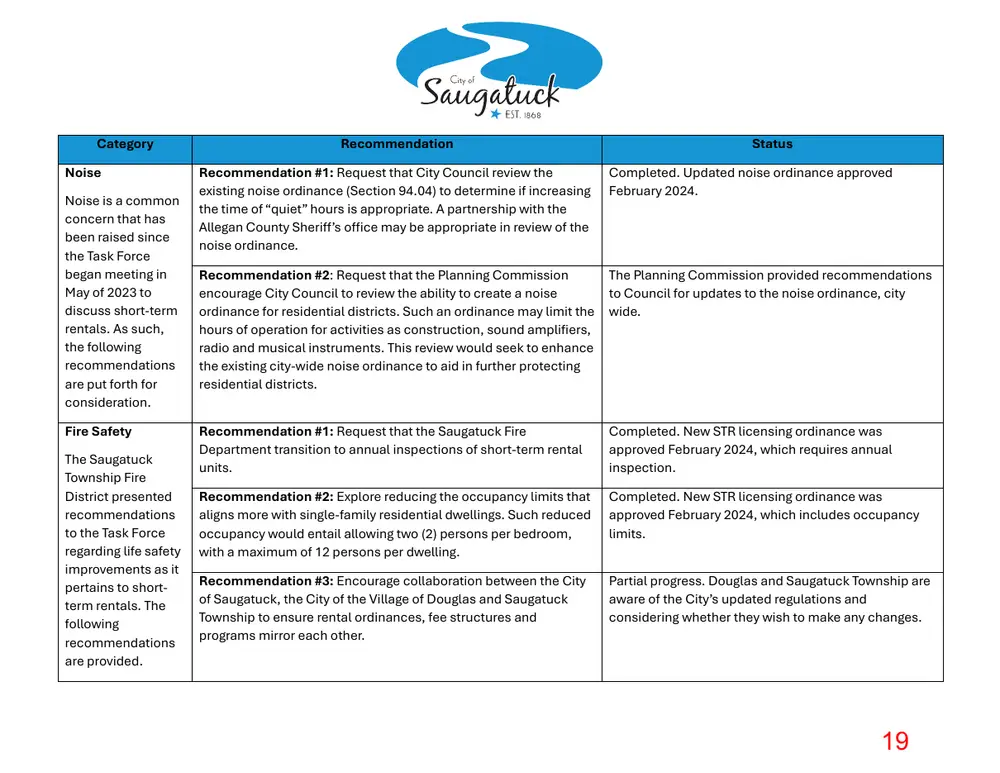
Category Noise Noise is a common concern that has been raised since the Task Force began meeting in May of 2023 to discuss short-term rentals. As such, the following recommendations are put forth for consideration. Fire Safety The Saugatuck Township Fire District presented recommendations to the Task Force regarding life safety improvements as it pertains to shortterm rentals. The following recommendations are provided.
Recommendation
Status
Recommendation #1: Request that City Council review the existing noise ordinance (Section 94.04) to determine if increasing the time of “quiet” hours is appropriate. A partnership with the Allegan County Sheriff’s office may be appropriate in review of the noise ordinance.
Completed. Updated noise ordinance approved February 2024.
Recommendation #2: Request that the Planning Commission encourage City Council to review the ability to create a noise ordinance for residential districts. Such an ordinance may limit the hours of operation for activities as construction, sound amplifiers, radio and musical instruments. This review would seek to enhance the existing city-wide noise ordinance to aid in further protecting residential districts.
The Planning Commission provided recommendations to Council for updates to the noise ordinance, city wide.
Recommendation #1: Request that the Saugatuck Fire Department transition to annual inspections of short-term rental units.
Completed. New STR licensing ordinance was approved February 2024, which requires annual inspection.
Recommendation #2: Explore reducing the occupancy limits that aligns more with single-family residential dwellings. Such reduced occupancy would entail allowing two (2) persons per bedroom, with a maximum of 12 persons per dwelling.
Completed. New STR licensing ordinance was approved February 2024, which includes occupancy limits.
Recommendation #3: Encourage collaboration between the City of Saugatuck, the City of the Village of Douglas and Saugatuck Township to ensure rental ordinances, fee structures and programs mirror each other.
Partial progress. Douglas and Saugatuck Township are aware of the City’s updated regulations and considering whether they wish to make any changes.
Page 20
Text of page 20
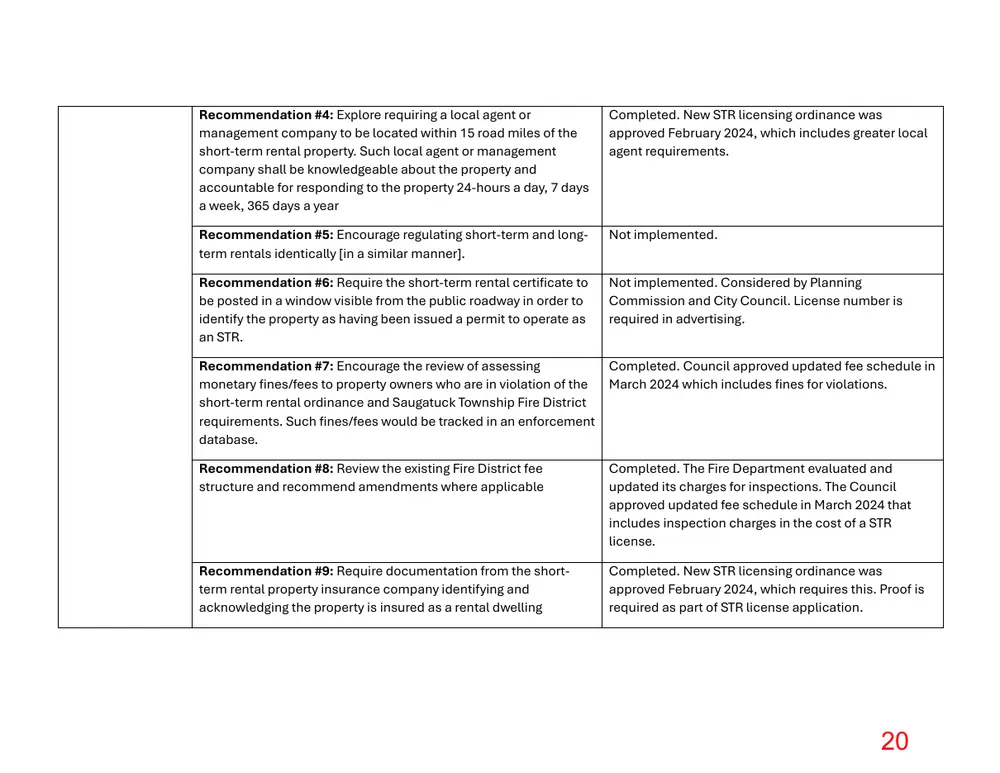
Recommendation #4: Explore requiring a local agent or management company to be located within 15 road miles of the short-term rental property. Such local agent or management company shall be knowledgeable about the property and accountable for responding to the property 24-hours a day, 7 days a week, 365 days a year
Completed. New STR licensing ordinance was approved February 2024, which includes greater local agent requirements.
Recommendation #5: Encourage regulating short-term and longterm rentals identically [in a similar manner].
Not implemented.
Recommendation #6: Require the short-term rental certificate to be posted in a window visible from the public roadway in order to identify the property as having been issued a permit to operate as an STR.
Not implemented. Considered by Planning Commission and City Council. License number is required in advertising.
Recommendation #7: Encourage the review of assessing monetary fines/fees to property owners who are in violation of the short-term rental ordinance and Saugatuck Township Fire District requirements. Such fines/fees would be tracked in an enforcement database.
Completed. Council approved updated fee schedule in March 2024 which includes fines for violations.
Recommendation #8: Review the existing Fire District fee structure and recommend amendments where applicable
Completed. The Fire Department evaluated and updated its charges for inspections. The Council approved updated fee schedule in March 2024 that includes inspection charges in the cost of a STR license.
Recommendation #9: Require documentation from the shortterm rental property insurance company identifying and acknowledging the property is insured as a rental dwelling
Completed. New STR licensing ordinance was approved February 2024, which requires this. Proof is required as part of STR license application.
Page 21
Text of page 21
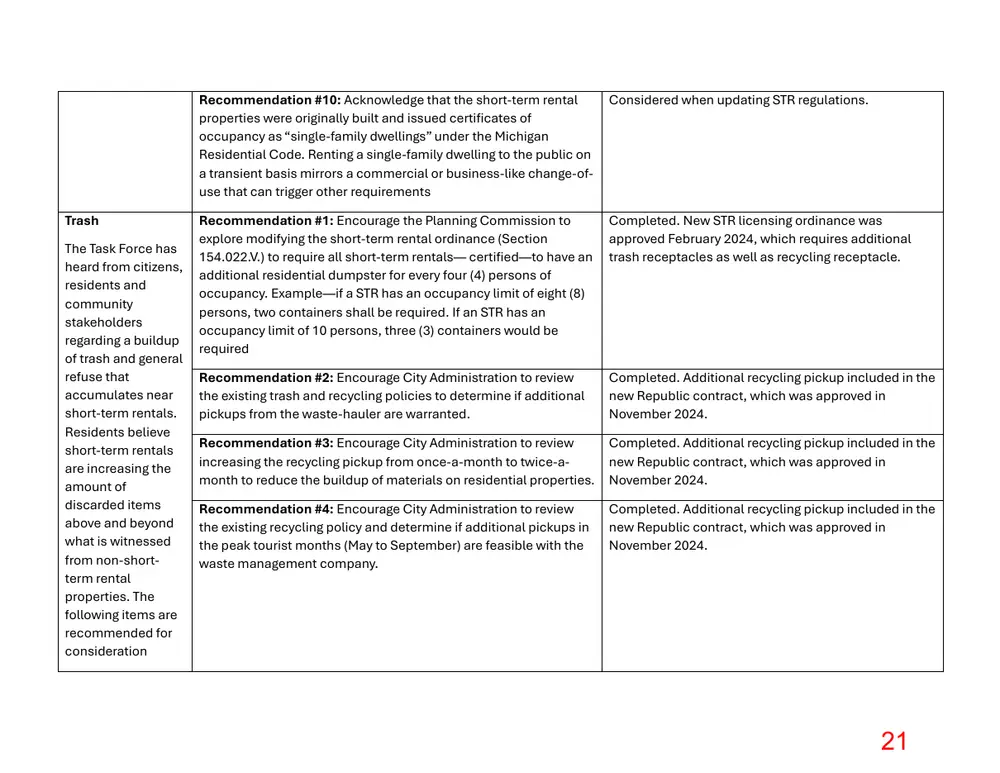
Trash The Task Force has heard from citizens, residents and community stakeholders regarding a buildup of trash and general refuse that accumulates near short-term rentals. Residents believe short-term rentals are increasing the amount of discarded items above and beyond what is witnessed from non-shortterm rental properties. The following items are recommended for consideration
Recommendation #10: Acknowledge that the short-term rental properties were originally built and issued certificates of occupancy as “single-family dwellings” under the Michigan Residential Code. Renting a single-family dwelling to the public on a transient basis mirrors a commercial or business-like change-ofuse that can trigger other requirements
Considered when updating STR regulations.
Recommendation #1: Encourage the Planning Commission to explore modifying the short-term rental ordinance (Section 154.022.V.) to require all short-term rentals— certified—to have an additional residential dumpster for every four (4) persons of occupancy. Example—if a STR has an occupancy limit of eight (8) persons, two containers shall be required. If an STR has an occupancy limit of 10 persons, three (3) containers would be required
Completed. New STR licensing ordinance was approved February 2024, which requires additional trash receptacles as well as recycling receptacle.
Recommendation #2: Encourage City Administration to review the existing trash and recycling policies to determine if additional pickups from the waste-hauler are warranted.
Completed. Additional recycling pickup included in the new Republic contract, which was approved in November 2024.
Recommendation #3: Encourage City Administration to review increasing the recycling pickup from once-a-month to twice-amonth to reduce the buildup of materials on residential properties.
Completed. Additional recycling pickup included in the new Republic contract, which was approved in November 2024.
Recommendation #4: Encourage City Administration to review the existing recycling policy and determine if additional pickups in the peak tourist months (May to September) are feasible with the waste management company.
Completed. Additional recycling pickup included in the new Republic contract, which was approved in November 2024.
Page 22
Text of page 22
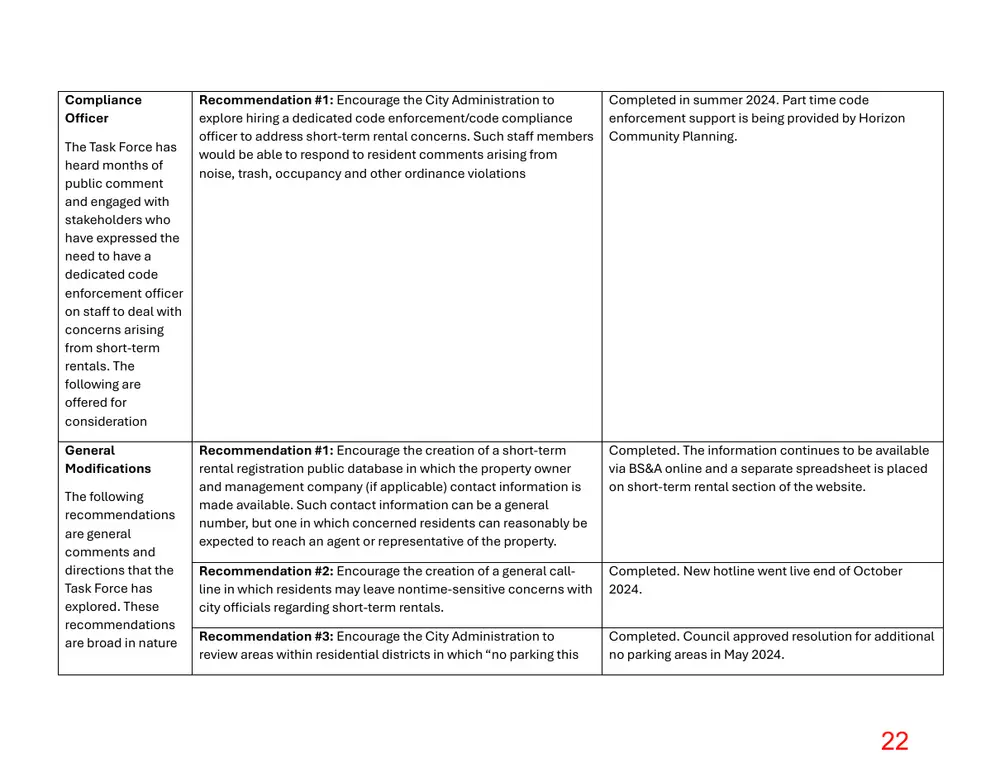
Compliance Officer The Task Force has heard months of public comment and engaged with stakeholders who have expressed the need to have a dedicated code enforcement officer on staff to deal with concerns arising from short-term rentals. The following are offered for consideration General Modifications The following recommendations are general comments and directions that the Task Force has explored. These recommendations are broad in nature
Recommendation #1: Encourage the City Administration to explore hiring a dedicated code enforcement/code compliance officer to address short-term rental concerns. Such staff members would be able to respond to resident comments arising from noise, trash, occupancy and other ordinance violations
Completed in summer 2024. Part time code enforcement support is being provided by Horizon Community Planning.
Recommendation #1: Encourage the creation of a short-term rental registration public database in which the property owner and management company (if applicable) contact information is made available. Such contact information can be a general number, but one in which concerned residents can reasonably be expected to reach an agent or representative of the property.
Completed. The information continues to be available via BS&A online and a separate spreadsheet is placed on short-term rental section of the website.
Recommendation #2: Encourage the creation of a general callline in which residents may leave nontime-sensitive concerns with city officials regarding short-term rentals.
Completed. New hotline went live end of October 2024.
Recommendation #3: Encourage the City Administration to review areas within residential districts in which “no parking this
Completed. Council approved resolution for additional no parking areas in May 2024.
Page 23
Text of page 23
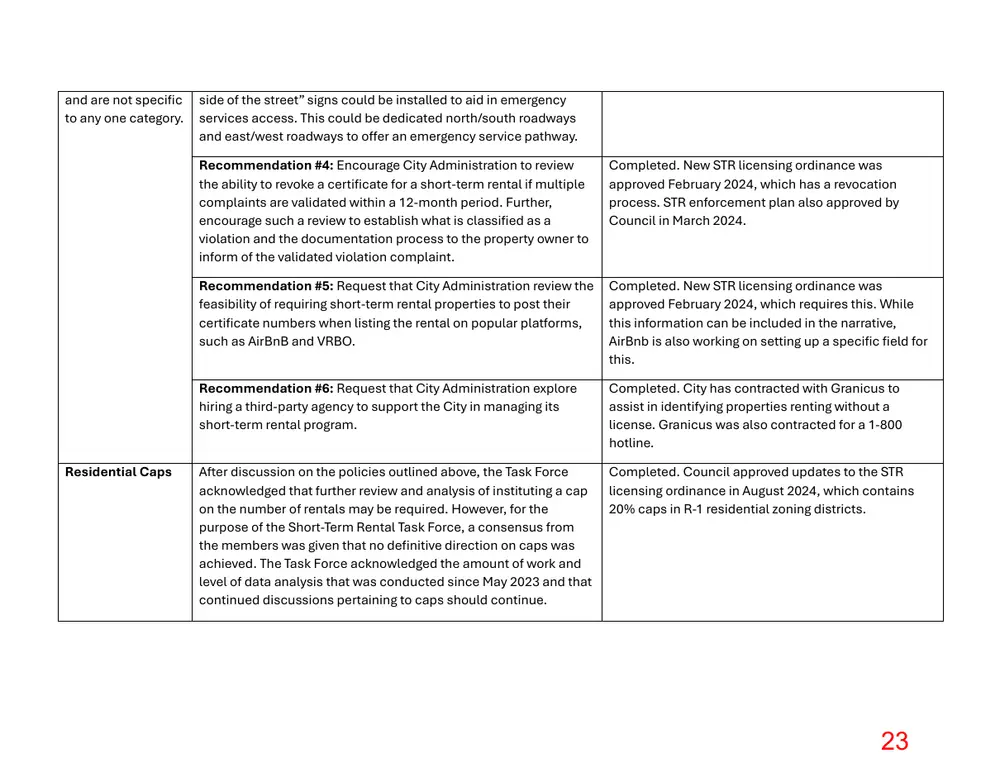
and are not specific to any one category.
Residential Caps
side of the street” signs could be installed to aid in emergency services access. This could be dedicated north/south roadways and east/west roadways to offer an emergency service pathway. Recommendation #4: Encourage City Administration to review the ability to revoke a certificate for a short-term rental if multiple complaints are validated within a 12-month period. Further, encourage such a review to establish what is classified as a violation and the documentation process to the property owner to inform of the validated violation complaint.
Completed. New STR licensing ordinance was approved February 2024, which has a revocation process. STR enforcement plan also approved by Council in March 2024.
Recommendation #5: Request that City Administration review the feasibility of requiring short-term rental properties to post their certificate numbers when listing the rental on popular platforms, such as AirBnB and VRBO.
Completed. New STR licensing ordinance was approved February 2024, which requires this. While this information can be included in the narrative, AirBnb is also working on setting up a specific field for this.
Recommendation #6: Request that City Administration explore hiring a third-party agency to support the City in managing its short-term rental program.
Completed. City has contracted with Granicus to assist in identifying properties renting without a license. Granicus was also contracted for a 1-800 hotline.
After discussion on the policies outlined above, the Task Force acknowledged that further review and analysis of instituting a cap on the number of rentals may be required. However, for the purpose of the Short-Term Rental Task Force, a consensus from the members was given that no definitive direction on caps was achieved. The Task Force acknowledged the amount of work and level of data analysis that was conducted since May 2023 and that continued discussions pertaining to caps should continue.
Completed. Council approved updates to the STR licensing ordinance in August 2024, which contains 20% caps in R-1 residential zoning districts.
Page 24
Text of page 24
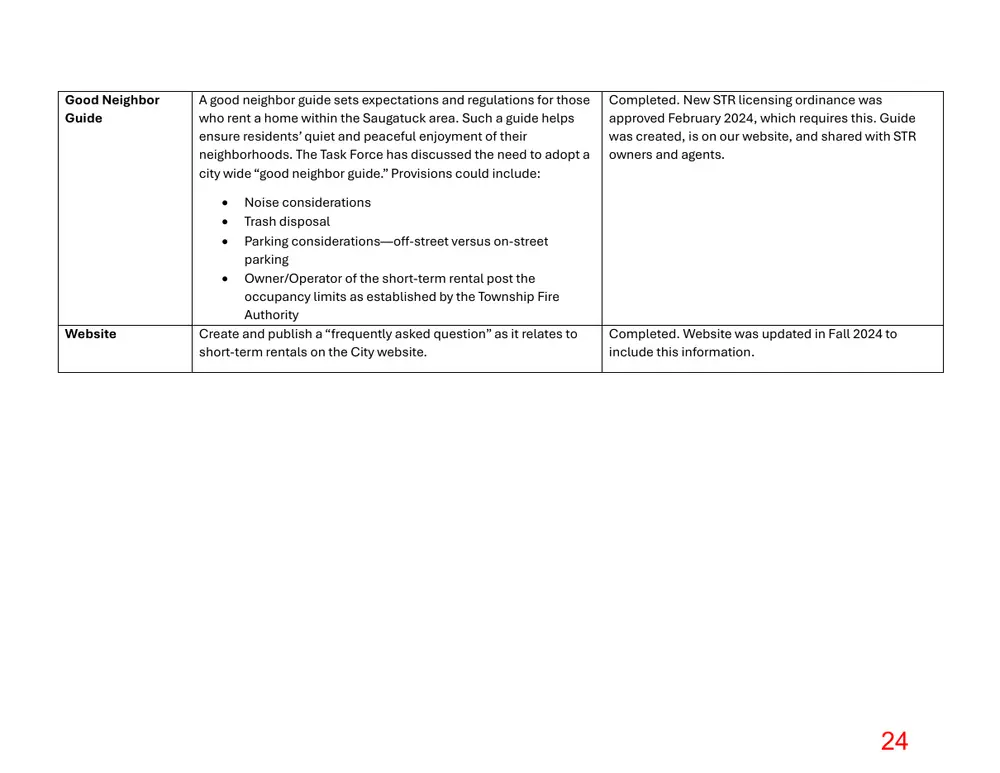
Good Neighbor Guide
A good neighbor guide sets expectations and regulations for those who rent a home within the Saugatuck area. Such a guide helps ensure residents’ quiet and peaceful enjoyment of their neighborhoods. The Task Force has discussed the need to adopt a city wide “good neighbor guide.” Provisions could include: Noise considerations Trash disposal Parking considerations—off-street versus on-street parking • Owner/Operator of the short-term rental post the occupancy limits as established by the Township Fire Authority Create and publish a “frequently asked question” as it relates to short-term rentals on the City website.
Completed. New STR licensing ordinance was approved February 2024, which requires this. Guide was created, is on our website, and shared with STR owners and agents.
Website
Completed. Website was updated in Fall 2024 to include this information.