
Council Agenda item 7D
Proposals for City-Wide Invasive Species Survey & Management Plan
City Council, Wednesday, April 8, 2026
Download these 32 pages, 18.3 MB Whole packet, 198 pages, 91.5 MB
Page 49
Text of page 49
City Council Agenda Item Report FROM:
Scott Herbert – Public Works Superintendent
MEETING DATE:
April 8, 2026 Workshop / April 13, 2026 Regular Meeting
SUBJECT:
City-Wide Invasive Species Survey & Management Plan
DESCRIPTION: City staff reached out to multiple organizations to solicit proposals to develop a comprehensive, city-wide approach to identify and manage invasive species within the City of Saugatuck. The intent of this effort is to establish a data-driven foundation for future invasive species control, habitat restoration, and long-term ecological stewardship. Staff received four proposals: •
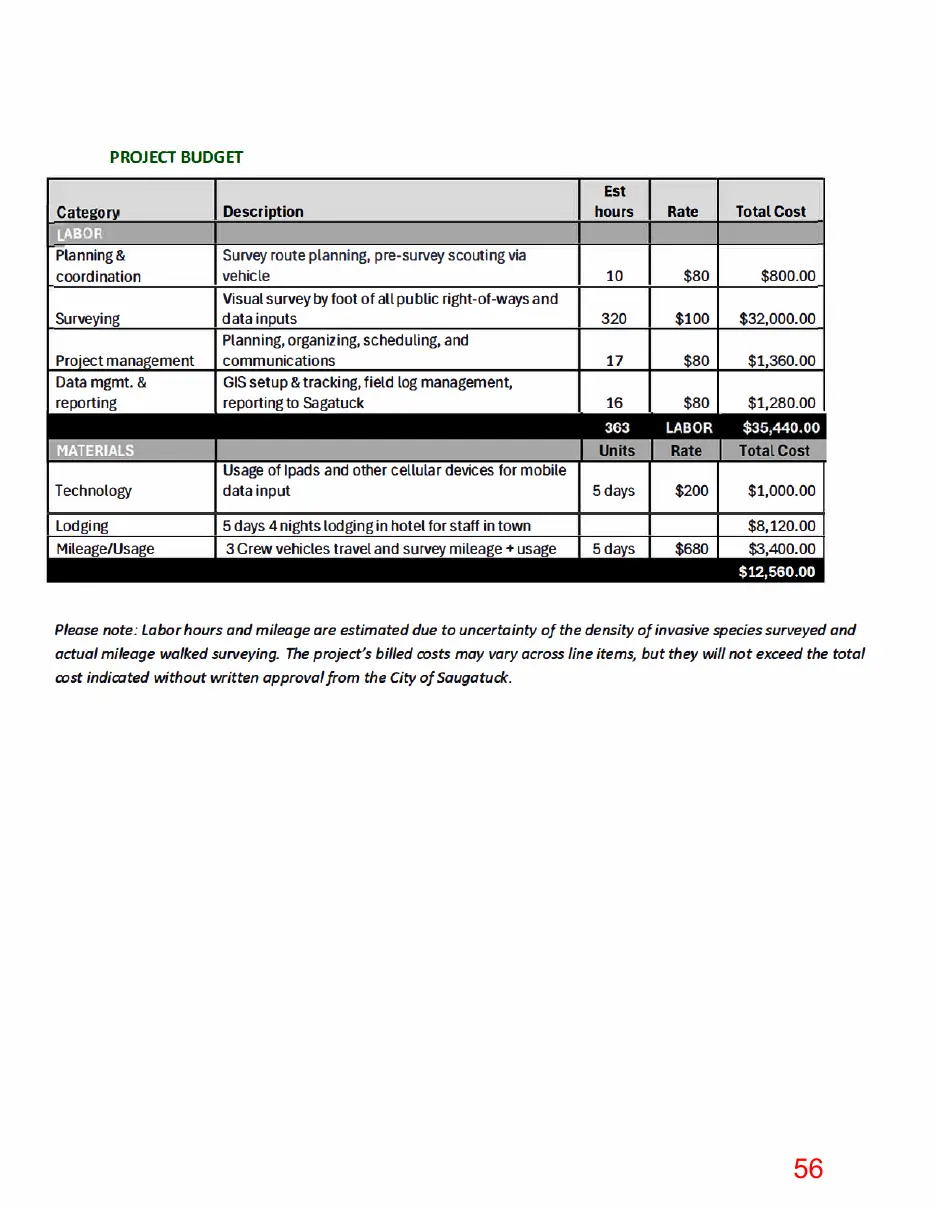
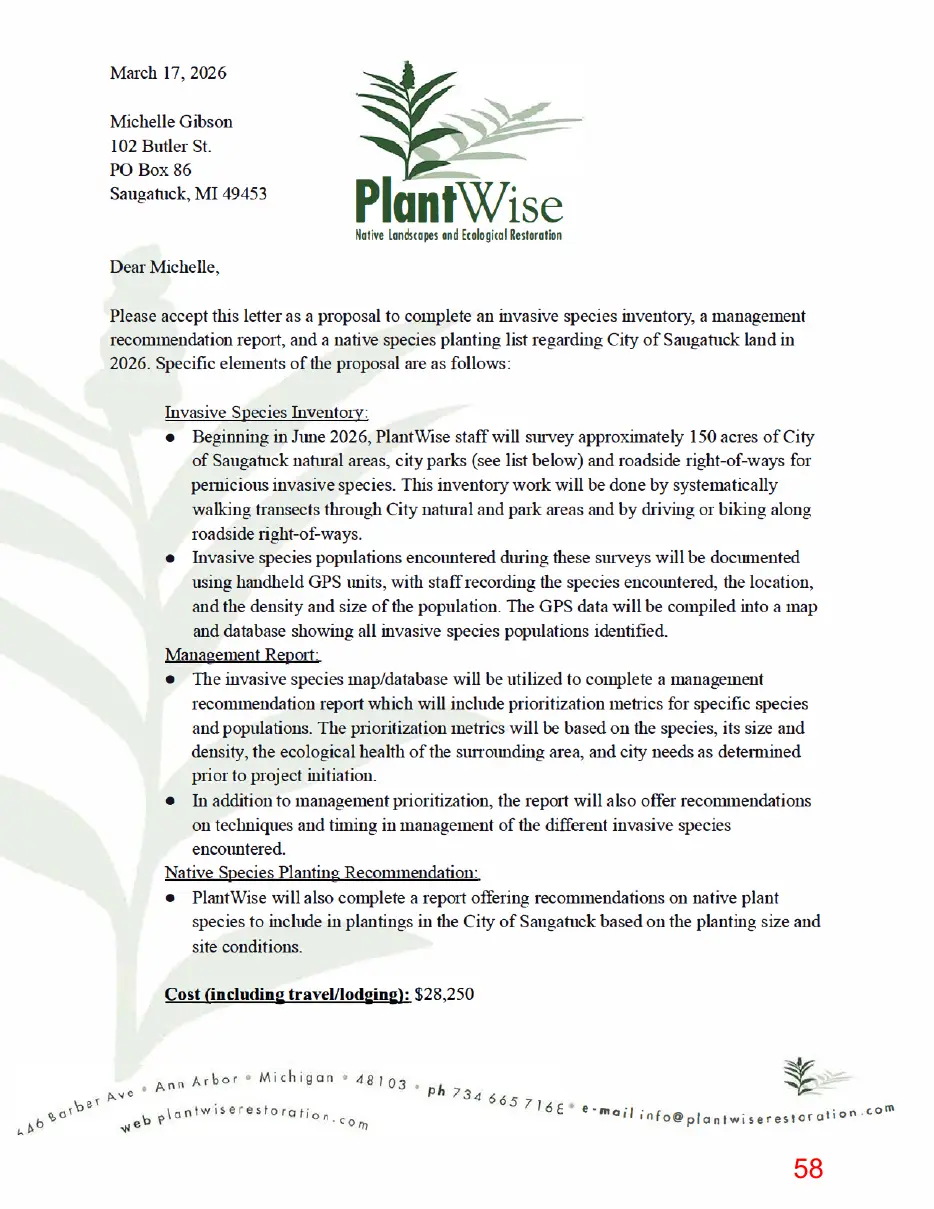
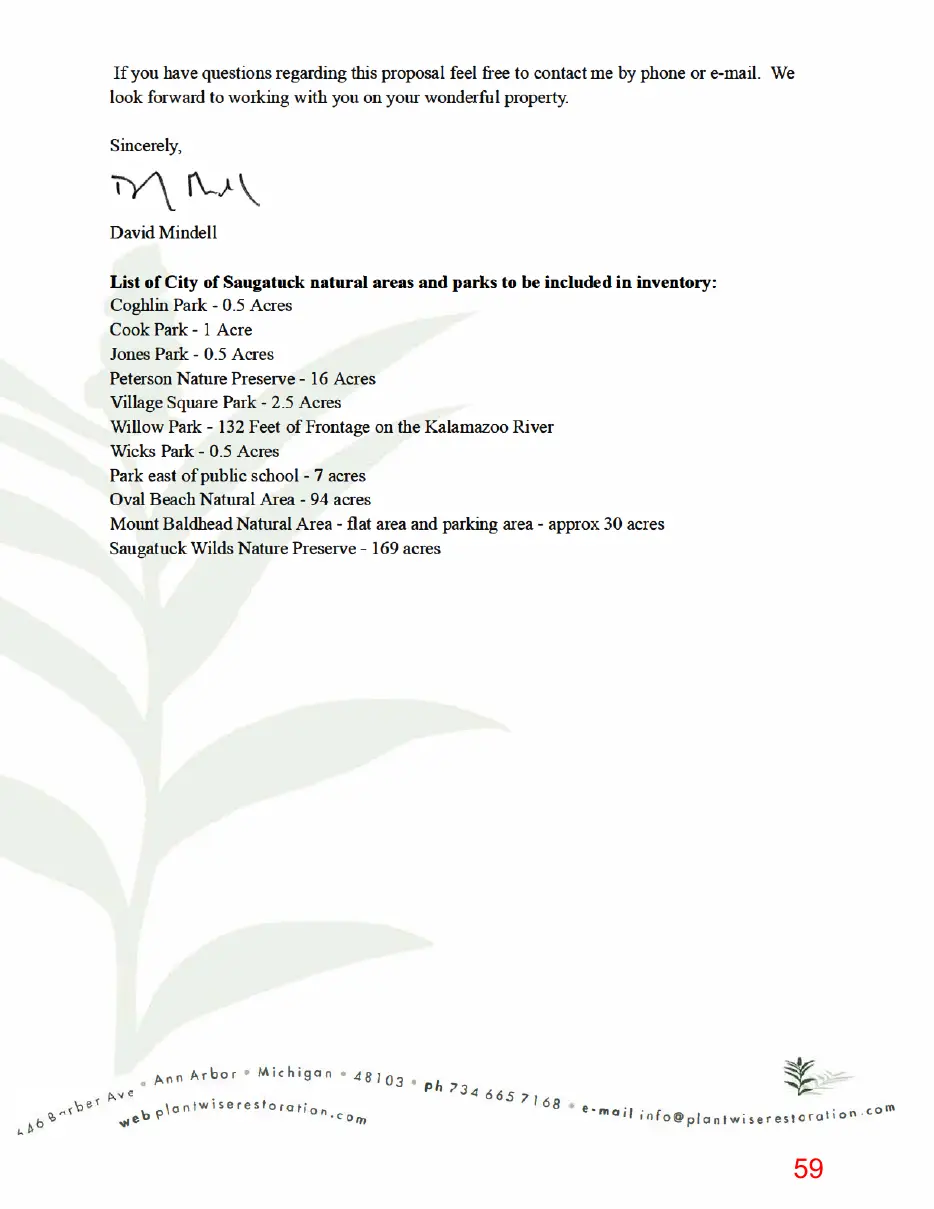
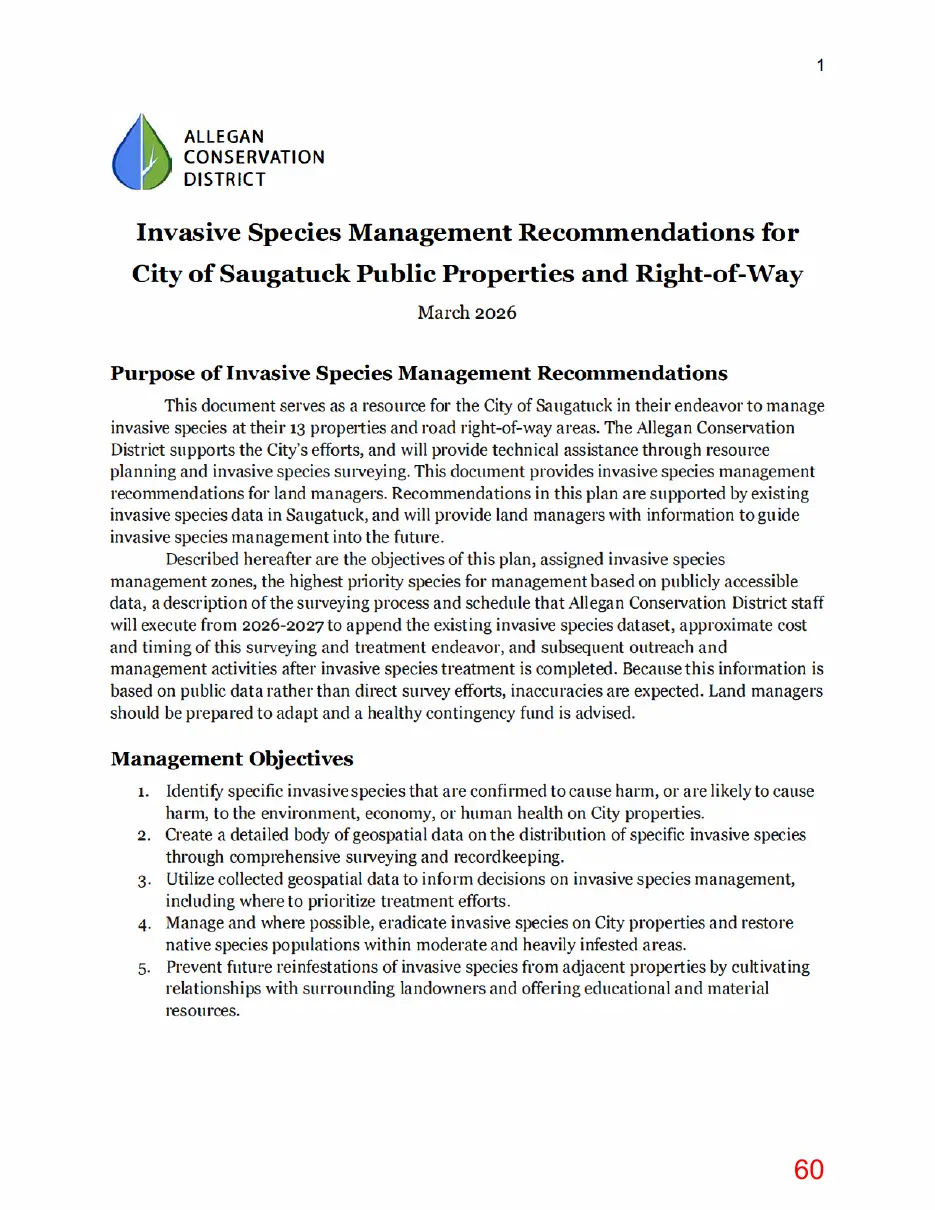
Kalamazoo Nature Center (KNC) proposes a right-of-way focused survey identifying six high-risk invasive species. Their work includes GPS mapping through the MISIN database, photographic documentation, and a final report. The survey would be conducted over a one-week period in August, with a total project cost not to exceed $48,000. Outdoor Discovery Center (ODC) proposed a more comprehensive, multi-season survey (May -September) covering right-of-ways, parks, and natural areas. Their proposal includes a detailed report with mapping, key findings, and ranked priorities. The total project cost is $26,000. PlantWise submitted a proposal to survey approximately 150 acres of City parks, natural areas, and right-ofways. Proposal also includes 169 acres at the Saugatuck Wilds. In addition to inventorying invasive species, PlantWise would provide a management recommendation report and a native species planting list. The total project cost is $28,250. Allegan Conservation District provided an estimate recommending approximately $15,000 for first-year invasive species treatment based on MISIN data and known conditions within the City. There would be no cost to the City for surveying urban properties and City right of ways. For larger properties such as Oval Beach and Saugatuck Wilds, there would be a fee associated for time spent surveying and mileage. The additional charge for surveying both properties is $7,728, bringing the total cost to $22,728.
While each proposal varies in scope, methodology, and cost, all emphasize the importance of establishing a baseline inventory and prioritization framework before implementing treatment strategies. After reviewing all proposals, staff recommends awarding the City-wide invasive species survey and management recommendations project to ODC. ODC’s team has extensive experience with invasive species management in Michigan and is already managing two other City projects this summer. Selecting ODC will allow for continuity across
Page 50
Text of page 50
projects, efficient coordination, and integration of survey data with existing initiatives, providing the City with the most comprehensive and actionable information for future treatment and habitat management. BUDGET ACTION REQUIRED: Sufficient dollars were budgeted for invasive species treatment and evaluation under public works contractual services. COMMITTEE/COMMISSION REVIEW: Parks & Public Works Committee recommends accepting the proposal from the Outdoor Discovery Center. LEGAL REVIEW: N/A SAMPLE MOTION: Motion to approve the proposal from ODC to conduct the City-Wide invasive species survey and management recommendations project in an amount of $26,000.
Page 51
Text of page 51
PROPOSAL FOR CONSERVATION SERVICES This proposal was created for: City of Saugatuck 102 Butler St, Saugatuck, MI 49453 General Background and Scope of Work: This proposal outlines a plan to conduct a comprehensive survey of invasive species and ecological threats within the City of Saugatuck. The purpose of this survey is to identify current and emerging ecological risks, enabling city staff and partners to prioritize management actions effectively and maintain the ecological quality of the city’s natural areas and right-of-ways. We recommend the following work plan in 2026: 1. Invasive Species Survey ▪ Conduct a comprehensive survey within the City of Saugatuck (see Appendix A for map) to identify existing and emerging invasive species and other potential ecological threats. ▪ Surveys will include both road-side monitoring of public right-of-ways, as well as walking surveys within parks, natural areas, and other greenspaces. ▪ Field surveys will take place during multiple periods of the growing season to capture seasonal variation and ensure a holistic assessment of the plant communities: • Spring-early summer 2026 • Late summer-early fall 2026 ▪ Following completion of the field surveys, we will provide a detailed written report accompanied by key findings, maps, and ranked priorities of invasive species threats within the City. ▪ Target date for report submission: October 15, 2026 Project Timeline: • Field surveys will conducted between May-September of 2026. • Completed report will be submitted by October 15, 2026. Project Budget: • Invasive Species Survey & Report o All parcels and natural areas outlined in Appendix A - $22,000 (50% billed in June, 50% billed upon submission of report) ☐ o Saugatuck Wilds Park (~170 acres) - $4,000 (50% billed in June, 50% billed upon submission of report) ☐ *PLEASE CHECK THE APPROPRIATE BOXES ABOVE TO INDICATE ACCEPTED SERVICES. TO ENSURE TIMELY SCHEDULING AND SERVICE DELIVERY, PLEASE RESPOND PROMPTLY. DELAYS IN RESPONSE MAY RESULT IN CHANGES TO PROPOSED PROJECT TIMELINE OR AVAILABILITY. Exclusions: The following items are excluded from this proposal: • Creation of long-term stewardship or management plan. • Treatment of any identified invasive species. • Assessment of privately owned parcels (unless written permission is granted beforehand). • Detailed assessments of natural communities beyond general invasive species observations. • Permitting, regulatory approvals, or coordination with other agencies required for management actions. While not covered under this proposal, we are happy to provide proposals for any of the above items upon request. Note: This proposal accounts for pricing of all labor, materials, and equipment necessary to execute the outlined work plan. If additional work is required beyond the scope of this proposal, we will provide written notification and pricing will be determined on a time and materials basis. INITIAL _____
Page 52
Text of page 52
Qualifications: ODC Conservation Services staff is staffed by highly qualified conservation professionals with extensive experience in invasive species management, habitat assessment, and ecological restoration. • ODC Network, and its subsidiaries, is a fully insured 501c3 and carries an extensive liability policy to conduct habitat improvement services in Michigan. • State licensed herbicide applicators with certifications in Forest Pest, Right-of-Way, and Aquatic pesticide application. • Manage 2,500+ acres of natural area across Michigan. • Combined 25+ years’ experience in invasive species management. • Successfully restored over 250 acres of native prairie habitat. • Experienced consultants in invasive species management, habitat assessment, and ecological restoration. • Experience designing, installing, and maintaining native gardens/landscape beds. • Proficient in identification of native and non-native Michigan flora and fauna. • Advanced wetland delineation certification. • Experienced GIS professionals. We appreciate the opportunity to submit this proposal. We look forward to discussing the opportunity further with you. Please do not hesitate to ask questions or clarifications. If you choose to accept this proposal, please sign and return a copy.
Tanner Bricker, Conservation Services Director ODC Network
If you wish to accept this proposal, please initial each page, as well as sign and date below:
________________________________________________ Signature of Authorized Property Owner/Manager
_____________________________ Date
INITIAL _____
Page 53
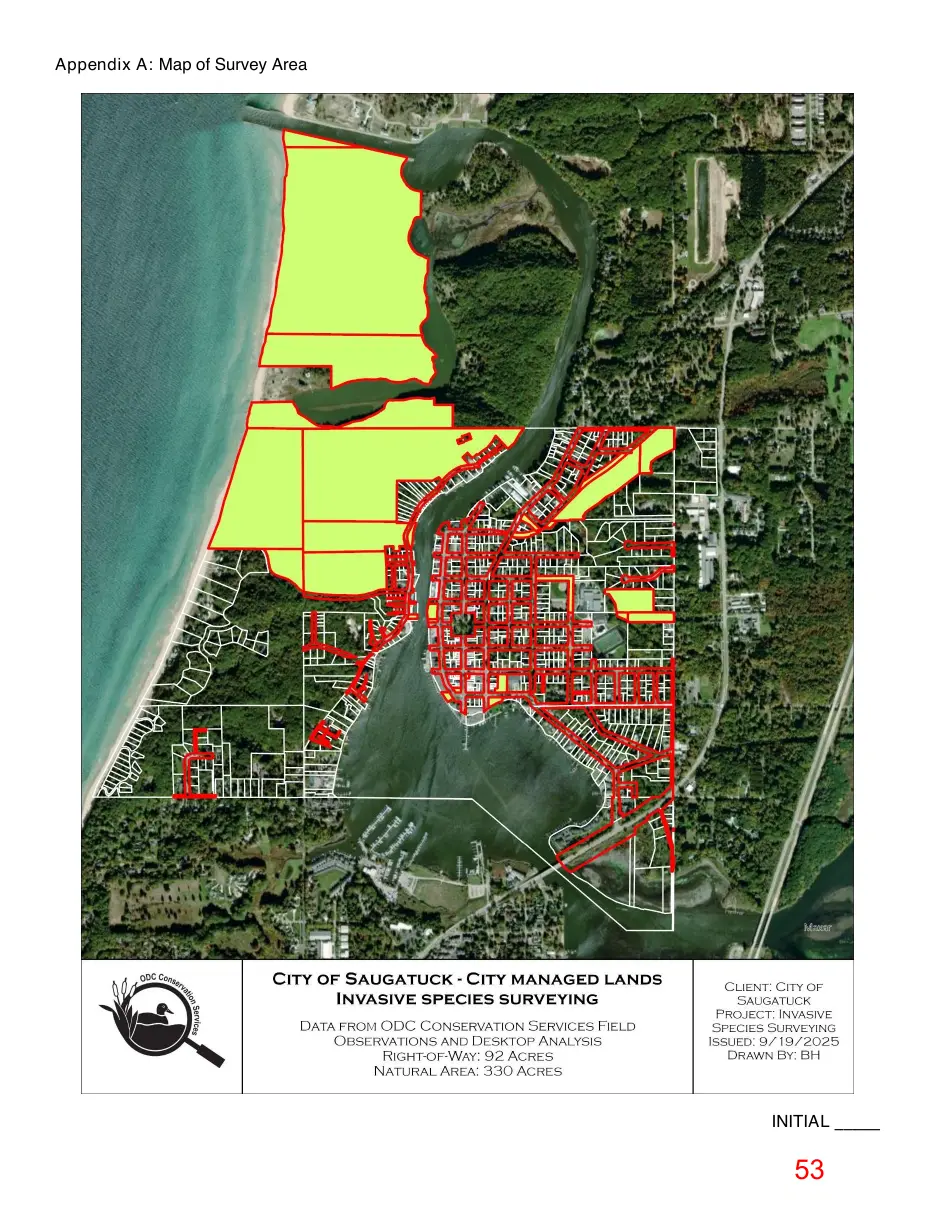
Text of page 53
Appendix A: Map of Survey Area
INITIAL _____
Page 54
This page is a scanned image with no text layer. The PDF of these pages has it at full resolution.
Page 55
Text of page 55
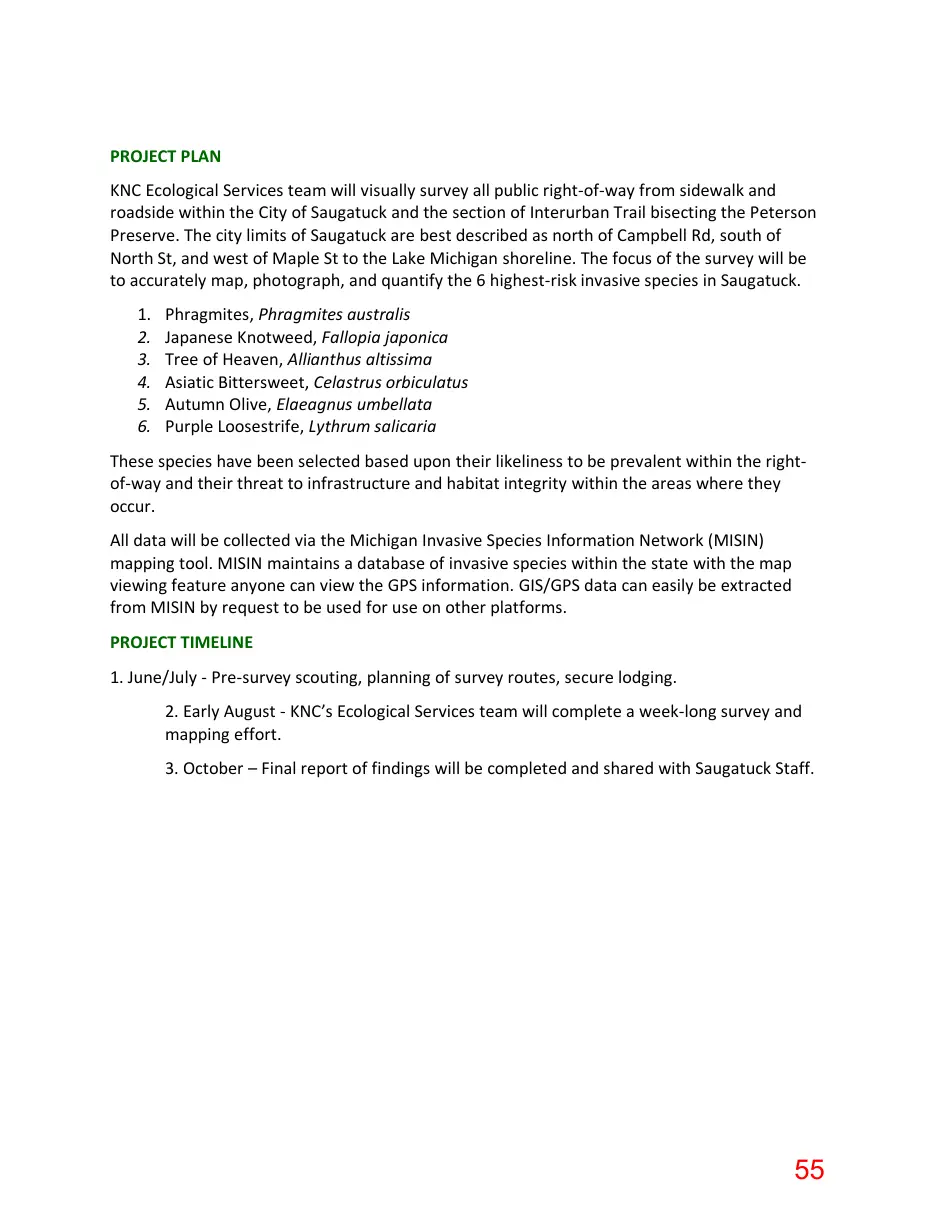
PROJECT PLAN KNC Ecological Services team will visually survey all public right-of-way from sidewalk and roadside within the City of Saugatuck and the section of Interurban Trail bisecting the Peterson Preserve. The city limits of Saugatuck are best described as north of Campbell Rd, south of North St, and west of Maple St to the Lake Michigan shoreline. The focus of the survey will be to accurately map, photograph, and quantify the 6 highest-risk invasive species in Saugatuck. 1. 2. 3. 4. 5. 6.
Phragmites, Phragmites australis Japanese Knotweed, Fallopia japonica Tree of Heaven, Allianthus altissima Asiatic Bittersweet, Celastrus orbiculatus Autumn Olive, Elaeagnus umbellata Purple Loosestrife, Lythrum salicaria
These species have been selected based upon their likeliness to be prevalent within the rightof-way and their threat to infrastructure and habitat integrity within the areas where they occur. All data will be collected via the Michigan Invasive Species Information Network (MISIN) mapping tool. MISIN maintains a database of invasive species within the state with the map viewing feature anyone can view the GPS information. GIS/GPS data can easily be extracted from MISIN by request to be used for use on other platforms. PROJECT TIMELINE 1. June/July - Pre-survey scouting, planning of survey routes, secure lodging. 2. Early August - KNC’s Ecological Services team will complete a week-long survey and mapping effort. 3. October – Final report of findings will be completed and shared with Saugatuck Staff.
Page 56
This page is a scanned image with no text layer. The PDF of these pages has it at full resolution.
Page 57
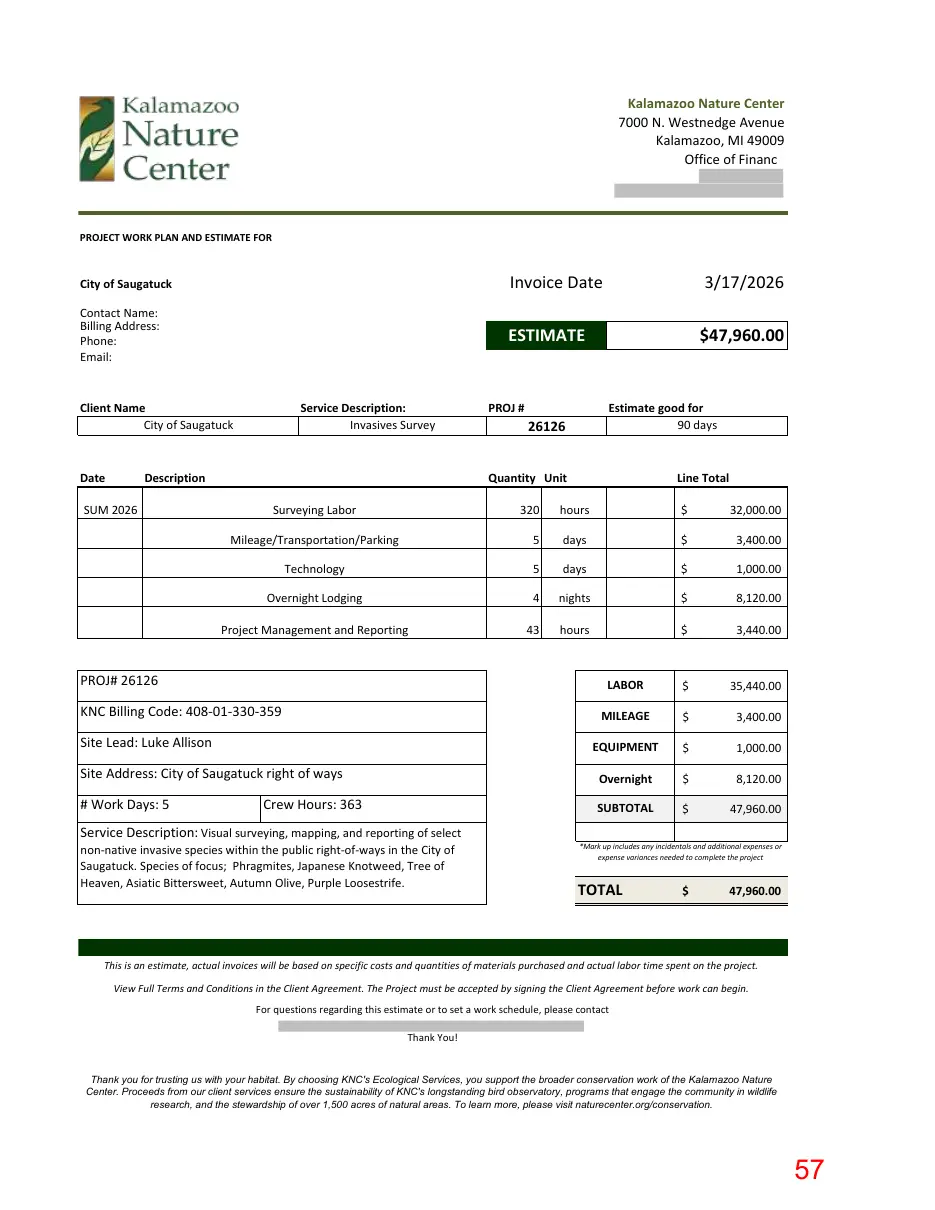
Text of page 57
Kalamazoo Nature Center 7000 N. Westnedge Avenue Kalamazoo, MI 49009 Office of Financ
PROJECT WORK PLAN AND ESTIMATE FOR
City of Saugatuck
Invoice Date
3/17/2026
Contact Name: Billing Address: Phone: Email:
ESTIMATE
$47,960.00
Client Name City of Saugatuck
Date
Service Description: Invasives Survey
Description
SUM 2026
PROJ #
Estimate good for 90 days
26126 Quantity Unit
Line Total
Surveying Labor
hours
32,000.00
Mileage/Transportation/Parking
days
3,400.00
Technology
days
1,000.00
Overnight Lodging
nights
8,120.00
Project Management and Reporting
hours
3,440.00
PROJ# 26126
LABOR
35,440.00
KNC Billing Code: 408-01-330-359
MILEAGE
3,400.00
Site Lead: Luke Allison
EQUIPMENT
1,000.00
Site Address: City of Saugatuck right of ways
Overnight
8,120.00
# Work Days: 5
SUBTOTAL
47,960.00
Crew Hours: 363
Service Description: Visual surveying, mapping, and reporting of select non-native invasive species within the public right-of-ways in the City of Saugatuck. Species of focus; Phragmites, Japanese Knotweed, Tree of Heaven, Asiatic Bittersweet, Autumn Olive, Purple Loosestrife.
*Mark up includes any incidentals and additional expenses or expense variances needed to complete the project
TOTAL
47,960.00
This is an estimate, actual invoices will be based on specific costs and quantities of materials purchased and actual labor time spent on the project. View Full Terms and Conditions in the Client Agreement. The Project must be accepted by signing the Client Agreement before work can begin. For questions regarding this estimate or to set a work schedule, please contact Thank You!
Thank you for trusting us with your habitat. By choosing KNC's Ecological Services, you support the broader conservation work of the Kalamazoo Nature Center. Proceeds from our client services ensure the sustainability of KNC's longstanding bird observatory, programs that engage the community in wildlife research, and the stewardship of over 1,500 acres of natural areas. To learn more, please visit naturecenter.org/conservation.
Page 58
This page is a scanned image with no text layer. The PDF of these pages has it at full resolution.
Page 59
This page is a scanned image with no text layer. The PDF of these pages has it at full resolution.
Page 60
This page is a scanned image with no text layer. The PDF of these pages has it at full resolution.
Page 61
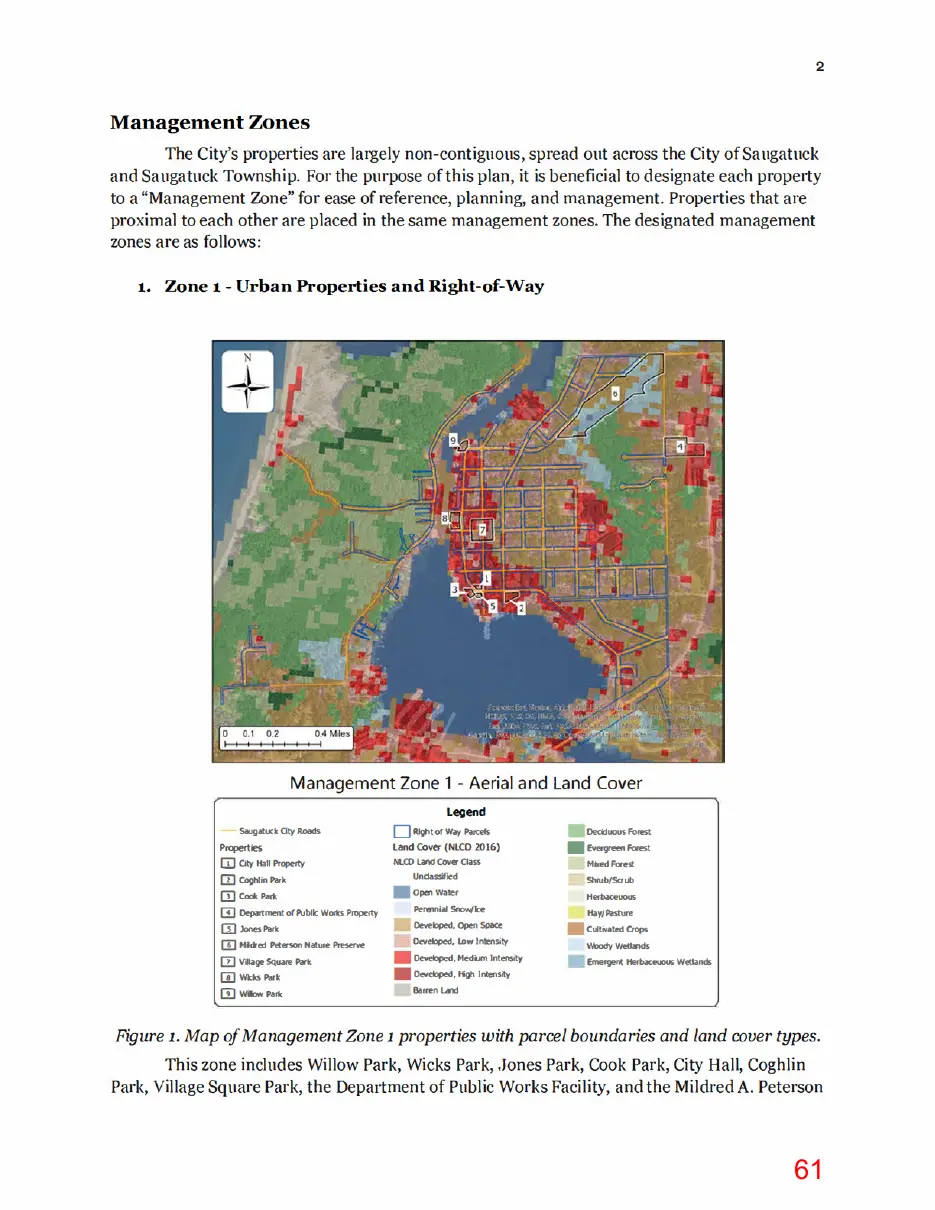
This page is a scanned image with no text layer. The PDF of these pages has it at full resolution.
Page 62
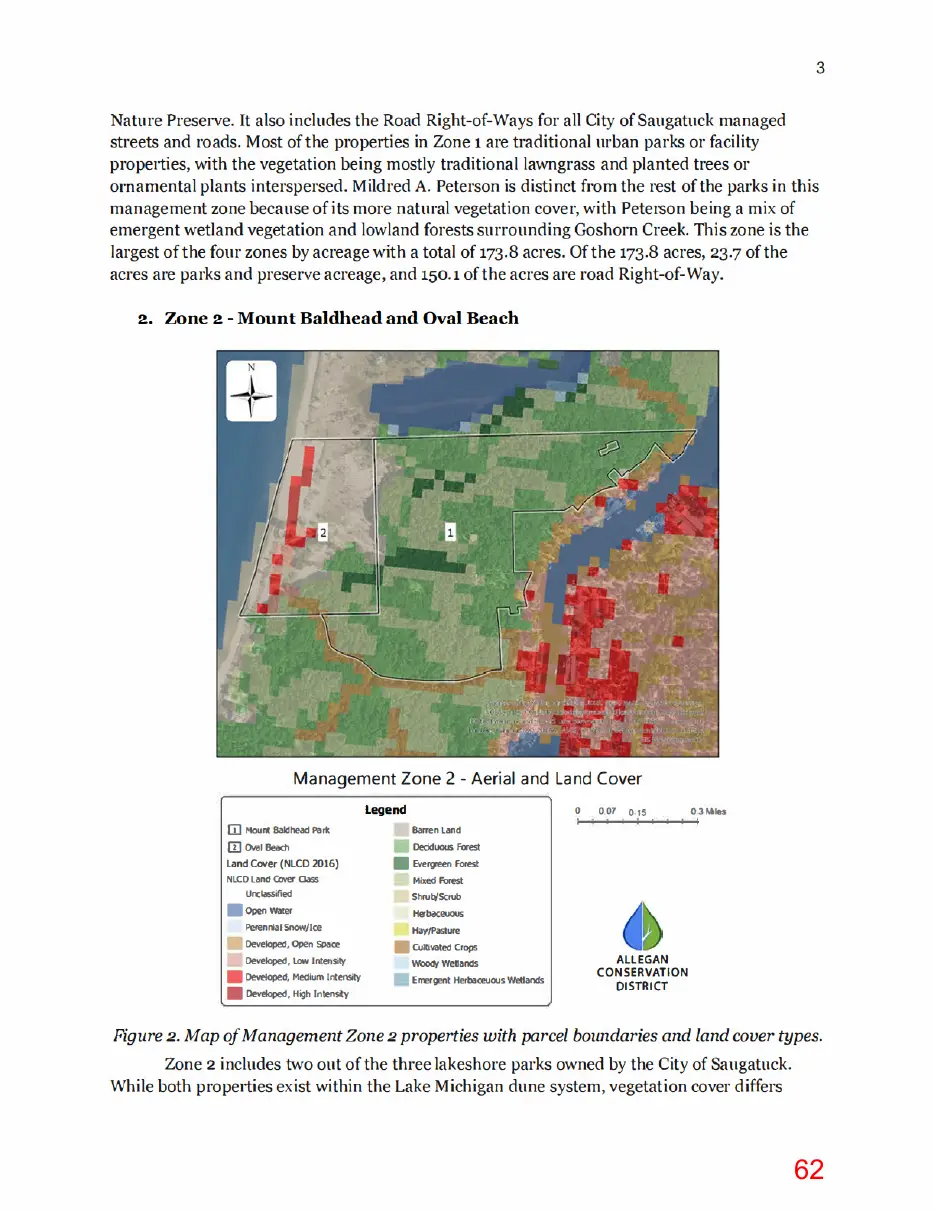
This page is a scanned image with no text layer. The PDF of these pages has it at full resolution.
Page 63
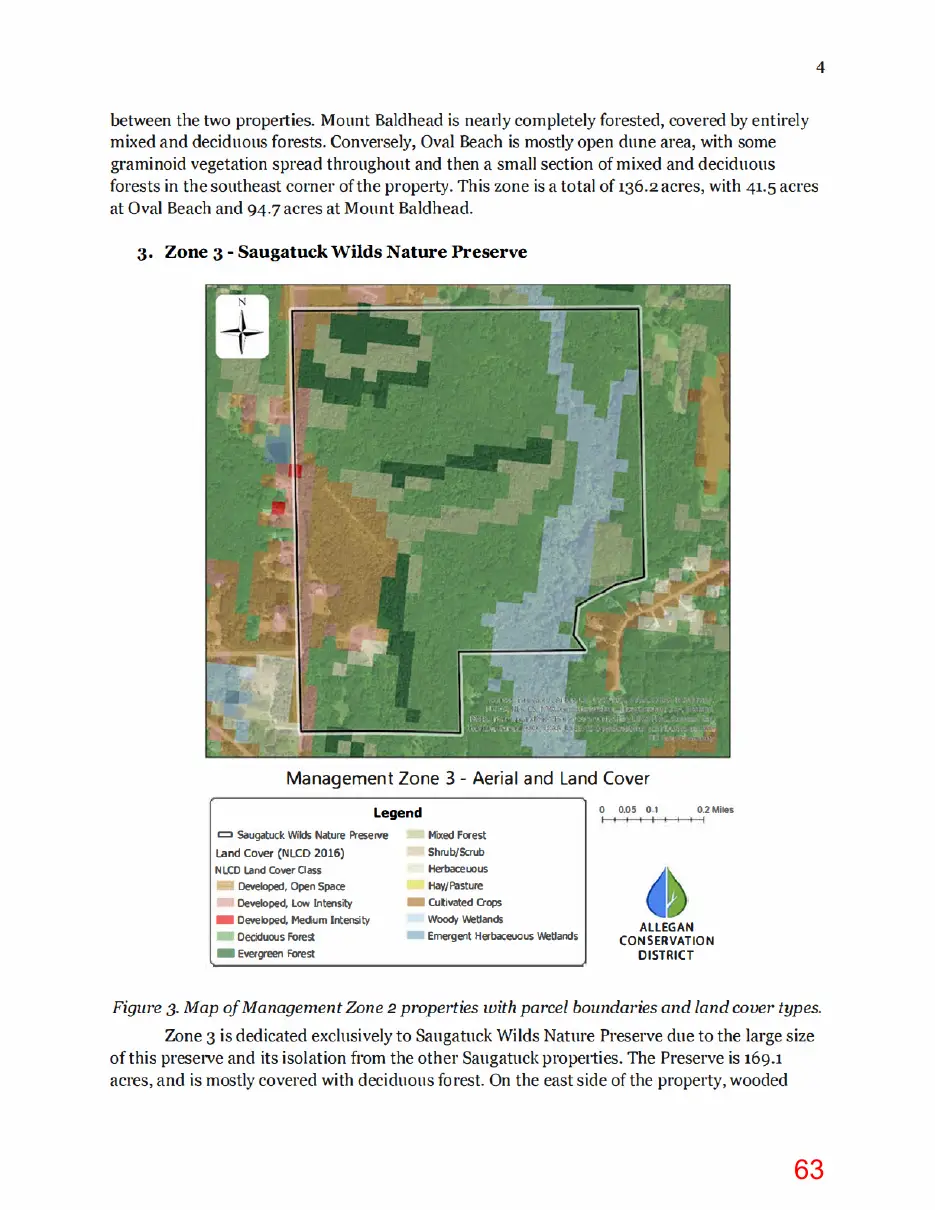
This page is a scanned image with no text layer. The PDF of these pages has it at full resolution.
Page 64
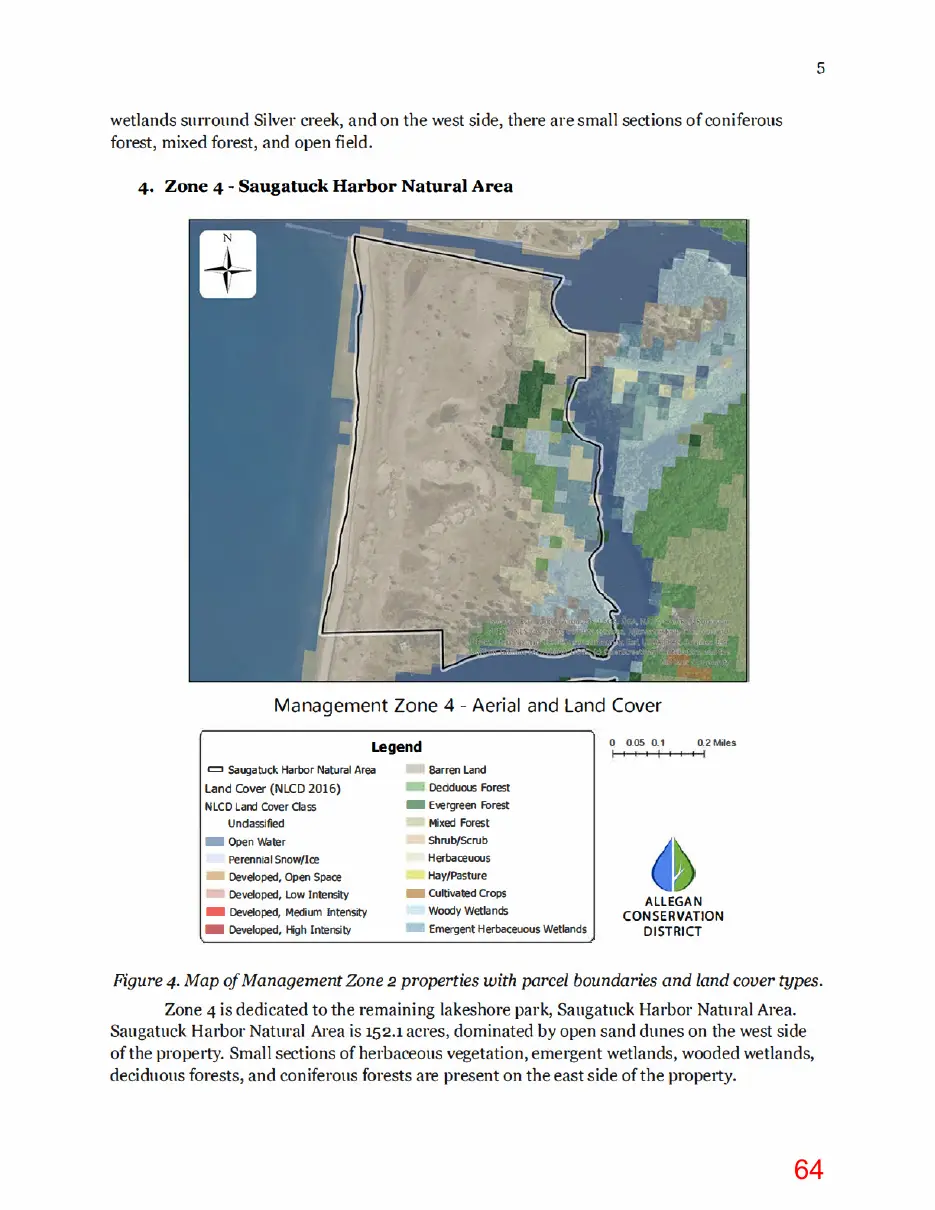
This page is a scanned image with no text layer. The PDF of these pages has it at full resolution.
Page 65
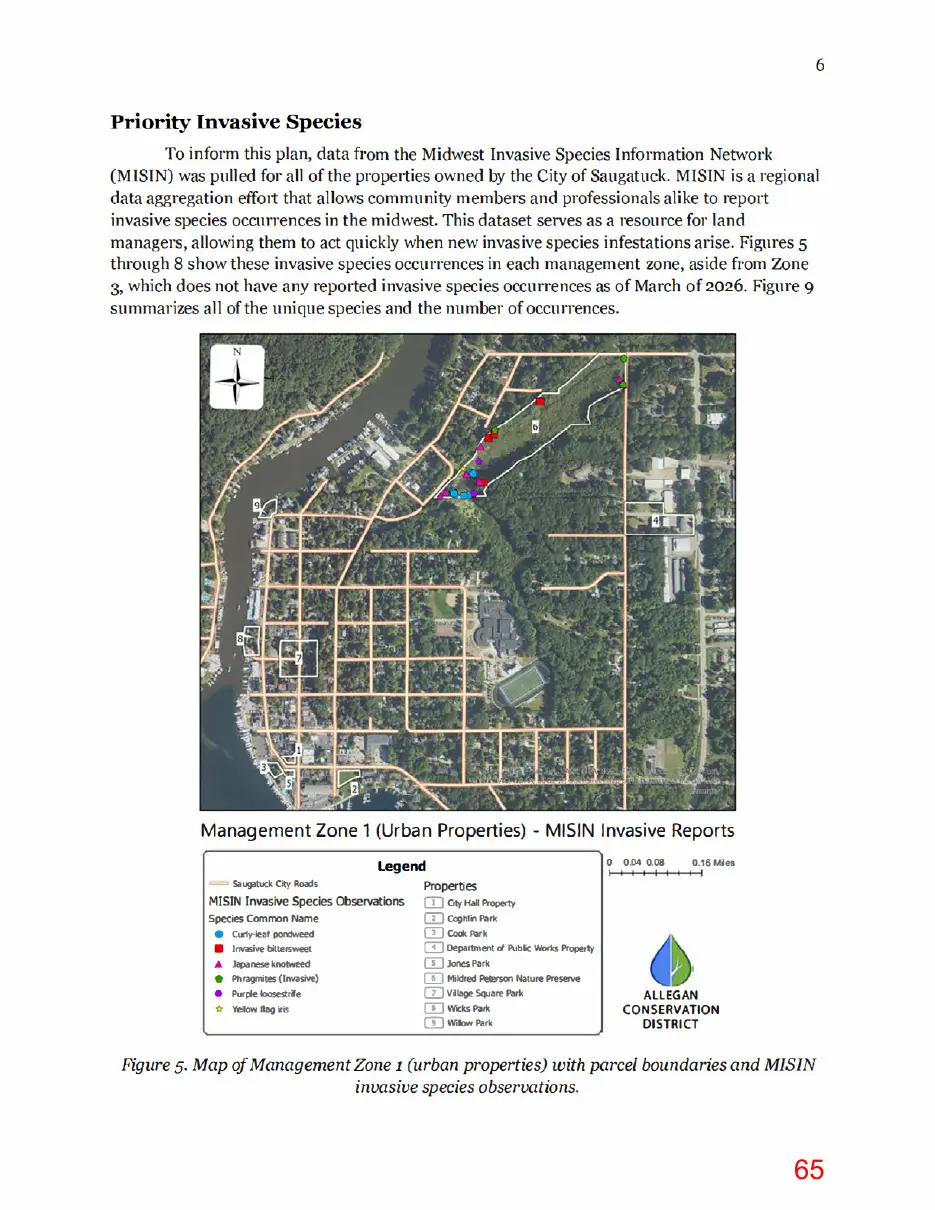
This page is a scanned image with no text layer. The PDF of these pages has it at full resolution.
Page 66
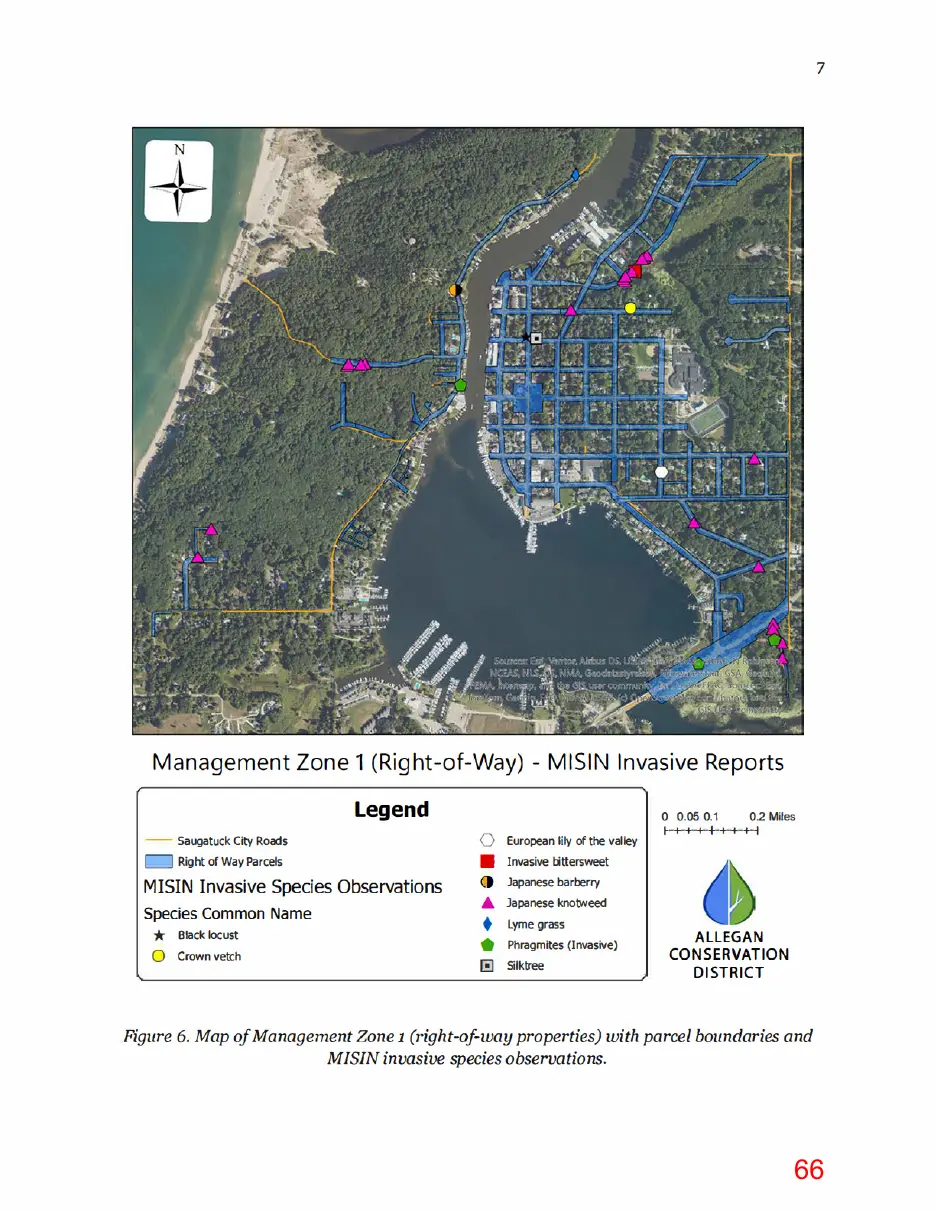
This page is a scanned image with no text layer. The PDF of these pages has it at full resolution.
Page 67
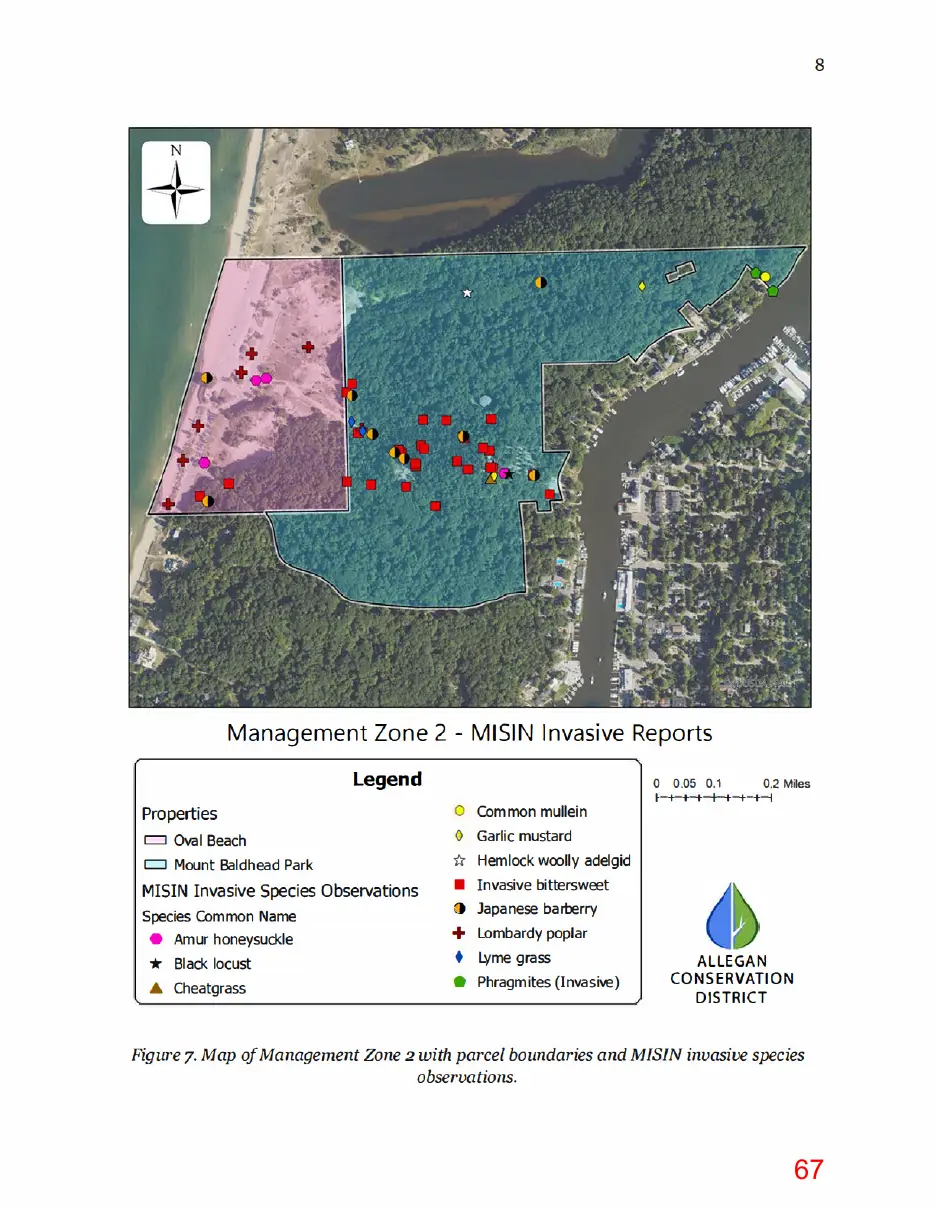
This page is a scanned image with no text layer. The PDF of these pages has it at full resolution.
Page 68
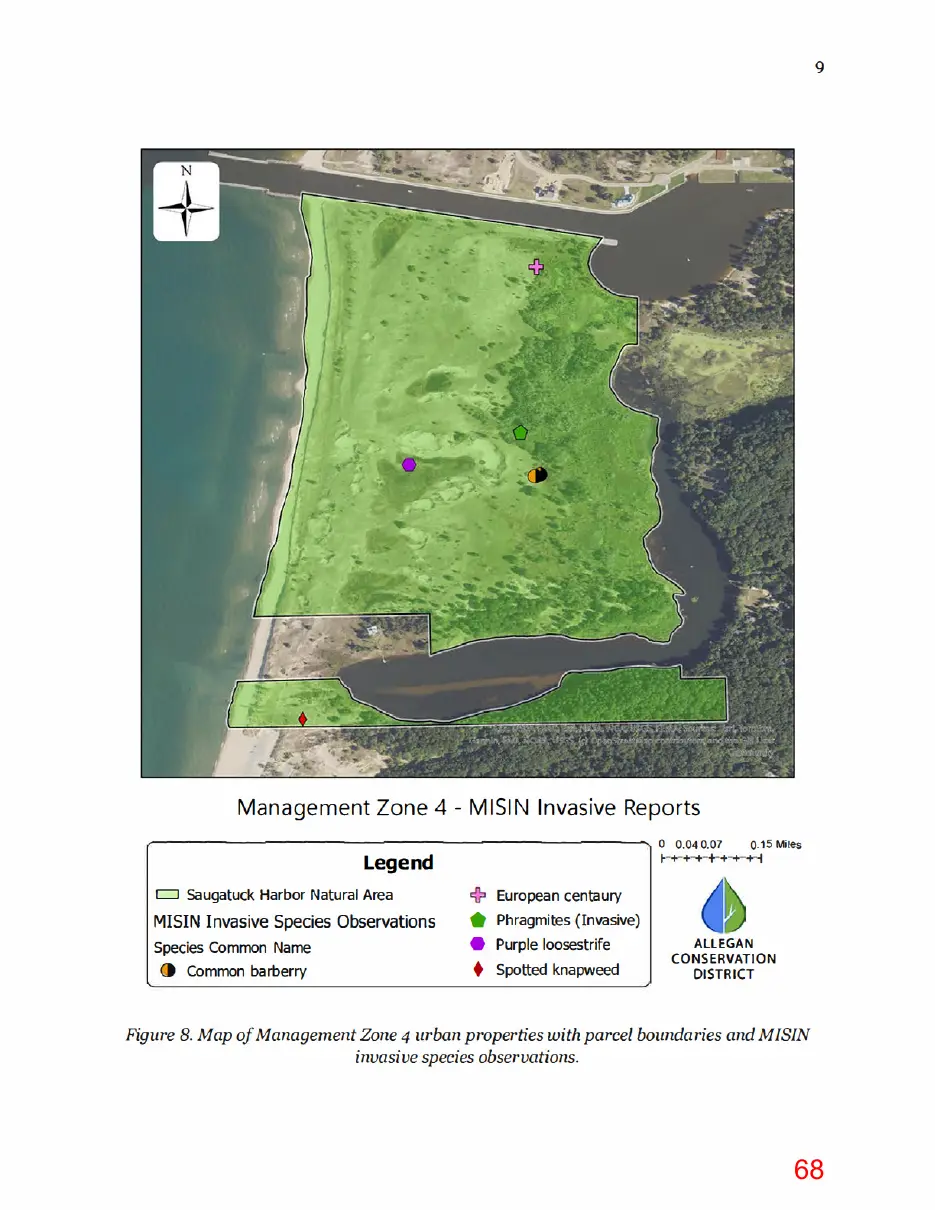
This page is a scanned image with no text layer. The PDF of these pages has it at full resolution.
Page 69
Text of page 69
1-,"ll••'':ll1T:J
1r.iiF.,at
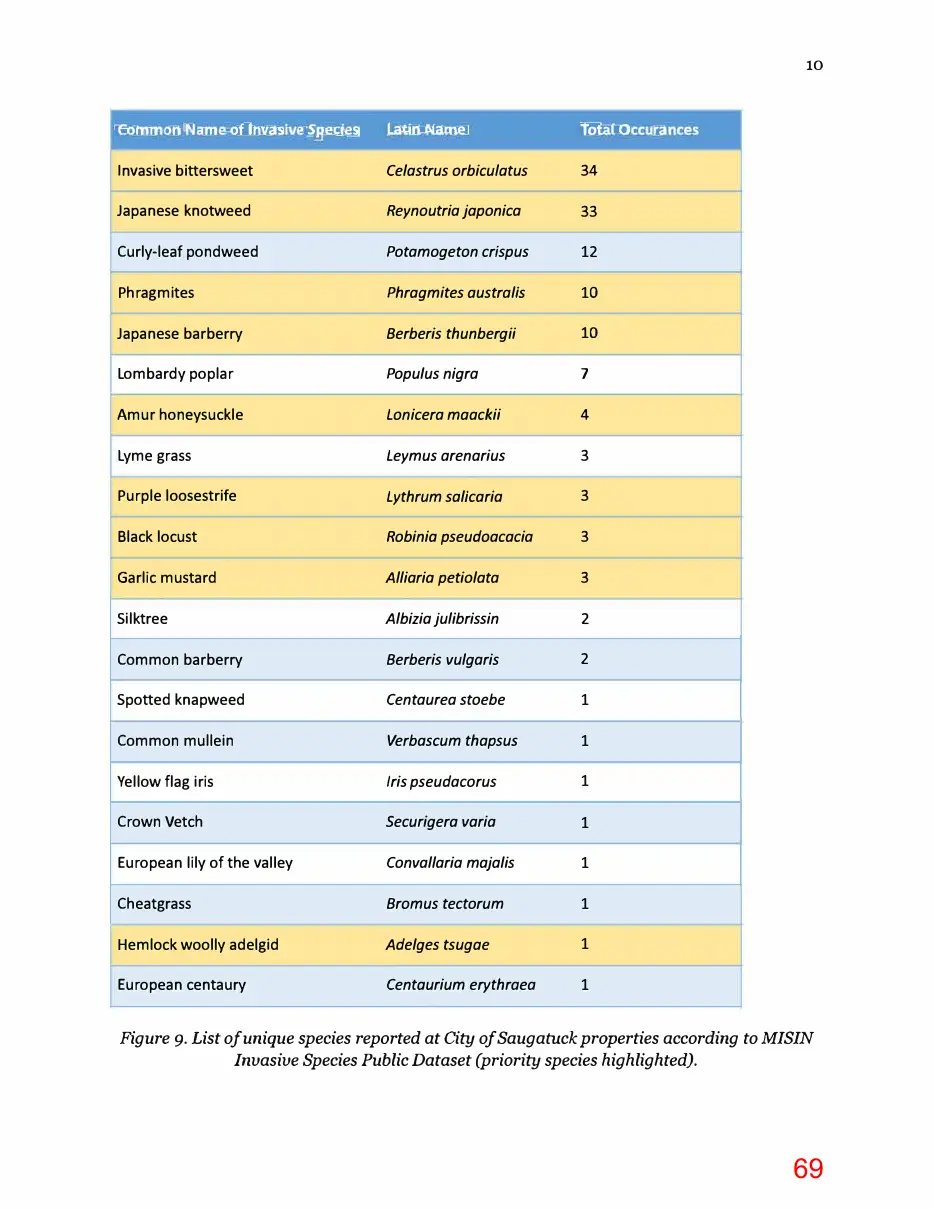
Invasive bittersweet
Celastrus orbiculatus
Japanese knotweed
Reynoutria japonica
Curly-leaf pondweed
Potamogeton crispus
Phrag mites
Phragmites australis
Japanese barberry
Berberis thunbergii
Lombardy poplar
Populus nigra
Amur honeysuckle
Lonicera maackii
Lyme grass
Leymus arenarius
Purple loosestrife
Lythrum salicaria
Black locust
Robinia pseudoacacia
Garlic mustard
Alliaria petiolata
Silktree
Albizia julibrissin
Common barberry
Berberis vulgaris
Spotted knapweed
Centaurea stoebe
Common mullein
Verbascum thapsus
Yellow flag iris
Iris pseudacorus
Crown Vetch
Securigera varia
European lily of the valley
Convallaria majalis
Cheatgrass
Bromus tectorum
Hemlock woolly adelgid
Adelges tsugae
European centaury
Centaurium erythraea
l•tll 11■ Ill ,.-. •■■■ •---11,llll'I': ..
• 1�_:1:.t."-1.!+
Figure 9. List ofunique species reported at City ofSaugatuck properties according to MISIN Invasive Species Public Dataset (priority species highlighted).
Page 70
Text of page 70
The most frequent species in the MISIN dataset are Invasive bittersweet with 34 reports, followed by Japanese knotweed with 33 reports, Curly-leaf pondweed with 12 reports, Phragmites with 10 reports, and Japanese barberry with 10 reports. An important note is that the MISIN dataset is not conclusive, and likely does not include all species present or all occurrences due to it being an observance-based, community-science dataset. An example of this is that there are no reports of Japanese barberry, Phragmites, Black locust, or Hemlock woolly adelgid at Saugatuck Harbor Natural Area, but according to the Land Conservancy of West Michigan's Management Recommendation Document (October 2024), there are small populations of these species at Saugatuck Harbor. Treating all of the species present across all of the City's properties would be a very costly and time consuming endeavor. Instead, it is best to select specific priority species to focus surveying and removal efforts on. The recommended priority species are as follows: Invasive bittersweet (Celastrus orbiculatus) Japanese knotweed (Reynoutriajaponica) 3. Phragmites (Phragmites australis) 4. Japanese barberry (Berberis thunbergii) 5. Honeysuckle species (Lonicera spp.) 6. Purple loosestrife (Lythrum salicaria) 7. Black locust (Robinia pseudoacacia) 8. Garlic mustard (Alliaria petiolata) 9. Cinnamon vine (Dioscorea polystachya) (Watch List Species) 10. Hemlock woolly adelgid (Adelges tsugae) (Watch List Species) 1.
The priority species were selected based on the number of reports in the MISIN dataset and their ability to spread across differing properties and ecosystems. For example, Curly-leaf pondweed is not a priority species for the purposes of this plan, despite it having a high amount of reports, because it only occurs at one of the properties (Mildred A. Peterson Preserve) and does not have the ability to easily spread across the other properties due to it being a strictly aquatic species. Curly-leaf pondweed should not be ignored, but due to its aquatic nature and connectivity with the Kalamazoo River, management will require a concerted effort among riparians which is outside the scope of this document. The last two priority species, Cinnamon vine and Hemlock woolly adelgid, were selected because they are listed on the Michigan Invasive Species Watch List. Watch List species are invasive species that pose significant risk to Michigan's economy, environment, and/or human health, but either do not exist in the wild yet or have a limited distribution in Michigan. While there are no reports of Cinnamon vine at City properties as of March of 2026, there are confirmed observations nearby dating back to 2016, according to the Michigan Invasive Species Watch List Viewer. Surveying for Cinnamon vine on Saugatuck properties will allow for swift removal action if there are any populations discovered, thereby preventing establishment of this species before it becomes an economical and environmental threat. While there is only 1 report of Hemlock woolly adelgid (HWA) at City of Saugatuck properties in the MISIN dataset, Hemlock wooly adelgid has numerous, confirmed infestations across Saugatuck. The ODC Network conducted an extensive HWA inventory in 2023 on all of the Eastern hemlocks (Tsuga canadensis) at Saugatuck Harbor Natural Area, Oval Beach and
Page 71
Text of page 71
Mount Baldhead at the request of Allegan Conservation District. Over 4,000 trees were checked for HWA, and it was found that a large majority of these trees did have HWA present and were subsequently treated. Monitoring these tree populations will be important for tracking the effectiveness of treatment efforts and determining when follow-up treatment is appropriate.
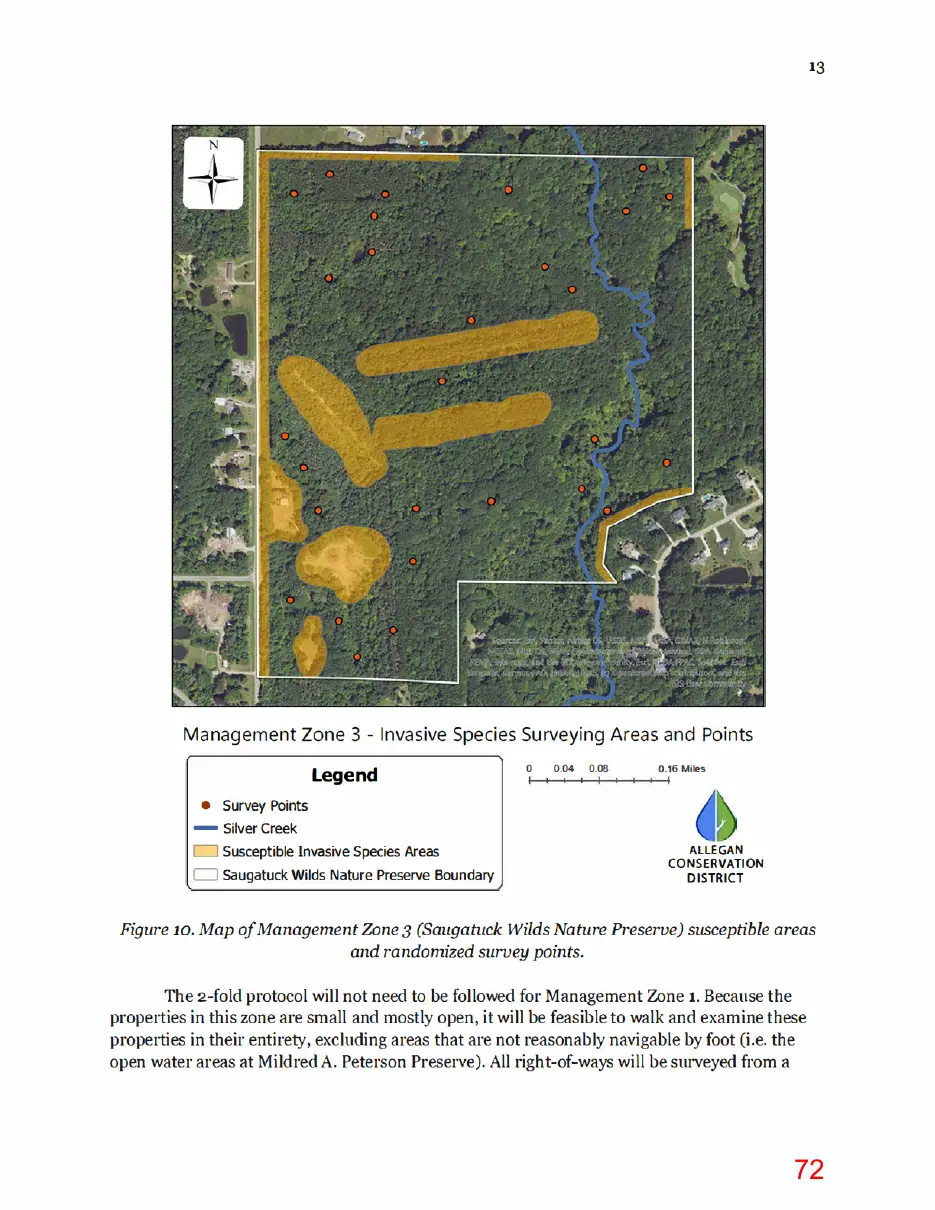
Invasive Species Surveying Invasive species surveying will be conducted by Allegan Conservation District staff at City of Saugatuck properties during 2026-2027 across Management Zone 1, 2 and 3. Surveying protocol for plant priority species differs from surveying protocol for Hemlock woolly adelgid, so these processes have been separated in the sections that follow. Management Zone 4 (Saugatuck Harbor Natural Area) will not receive surveying from ACD as treatment and surveying work is already planned to be conducted by ODC Network in that Zone. Maps of Zone 4 included in this plan are solely for reference and treatment planning. Protocol - Plant Priority Species Surveying for all of the plant priority species in Management Zones 2 and 3 will be done using a two-fold surveying protocol-detailed survey of susceptible areas and spot survey of the remainder. Susceptible areas are those where invasive species are more likely to occur based on land use history or human activity, including roadsides, trail areas, previously cultivated or developed lands, utility right-of-ways, field edges, hedgerows, and evergreen stands or plantations. Additionally, susceptible areas will be surveyed with a buffer of 50 feet. If, for example, a property has an old field that is surrounded by forest, the old field will be surveyed in its entirety, as well as 50 feet into the surrounding forest. Road sides will be surveyed from the road edge to 50 feet away from the road edge on either side. The remainder of each parcel will be surveyed through randomized sampling points generated using GIS software at a rate of one sampling point per six acres. ACD staff will travel to each of these points and record any of the plant priority invasive species they see at each point, as well as the phenology, density, area covered, and any other useful information. This data will be recorded with a geospatial data collection app and recorded as points and/or polygons. Figure 8 shows an example map of this surveying protocol.
Page 72
This page is a scanned image with no text layer. The PDF of these pages has it at full resolution.
Page 73
Text of page 73
14 vehicle, with stops made as needed to verify species identifications. Data will be collected using a geospatial data app in the same manner as for Zones 2 and 3. Decontaminating clothing and footwear will be important to avoid inadvertently spreading any invasive species seeds or material during the surveying process. ACD staff will examine their boots and clothing for any seeds or seed containing material (ie. dirt in the tread of boots) before leaving the ACD office for a surveying day, and before leaving each surveying site. Staff will use boot brushes and water to clean off all surfaces of boots or footwear before beginning surveying and before leaving each site. Staff will also wash all clothing worn in invasive species areas directly after completing surveying for the day.
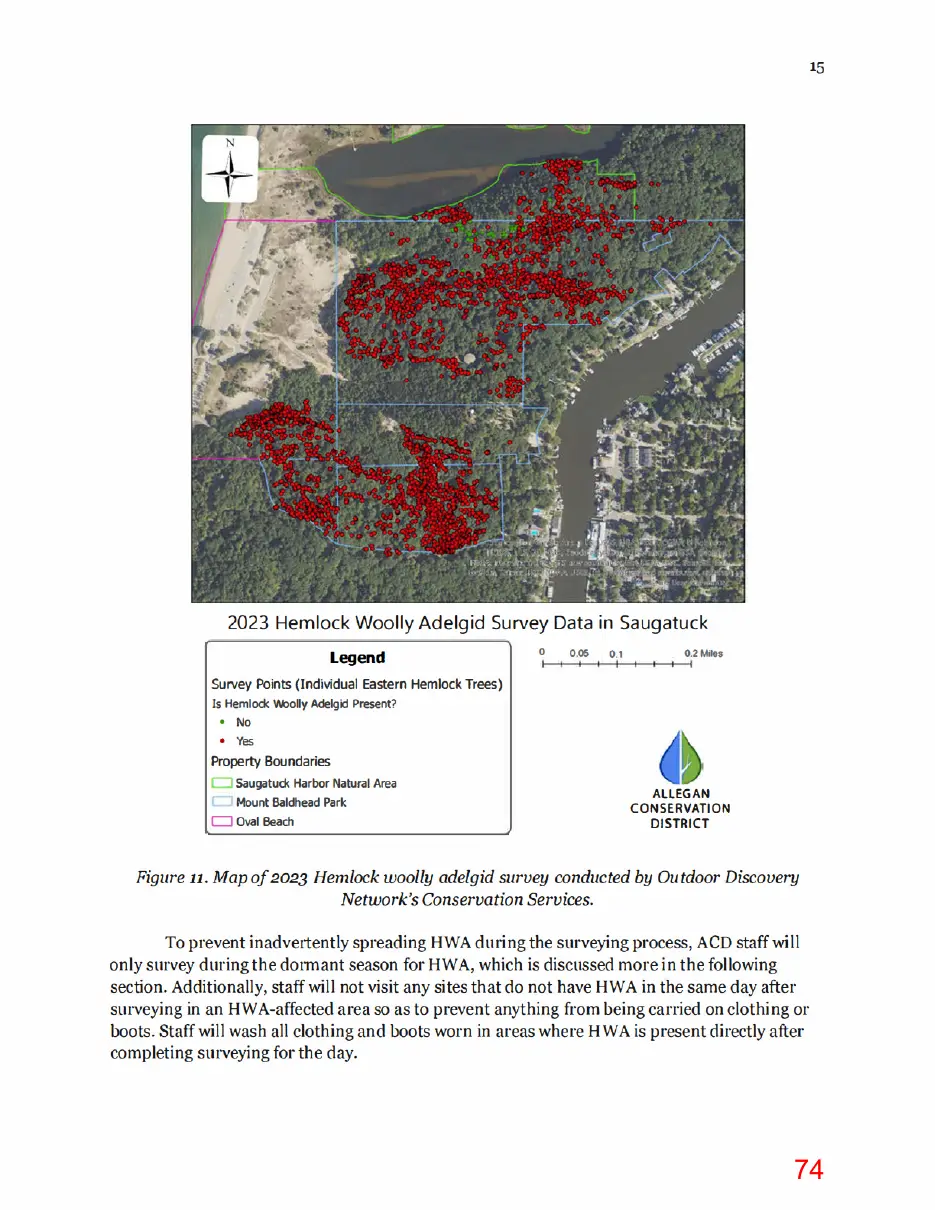
Protocol - Hemlock Woolly Adelgid Hemlock woolly adelgid (HWA) will require a slightly different surveying method relative to the other priority species in this plan. The ODC Network's survey in 2023 was extensive and covered every single Eastern hemlock tree occurring at Mount Baldhead and the surrounding areas. Instead of repeating this previous inventory, it will be best to randomly sample these populations of trees to assess their health following insecticide treatments done in 2023. Within the areas of the three properties that have hemlocks, sampling points will be generated in a similar manner as in the plant species procedure. However, the rate of sampling points will be higher, with one point generated per three acres. Each sampling point will have a buffer circle with a 25 foot radius around it. ACD staff will check all of the hemlock trees within that buffer, recording if each tree has HWA present, the tree tag number if available, latitude and longitude, percentage crown density, and DBH (diameter at breast height). Below, figure 11 shows the datapoints of the 2023 survey conducted by ODC, and is included for reference.
Page 74
This page is a scanned image with no text layer. The PDF of these pages has it at full resolution.
Page 75
Text of page 75
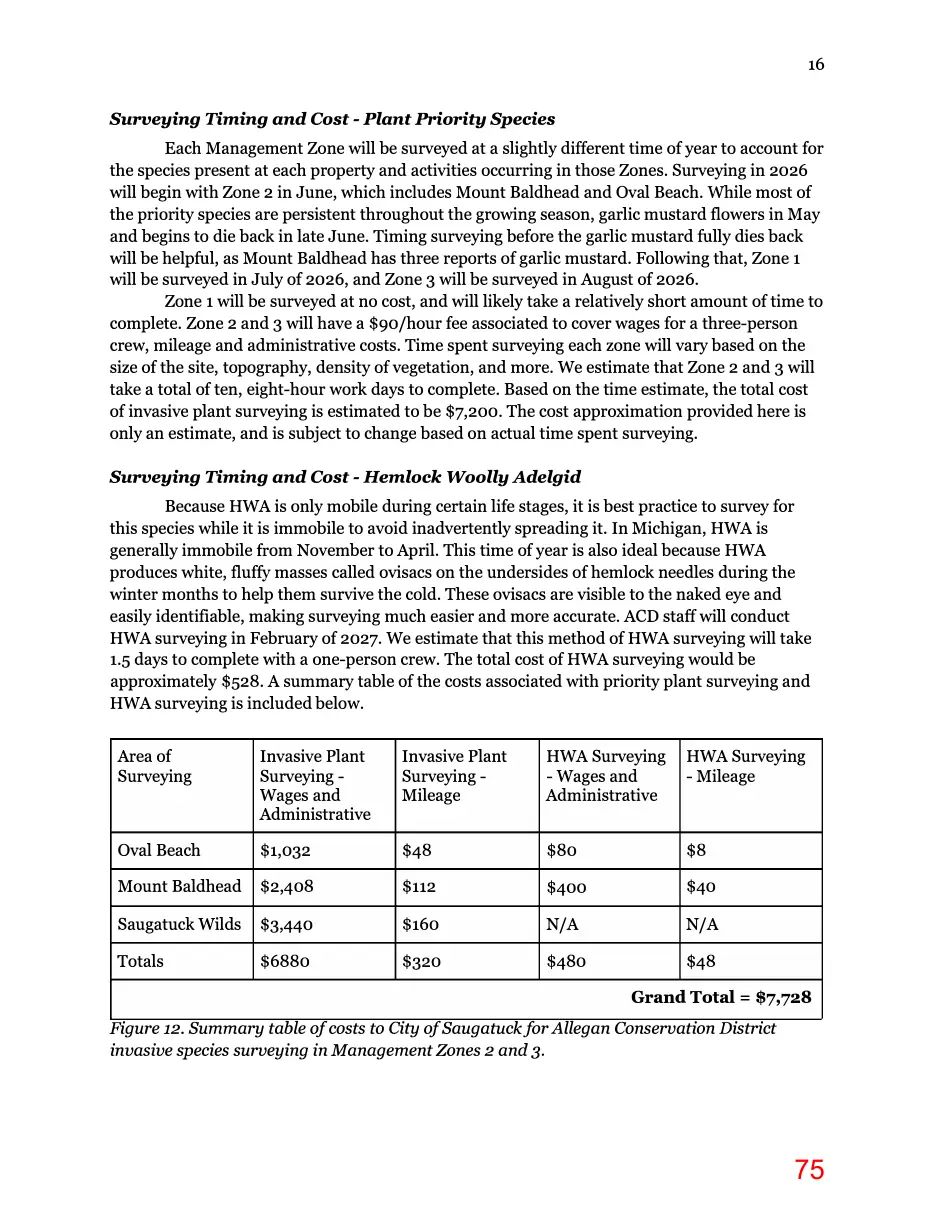
Surveying Ti.ming and Cost - Plant Priority Species EachManagement Zone will be surveyed at a slightly different time of year to account for the species present at each property and activities occurring in those Zones. Surveying in 2026 will begin with Zone 2 in June, which includesMount Baldhead and Oval Beach. While most of the priority species are persistent throughout the growing season, garlic mustard flowers inMay and begins to die back in late June. Timing surveying before the garlic mustard fully dies back will be helpful, asMount Baldhead has three reports of garlic mustard. Following that, Zone 1 will be surveyed in July of 2026, and Zone 3 will be surveyed in August of 2026. Zone 1 will be surveyed at no cost, and will likely take a relatively short amount of time to complete. Zone 2 and 3 will have a $90/hour fee associated to cover wages for a three-person crew, mileage and administrative costs. Time spent surveying each zone will vary based on the size of the site, topography, density of vegetation, and more.We estimate that Zone 2 and 3 will take a total of ten, eight-hour work days to complete. Based on the time estimate, the total cost of invasive plant surveying is estimated to be $7,200. The cost approximation provided here is only an estimate, and is subject to change based on actual time spent surveying. Surveying Ti.ming and Cost - Hemlock Woolly Adelgid Because HWA is only mobile during certain life stages, it is best practice to survey for this species while it is immobile to avoid inadvertently spreading it. InMichigan, HWA is generally immobile from November to April. This time of year is also ideal because HWA produces white, fluffy masses called ovisacs on the undersides of hemlock needles during the winter months to help them survive the cold. These ovisacs are visible to the naked eye and easily identifiable, making surveying much easier and more accurate. ACD staff will conduct HWA surveying in February of 2027.We estimate that this method of HWA surveying will take 1.5 days to complete with a one-person crew. The total cost of HWA surveying would be approximately $528. A summary table of the costs associated with priority plant surveying and HWA surveying is included below. Area of Surveying
Invasive Plant Surveying Wages and Administrative
Invasive Plant Surveying Mileage
HWA Surveying -Wages and Administrative
HWA Surveying -Mileage
Oval Beach
$1,032
$48
$80
Mount Baldhead
$2,408
$112
$400
$40
SaugatuckWilds
$3,440
$160
N/A
N/A
Totals
$6880
$320
$480
$48 Grand Total= $7,728
Figure 12. Summary table of costs to City of Saugatuck for Allegan Conservation District invasive species surveying in Management Zones 2 and 3.
Page 76
Text of page 76
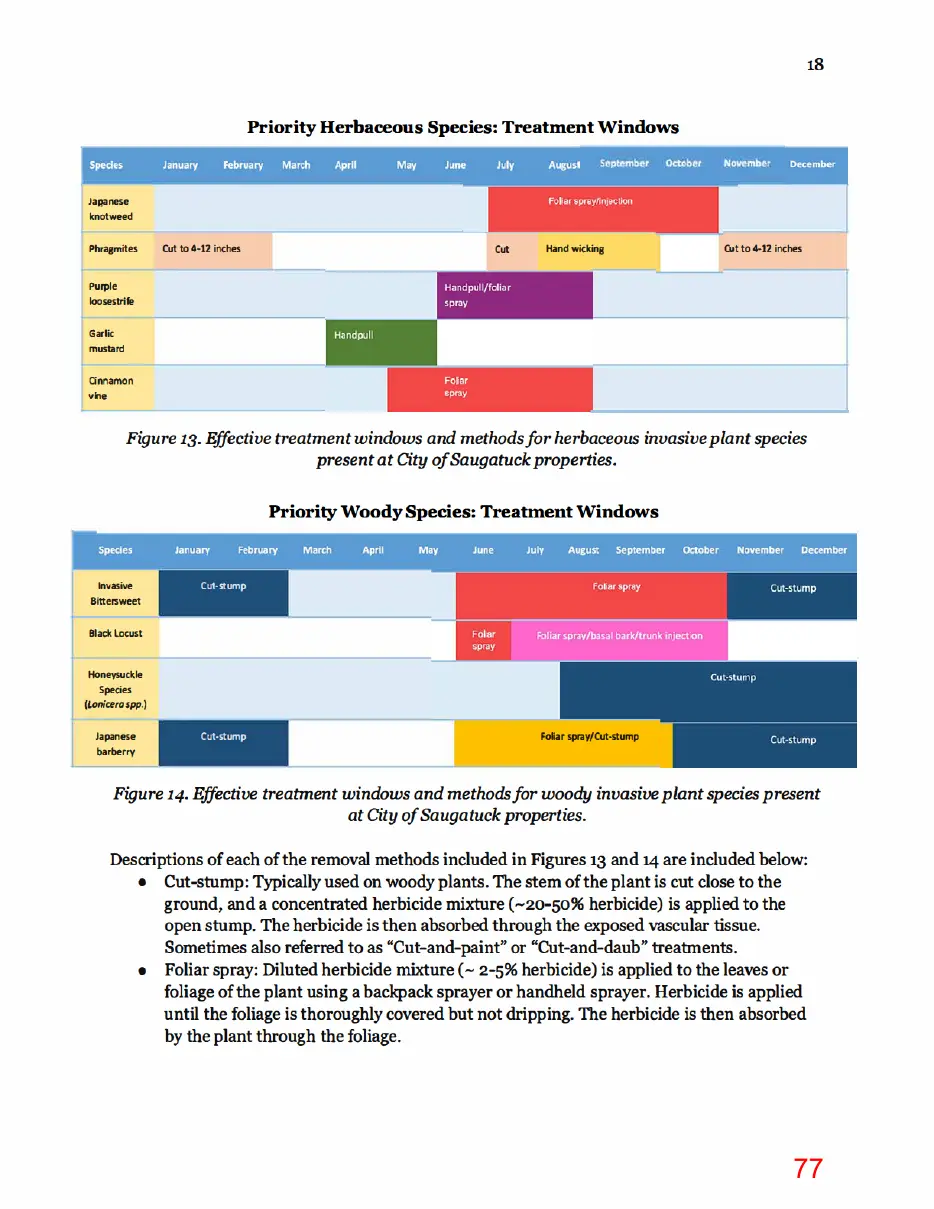
Management Schedule For the next four to five years, beginning in 2026, invasive plant species populations will need to be treated at least once a year, if not more. During the first few years of invasive plant species treatment, it is imperative that each property is re-treated consistently each year, as invasive species infestations are very rarely eradicated after just one treatment or even after one year of multiple treatments. After the first four to five years of treatment, each property should be assessed for relative invasive presence, and treatment action can be shifted accordingly. If eradication seems to be achieved by the end of year four or five, treatment can cease and be replaced by yearly monitoring at the treatment areas to ensure there is no resurgence of invasives. After 3 years of yearly monitoring, if no priority species have returned, yearly monitoring of past treatment sites may cease. Each property should still be re-surveyed in full every three to five years to identify any new infestations that may arise. However, if eradication is not achieved by the end of year five, yearly treatment must continue until eradication is achieved. While yearly treatment on all priority species will be the most effective and timely way to eradicate invasive species at City properties, budget or other material resources may be a limiting factor. Should this be the case, efforts should be prioritized to areas that are most likely to be damaged. Priority areas typically include high quality or sensitive habitats, trail areas where it is more likely that park users could accidentally transport invasive seeds, and areas where invasive species are negatively affecting infrastructure or wildlife habitat. Area prioritization will depend heavily on the specific goals that the City has for each of their properties. For example, in a park built for human use and recreation, it is best to focus on instances of species that damage infrastructure such as Japanese knotweed near concrete or buildings, and species that impact human health such as Japanese barberry, which has sharp thorns and is a preferred habitat for ticks. Conversely, in a wildlife area or nature preserve, it's important to focus on removal of invasive species that negatively affect wildlife habitat, such as hemlock woolly adelgid. Prioritizing this way allows land managers to make the most of limited resources. Prioritization recommendations made by Allegan Conservation District will be influenced in the future by the findings made during surveying in 2026 and 2027. Treatment methods and timing vary based on species due to differences in their biology and lifecycle. Figures 13 and 14 summarize the effective treatment windows and recommended treatment methods by each species. The treatment methods and windows included here are not strict rules, but rather a general guideline to follow when planning treatment for various properties and coordinating treatments of multiple invasive species at once.
Page 77
This page is a scanned image with no text layer. The PDF of these pages has it at full resolution.
Page 78
Text of page 78
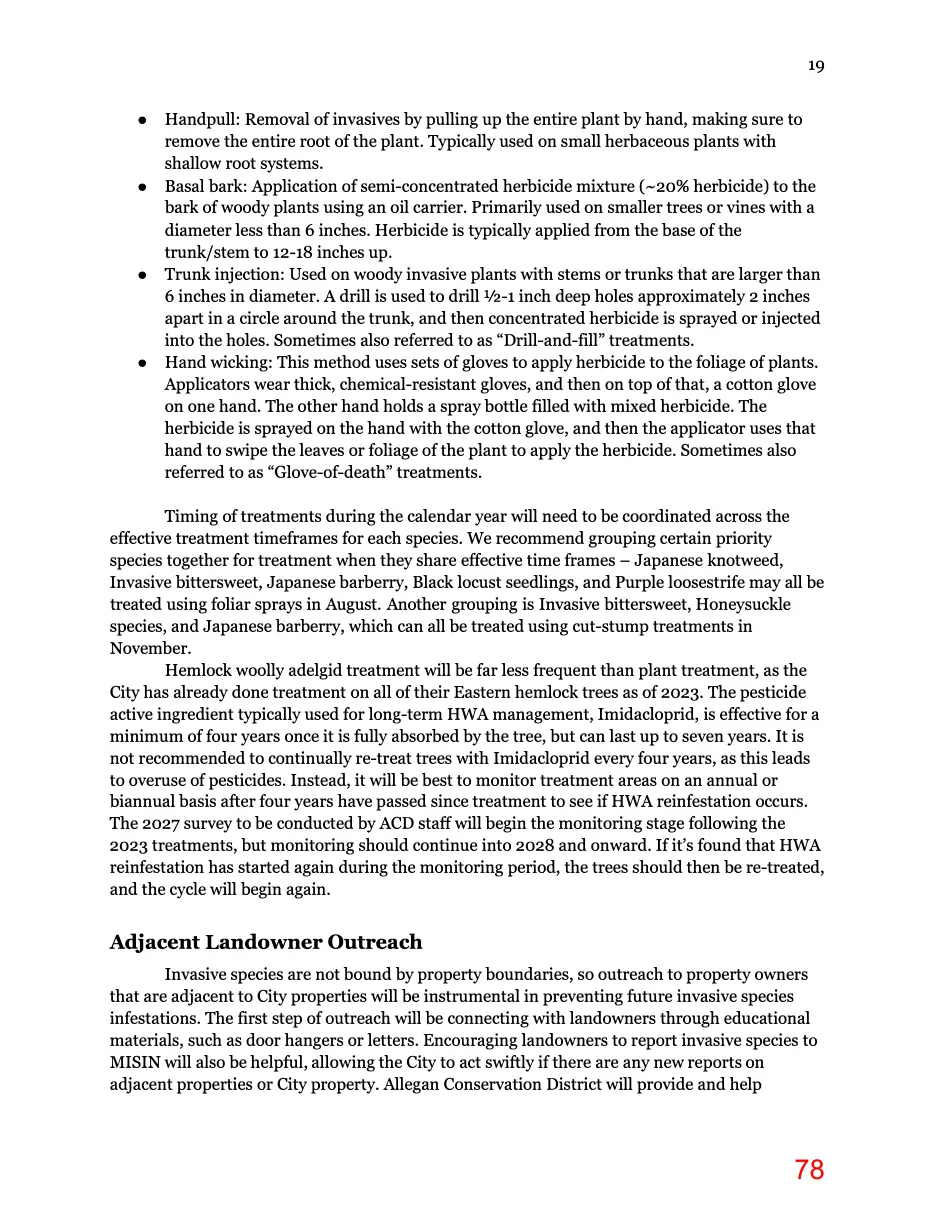
Handpull: Removal of invasives by pulling up the entire plant by hand, making sure to remove the entire root of the plant. Typically used on small herbaceous plants with shallow root systems. • Basal bark: Application of semi-concentrated herbicide mixture (~20% herbicide) to the bark of woody plants using an oil carrier. Primarily used on smaller trees or vines with a diameter less than 6 inches. Herbicide is typically applied from the base of the trunk/stem to 12-18 inches up. • Trunk injection: Used on woody invasive plants with stems or trunks that are larger than 6 inches in diameter. A drill is used to drill ½-1 inch deep holes approximately 2 inches apart in a circle around the trunk, and then concentrated herbicide is sprayed or injected into the holes. Sometimes also referred to as "Drill-and-fill" treatments. • Hand wicking: This method uses sets of gloves to apply herbicide to the foliage of plants. Applicators wear thick, chemical-resistant gloves, and then on top of that, a cotton glove on one hand. The other hand holds a spray bottle filled with mixed herbicide. The herbicide is sprayed on the hand with the cotton glove, and then the applicator uses that hand to swipe the leaves or foliage of the plant to apply the herbicide. Sometimes also referred to as "Glove-of-death" treatments. Timing of treatments during the calendar year will need to be coordinated across the effective treatment timeframes for each species. We recommend grouping certain priority species together for treatment when they share effective time frames - Japanese knotweed, Invasive bittersweet, Japanese barberry, Black locust seedlings, and Purple loosestrife may all be treated using foliar sprays in August. Another grouping is Invasive bittersweet, Honeysuckle species, and Japanese barberry, which can all be treated using cut-stump treatments in November. Hemlock woolly adelgid treatment will be far less frequent than plant treatment, as the City has already done treatment on all of their Eastern hemlock trees as of 2023. The pesticide active ingredient typically used for long-term HWA management, Imidacloprid, is effective for a minimum of four years once it is fully absorbed by the tree, but can last up to seven years. It is not recommended to continually re-treat trees with Imidacloprid every four years, as this leads to overuse of pesticides. Instead, it will be best to monitor treatment areas on an annual or biannual basis after four years have passed since treatment to see if HWA reinfestation occurs. The 2027 survey to be conducted by ACD staff will begin the monitoring stage following the 2023 treatments, but monitoring should continue into 2028 and onward. If it's found that HWA reinfestation has started again during the monitoring period, the trees should then be re-treated, and the cycle will begin again.
Adjacent Landowner Outreach Invasive species are not bound by property boundaries, so outreach to property owners that are adjacent to City properties will be instrumental in preventing future invasive species infestations. The first step of outreach will be connecting with landowners through educational materials, such as door hangers or letters. Encouraging landowners to report invasive species to MISIN will also be helpful, allowing the City to act swiftly if there are any new reports on adjacent properties or City property. Allegan Conservation District will provide and help
Page 79
Text of page 79
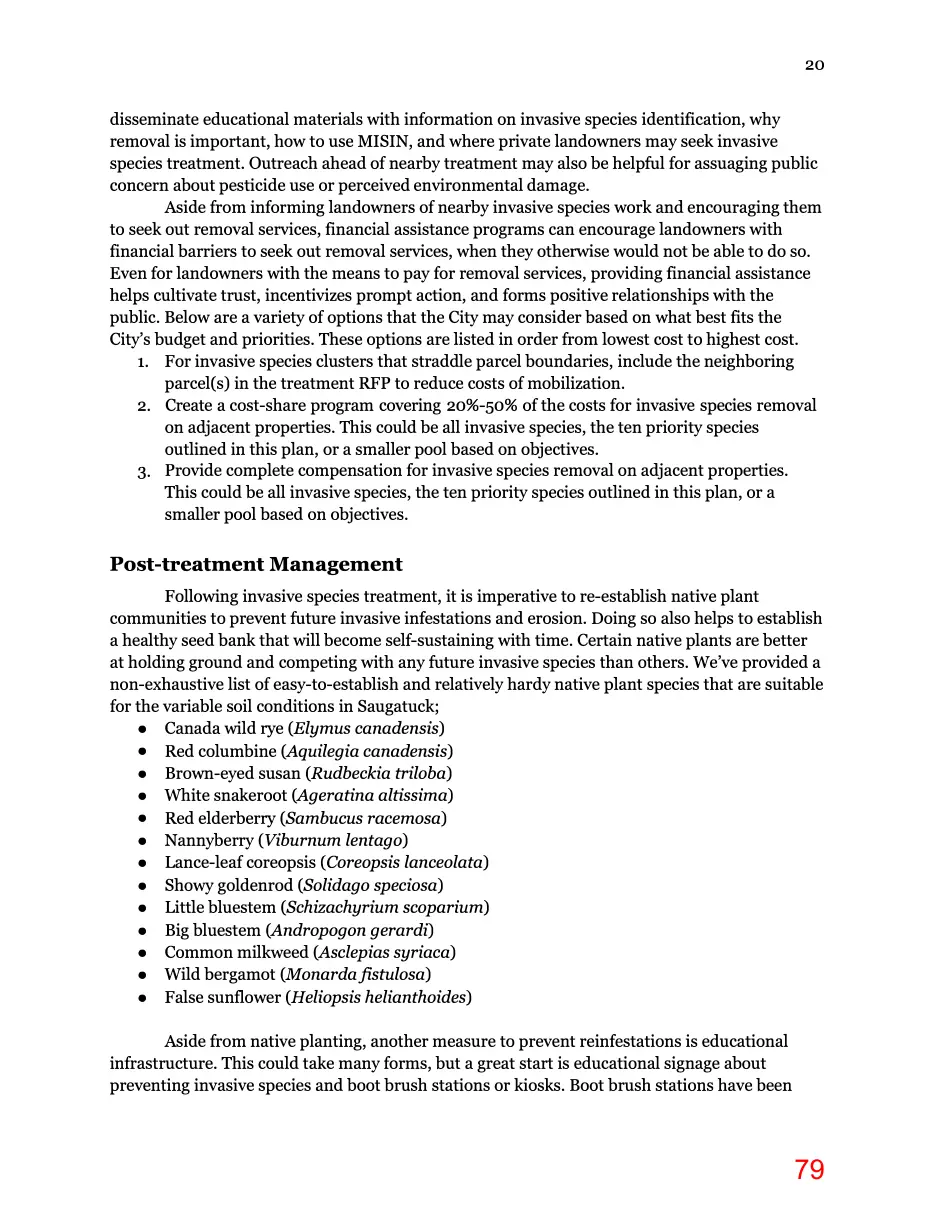
disseminate educational materials with information on invasive species identification, why removal is important, how to use MISIN, and where private landowners may seek invasive species treatment. Outreach ahead of nearby treatment may also be helpful for assuaging public concern about pesticide use or perceived environmental damage. Aside from informing landowners of nearby invasive species work and encouraging them to seek out removal services, financial assistance programs can encourage landowners with financial barriers to seek out removal services, when they otherwise would not be able to do so. Even for landowners with the means to pay for removal services, providing financial assistance helps cultivate trust, incentivizes prompt action, and forms positive relationships with the public. Below are a variety of options that the City may consider based on what best fits the City's budget and priorities. These options are listed in order from lowest cost to highest cost. 1. For invasive species clusters that straddle parcel boundaries, include the neighboring parcel(s) in the treatment RFP to reduce costs of mobilization. 2. Create a cost-share program covering 20%-50% of the costs for invasive species removal on adjacent properties. This could be all invasive species, the ten priority species outlined in this plan, or a smaller pool based on objectives. 3. Provide complete compensation for invasive species removal on adjacent properties. This could be all invasive species, the ten priority species outlined in this plan, or a smaller pool based on objectives.
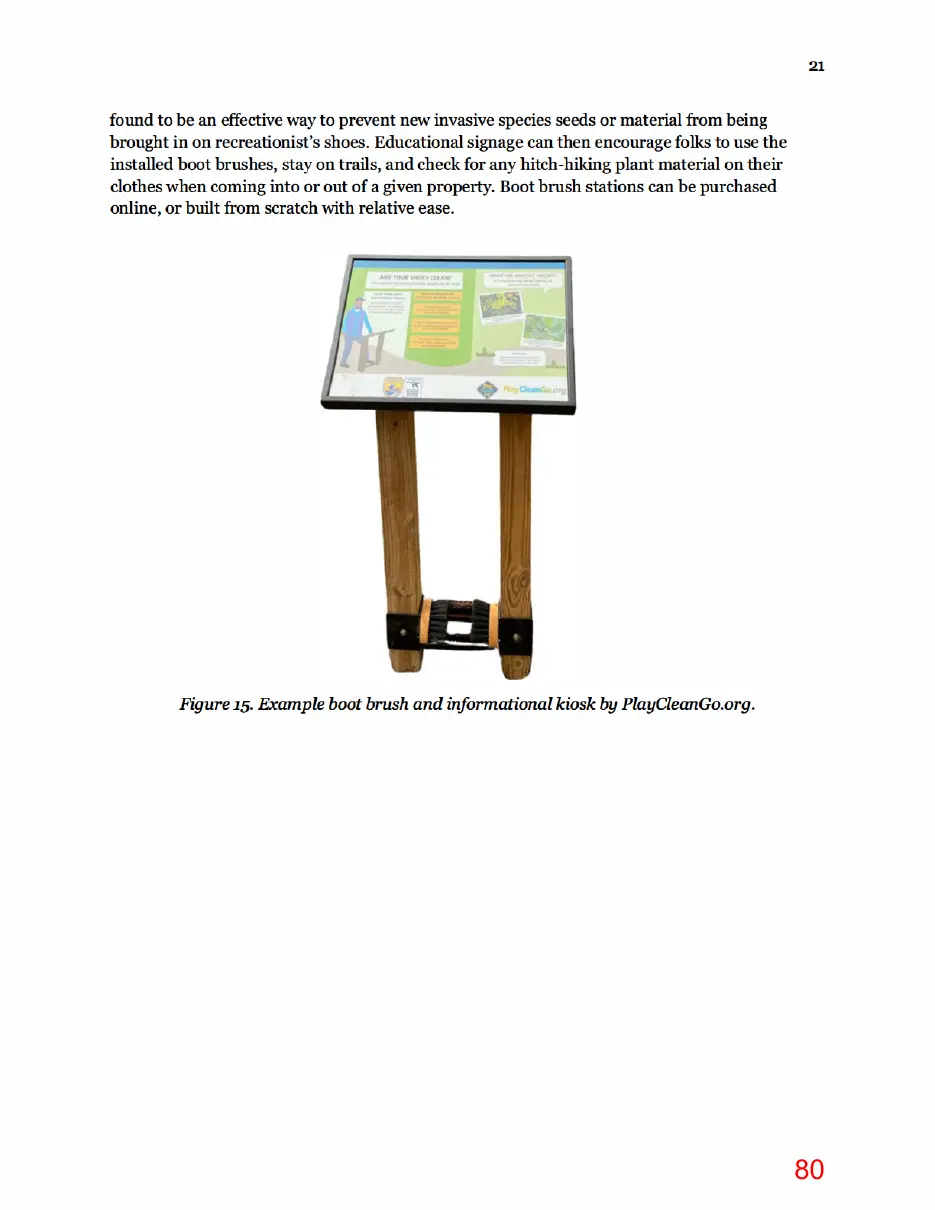
Post-treatment Management Following invasive species treatment, it is imperative to re-establish native plant communities to prevent future invasive infestations and erosion. Doing so also helps to establish a healthy seed bank that will become self-sustaining with time. Certain native plants are better at holding ground and competing with any future invasive species than others. We've provided a non-exhaustive list of easy-to-establish and relatively hardy native plant species that are suitable for the variable soil conditions in Saugatuck; • Canada wild rye (Elymus canadensis) • Red columbine (Aquilegia canadensis) • Brown-eyed susan (Rudbeckia triloba) • White snakeroot (Ageratina altissima) • Red elderberry (Sambucus racemosa) • Nannyberry (Viburnum lentago) • Lance-leaf coreopsis (Coreopsis lanceolata) • Showy goldenrod (Solidago speciosa) • Little bluestem (Schizachyrium scoparium) • Big bluestem (Andropogon gerard1) • Common milkweed (Asclepias syriaca) • Wild bergamot (Monardafistulosa) • False sunflower (Heliopsis helianthoides) Aside from native planting, another measure to prevent reinfestations is educational infrastructure. This could take many forms, but a great start is educational signage about preventing invasive species and boot brush stations or kiosks. Boot brush stations have been
Page 80
This page is a scanned image with no text layer. The PDF of these pages has it at full resolution.