
Council Agenda item 14C
Updated Policy on Ethical Standards of Conduct. (Roll Call)
City Council, Monday, February 10, 2025
Download these 11 pages, 1.2 MB Whole packet, 197 pages, 19.1 MB
Page 129
Text of page 129
City Council Agenda Item Report FROM:
Ryan Cummins, City Manager
MEETING DATE:
February 10, 2025
SUBJECT:
Updated Policy on Ethical Standards of Conduct
DESCRIPTION: In September, Council held a workshop and asked for City Attorney Mills to conduct further review of the ethics policy. City Attorney Mills conducted further review and Council discussed changes to the policy at the January 8 and February 5 workshops. Attached is the updated policy with the consensus changes from the last workshop. The changes are highlighted, but appear in Part A(2), the title of Part B, Part B(1), and the introductory sentence and section (b) of Part (B)(3). BUDGET ACTION: None at this time. LEGAL REVIEW: Legal reviewed, prepared recommended and requested changes, and will be at your meeting to answer questions. SAMPLE MOTION: Motion to approve the updated policy on ethical standards of conduct.
Page 130
Text of page 130
CITY OF SAUGATUCK COUNTY OF ALLEGAN STATE OF MICHIGAN
POLICY ON ETHICAL STANDARDS OF CONDUCT PART A - ETHICAL STANDARDS 1. The citizens of Saugatuck have entrusted our elected and appointed officials and employees with the good stewardship of their local government. In return, as we carry out our City responsibilities, we pledge to conduct ourselves so as always to justify and merit that trust. 2. This policy is not designed to address general performance concerns or questions. Rather, it is focused on the expectation that our City officials and employees shall act with fairness, integrity, impartiality, professionalism, and obedience to the law, as they carry out their City responsibilities and service to public interest. 3. We expect the highest ethical conduct as a matter of course, not merely because there are laws or rules mandating it. All citizens of the City are entitled to high ethical conduct in their local government, and Council members, appointed officials and City employees shall always act to honor that expectation. 4. Some examples of the high standards of ethical conduct we require of all elected and appointed officials and City employees are the following: (a) Our primary role as an elected or appointed official or employee is to serve the public interests. (b) We may not use our official positions to gain an advantage or preference that we would not otherwise be entitled to. (c) We may not solicit or accept a gift of value offered or given for the purpose of influencing a vote, decision or other City action. (d) We may not disclose public records or information that we receive in confidence in the performance of our City duties, except when authorized to do so and in compliance with the law. (e) We may not vote upon or take other action with respect to a matter as to which we have a conflict of interest, as defined and determined by law. Council members and appointed officials shall disclose such conflicts, and act accordingly, in the manner required by law. (f) We may not use City property for personal purposes except as authorized for such use on an incidental or emergency basis under current City policies or established practice. (g) We may not use confidential City information or records for the purpose of personal financial advantage, whether in a business transaction or to enable others to profit or gain competitive advantage.
February 10, 2025
Page 131
Text of page 131
(h) We may not accept or engage in public service or private employment that is in conflict with our official duties as a Council member, appointed official or City employee. (i)
We may not engage in other types of conduct in violation of the standards of this Policy.
5. This Policy is not intended to limit the normal and proper activities associated with the legislative responsibilities of Council members, the official duties of appointed officials, or the job requirements of City employees. Rather, the Policy is adopted for the purpose of improving the governance of the City by emphasizing our long-standing commitment to high ethical standards by officials and employees, and determining the types of conduct that would not be consistent with those standards. 6. This Policy will be circulated to all employees, Council members, and appointed officials on an annual basis. Each shall complete an acknowledgement, attesting to knowledge and understanding of the content of this Policy. PART B - REPORTING AND RESOLVING ETHICAL COMPLAINTS 1. While our officials and employees have always been prompt to correct actions which may fall short of the high ethical standards that the City expects, it is nevertheless important that there be procedures to raise concerns or take further action regarding conduct they believe to be in violation of this Policy. This Policy identifies those basic procedures and Council may, in its discretion, adopt additional procedures for administering this Policy. 2. Certainly, officials, the Manager, and employees may also self-report and confer with the Mayor, and/or Manager to assess appropriate next steps and/or resolutions. 3. We encourage persons who believe that a failure of ethical conduct has occurred, or may occur, to bring the basis for that belief to the attention of the appropriate person as follows: (a) For complaints about an elected or an appointed official (other than the Mayor), notify the Mayor, who will confer with the City Manager and City Attorney to determine appropriate next steps and/or resolutions, if any. (b) For complaints about the Mayor, notify the Mayor Pro-Tem and/or City Attorney, who will confer with one another and the City Manager to determine appropriate next steps and/or resolutions, if any. (c) For complaints about the Manager, notify the Mayor, who will confer with the City Attorney to determine appropriate next steps and/or resolutions, if any. (d) For complaints about employees, notify the Manager, who will confer with the City Attorney to determine appropriate next steps and/or resolutions, if any. In the ensuing exchange of views, correspondence or other contact, we believe that most such situations can be satisfactorily explained or resolved. With support from the Mayor or Manager, (or in the
February 10, 2025
Page 132
Text of page 132
case of a complaint against the Mayor, the Mayor Pro-Tem) an advisory opinion may be sought from the City Attorney . 4. As to ethical concerns that may not be resolved by contact with the official or the appropriate person identified by this Policy, or in cases where a citizen may prefer not to contact the person involved, we believe that the matter may best be considered outside of City government. The City Council is a legislative body and is not vested with judicial powers. As officials chosen by political process, Council members should generally avoid serving in effect as judges of their own or other officials' conduct, except in cases where they are vested with that responsibility by law. We encourage citizens who have concerns about serious unethical conduct to utilize procedures already available under Michigan law. There are several possible actions that citizens could take: (a) Reporting an Alleged Violation to a Supervisor or the Council. Under the Public Officials and Employees Ethical Conduct Act, Act 196 of 1973 (“Act 196”), a City official or employee may report an alleged ethical violation to a supervisory person or to the Council; an employee reporting such an alleged violation is protected by the Act from dismissal or other reprisal. (b) Commencing a Lawsuit in the Circuit Court. A citizen of the City may bring a civil action in the circuit court, alleging a violation of Act 196, and may request injunctive relief, actual damages or both, within the time limitation stated in the Act. If the court renders a judgment in favor of the complainant, the court has authority to award the complainant all or part of the costs of the civil action, including reasonable attorney fees. (c) Reporting an Alleged Violation to the County Prosecutor. A public official, including a Council member, appointed official or City employee, who violates Act 317 of 1968, the Public Servants’ Conflict of Interest Act, is guilty of a misdemeanor under that Act. Accordingly, citizens who believe that such a violation has occurred are encouraged to bring the matter to the attention of the County Prosecuting Attorney, who has authority to prosecute misdemeanors and other criminal offenses. (d) Requesting the County Prosecutor to Commence a Lawsuit. In the case of a violation of Act 566 of 1978, the Incompatibility of Public Offices Act, the County Prosecuting Attorney has authority under that Act to commence an action in the circuit court against the alleged violator, for injunctive relief or other appropriate remedy in the discretion of the circuit court. Accordingly, citizens who believe that a violation of the Act has occurred are encouraged to bring the matter to the attention of the County Prosecuting Attorney and request that the attorney take such action as may be warranted in the circumstances. PART C The Council may, from time to time, amend or supplement this policy. The City Manager is directed to arrange for appropriate publicity concerning this policy, in order that the elected and appointed officials, employees, and citizens of the City may be more fully aware of the
February 10, 2025
Page 133
Text of page 133
high ethical standards required in the course of City governance and the procedures available to individuals who believe that ethical violations have occurred.
February 10, 2025
Page 134
Text of page 134
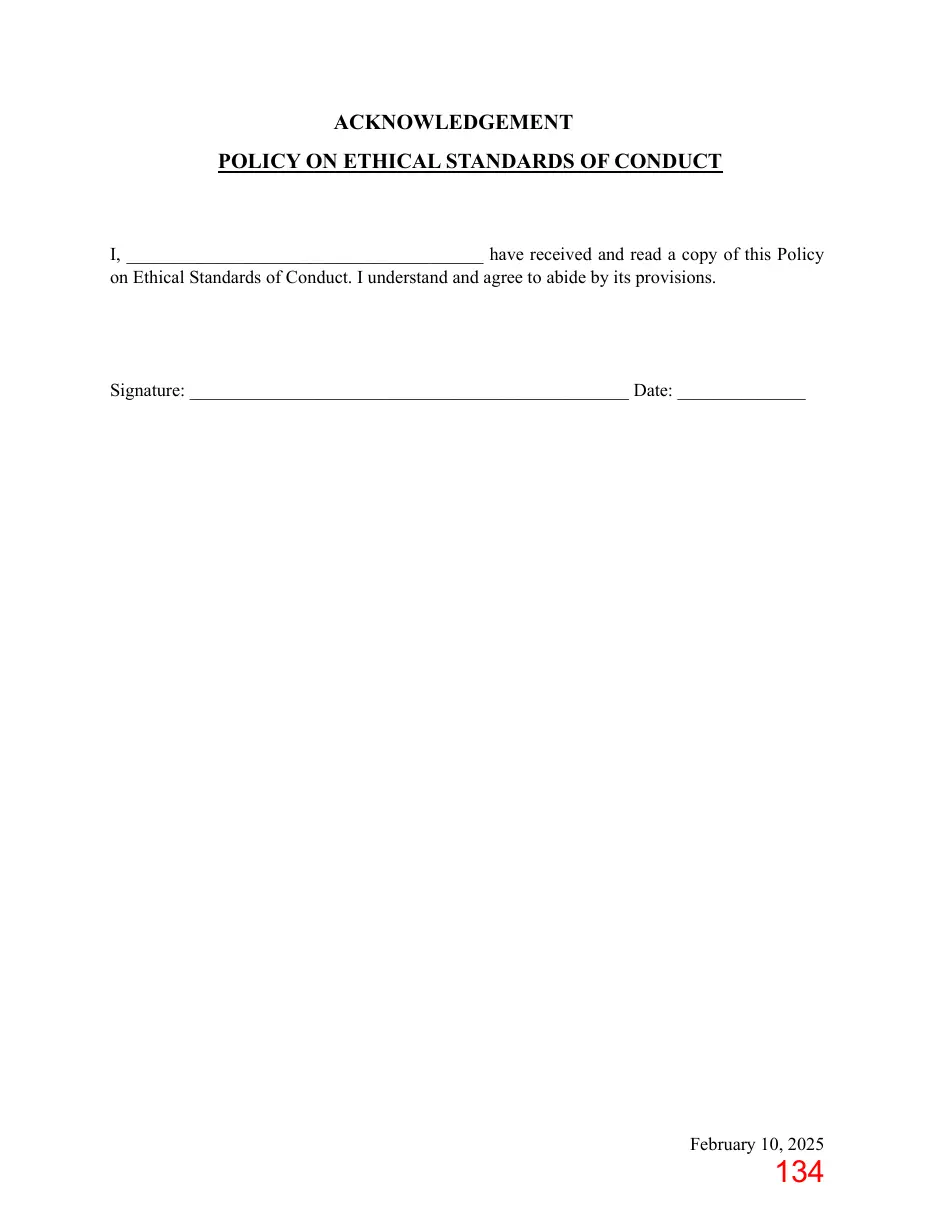
ACKNOWLEDGEMENT POLICY ON ETHICAL STANDARDS OF CONDUCT
I, _______________________________________ have received and read a copy of this Policy on Ethical Standards of Conduct. I understand and agree to abide by its provisions.
Signature: ________________________________________________ Date: ______________
February 10, 2025
Page 135
Text of page 135
CITY OF SAUGATUCK COUNTY OF ALLEGAN STATE OF MICHIGAN
Formatted: Font: 12 pt
POLICY ON ETHICAL STANDARDS OF CONDUCT
Formatted: Font: 14 pt
PART A - ETHICAL STANDARDS
Formatted: Font: 11 pt
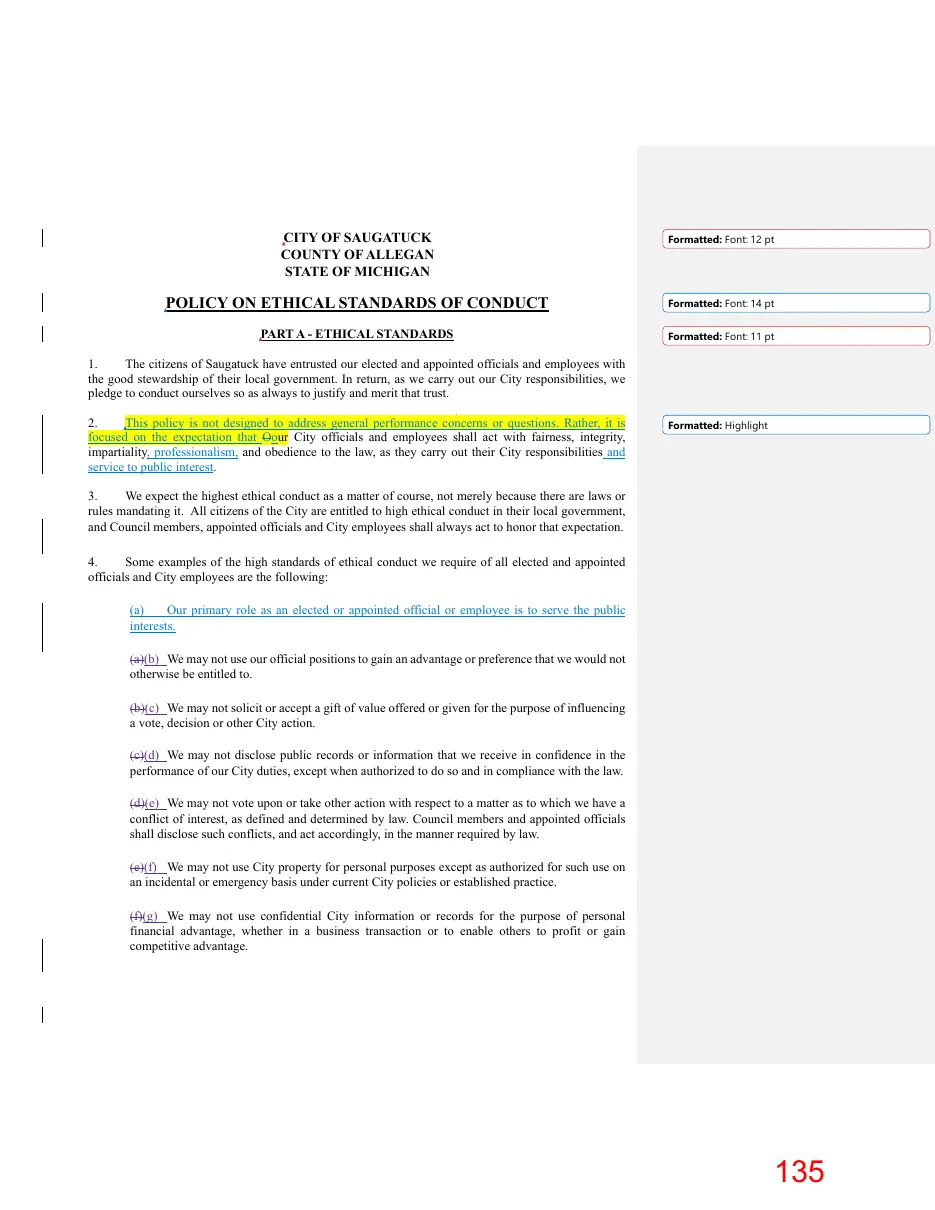
1. The citizens of Saugatuck have entrusted our elected and appointed officials and employees with the good stewardship of their local government. In return, as we carry out our City responsibilities, we pledge to conduct ourselves so as always to justify and merit that trust. 2. This policy is not designed to address general performance concerns or questions. Rather, it is focused on the expectation that Oour City officials and employees shall act with fairness, integrity, impartiality, professionalism, and obedience to the law, as they carry out their City responsibilities and service to public interest.
Formatted: Highlight
3. We expect the highest ethical conduct as a matter of course, not merely because there are laws or rules mandating it. All citizens of the City are entitled to high ethical conduct in their local government, and Council members, appointed officials and City employees shall always act to honor that expectation. 4. Some examples of the high standards of ethical conduct we require of all elected and appointed officials and City employees are the following: (a) Our primary role as an elected or appointed official or employee is to serve the public interests. (a)(b) We may not use our official positions to gain an advantage or preference that we would not otherwise be entitled to. (b)(c) We may not solicit or accept a gift of value offered or given for the purpose of influencing a vote, decision or other City action. (c)(d) We may not disclose public records or information that we receive in confidence in the performance of our City duties, except when authorized to do so and in compliance with the law. (d)(e) We may not vote upon or take other action with respect to a matter as to which we have a conflict of interest, as defined and determined by law. Council members and appointed officials shall disclose such conflicts, and act accordingly, in the manner required by law. (e)(f) We may not use City property for personal purposes except as authorized for such use on an incidental or emergency basis under current City policies or established practice. (f)(g) We may not use confidential City information or records for the purpose of personal financial advantage, whether in a business transaction or to enable others to profit or gain competitive advantage.
Page 136
Text of page 136
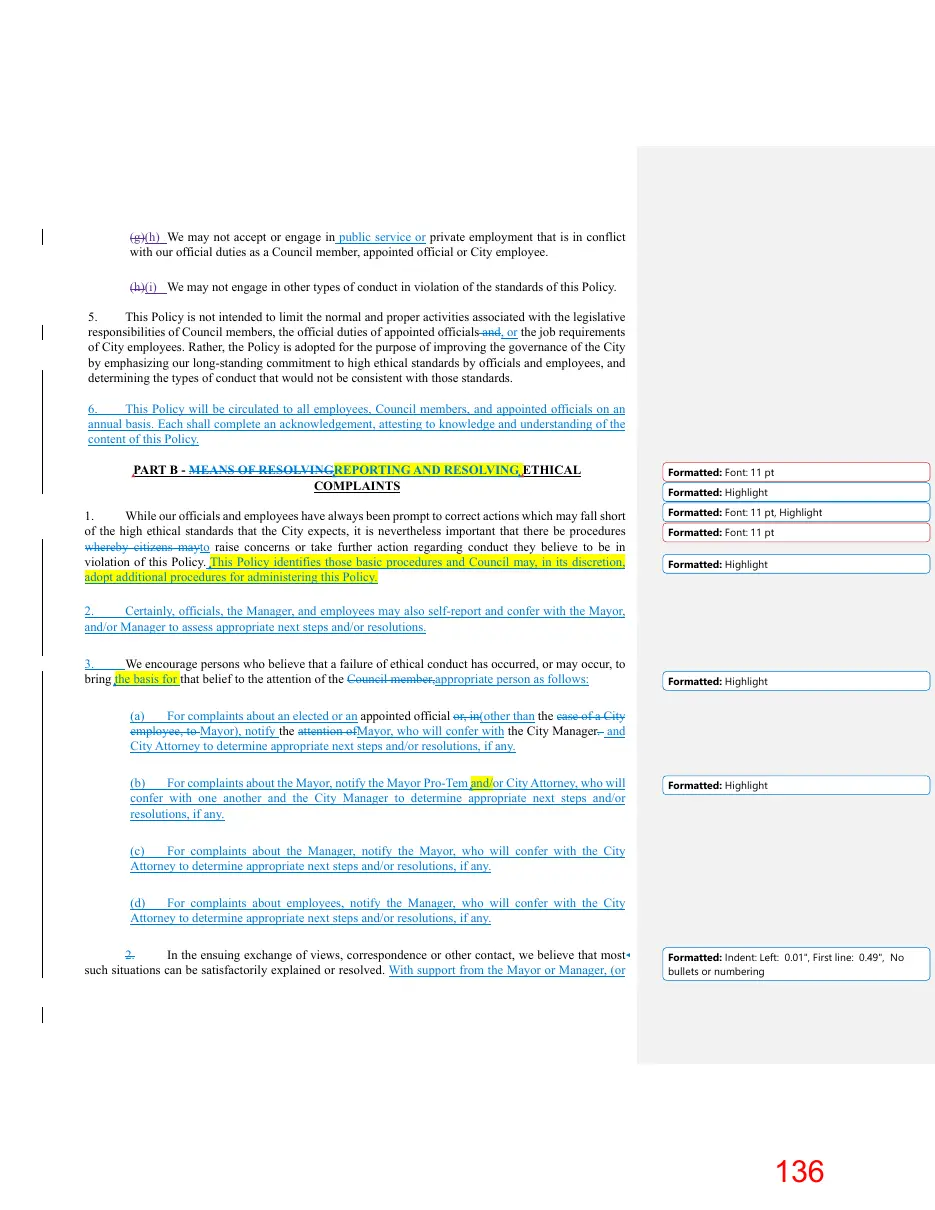
(g)(h) We may not accept or engage in public service or private employment that is in conflict with our official duties as a Council member, appointed official or City employee. (h)(i) We may not engage in other types of conduct in violation of the standards of this Policy. 5. This Policy is not intended to limit the normal and proper activities associated with the legislative responsibilities of Council members, the official duties of appointed officials and, or the job requirements of City employees. Rather, the Policy is adopted for the purpose of improving the governance of the City by emphasizing our long-standing commitment to high ethical standards by officials and employees, and determining the types of conduct that would not be consistent with those standards. 6. This Policy will be circulated to all employees, Council members, and appointed officials on an annual basis. Each shall complete an acknowledgement, attesting to knowledge and understanding of the content of this Policy. PART B - MEANS OF RESOLVINGREPORTING AND RESOLVING ETHICAL COMPLAINTS 1. While our officials and employees have always been prompt to correct actions which may fall short of the high ethical standards that the City expects, it is nevertheless important that there be procedures whereby citizens mayto raise concerns or take further action regarding conduct they believe to be in violation of this Policy. This Policy identifies those basic procedures and Council may, in its discretion, adopt additional procedures for administering this Policy.
Formatted: Font: 11 pt Formatted: Highlight Formatted: Font: 11 pt, Highlight Formatted: Font: 11 pt Formatted: Highlight
2. Certainly, officials, the Manager, and employees may also self-report and confer with the Mayor, and/or Manager to assess appropriate next steps and/or resolutions. 3. We encourage persons who believe that a failure of ethical conduct has occurred, or may occur, to bring the basis for that belief to the attention of the Council member,appropriate person as follows:
Formatted: Highlight
(a) For complaints about an elected or an appointed official or, in(other than the case of a City employee, to Mayor), notify the attention ofMayor, who will confer with the City Manager. and City Attorney to determine appropriate next steps and/or resolutions, if any. (b) For complaints about the Mayor, notify the Mayor Pro-Tem and/or City Attorney, who will confer with one another and the City Manager to determine appropriate next steps and/or resolutions, if any.
Formatted: Highlight
(c) For complaints about the Manager, notify the Mayor, who will confer with the City Attorney to determine appropriate next steps and/or resolutions, if any. (d) For complaints about employees, notify the Manager, who will confer with the City Attorney to determine appropriate next steps and/or resolutions, if any. 2. In the ensuing exchange of views, correspondence or other contact, we believe that most such situations can be satisfactorily explained or resolved. With support from the Mayor or Manager, (or
Formatted: Indent: Left: 0.01", First line: 0.49", No bullets or numbering
Page 137
Text of page 137
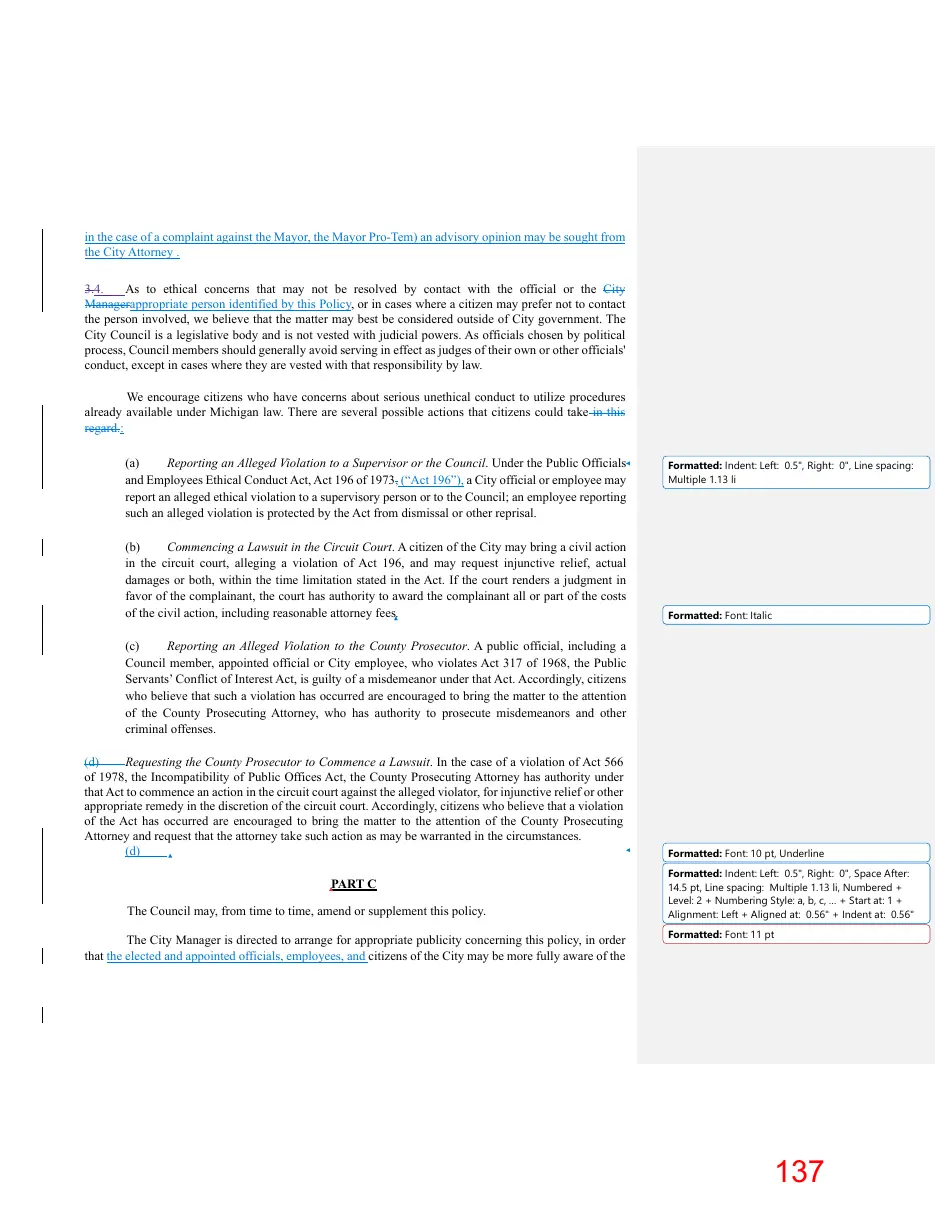
in the case of a complaint against the Mayor, the Mayor Pro-Tem) an advisory opinion may be sought from the City Attorney . 3.4. As to ethical concerns that may not be resolved by contact with the official or the City Managerappropriate person identified by this Policy, or in cases where a citizen may prefer not to contact the person involved, we believe that the matter may best be considered outside of City government. The City Council is a legislative body and is not vested with judicial powers. As officials chosen by political process, Council members should generally avoid serving in effect as judges of their own or other officials' conduct, except in cases where they are vested with that responsibility by law. We encourage citizens who have concerns about serious unethical conduct to utilize procedures already available under Michigan law. There are several possible actions that citizens could take in this regard.: (a) Reporting an Alleged Violation to a Supervisor or the Council. Under the Public Officials and Employees Ethical Conduct Act, Act 196 of 1973, (“Act 196”), a City official or employee may report an alleged ethical violation to a supervisory person or to the Council; an employee reporting such an alleged violation is protected by the Act from dismissal or other reprisal. (b) Commencing a Lawsuit in the Circuit Court. A citizen of the City may bring a civil action in the circuit court, alleging a violation of Act 196, and may request injunctive relief, actual damages or both, within the time limitation stated in the Act. If the court renders a judgment in favor of the complainant, the court has authority to award the complainant all or part of the costs of the civil action, including reasonable attorney fees.
Formatted: Indent: Left: 0.5", Right: 0", Line spacing: Multiple 1.13 li
Formatted: Font: Italic
(c) Reporting an Alleged Violation to the County Prosecutor. A public official, including a Council member, appointed official or City employee, who violates Act 317 of 1968, the Public Servants’ Conflict of Interest Act, is guilty of a misdemeanor under that Act. Accordingly, citizens who believe that such a violation has occurred are encouraged to bring the matter to the attention of the County Prosecuting Attorney, who has authority to prosecute misdemeanors and other criminal offenses. (d) Requesting the County Prosecutor to Commence a Lawsuit. In the case of a violation of Act 566 of 1978, the Incompatibility of Public Offices Act, the County Prosecuting Attorney has authority under that Act to commence an action in the circuit court against the alleged violator, for injunctive relief or other appropriate remedy in the discretion of the circuit court. Accordingly, citizens who believe that a violation of the Act has occurred are encouraged to bring the matter to the attention of the County Prosecuting Attorney and request that the attorney take such action as may be warranted in the circumstances. (d) PART C The Council may, from time to time, amend or supplement this policy. The City Manager is directed to arrange for appropriate publicity concerning this policy, in order that the elected and appointed officials, employees, and citizens of the City may be more fully aware of the
Formatted: Font: 10 pt, Underline Formatted: Indent: Left: 0.5", Right: 0", Space After: 14.5 pt, Line spacing: Multiple 1.13 li, Numbered + Level: 2 + Numbering Style: a, b, c, … + Start at: 1 + Alignment: Left + Aligned at: 0.56" + Indent at: 0.56" Formatted: Font: 11 pt
Page 138

Text of page 138
high ethical standards required in the course of City governance and the procedures available to citizensindividuals who believe that ethical violations have occurred.
Page 139
Text of page 139
ACKNOWLEDGEMENT
Formatted: Font: 14 pt
POLICY ON ETHICAL STANDARDS OF CONDUCT
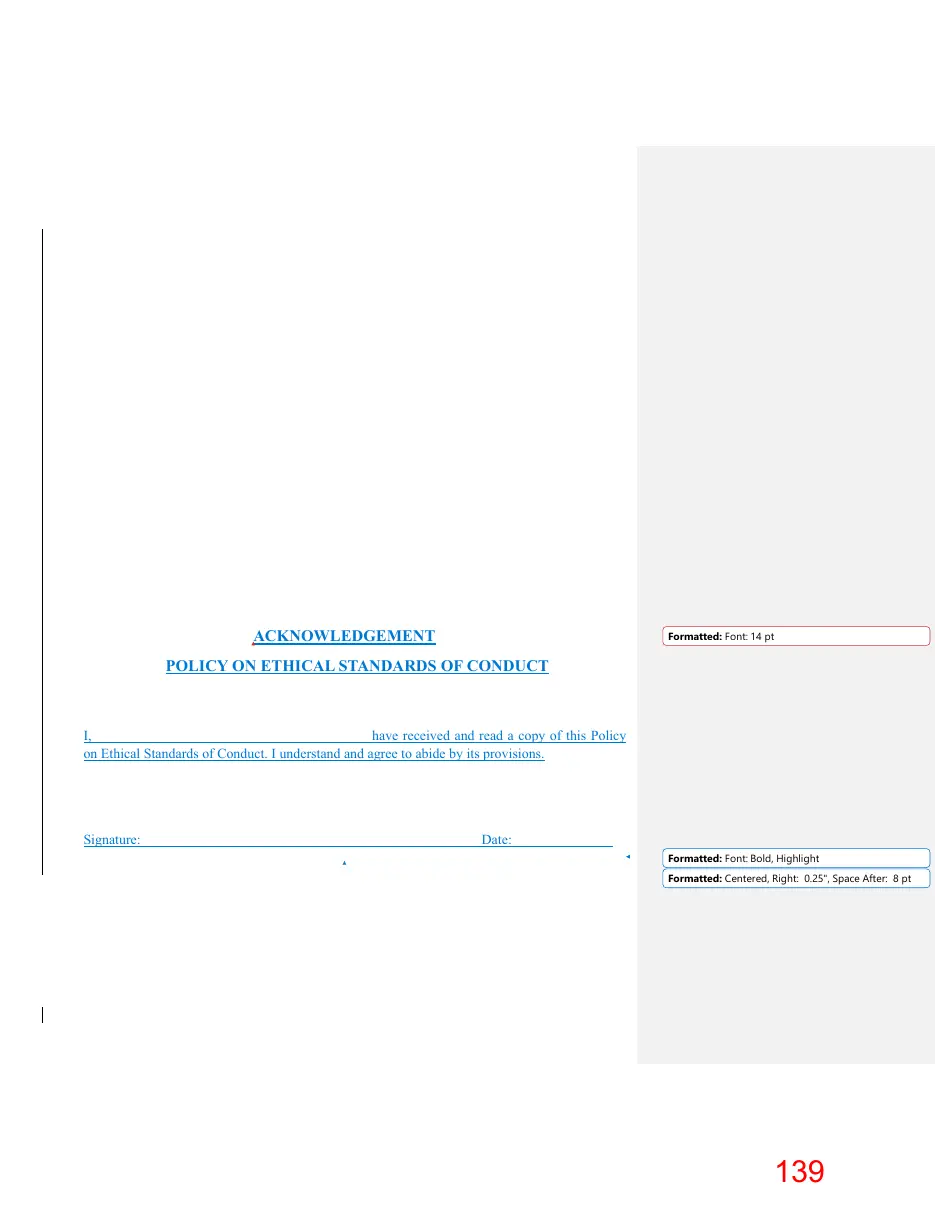
I, _______________________________________ have received and read a copy of this Policy on Ethical Standards of Conduct. I understand and agree to abide by its provisions.
Signature: ________________________________________________ Date: ______________ Formatted: Font: Bold, Highlight Formatted: Centered, Right: 0.25", Space After: 8 pt