
The text of this plan
Green Hills Regional Planning Commission (GHRPC)
Title VI Program
Date Approved by MoDOT Transit Section: July 15, 2024 DATE
This TEMPLATE is provided by the Missouri Department of Transportation (MoDOT) Transit Section, as a resource for producing the triennial Title VI Program document for Federal Transit
This template is available online, through a link at: http://www.modot.org/othertransportation/transit/transitapplicationsreportsprograms.htm Check this link periodically for the most recent, dated template updates.
Title VI Plan Table of Contents A. Introduction / Title VI Assurances
B. Agency Information
C. Notice to the Public
D. Procedure for Filing a Title VI Complaint
E. Title VI Complaints, Investigations, Lawsuits
and Evidence of Agency Staff Title VI Training F. Public Participation Plan
G. Language Assistance Plan
H. Advisory Bodies
I. Subrecipient Assistance
J. Subrecipient Monitoring
K. Equity Analysis of Facilities L. Fixed Route Transit Providers
M. Attachments
GHRPC’s Title VI/ADA Complain Form
A. Title VI Assurances
GHRPC agrees to comply with all provisions prohibiting discrimination on the basis of race, color, or national origin of Title VI of the Civil Rights Act of 1964, as amended, 42 U.S.C. 200d et seq., and with U.S. DOT regulations, “Nondiscrimination in Federally-Assisted Programs of the Department of Transportation – Effectuation of Title VI of the Civil Rights Act,” 49 CFR part 21. GHRPC assures that no person shall, as provided by Federal and State civil rights laws, be excluded from participation in, be denied the benefits of, or be subjected to discrimination under any program or activity. GHRPC further ensures every effort will be made to ensure non-discrimination in all programs and activities, whether those programs and activities are federally funded or not. GHRPC meets the objectives of the FTA Master Agreement which governs all entities applying for FTA funding, including GHRPC and its third-party contractors by promoting actions that: A. Ensure that the level and quality of transportation service is provided without regard to race, color, or national origin. B. Identify and address, as appropriate, disproportionally high, and adverse effects of programs and activities on minority populations and low-income populations. C. Promote the full and fair participation of all affected Title VI populations in transportation decision making. D. Prevent the denial, reduction, or delay in benefits related to programs and activities that benefit minority populations or low-income populations. E. Ensure meaningful access to programs and activities by persons with Limited English Proficiency (LEP).
Signed:
___________________________________________
Title:
___________________________________________
Date:
___________________________________________
B. Agency Information 1. Mission of Green Hills Regional Planning Commission:
Green Hills Regional Planning Commission’s purpose is to bring progress in a number of ways to the eleven counties in north central Missouri: Caldwell, Carroll, Chariton, Daviess, Grundy, Harrison, Linn, Livingston, Mercer, Putnam, and Sullivan County. GHRPC does this through economic development, solid waste management, workforce development, grant administration, hazard mitigation, and transportation planning. GHRPC communicates with all our members to identify the needs and concerns of each community, and then implements plans to achieve these goals and create the progress each community desires. 2. History: The Green Hills Regional Planning Commission (GHRPC) is one of nineteen regional planning commissions in the State of Missouri, which are authorized by the State of Missouri Regional Planning and Community Development Act of 1966, revised Missouri Statutes Chapter 251. The Regional Planning and Community Development Act of 1966 permitted the establishment of regional planning commissions to formally organize and band together by counties to promote the spirit of cooperatively working together to solve problems and plan the future development of regions in the State of Missouri. The Green Hills Regional Planning Commission was designated as such by the State of Missouri Governor Warren E. Hearnes on the 2nd day of March in 1967. The original region served only nine counties and 60 incorporated cities for a total of 69 member governments in North Central Missouri. In the year 1991 Chariton County joined the region and one month later Carroll County joined the region. 3. Regional Profile (regional population; growth projection) Green Hills RPC covers 11 counties and approximately 6,420 square miles in North Central Missouri. The Green Hills Region is geographically uniform in the north, with portions of the southern counties differing from the rolling uplands and stream valleys of the northern counties. The southern counties open onto a wide expanse of floodplains meandering along the Missouri River and its tributary, the Grand River. The population distribution throughout the Region is fairly uniform, with the greatest number of persons living within 10 miles of US HWY 36, which runs east to west across the Region and in communities along the Interstate 35 corridor. Counties with the most population are those that border the Kansas City Metropolitan area: Caldwell and Daviess County; and those that are dissected by US HWY 36: Livingston and Linn County. The region has not had any growth in recent years, and in fact, the population in most of the counties served by GHRPC is declining. 4. Population Served (in relation to regional population)
Green Hills RPC is made up of 11 counties and 75 cities with a total population of 93,335 according to the 2020 Census. The regional population decreased by 1.402 persons since 2017. 5. Service Area
6. Governing body make-up (including terms of office)
An Executive Board of Directors that is appointed from the general membership governs the Commission/Corporation. The Executive Board is comprised of one county elected official or their designee, one city elected official or their designee, and one citizen member from each of the eleven counties. There is a two-year term limit for officers while there is no term limit for general board members.
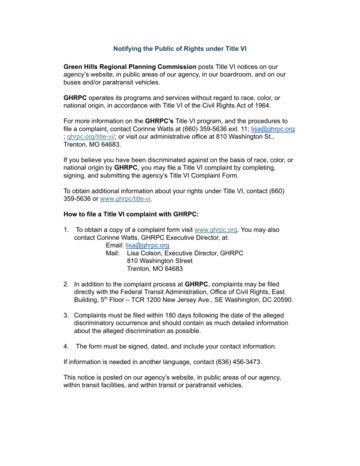
C. Notice to the Public Notifying the Public of Rights under Title VI Green Hills Regional Planning Commission posts Title VI notices on our agency’s website, in public areas of our agency, in our board room, and on our buses and/or paratransit vehicles. GHRPC operates its programs and services without regard to race, color, or national origin, in accordance with Title VI of the Civil Rights Act of 1964. For more information on the GHRPC’s Title VI program, and the procedures to file a complaint, contact Corinne Watts at (660) 359-5636 ext. 11; corinne@ghrpc.org; ghrpc.org/title-vi/; or visit our administrative office at 810 Washington St., Trenton, MO 64683. If you believe you have been discriminated against on the basis of race, color, or national origin by GHRPC, you may file a Title VI complaint by completing, signing, and submitting the agency’s Title VI Complaint Form. To obtain additional information about your rights under Title VI, contact (660) 359-5636 or www.ghrpc/title-vi. How to file a Title VI complaint with GHRPC: 1.
To obtain a copy of a complaint form visit www.ghrpc.org. You may also contact Corinne Watts, GHRPC Executive Director, at: Email: Corrine@ghrpc.org Mail: Corinne Watts, Executive Director, GHRPC 810 Washington Street Trenton, MO 64683
2. In addition to the complaint process at GHRPC, complaints may be filed directly with the Federal Transit Administration, Office of Civil Rights, East Building, 5th Floor – TCR 1200 New Jersey Ave., SE Washington, DC 20590. 3. Complaints must be filed within 180 days following the date of the alleged discriminatory occurrence and should contain as much detailed information about the alleged discrimination as possible. 4.
The form must be signed, dated, and include your contact information.
If information is needed in another language, contact Corinne Watts at (660)0359-5636 ext. 11, or at corinne@ghrpc.org. This notice is posted on our agency’s website, in public areas of our agency, within transit facilities, and within transit or paratransit vehicles.
D. Procedure for Filing a Title VI Complaint Filing a Title VI Complaint The complaint procedures apply to the beneficiaries of GHRPC’s programs, activities, and services. RIGHT TO FILE A COMPLAINT: Any person who believes they have been discriminated against on the basis of race, color, or national origin by GHRPC may file a Title VI complaint by completing and submitting the agency’s Title VI Complaint Form. Title VI complaints must be received in writing within 180 days of the alleged discriminatory complaint. HOW TO FILE A COMPLAINT: Information on how to file a Title VI complaint is posted on our agency’s website, and in public areas of our agency. You may download the GHRPC Title VI Complaint Form at www.ghrpc.org, or request a copy by writing to 810 Washington St., Trenton, MO 64683. Information on how to file a Title VI complaint may also be obtained by calling Lisa Colson at (660) 359-5636 x23. You may file a signed, dated complaint no more than 180 days from the date of the alleged incident. The complaint should include: •
Your name, address and telephone number. Specific, detailed information (how, why and when) about the alleged act of discrimination. Any other relevant information, including the names of any persons, if known, the agency should contact for clarity of the allegations.
Please submit your complaint form to Green Hills Regional Planning Commission 810 Washington St., Trenton, Mo 64683. COMPLAINT ACCEPTANCE: Green Hills RPC will process complaints that are complete. Once a completed Title VI Complaint Form is received, GHRPC will review it to determine if GHRPC has jurisdiction. The complainant will receive an acknowledgement letter informing them whether or not the complaint will be investigated by GHRPC. INVESTIGATIONS: Green Hills RPC will generally complete an investigation within 90 days from receipt of a completed complaint form. If more information is needed to resolve the case, GHRPC may contact the complainant. Unless a longer period is specified by GHRPC, the complainant will have ten (10) days from the date of the letter to send requested information to the Green Hills RPC investigator assigned to the case. If the requested information is not received within that timeframe the case will be closed. Also, a case can be administratively closed if the complainant no longer wishes to pursue the case.
LETTERS OF CLOSURE OR FINDING: After the Title VI investigator reviews the complaint, the Title VI investigator will issue one of two letters to the complainant: a closure letter or letter of finding (LOF). - A closure letter summarizes the allegations and states that there was not a Title VI violation and that the case will be closed. - A Letter of Finding (LOF) summarizes the allegations and provides an explanation of the corrective action taken. If the complainant disagrees with Green Hill RPC’s determination, the complainant may request reconsideration by submitting the request in writing to the Title VI investigator within seven (7) days after the date of the letter of closure or letter of finding, stating with specificity the basis for the reconsideration. GHRPC will notify the complainant of the decision either to accept or reject the request for reconsideration within ten (10) days. In cases where reconsideration is granted, GHRPC will issue a determination letter to the complainant upon completion of the reconsideration review. -A Determination Letter for cases where reconsideration is granted summarizes the allegations, the original finding, the basis for reconsideration, the final findings, and what remedial action(s) are necessary disciplinary action, additional training of the staff member, or other action will occur. A person may also file a complaint directly with the Federal Transit Administration, at the FTA Office of Civil Rights, East Building, 5th Floor - TCR 1200 New Jersey Avenue SE, Washington, DC 20590. GHRPC will notify the Missouri Department of Transportation of all Discrimination complaints within 72 hours by contacting the MoDOT Title VI Coordinator via the External Civil Rights main line at (573) 526-2978; or via email at TitleVI@modot.mo.gov. If information is needed in another language, call Corinne Watts, executive director at (660) 359-5636 ext. 11, or at corinne@ghrpc.org.
E. Monitoring Title VI Complaints, Investigations, Lawsuits and Documenting Evidence of Agency Staff Title VI Training Documenting Title VI Complaints/Investigations All Title VI complaints will be entered and tracked in GHRPC’s complaint log. Active Investigations will be monitored for timely response on the part of all parties. The agency’s Title VI Coordinator shall maintain the log. Agency Title VI Complaint Log Date complaint filed
Basis of complaint R-C-NO Complainant
Summary of allegation
Pending status of complaint
Actions taken
Closu re Letter (CL)
Letter of Finding (LOF)
Date of CL or LOF
Documenting Evidence of Agency Staff Title VI Training GHRPC’s staff are given Title VI training, and agency can answer affirmatively to all the following questions: 1. Are new employees made aware of Title VI responsibilities pertaining to their specific duties? 2. Do new employees receive this information via employee orientation? 3. Is Title VI information provided to all employees and program applicants? 4. Is Title VI information prominently displayed in the agency and on any program materials distributed, as necessary? The following Title VI training will be provided to GHRPC’s staff:
1. Information on Title VI such as the requirements of Title VI, the protections afforded, and GHRPC’s obligations under Title VI. 2. Information regarding displayed Title VI information and program materials such as the Title VI Nondiscrimination Notice to the Public. 3. Information on GHRPC’s Title VI Complaint Procedures, Title VI Complaint Form, and the complaint investigation process. 4. Information on GHRPC’s outreach efforts from the Public Participation Plan and the agency’s efforts to engage minority and LEP populations. Green Hills Regional Planning Commission will identify staff that are likely to routinely encounter or have frequent contact with members of the public and/or customers, as well as their supervisors and all management staff. GHRPC will include the Title VI training as part of the orientation for new employees. Existing employees, especially those who frequently encounter the public and/or customers, will take part in re-training or new training sessions to keep up to date on their Title VI responsibilities on an annual basis. The Title VI training will be administered in conjunction with training on GHRPC’s Language Assistance Plan and a summary of the agency’s LEP responsibilities as discussed in the later Section G. “Language Assistance Plan.”
F. Public Engagement Plan
Goal: Option A The goal of the Public Engagement Plan is to have significant and ongoing public involvement, by all identified audiences, in the public participation process for major agency outreach efforts. The Public Engagement plan describes the proactive strategies, procedures, and desired outcomes that underpin GHRPC’s public participation activities.
Objectives ●
To understand the service area demographics and determine what non-English languages and other cultural barriers exist to public participation.
To provide general notification of meetings and forums for public input, in a manner that is understandable to all populations in the area.
To hold public meetings in locations that are accessible to all area stakeholders, including but not limited to minority and low-income members of the community.
To provide methods for two-way communication and information and input from populations which are less likely to attend meetings.
To convey the information in various formats to reach all key stakeholder groups.
Identification of Stakeholders Stakeholders are those who are either directly or indirectly affected by an outreach effort, system or service plan or recommendations of that plan. Stakeholders include but are not limited to the following: •
Board of Directors – the governing board of the agency. The role of the Board is to establish policy and legislative direction for the agency. The Board defines the agency’s mission, establishes goals, and approves then budget to accomplish the goals. Advisory Bodies – non-elected advisory bodies review current and proposed activities of the agency and are encouraged to be active in the agency’s public engagement process. Advisory bodies provide insight and feedback to the agency. Agency Transit riders and clients Minority and low-income populations, including limited English proficient persons. Local jurisdictions and other government stakeholders Private businesses and organizations Employers Partner agencies
Elements of the Public Engagement Plan It is necessary to establish a public participation plan that includes an outreach plan to engage minority and limited English proficient (LEP) populations.
Elements of the Public Engagement Plan include: 1.
Public Notice a. Official notification of intent to provide opportunity for members of the general public to participate in public engagement plan development, including participation in open Board/council meetings, and advisory committees.
2. Public Engagement Process/Outreach Efforts: a. Public meetings b. Open houses c. Rider forums d. Rider outreach e. Public hearings f. Focus groups g. Surveys h. Services for the Disabled (Notices of opportunities for public involvement include contact information for people needing these or other special accommodations.) Events such as public meetings and/or open houses are held at schools, churches, libraries, and other non-profit locations easily accessible to public transit and compliant with the Americans with Disabilities Act. 3. Public Comment a. Formal public comment periods are used to solicit comments on major public involvement efforts around an agency service or system change. b. Comments are accepted through various means: i. Dedicated email address at ghrpc@ghrpc.org. ii. Website at http://www.ghrpc.org. iii. Regular mail at 810 Washington St., Trenton, MO 64683. iv. Forms using survey tool for compilation. 4. Response to Public Input All public comments are provided to the Board of Directors prior to decision making. A publicly available summary report is compiled, including all individual comments.
Title VI Outreach Best Practices Green Hills Regional Planning Commission ensures all outreach strategies, communications and public involvement efforts comply with Title VI. GHRPC’s Public Engagement Plan proactively initiates the public involvement process and makes concerted efforts to involve
members of all social, economic, and ethnic groups in the public involvement process. Aligned with the above referenced communication tactics, GHRPC provides the following: a. Public notices published in non-English publications (if available) that serve LEP populations. b. Title VI Non-Discrimination Notice to the Public posted at the following locations: a. The agency’s website; b. Public areas of the agency’s office; c. Agency communication materials in languages other than English (subject to Safe Harbor parameters). d. Services for Limited English Proficient persons. Upon advance notice, translators may be provided. Additional Best Practices Include: a. The distribution of agency materials and information such as newsletters, flyers, and outreach and recruitment information about the various programs that GHRPC is involved in. This distribution of the various materials is routinely sent out via social media (GHRPC’s Facebook page), email (to specific members of committees or organizations), and via the US Postal Service. b. Advertised public announcements through newspapers, fliers, or radio stations. c. Partnering with local agencies and community-based organizations such as http://www.mosourcelink.com/guides/start-a-business/ to advertise services provided, d. Added public content to agency’s webpage to communicate schedule changes and/or outreach activities at: http://www.ghrpc.org. e. Public Content added to agency’s social media to communicate schedule changes and/or outreach activities at www.facebook.com: Green Hills Regional Planning Commission. f. Hosting an information booth at community events. The Missouri Municipal League Conference on 6/8/2023 and Missouri Days in Trenton, Missouri 10/20/2023-10/21/2024, and the Sullivan County Health Fair on 9/18/2023.
2022-2024 Title VI Program Public Engagement Process Green Hills Regional Planning Commission will conduct a Public Engagement Process for the 2022-2024 Title VI Program. This process includes Community Meetings to seek input, provide education, and highlight key components of the Title VI Plan. Materials have been created to explain Title VI policies as well as provide education on how they relate to minority populations. GHRPC will provide briefings to the Board of Directors and Advisory Bodies. GHRPC will conduct a 30-day public comment period to provide opportunities for feedback on the 2022-2024 Title VI Program. Comments are accepted during the public outreach period via: a. Email at ghrpc@ghrpc.org
b. Mail or in person at 810 Washington Street, Trenton, MO 64683 c. Phone at (660) 359-5636
Three-Year Summary of Public Outreach Efforts Green Hills Regional Planning Commission is a regional planning commission that encompasses 11 counties in North Missouri (Caldwell, Carroll, Chariton, Daviess, Grundy, Harrison, Linn, Livingston, Mercer, Putnam, and Sullivan County). In our capacity as a planning partner with these counties and the communities within these counties, the staff at GHRPC attends hundreds of meetings per year, for a variety of reasons. ● Transportation Planning: to assist our planning partners in the development of transportation projects, sidewalk projects, MoDOT projects, etc. GHRPC has attended the following types of public meetings: o City Council o County Commission Meetings o One-on-one meetings with city and county officials o Public meetings held for transportation purposes o MoDOT meetings o Quarterly meetings of the Transportation Advisory Committee o Northwest Missouri Coalition of Roadway Safety Meetings o National Rural Road Safety meetings o Monthly meetings and MACOG ● Economic Development: to assist our planning partners in economic development in the Green Hills Region GHRPC staff has attended the following types of public meetings: o City Council o County Commission Meetings o One-on-one meetings with city and county officials o Public meetings held for economic development purposes o Quarterly meetings of the GHRPC Board o Monthly meetings at MACOG ● Non-profit: to assist our regional partners in the non-profit sector Green Hills Regional Planning Commission (GHRPC) staff has attended the following types of public meetings: o City Council o County Commission Meetings o One-on-one meetings with city officials, county officials, and stakeholders in the non-profit sectors o Public meetings held for non-profit organizations o Quarterly GHRPC meetings ● Public Water Districts: to assist the water districts and the populations of the 11-county region GHRPC staff has attended the following types of public meetings to assist in planning related to the public water districts: o City Council o Public water districts public meetings o One-on-one meetings with officials in the public water districts
Public meetings held to present projects or improvements within a public water district o Quarterly meetings of GHRPC Work Force Development: GHRPC also has a program through WIOA to assist individuals in obtaining employment and skills to increase their employability. GHRPC is open to the public Monday through Thursday where individuals seeking employment may go for help. There are public offices located in Trenton, Missouri, Kirksville, Missouri, and Chillicothe, Missouri. Title VI forms are located on GHRPC’s website: http://www.ghrpc.org Title VI Plan updates will be posted on the GHRPC website: http://www.ghrpc.org The GHRPC Board of Directors will be presented with the Plan for approval at the quarterly meeting in June, 2024. o
•
G. Language Assistance Plan
Green Hills Regional Planning Commission’s Limited English Proficiency Plan This limited English Proficiency (LEP) Plan has been prepared to address GHRPC‘s responsibilities as a recipient of federal financial assistance as they relate to the needs of individuals with limited language skills. The plan has been prepared in accordance with Title VI of the Civil Rights Act of 1964; Federal Transit Administration Circular 4702.1B, dated October 1, 2012, which states that the level and quality of transportation service is provided without regard to race, color, or national origin. Executive Order 13166, titled “Improving Access to Services for Persons with Limited English Proficiency,” indicates that differing treatment based upon a person's inability to speak, read, write or understand English is a type of national origin discrimination. It directs each federal agency to publish guidance for its respective recipients clarifying their obligation to ensure that such discriminations do not take place. This order applies to all state and local agencies which receive federal funds. Service Area Description: The region includes the following counties: Caldwell, Carroll, Chariton, Daviess, Grundy, Harrison, Linn, Livingston, Mercer, Putnam, and Sullivan.
GHRPC has developed this LEP Plan to help identify reasonable steps for providing language assistance to persons with limited English proficiency who wish to seek meaningful access to services provided by GHRPC. Meaningful access is language assistance that results in accurate, timely, and effective communication at no cost to the LEP individual. As defined in Executive Order 13166, LEP persons are those who do not speak English as their primary language and have limited ability to read, speak, write, or understand English. This plan outlines how to identify a person who may need language assistance, and the ways in which assistance may be provided. In order to prepare this plan, GHRPC undertook the four-factor LEP analysis which considers the following factors: Four Factor Analysis 1. The number and proportion of LEP persons eligible to be served or likely to be encountered in the service area: A significant majority of people in the Green Hills Regional Planning Commission’s service area are proficient in the English language. Based on the ACS 5-Year Estimates Detailed Table, US Census Bureau, Table C16001, 1.64% of the population five years of age and older speak English “less than very well” – a definition of limited English proficiency. According to the data obtained from the US Census Table C16001, there is no LEP group(s) that speak English “less than very well” that have reached the Safe Harbor threshold for the GHRPC service area. The “Safe Harbor Provision” stipulates a recipient is to provide written translation of vital documents for each eligible Limited English Proficient (LEP) language group that constitutes
five percent (5%) or 1,000 persons, whichever is less, of the total population five years of age and older eligible to be served or likely to be affected or encountered. There was no LEP group in the GHRPC planning area that reached this threshold. The U.S. DOT Language Access Plan defines “vital documents” as “paper or electronic written material that contains information that is critical for accessing a component’s programs, services, benefits, or activities; directly and substantially related to public safety; or required by law.” The FTA Circular 4702.1B specifies the Title VI Notice to the Public, Title VI Complaint Procedures, and Title VI Complaint Form are vital documents. Translation of non-vital documents, if needed, can be provided orally. If there are fewer than 50 persons in a language group that reaches the five percent (5%) trigger, the recipient is not required to translate vital written materials but should provide written notice in the primary language of the LEP language group of the right to receive competent oral interpretation of those written materials, free of cost. Safe Harbor provisions apply to the translation of written documents only. They do not affect the requirement to provide meaningful access to LEP individuals through competent oral interpreters where oral language services are needed and are reasonable. Based on the 2022 5-Year American Community Survey data for Table C16001 for Green Hills Regional Planning Commission’s service area consisting of Caldwell, Carroll, Chariton, Daviess, Grundy, Harrison, Linn, Livingston, Mercer, Putnam, and Sullivan County, 82,335 persons or 95.45% of the total population five years of age and older of 86,256 speak only English. A total of 1,416 or 1.64% of the total population speak English “less than very well” – a definition of Limited English Proficiency. Of the LEP Language group(s) that speak English “less than very well”, German or other West Germanic speaking persons that “speak English less than very well” had the highest population at 647 or 0.75%, Spanish speaking persons that “speak English less than very well” had the second highest population at 519 or 0.60%, and French, Haitian, or Cajun persons that “speak English less than very well” had the third highest population at 62 or 0.07%. Currently, no LEP language group(s) meet the Safe Harbor threshold. However, efforts will be made to reasonably accommodate any language access requests that arise.
LEP Population in GHRPC Service Area
Population 5 years and over by language spoken at home and ability to speak English
Population 5 Years and Over Speak Only English Total Speak English “Less Than Very Well” Spanish Speak English “Less Than Very Well” French, Haitian, or Cajun Speak English “Less Than Very Well” German or other West Germanic Languages Speak English “Less Than Very Well” Russian, Polish, or other Slavic Languages Speak English “Less Than Very Well” Other Indo-European Languages Speak English “Less Than Very Well” Korean Speak English “Less Than Very Well” Chinese (incl. Mandarin, Cantonese) Speak English “Less Than Very Well” Vietnamese Speak English “Less Than Very Well” Tagalog (inc. Filipino) Speak English “Less Than Very Well” Other Asian & Pacific Island Languages
a d w e o u n t y
a r r o o u n t y
h a r it o o u n t y
D a e s s o u n t y
G r u n d y o u n t y
H a r r s o n o u n t y
8,38 8,18
8,08 7,99
6,98 6,78
7,84 7,08
9,17 8,64
7,68 7,53
n g st o n o u nt y
M e r e r o u n t y
P u t n a m o u n t y
S u a n o u n t y
3,25
10,85
13,62 13,31
4,42 4,22
5,60 4,59
n n o u nt y
Servic e Area Total
Percentag e of Population 5 Years and Older
86,256
100%
82,335
95.45%
1,416
1.64%
0.60%
0.07%
0.75%
0.01%
0.04%
0.00%
0.02%
0.02%
0.05%
11,182
3,111
Speak English “Less Than Very Well” Arabic Speak English “Less Than Very Well” Other Unspecified Languages Speak English Less Than Very Well”
0.03%
0.03%
0.01%
2. Frequency of Contact by LEP Persons with GHRPC’s Services: The GHRPC staff reviewed the frequency with which office staff, dispatchers and drivers have, or could have, contact with LEP persons. To date, Green Hills RPC has, on average, less than one request per month for an interpreter. Green Hills RPC averages 1300 phone calls per month.
LEP Staff Survey Form
Green Hills Regional Planning Commission is studying the language assistance needs of its riders so that we can better communicate with them if needed.
1. How often do you come into contact with passengers who do not speak English or have trouble understanding you when you speak English to them? DAILY WEEKLY MONTHLY LESS THAN MONTHLY 2. What languages do these passengers speak? 3. What languages (other than English) do you understand or speak? 4. Would you be willing to serve as a translator when needed? Frequency of Contact with LEP Persons Language Spoken by LEP Persons Daily n/a Weekly n/a Monthly n/a Less frequently than monthly German, Tongan, Spanish Frequency
Language Assistance Requests Log Date
Language Spoken by Individual (If Available)
Name
Phone Number or Email (If Available)
Service(s) Requested
Staff Member Providing Aid
Notes and Follow-Up
3. The importance of programs, activities or services provided by GHRPC to LEP persons:
Outreach activities, summarized in GHRPC’s Title VI Public Engagement Plan, include events such as public meetings and/or open houses held at schools, churches, libraries and other non-profit locations, and include specific outreach to LEP persons to gain understanding of the needs of the LEP population, and the manner (if at all) needs are addressed.
Outside Organization LEP Survey Organization: __________________ 1. What language assistance needs are encountered? 2. What languages are spoken by persons with language assistance needs? 3. What language assistance efforts are you undertaking to assist persons with language assistance needs? 4. When necessary, can we use these services? 4. The resources available to GHRPC and overall cost to provide LEP assistance: Strategies for Engaging Individuals with Limited English Proficiency include: 1. Language line. Upon advance notice, translators can be provided. 2. Language identification flashcards. 3. Written translations of vital documents (identified via safe harbor provision) 4. One-on-one assistance through outreach efforts. 5. Website information. 6. To the extent feasible, assign bilingual staff for community events, public hearings and Board of Directors meetings and on the customer service phone lines. As applicable: Based on our demographic analysis (Factor 1) Green Hills RPC has determined that no language group(s) within its service area meets Safe Harbor criteria requiring written translated “vital documents” by language group(s). Should Factor 1 in the Four Factor analysis indicate in the future that an LEP group reaches the safe harbor threshold, GHRPC will evaluate its vital documents and provide translations. Green Hills RPC will provide assistance and direction to LEP persons upon request. Overall Costs: At this time GHRPC utilizes a language translation service at 1-888-338-7394, which is free. There is currently less than 6 hours of staff time per year spent providing LEP assistance, or less than 1% of total staff time. The cost that GHRPC incurs providing LEP assistance is currently under $100 per year. Staff LEP Training The following training will be provided to GHRPC staff: 1. Information on GHRPC ‘s Title VI Procedures and Title VI responsibilities pertaining to their specific duties.
2. Information on GHRPC’s Language Assistance Plan and LEP Responsibilities. 3. Information on the written and oral language assistance services available, and instructions on how agency staff can access these products and services. 4. Information on how to respond to LEP callers, written communications from LEP persons, how to respond to in-person contact from LEP persons, and how to arrange providing language assistance services. 3. Use of Language Identification Flashcards such as “I Speak” Cards. 4. Documentation of language assistance requests by maintaining a Language Assistance Requests Log GHRPC will identify staff that are likely to routinely encounter or have frequent contact with LEP persons, as well as their supervisors and all management staff in order to target training to appropriate staff. GHRPC will include the LEP training as part of the orientation for new employees. Existing employees, especially those who frequently encounter the public and/or customers, will take part in re-training or new training sessions to keep up to date on their responsibilities to LEP persons on a yearly basis.
Monitoring and Updating the LEP Plan GHRPC will update the LEP plan as required. The plan will be reviewed and updated on a triennial basis, at minimum, or when it is clear that higher concentrations of LEP individuals are present in the GHRPC service area. Updates include the following: 1. How the needs of LEP persons have been addressed. 2. Determine the current LEP population in the service area. 3. Determine as to whether the need for, and/or extent of, translation services has changed. 4. Determine whether local language assistance programs have been effective and sufficient to meet the needs. 5. Determine whether GHRPC's financial resources are sufficient to fund language assistance resources as needed. 6. Determine whether Green Hills RPC has fully complied with the goals of this LEP Plan. 7. Determine whether complaints have been received concerning Green Hills RPC’s failure to meet the needs of LEP individual.
H. Advisory Bodies Table Depicting Membership of Committees, Councils, By Race Committee African Asian Caucasian Latino Total [examples] American American GHRPC 100% 100% Board Transportatio n Advisory 100% 100% Committee
GHRPC Board and GHRPC’s Transportation Advisory Committee are comprised of an elected commissioner (usually the presiding commissioner) and a representative from the city and a citizen representative. Individuals wishing to serve on either committee are chosen by their county commission. GHRPC is an equal opportunity employer, and the local governments are equal opportunity employers. While none of the current members of the GHRPC Board or the Transportation Advisory Committee represent a minority group, the meetings are open to the public and meeting notices are posted publicly and on the GHRPC website.
I. Subrecipient Assistance Subrecipient Assistance Green Hills RPC does not have any subrecipients.
J. Subrecipient Monitoring Subrecipient Monitoring Green Hills RPC does not have any subrecipients.
K. Equity Analysis of Facilities A Title VI equity analysis will be completed when GHRPC constructs facilities, such as storage facilities, maintenance facilities, or operations centers. The term “facilities” does not include bus shelters, transit stations, or power substations. The equity analysis will be conducted during the planning stage with regard to where a project is located or sited to ensure the location is selected without regard to race, color, or national origin. The equity analysis is conducted to determine whether the location of the project will result in a disparate impact on minority communities on the basis of race, color, or national origin. The Title VI equity analysis will compare the equity impacts of various siting alternatives, and the analysis will occur before the selection of the preferred site. Green Hills RPC has not constructed any storage facilities, maintenance facilities, or operations centers in the last three years.
L. Fixed Route Transit Providers GHRPC is not a transit provider that operates fixed route service, or transit provider that operates fifty (50) or more fixed route vehicles in peak service and are in an urbanized size area with a population of 200,000 or more. Thus, the requirements to set system-wide service standards and policies, collect and report demographic data, monitor transit service, and to evaluate service and fare changes, are not applicable to Green Hills RPC.
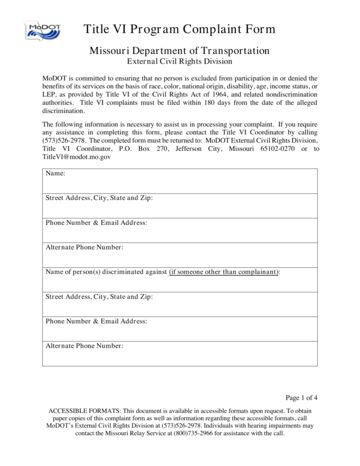
M. Attachments Attachment 1: GHRPC’s TITLE VI/ADA COMPLAINT FORM “No person in the United States shall, on the basis of race, color, or national origin, be excluded from participation in, be denied the benefits of, or be subjected to discrimination under any program or activity receiving Federal financial assistance.” If you feel that you have been discriminated against in the provision of transportation services, please provide the following information to assist us in processing your complaint. Should you require any assistance in completing this form or need information in alternate formats, please let us know. Please mail or return this form to: Lisa Colson Green Hills RPC 810 Washington Street Trenton, MO 64683 (660) 359-5636 ext. 23 Fax: (660) 356-3096 lisa@ghrpc.org PLEASE PRINT 1. Complainant’s Name: a. Address: b. City: State: Zip Code: c. Telephone (include area code): Home ( ) or Cell ( ) Work ( ) ( ) d. Electronic mail (e-mail) address: Do you prefer to be contacted by this e-mail address? ( ) YES ( ) NO 2. Accessible Format of Form Needed? ( ) YES specify:_________________________ ( ) NO 3. Are you filing this complaint on your own behalf? ( ) YES If YES, please go to question 7. ( ) NO If no, please go to question 4 4. If you answered NO to question 3 above, please provide your name and address. a. Name of Person Filing Complaint: b. Address: c. City: State: Zip code: d. Telephone (include area code): Home ( ) or Cell ( ) Work ( ) ( ) e. Electronic mail (e-mail) address: Do you prefer to be contacted by this e-mail address? ( ) YES ( ) NO 5. What is your relationship to the person for whom you are filing the complaint? 6. Please confirm that you have obtained the permission of the aggrieved party if you are filing on behalf of a third party. ( ) YES, I have permission. ( ) NO, I do not have permission. 7. I believe that the discrimination I experienced was based on (check all that apply): ( ) Race ( ) Color ( ) National Origin (classes protected by Title VI) ( ) Disability (class protected by ADA)
( ) Other (please specify) continued
TITLE VI COMPLAINT FORM – PAGE 2 8. Date of Alleged Discrimination (Month, Day, Year): 9. Where did the Alleged Discrimination take place? 10. Explain as clearly as possible what happened and why you believe that you were discriminated against. Describe all of the persons that were involved. Include the name and contact information of the person(s) who discriminated against you (if known). Use the back of this form or separate pages if additional space is required.
11. Please list any and all witnesses’ names and phone numbers/contact information. Use the back of this form or separate pages if additional space is required.
12. What type of corrective action would you like to see taken?
13. Have you filed a complaint with any other Federal, State, or local agency, or with any Federal or State court? ( ) YES If yes, check all that apply. ( ) NO a. ( ) Federal Agency (List agency’s name) b. ( ) Federal Court (Please provide location) c. ( ) State Court d. ( ) State Agency (Specify Agency) e. ( ) County Court (Specify Court and County) f. ( ) Local Agency (Specify Agency) 14. If YES to question 14 above, please provide information about a contact person at the agency/court where the complaint was filed. Name: Title: Agency: Telephone: ( ) Address: City: State: Zip Code: You may attach any written materials or other information that you think is relevant to your complaint. Signature and date is required: ________________________________ Signature
______________________________ Date
If you completed Questions 4, 5 and 6, your signature and date is required: ________________________________ Signature
______________________________ Date
If information is needed in another language, contact Corinne Watts at 810 Washington Street, Trenton, MO 64683, or at (660) 748-3659.
More from Title VI and equal opportunity
-
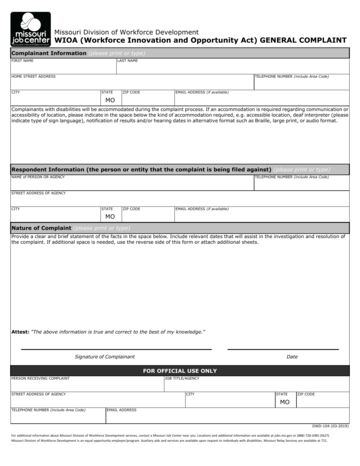 Complaint Form: If You Feel Discriminated Against
May 2024
-
 Babel Notice: Help with Translation
-
 Equal Opportunity Is the Law (English)
-
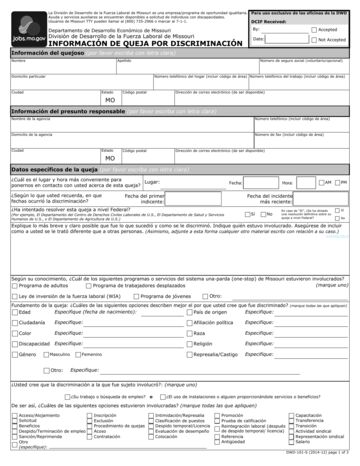 Formulario de Queja: Si Te Sientes Discriminado (DWD-101, Spanish)
-
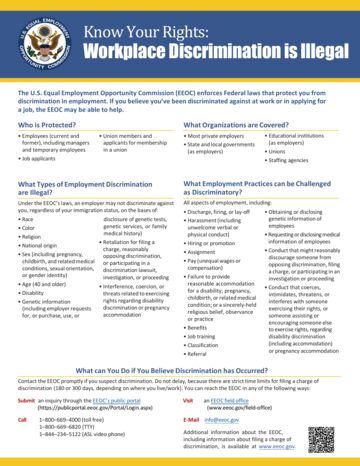 Know Your Rights: Workplace Discrimination Is Illegal
-
 La Igualdad de Oportunidades Es la Ley (Equal Opportunity Is the Law, Spanish)
-
 Public Notice of Rights Under Title VI
-
 Title VI Complaint Form