
Parks & Public Works Agenda item 6A
Presentation on Mount Baldhead Erosion and Vegetation, Brian Talsma (Allegan County Conservation District)
Parks and Public Works Committee, Tuesday, June 24, 2025
Download these 14 pages, 27.7 MB Whole packet, 19 pages, 28.1 MB
Page 6
Text of page 6
Parks & Public Works Committee Agenda Item Report
FROM:
Scott Herbert – Public Works Superintendent
MEETING DATE:
June 24th, 2025
SUBJECT:
Mt. Baldhead Erosion and Vegetation
DESCRIPTION: Several years ago, a pesticide application was applied to the Mt. Baldhead slope to irradicate/control Asian bittersweet. In doing so, inadvertent damage was caused to the native vegetation which included trees, shrubs, and groundcovers. Erosion had resulted from the absence of root structures to hold the sand in place. Several steps have been taken to stabilize the dune with some success. To further improve the dune stabilization, City Council has prioritized revegetating the slope as a 2025 project priority. City Staff have consulted the Allegan County Conservation District to assess the dunes overall condition and health. Findings and recommendations are in the enclosed report. BUDGET ACTION REQUIRED: N/A COMMITTEE/COMMISSION REVIEW: Parks & Public Works Committee LEGAL REVIEW: N/A SAMPLE MOTION: Information/Discussion Only
Page 7
Text of page 7
Site Assessment and Recommendations Land Manager(s): Scott Herbert (Saugatuck DPW)
Site Location: Mount Baldhead Park, Saugatuck, MI 42.660917, -86.207329
Purpose and Background: Scott requested a site visit from Allegan Conservation District staff in order to assess the current state of erosion on the east face of Mt. Baldhead, paralleling the north side of the steps. Significant herbicide damage starting in 2011 caused significant vegetation loss. Subsequent measures to mitigate erosion have included felling dead trees and placing them perpendicular to the slope along the length of the impacted area, and replanting of trees and shrubs. Land Manager’s Objectives: 1. Determine severity of any ongoing erosion and prevent further erosion. 2. Promote native vegetation and biodiversity. 3. Restore the site’s aesthetic value. Observations: The damaged area is easily seen from a distance—noticeable due to the absence of mature trees. The area is roughly 0.5 acres measured from aerial imagery. There do not appear to be any signs of active erosion; downed trees are settled into the sand but are not being buried, leaf litter covers much of the area, and no sediment accumulations were observed. While many plants had yet to break dormancy, some sparse native vegetation was noted. Japanese Barberry (Berberis thunbergii) is colonizing the site and is currently a dominant understory component. Natural Resource Concerns: ACD staff identified the following natural resource concerns that should be addressed alongside the land manager’s objectives: 1. Undesirable invasive species - Japanese barberry and garlic mustard are becoming abundant on the site. In addition to crowding out native species, Japanese barberry is a preferred host for tick species and has painful thorns that may impact broader use of the park. While this specific area is not intended for traffic, it can easily spread to nearby areas that are. 2. Inadequate plant structure and composition - loss of the plant community is immediately apparent on the site with the absence of mature woody vegetation. Some desirable small shrubs and tree seedlings are visible, but much of the site did not have apparent growth. The lack of small forbs may be explained by the early timing of the visit, but supplemental planting will likely be necessary to speed the succession of the site and prevent further colonization by invasive plants. 3. Erosion susceptibility - while the site does not appear to be actively eroding, it is likely vulnerable to sporadic erosion during significant weather events (e.g. if a heavy wind were to uproot trees along the edge of the site). Further stabilization of the site is advisable to increase resilience to disturbance. A social trail near the site is an additional source of continued erosion. Dune systems are quite fragile, and even sporadic foot traffic can be enough to prevent vegetation re-establishment and accumulation of leaf litter.
Page 8
Text of page 8
Recommendations: 1. Native planting - a combination of broadcast seeding and direct planting native grasses and forbs will be the fastest way to establish vegetation and speed succession on the site. Tree and shrub seedlings can also be planted in areas where previous efforts were not successful. Because of limited water onsite, planting before an expected precipitation event is recommended, and seeding in late fall to early winter will take the fullest advantage of spring moisture and natural seed germination cycles. A list of common backdune species can be found in Attachment 1, plant and seed suppliers can be found in Attachment 2. Suppliers may have additional recommendations based on their stock and pricing. A non-exhaustive list of easy-to-establish plants suitable for the site is provided here: a. Canada wild rye (Elymus canadensis), b. bottlebrush grass (Elymus hystrix), c. junegrass (Koeleria cristata), d. wild columbine (Aquilegia canadensis), e. thimbleweed (Anemone cylindrica), f. spotted horsemint (Monarda punctata), g. common evening primrose (Oenothera biennis), h. roundleaf serviceberry (Amelanchier sanguinea), i. and shadbush serviceberry (Amelanchier spicata). 2. Invasive species removal - Japanese barberry can easily overtake an area if left alone. Except for small individuals in stable areas, mechanical pulling is not advised as the root systems may be quite extensive. Cut-stump (or cut-and-paint) treatment with an appropriate herbicide is the method most likely to be effective while minimizing risks of erosion and off-target impacts. Treatment equipment is inexpensive and easily carried in difficult terrain (search “buckthorn blaster” for an example applicator; DIY applicators are also easily made). In this method, stems are cut and the stumps are immediately painted with a concentrated herbicide. Active ingredient and concentration recommendations can be provided on request. The resulting brush should be removed and dried before disposal to prevent vegetative reproduction. 3. Traffic control - off-trail traffic is evident, continuing northwest of the disturbance site. It is unclear to what extent traffic is from wildlife or humans, but measures to limit use of the area are advisable. Educational signs noting the sensitivity of the area, sand fencing, or use of natural elements (logs, dense shrubs, etc.) may discourage traffic. 4. Formal erosion monitoring - no active erosion was observed on site. The absence of rills, sediment accumulation, and leaf litter disturbance suggests that any erosion is occurring at a natural or near-natural rate. Dunes are, however, transient by nature, and formal monitoring would enable the manager to establish baseline conditions and be proactive in making management decisions. Monitoring is relatively simple: place stakes with measurement markings into the ground vertically and periodically note how much of the stake is exposed. Monitoring locations, frequency, and data recording should be convenient to management personnel’s schedule in order to ensure continued use.
Page 9
Text of page 9
MI C H I G AN ’S CR ITIC AL DUN E AR EA S P R OG R AM
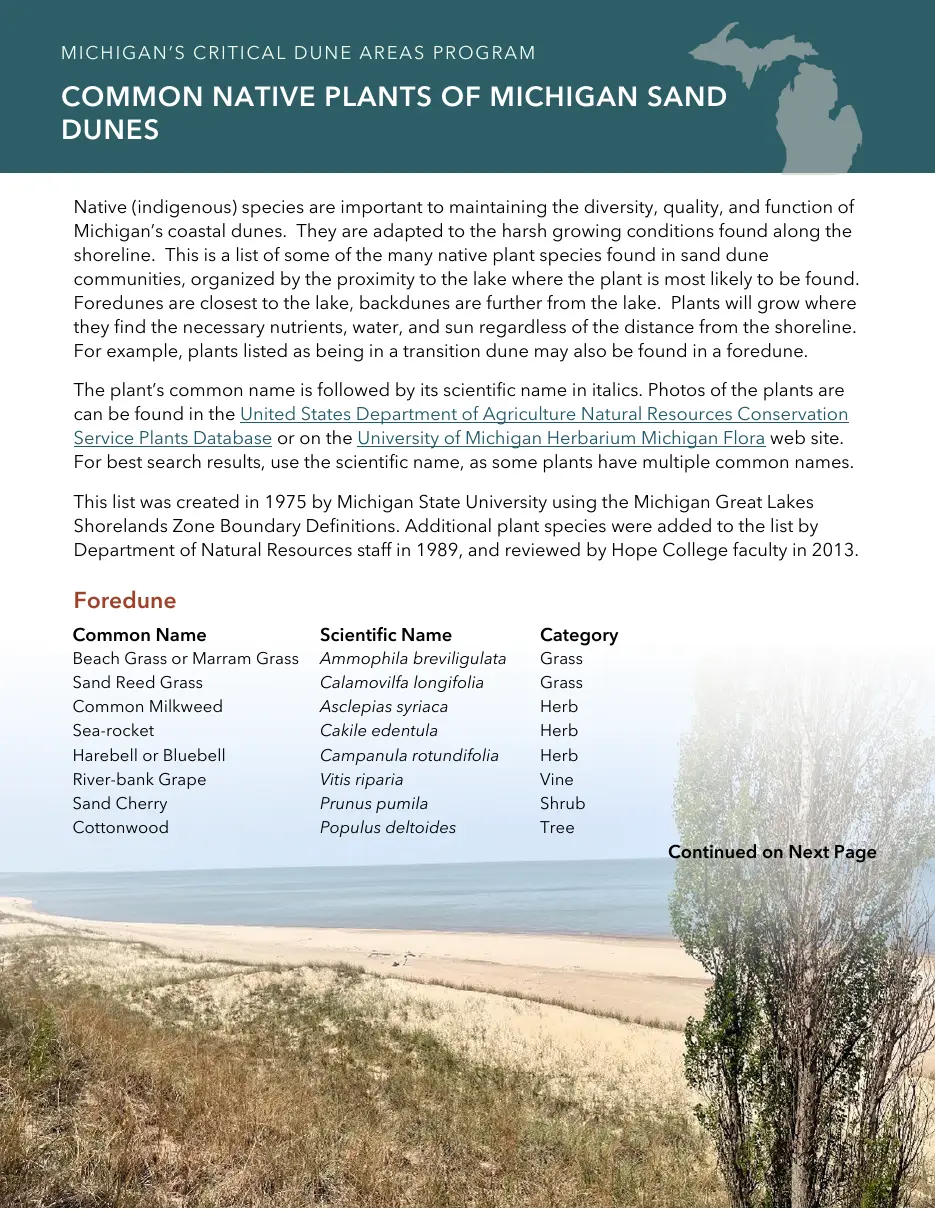
COMMON NATIVE PLANTS OF MICHIGAN SAND DUNES Native (indigenous) species are important to maintaining the diversity, quality, and function of Michigan’s coastal dunes. They are adapted to the harsh growing conditions found along the shoreline. This is a list of some of the many native plant species found in sand dune communities, organized by the proximity to the lake where the plant is most likely to be found. Foredunes are closest to the lake, backdunes are further from the lake. Plants will grow where they find the necessary nutrients, water, and sun regardless of the distance from the shoreline. For example, plants listed as being in a transition dune may also be found in a foredune. The plant’s common name is followed by its scientific name in italics. Photos of the plants are can be found in the United States Department of Agriculture Natural Resources Conservation Service Plants Database or on the University of Michigan Herbarium Michigan Flora web site. For best search results, use the scientific name, as some plants have multiple common names. This list was created in 1975 by Michigan State University using the Michigan Great Lakes Shorelands Zone Boundary Definitions. Additional plant species were added to the list by Department of Natural Resources staff in 1989, and reviewed by Hope College faculty in 2013.
Foredune Common Name
Scientific Name
Category
Beach Grass or Marram Grass Sand Reed Grass Common Milkweed Sea-rocket Harebell or Bluebell River-bank Grape Sand Cherry Cottonwood
Ammophila breviligulata Calamovilfa longifolia Asclepias syriaca Cakile edentula Campanula rotundifolia Vitis riparia Prunus pumila Populus deltoides
Grass Grass Herb Herb Herb Vine Shrub Tree
Continued on Next Page
Page 10
Text of page 10
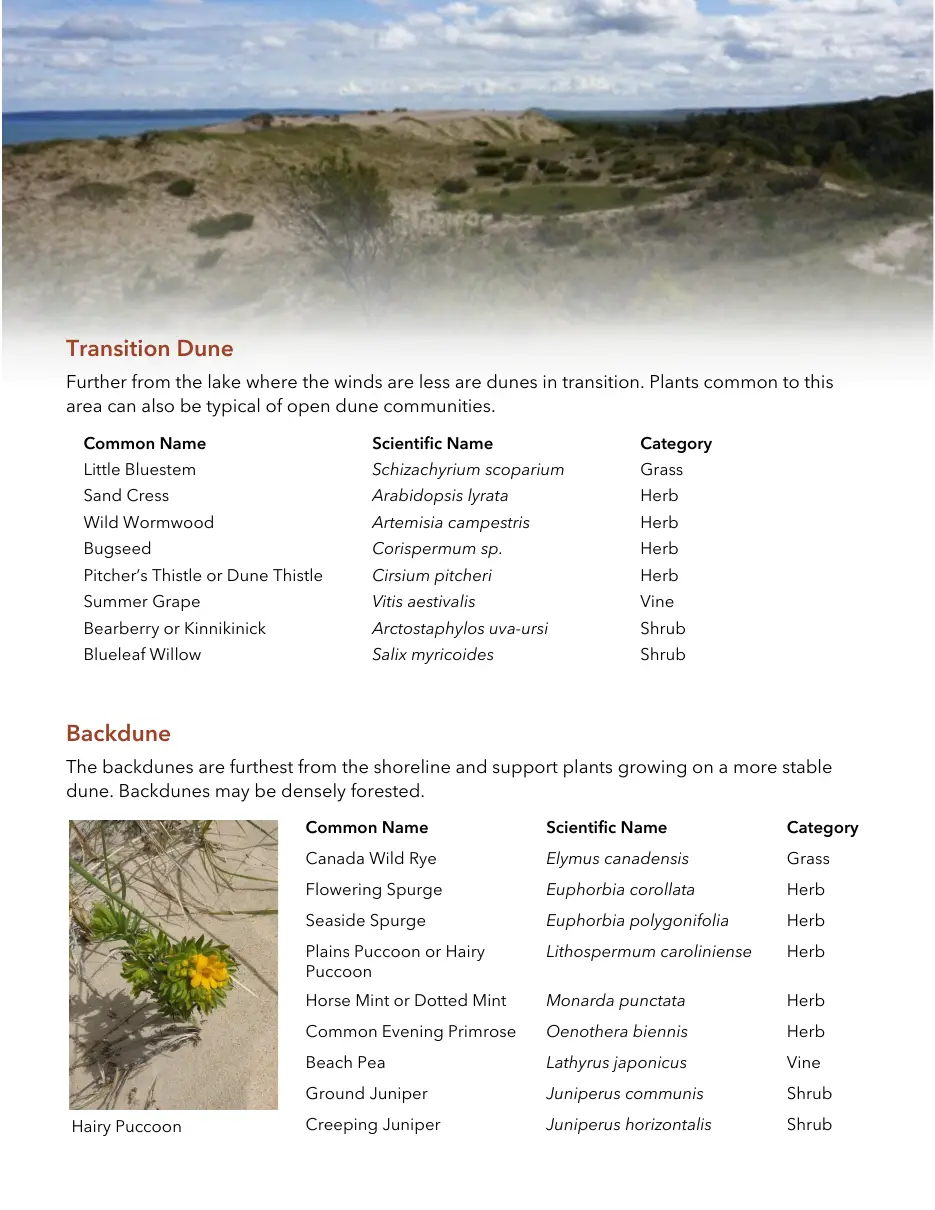
Transition Dune Further from the lake where the winds are less are dunes in transition. Plants common to this area can also be typical of open dune communities. Common Name
Scientific Name
Category
Little Bluestem
Schizachyrium scoparium
Grass
Sand Cress
Arabidopsis lyrata
Herb
Wild Wormwood
Artemisia campestris
Herb
Bugseed
Corispermum sp.
Herb
Pitcher’s Thistle or Dune Thistle
Cirsium pitcheri
Herb
Summer Grape
Vitis aestivalis
Vine
Bearberry or Kinnikinick
Arctostaphylos uva-ursi
Shrub
Blueleaf Willow
Salix myricoides
Shrub
Backdune The backdunes are furthest from the shoreline and support plants growing on a more stable dune. Backdunes may be densely forested.
Hairy Puccoon
Common Name
Scientific Name
Category
Canada Wild Rye
Elymus canadensis
Grass
Flowering Spurge
Euphorbia corollata
Herb
Seaside Spurge
Euphorbia polygonifolia
Herb
Plains Puccoon or Hairy Puccoon
Lithospermum caroliniense
Herb
Horse Mint or Dotted Mint
Monarda punctata
Herb
Common Evening Primrose
Oenothera biennis
Herb
Beach Pea
Lathyrus japonicus
Vine
Ground Juniper
Juniperus communis
Shrub
Creeping Juniper
Juniperus horizontalis
Shrub
Page 11
Text of page 11
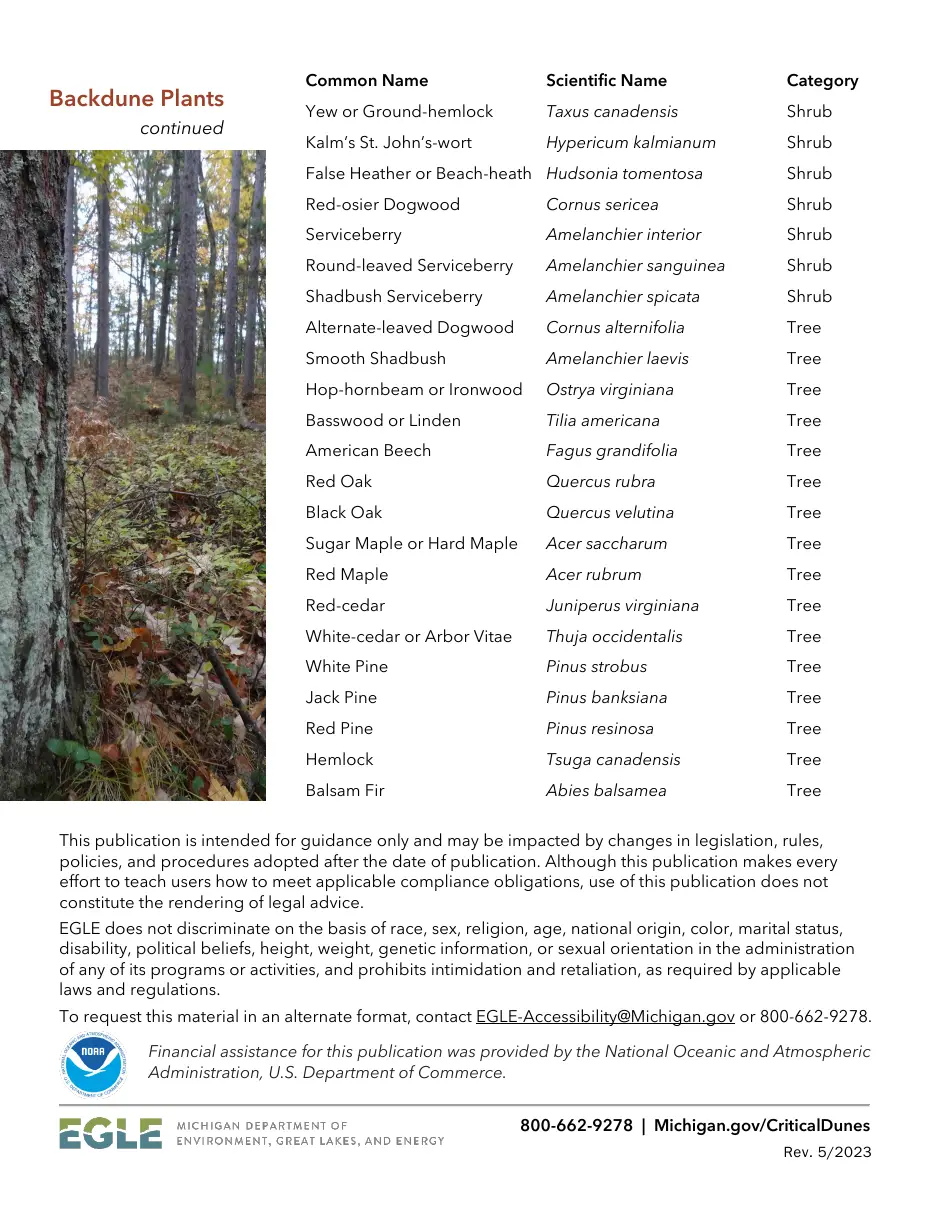
Backdune Plants continued
Common Name
Scientific Name
Category
Yew or Ground-hemlock
Taxus canadensis
Shrub
Kalm’s St. John’s-wort
Hypericum kalmianum
Shrub
False Heather or Beach-heath Hudsonia tomentosa
Shrub
Red-osier Dogwood
Cornus sericea
Shrub
Serviceberry
Amelanchier interior
Shrub
Round-leaved Serviceberry
Amelanchier sanguinea
Shrub
Shadbush Serviceberry
Amelanchier spicata
Shrub
Alternate-leaved Dogwood
Cornus alternifolia
Tree
Smooth Shadbush
Amelanchier laevis
Tree
Hop-hornbeam or Ironwood
Ostrya virginiana
Tree
Basswood or Linden
Tilia americana
Tree
American Beech
Fagus grandifolia
Tree
Red Oak
Quercus rubra
Tree
Black Oak
Quercus velutina
Tree
Sugar Maple or Hard Maple
Acer saccharum
Tree
Red Maple
Acer rubrum
Tree
Red-cedar
Juniperus virginiana
Tree
White-cedar or Arbor Vitae
Thuja occidentalis
Tree
White Pine
Pinus strobus
Tree
Jack Pine
Pinus banksiana
Tree
Red Pine
Pinus resinosa
Tree
Hemlock
Tsuga canadensis
Tree
Balsam Fir
Abies balsamea
Tree
This publication is intended for guidance only and may be impacted by changes in legislation, rules, policies, and procedures adopted after the date of publication. Although this publication makes every effort to teach users how to meet applicable compliance obligations, use of this publication does not constitute the rendering of legal advice. EGLE does not discriminate on the basis of race, sex, religion, age, national origin, color, marital status, disability, political beliefs, height, weight, genetic information, or sexual orientation in the administration of any of its programs or activities, and prohibits intimidation and retaliation, as required by applicable laws and regulations. To request this material in an alternate format, contact EGLE-Accessibility@Michigan.gov or 800-662-9278. Financial assistance for this publication was provided by the National Oceanic and Atmospheric Administration, U.S. Department of Commerce. 800-662-9278 | Michigan.gov/CriticalDunes Rev. 5/2023
Page 12
Text of page 12
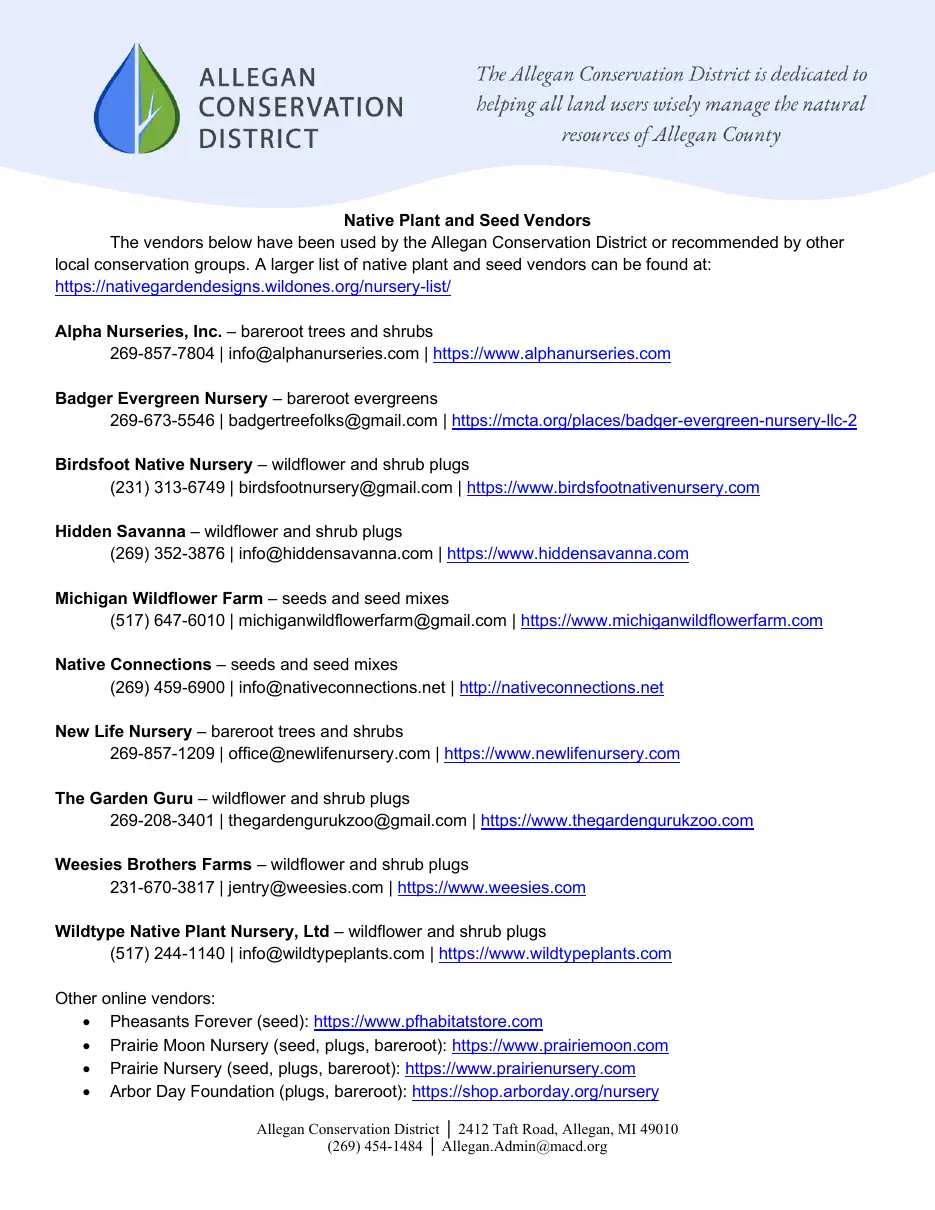
Native Plant and Seed Vendors The vendors below have been used by the Allegan Conservation District or recommended by other local conservation groups. A larger list of native plant and seed vendors can be found at: https://nativegardendesigns.wildones.org/nursery-list/ Alpha Nurseries, Inc. – bareroot trees and shrubs 269-857-7804 | info@alphanurseries.com | https://www.alphanurseries.com Badger Evergreen Nursery – bareroot evergreens 269-673-5546 | badgertreefolks@gmail.com | https://mcta.org/places/badger-evergreen-nursery-llc-2 Birdsfoot Native Nursery – wildflower and shrub plugs (231) 313-6749 | birdsfootnursery@gmail.com | https://www.birdsfootnativenursery.com Hidden Savanna – wildflower and shrub plugs (269) 352-3876 | info@hiddensavanna.com | https://www.hiddensavanna.com Michigan Wildflower Farm – seeds and seed mixes (517) 647-6010 | michiganwildflowerfarm@gmail.com | https://www.michiganwildflowerfarm.com Native Connections – seeds and seed mixes (269) 459-6900 | info@nativeconnections.net | http://nativeconnections.net New Life Nursery – bareroot trees and shrubs 269-857-1209 | office@newlifenursery.com | https://www.newlifenursery.com The Garden Guru – wildflower and shrub plugs 269-208-3401 | thegardengurukzoo@gmail.com | https://www.thegardengurukzoo.com Weesies Brothers Farms – wildflower and shrub plugs 231-670-3817 | jentry@weesies.com | https://www.weesies.com Wildtype Native Plant Nursery, Ltd – wildflower and shrub plugs (517) 244-1140 | info@wildtypeplants.com | https://www.wildtypeplants.com Other online vendors: • Pheasants Forever (seed): https://www.pfhabitatstore.com • Prairie Moon Nursery (seed, plugs, bareroot): https://www.prairiemoon.com • Prairie Nursery (seed, plugs, bareroot): https://www.prairienursery.com • Arbor Day Foundation (plugs, bareroot): https://shop.arborday.org/nursery Allegan Conservation District │ 2412 Taft Road, Allegan, MI 49010 (269) 454-1484 │ Allegan.Admin@macd.org
Page 13
Text of page 13
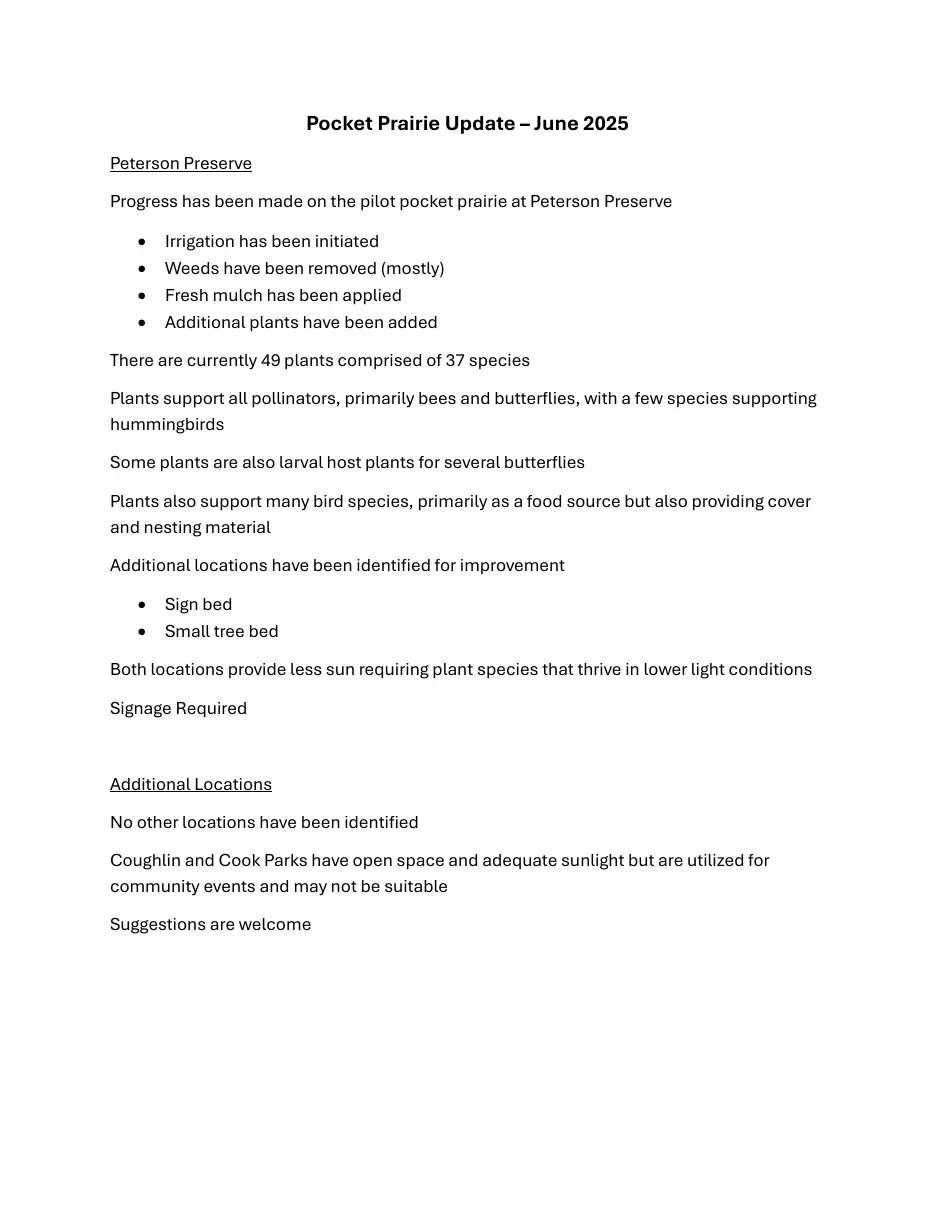
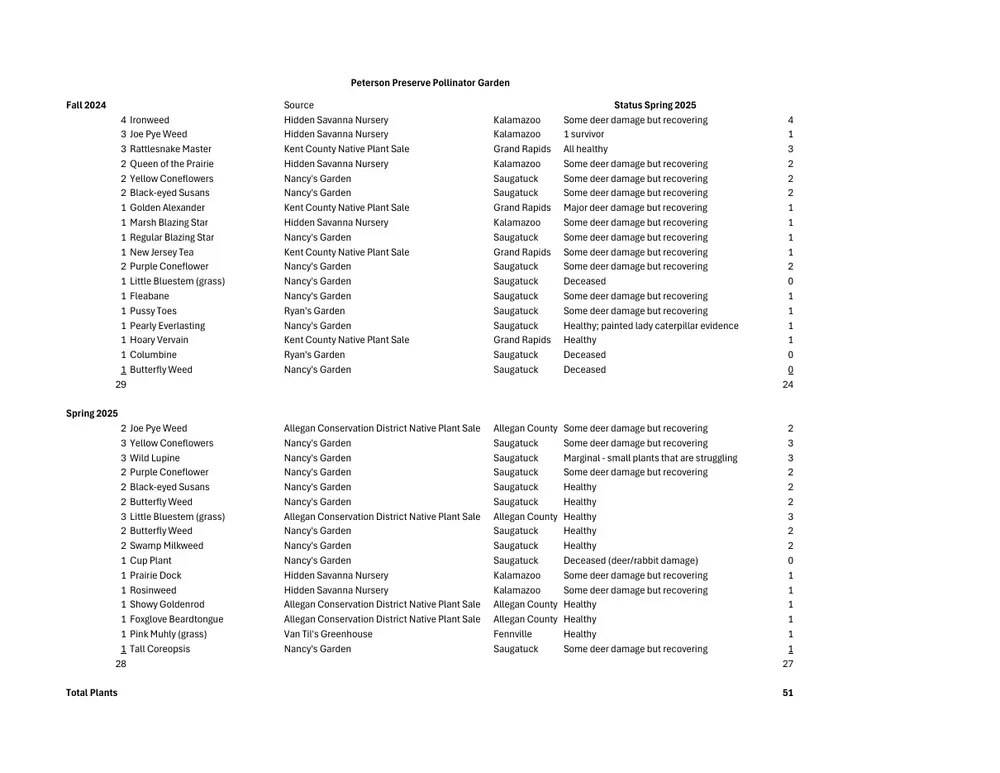
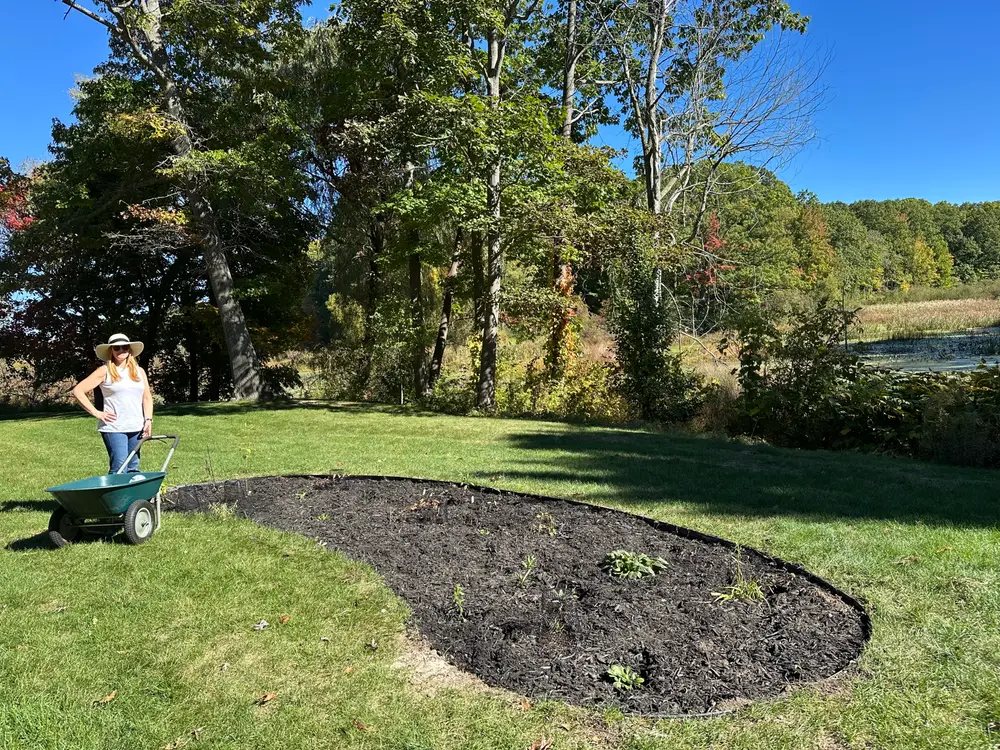
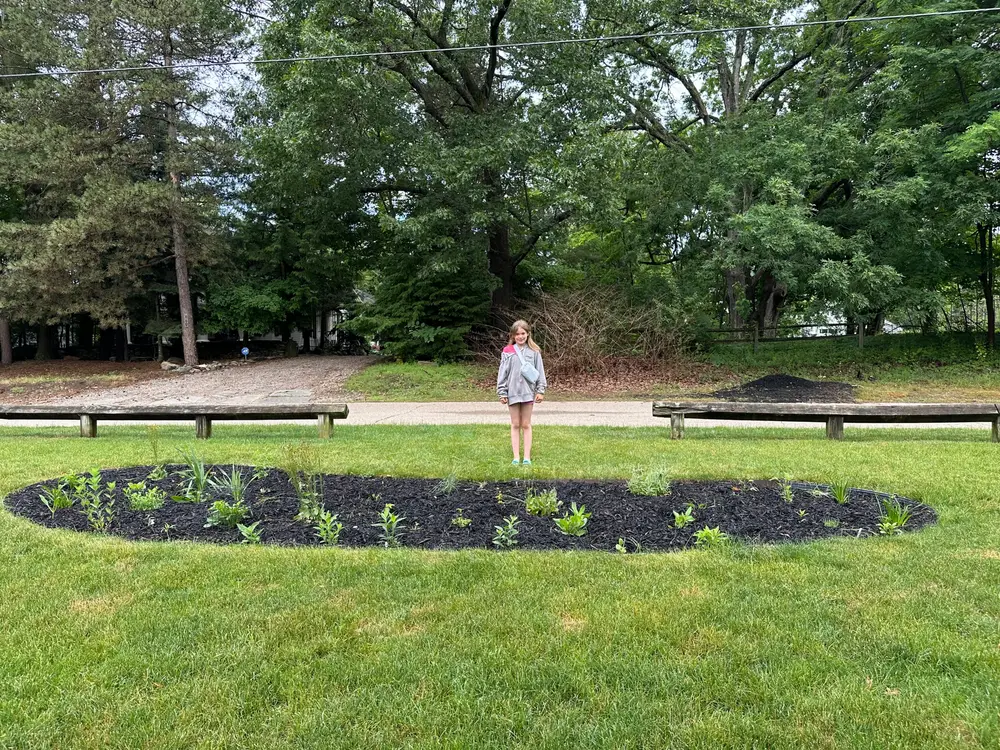
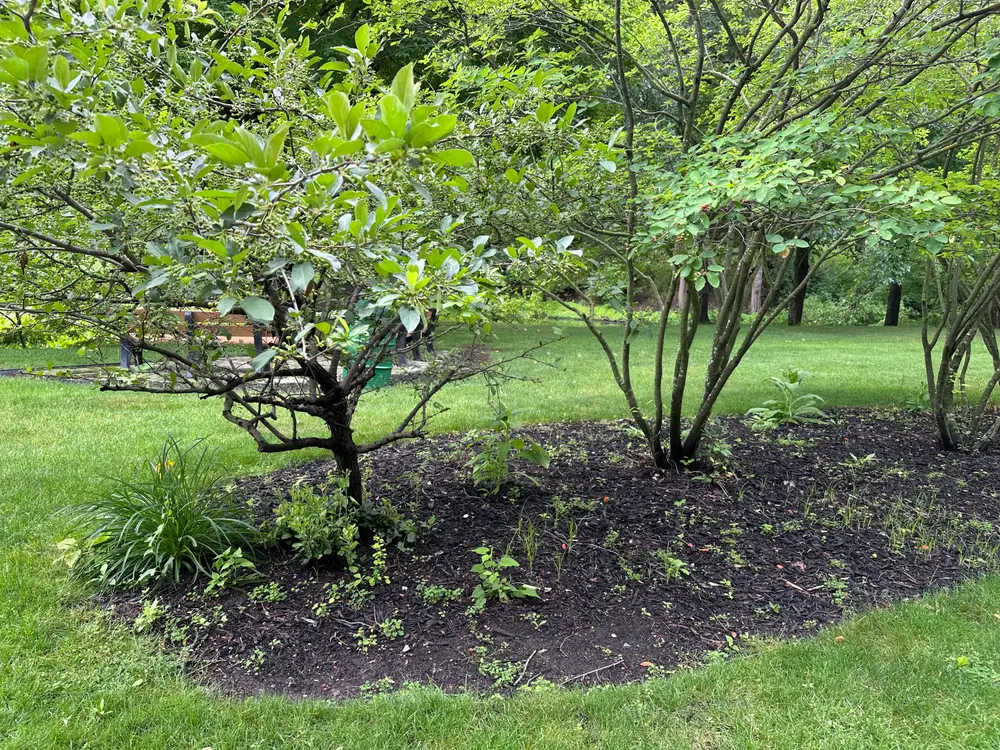
Pocket Prairie Update – June 2025 Peterson Preserve Progress has been made on the pilot pocket prairie at Peterson Preserve • • • •
Irrigation has been initiated Weeds have been removed (mostly) Fresh mulch has been applied Additional plants have been added
There are currently 49 plants comprised of 37 species Plants support all pollinators, primarily bees and butterflies, with a few species supporting hummingbirds Some plants are also larval host plants for several butterflies Plants also support many bird species, primarily as a food source but also providing cover and nesting material Additional locations have been identified for improvement • •
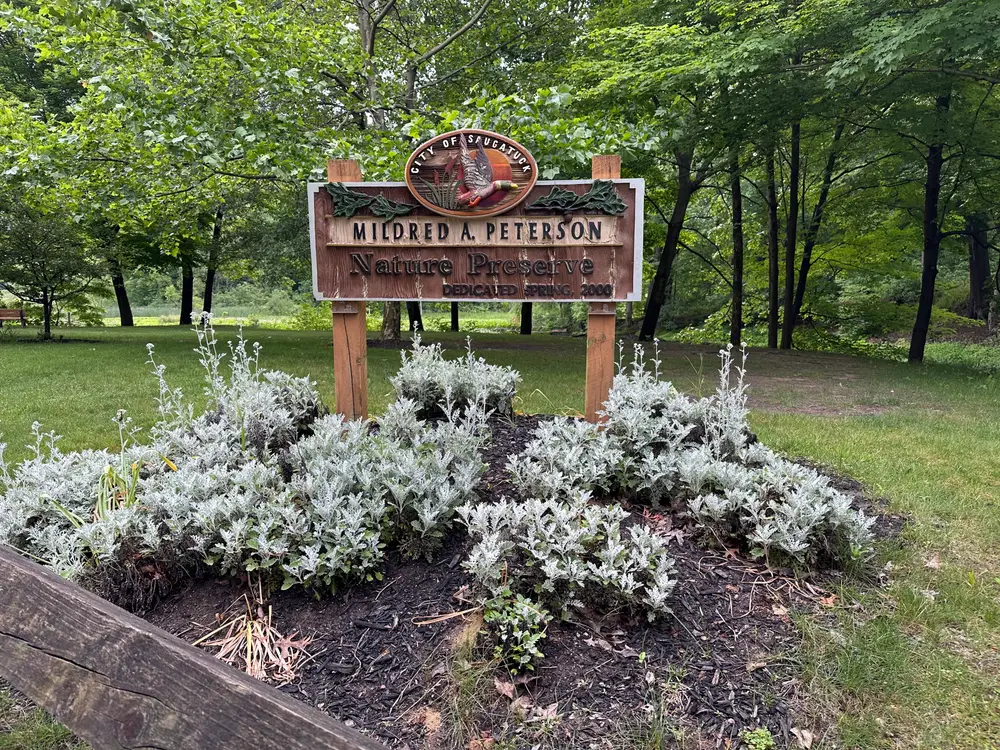
Sign bed Small tree bed
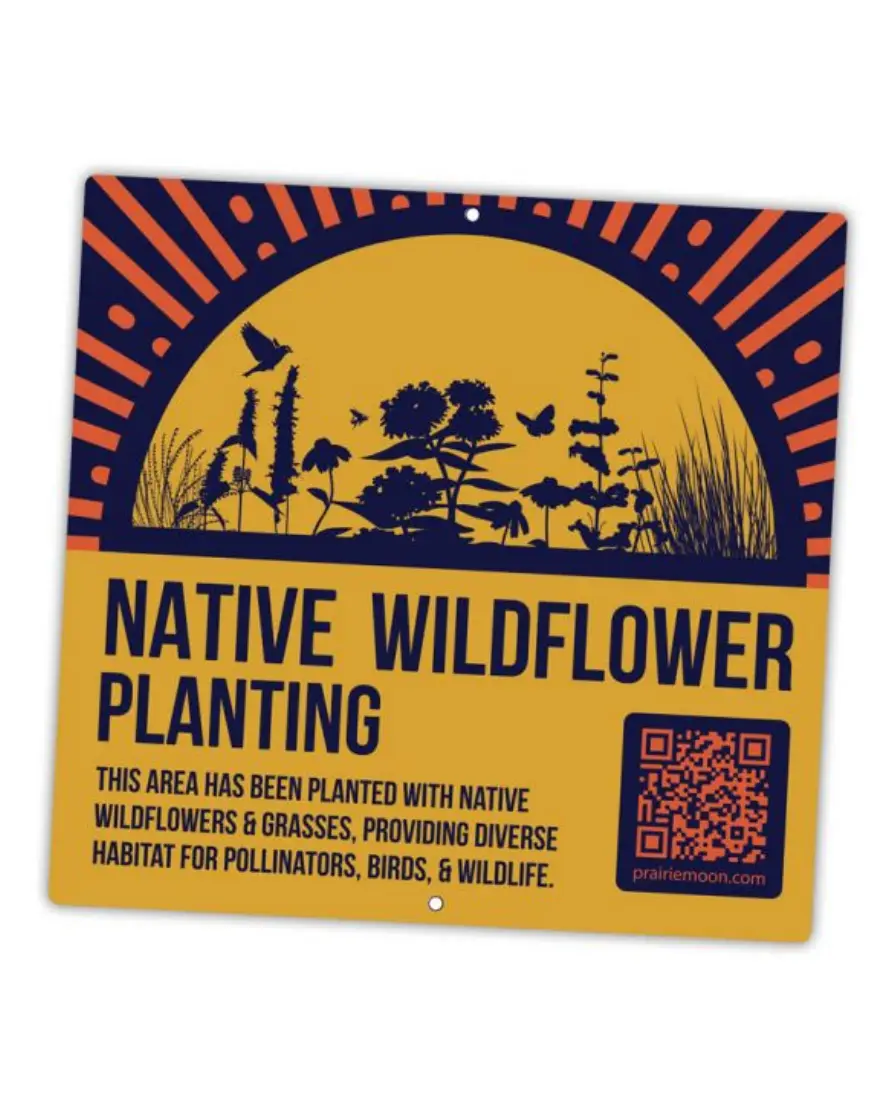
Both locations provide less sun requiring plant species that thrive in lower light conditions Signage Required
Additional Locations No other locations have been identified Coughlin and Cook Parks have open space and adequate sunlight but are utilized for community events and may not be suitable Suggestions are welcome
Page 14
Text of page 14
Peterson Preserve Pollinator Garden Fall 2024 4 Ironweed 3 Joe Pye Weed 3 Rattlesnake Master 2 Queen of the Prairie 2 Yellow Coneflowers 2 Black-eyed Susans 1 Golden Alexander 1 Marsh Blazing Star 1 Regular Blazing Star 1 New Jersey Tea 2 Purple Coneflower 1 Little Bluestem (grass) 1 Fleabane 1 Pussy Toes 1 Pearly Everlasting 1 Hoary Vervain 1 Columbine 1 Butterfly Weed 29
Source Hidden Savanna Nursery Hidden Savanna Nursery Kent County Native Plant Sale Hidden Savanna Nursery Nancy's Garden Nancy's Garden Kent County Native Plant Sale Hidden Savanna Nursery Nancy's Garden Kent County Native Plant Sale Nancy's Garden Nancy's Garden Nancy's Garden Ryan's Garden Nancy's Garden Kent County Native Plant Sale Ryan's Garden Nancy's Garden
Kalamazoo Kalamazoo Grand Rapids Kalamazoo Saugatuck Saugatuck Grand Rapids Kalamazoo Saugatuck Grand Rapids Saugatuck Saugatuck Saugatuck Saugatuck Saugatuck Grand Rapids Saugatuck Saugatuck
Allegan Conservation District Native Plant Sale Nancy's Garden Nancy's Garden Nancy's Garden Nancy's Garden Nancy's Garden Allegan Conservation District Native Plant Sale Nancy's Garden Nancy's Garden Nancy's Garden Hidden Savanna Nursery Hidden Savanna Nursery Allegan Conservation District Native Plant Sale Allegan Conservation District Native Plant Sale Van Til's Greenhouse Nancy's Garden
Allegan County Some deer damage but recovering Saugatuck Some deer damage but recovering Saugatuck Marginal - small plants that are struggling Saugatuck Some deer damage but recovering Saugatuck Healthy Saugatuck Healthy Allegan County Healthy Saugatuck Healthy Saugatuck Healthy Saugatuck Deceased (deer/rabbit damage) Kalamazoo Some deer damage but recovering Kalamazoo Some deer damage but recovering Allegan County Healthy Allegan County Healthy Fennville Healthy Saugatuck Some deer damage but recovering
Status Spring 2025 Some deer damage but recovering 1 survivor All healthy Some deer damage but recovering Some deer damage but recovering Some deer damage but recovering Major deer damage but recovering Some deer damage but recovering Some deer damage but recovering Some deer damage but recovering Some deer damage but recovering Deceased Some deer damage but recovering Some deer damage but recovering Healthy; painted lady caterpillar evidence Healthy Deceased Deceased
4 1 3 2 2 2 1 1 1 1 2 0 1 1 1 1 0 0 24
Spring 2025 2 Joe Pye Weed 3 Yellow Coneflowers 3 Wild Lupine 2 Purple Coneflower 2 Black-eyed Susans 2 Butterfly Weed 3 Little Bluestem (grass) 2 Butterfly Weed 2 Swamp Milkweed 1 Cup Plant 1 Prairie Dock 1 Rosinweed 1 Showy Goldenrod 1 Foxglove Beardtongue 1 Pink Muhly (grass) 1 Tall Coreopsis 28 Total Plants
2 3 3 2 2 2 3 2 2 0 1 1 1 1 1 1 27 51
Page 15
This page is a scanned image with no text layer. The PDF of these pages has it at full resolution.
Page 16
This page is a scanned image with no text layer. The PDF of these pages has it at full resolution.
Page 17
This page is a scanned image with no text layer. The PDF of these pages has it at full resolution.
Page 18
This page is a scanned image with no text layer. The PDF of these pages has it at full resolution.
Page 19
This page is a scanned image with no text layer. The PDF of these pages has it at full resolution.