
Parking Task Force Agenda item 7B
Jeff Blandford email
Parking Improvements Task Force, Tuesday, June 30, 2026
Download these 10 pages, 802 KB Whole packet, 44 pages, 1.6 MB
Page 35
Text of page 35
Dorsett, John From: Sent: To: Cc: Subject:
Ryan Cummins Tuesday, May 26, 2026 1 :20 PM Wendy Colsen; Gregory Muncey; Jamie Wolters Dorsett, John RE: Parking thoughts from Jeff
CAUTION: External Email: Do not click links or attachments unless you recognize the sender.
Thanks Wendy! We will include as correspondence in the next meeting packet. Thank you, Ryan Cummins City Manager City of Saugatuck 102 Butler St PO Box 86 Saugatuck,Ml49453 Ph: (269) 224-9443 From: Wendy Colsen Sent: Tuesday, May 26, 2026 7:29 AM To: Gregory Muncey
; Ryan Cummins
; Jamie Wolters
Subject: Fwd: Parking thoughts from Jeff
This email originated from outside of the organization. DO NOT click on links or Caution: open attachments unless you recognize the sender and know the content is safe.
Here's some community input to pass along to the committee. '1il Sent from my iPhone Begin forwarded message: From: Wendy Colsen Date: May 25, 2026 at 9:23:36 AM EDT To: Jeff Blandford Subject: Re: Parking thoughts from Jeff
Page 36
Text of page 36
Thanks, Jeff. I’ll pass this along! Sent from my iPhone
On May 15, 2026, at 3:23 PM, Jeff Blandford wrote:
With 24 years of observing parking in Saugatuck, I have witnessed a lot. My thoughts are unbiased to the best of my abilities. The conversation has different parts. 1. Customer Parking 2. Employee Parking 3. upstairs tenants (downtown residents) Concerns: 1. People give up and leave Saugatuck: I'm told this often by customers. 2. Blocking driveways/hydrants: Neighbor driveway often illegally blocked for hours at a time. 3. Angry conflicts over parking: I have seen many shouting matches and a couple shoving matches over parking. 4. Little to no Authoritative presence 5. Restaurant sales in closed off public parking spaces
Only recently has there been any kind of enforcement of parking. There are many signs posted "3 hour parking" but I've never seen them enforced before. The posted signs might as well be taken down if we are telling people that we don't even try to enforce our "rules". Enforcement is an obvious place to start. It should be done consistently and often, with a phone number for people to call that brings a quick response. The expensive answer would be to turn the SCA parking lot (or other space) into a 2-3 story parking complex. Retail and coffee on the bottom level... solar panels and wind turbines could make it off-grid and eco friendly. Done artfully to be a Saugatuck Version of a parking garage. Likely too expensive, but the only significant solution to adding parking. I understand the Covid-time need for outdoor dining, but those parking spots belong to all customers, not just that of a particular business. Permanently blocking off parking for these spaces, while the restaurant is only open for around 8 hours per day seems illogical and unfair to me, in the post-covid world. 10+ parking spots could easily turn over 5-10 times each in a single day... resulting in a parking spot for 50-100 different vehicles per day. This is potentially hundreds of "lost" shoppers for both retail and restaurants.
Page 37
Text of page 37
In town we have businesses of many sizes. My own gallery has a single employee at a time, requiring one parking space to open my business to the public. Businesses that have many employees per shift should be conscientious of this, and encourage employees to leave the "easy" parking for customers. There is a lot that falls onto individual business conduct and willingness to help with parking gains. My last thought is Biking: Our town is small and very bikeable. We should be encouraging biking by having consistent City Bike Racks in obvious places. It is surprisingly challenging for bikers to leave their bikes, and they often step on my gallery landscaping in order to lock their bikes to a tree (or sometimes my gallery door handle)!! Encouraging biking will make available a few more parking spaces each day. I'd be happy to chat more with anyone if there is a desire. Thanks for your time with helping to figure out improvements. Jeff
Page 38
Text of page 38
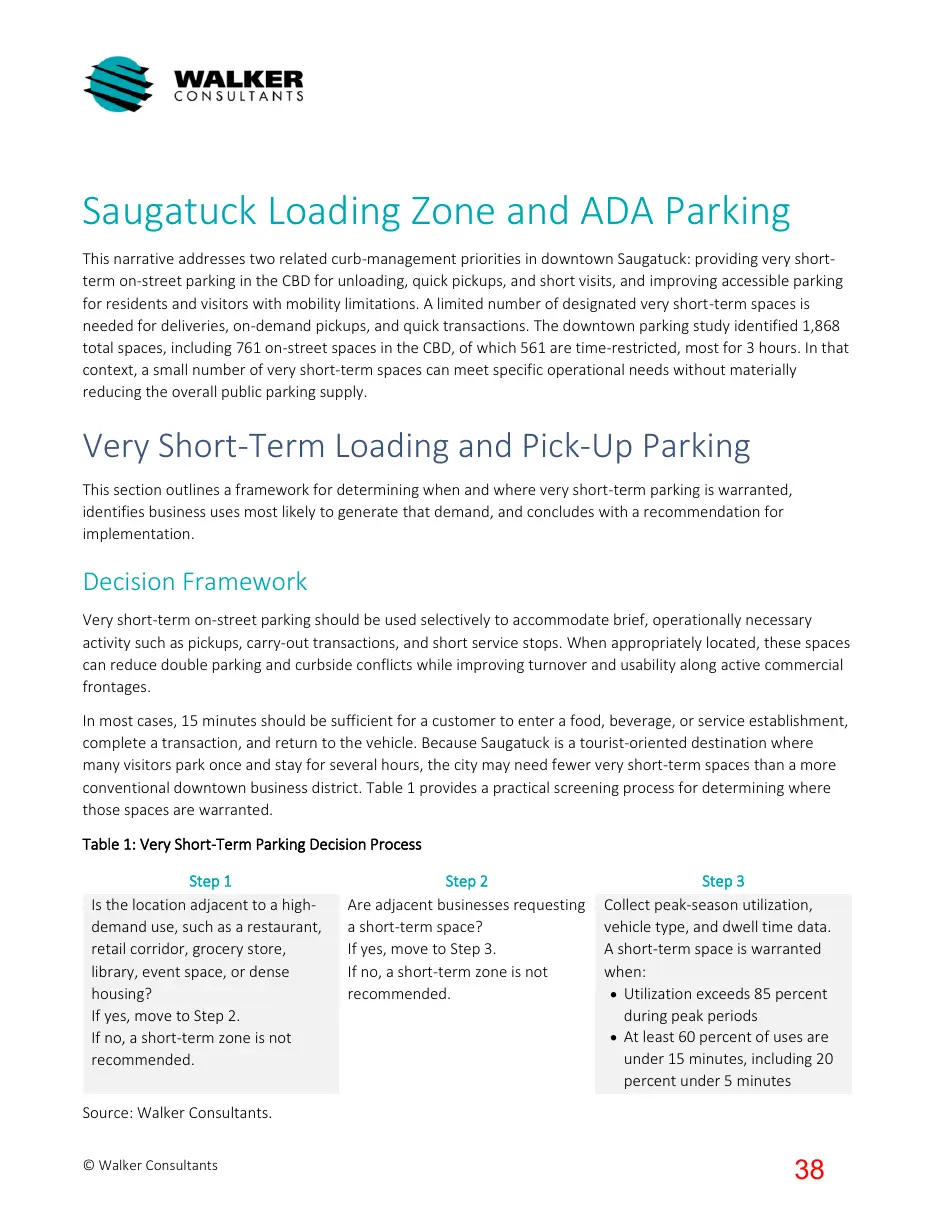
Saugatuck Loading Zone and ADA Parking This narrative addresses two related curb-management priorities in downtown Saugatuck: providing very shortterm on-street parking in the CBD for unloading, quick pickups, and short visits, and improving accessible parking for residents and visitors with mobility limitations. A limited number of designated very short-term spaces is needed for deliveries, on-demand pickups, and quick transactions. The downtown parking study identified 1,868 total spaces, including 761 on-street spaces in the CBD, of which 561 are time-restricted, most for 3 hours. In that context, a small number of very short-term spaces can meet specific operational needs without materially reducing the overall public parking supply.
Very Short-Term Loading and Pick-Up Parking This section outlines a framework for determining when and where very short-term parking is warranted, identifies business uses most likely to generate that demand, and concludes with a recommendation for implementation.
Decision Framework Very short-term on-street parking should be used selectively to accommodate brief, operationally necessary activity such as pickups, carry-out transactions, and short service stops. When appropriately located, these spaces can reduce double parking and curbside conflicts while improving turnover and usability along active commercial frontages. In most cases, 15 minutes should be sufficient for a customer to enter a food, beverage, or service establishment, complete a transaction, and return to the vehicle. Because Saugatuck is a tourist-oriented destination where many visitors park once and stay for several hours, the city may need fewer very short-term spaces than a more conventional downtown business district. Table 1 provides a practical screening process for determining where those spaces are warranted. Table 1: Very Short-Term Parking Decision Process Step 1 Is the location adjacent to a highdemand use, such as a restaurant, retail corridor, grocery store, library, event space, or dense housing? If yes, move to Step 2. If no, a short-term zone is not recommended.
Step 2 Are adjacent businesses requesting a short-term space? If yes, move to Step 3. If no, a short-term zone is not recommended.
Step 3 Collect peak-season utilization, vehicle type, and dwell time data. A short-term space is warranted when: • Utilization exceeds 85 percent during peak periods • At least 60 percent of uses are under 15 minutes, including 20 percent under 5 minutes
Source: Walker Consultants. © Walker Consultants
Page 39
Text of page 39
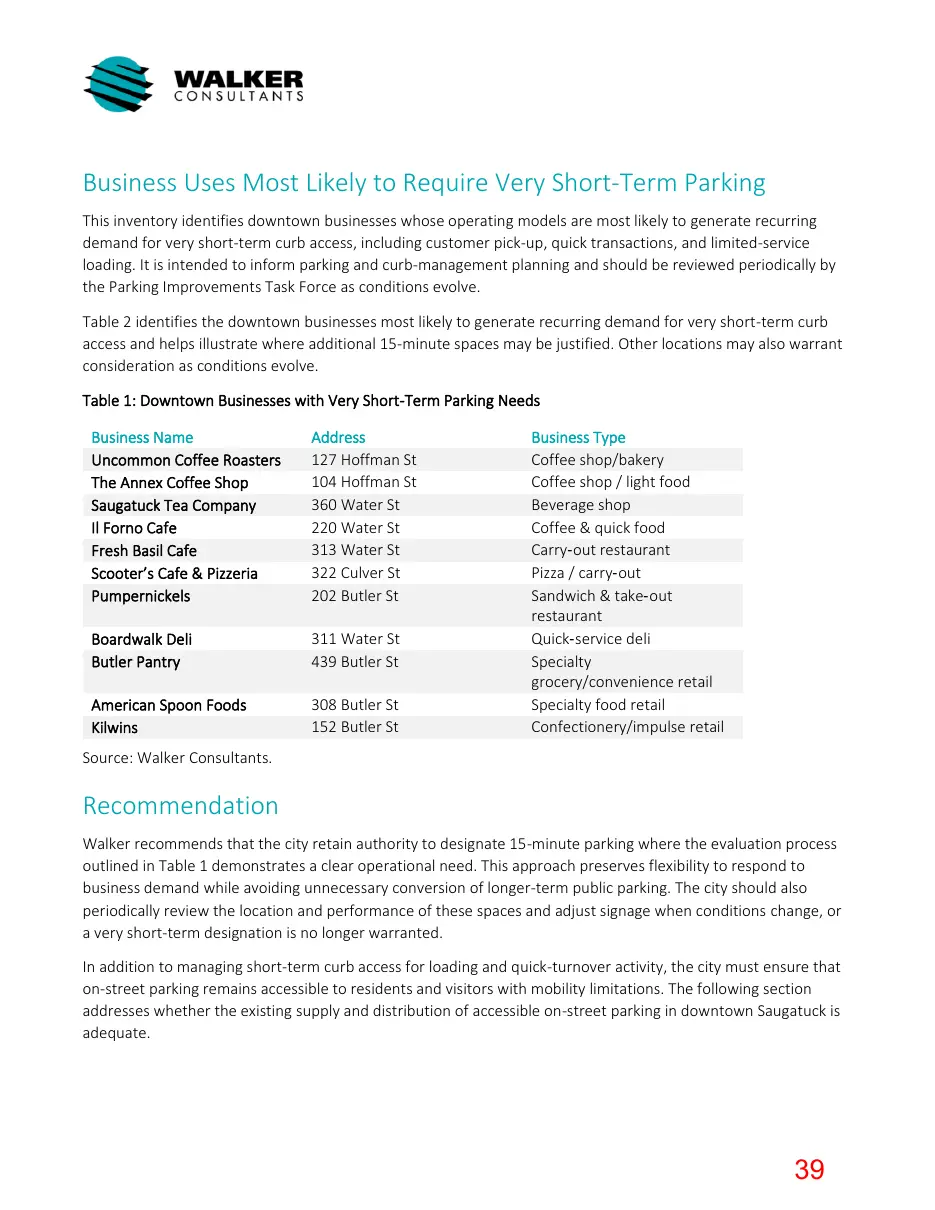
Business Uses Most Likely to Require Very Short-Term Parking This inventory identifies downtown businesses whose operating models are most likely to generate recurring demand for very short-term curb access, including customer pick-up, quick transactions, and limited-service loading. It is intended to inform parking and curb-management planning and should be reviewed periodically by the Parking Improvements Task Force as conditions evolve. Table 2 identifies the downtown businesses most likely to generate recurring demand for very short-term curb access and helps illustrate where additional 15-minute spaces may be justified. Other locations may also warrant consideration as conditions evolve. Table 1: Downtown Businesses with Very Short-Term Parking Needs Business Name Uncommon Coffee Roasters The Annex Coffee Shop Saugatuck Tea Company Il Forno Cafe Fresh Basil Cafe Scooter’s Cafe & Pizzeria Pumpernickels
Address 127 Hoffman St 104 Hoffman St 360 Water St 220 Water St 313 Water St 322 Culver St 202 Butler St
Boardwalk Deli Butler Pantry
311 Water St 439 Butler St
American Spoon Foods Kilwins
308 Butler St 152 Butler St
Business Type Coffee shop/bakery Coffee shop / light food Beverage shop Coffee & quick food Carry‑out restaurant Pizza / carry‑out Sandwich & take‑out restaurant Quick‑service deli Specialty grocery/convenience retail Specialty food retail Confectionery/impulse retail
Source: Walker Consultants.
Recommendation Walker recommends that the city retain authority to designate 15-minute parking where the evaluation process outlined in Table 1 demonstrates a clear operational need. This approach preserves flexibility to respond to business demand while avoiding unnecessary conversion of longer-term public parking. The city should also periodically review the location and performance of these spaces and adjust signage when conditions change, or a very short-term designation is no longer warranted. In addition to managing short-term curb access for loading and quick-turnover activity, the city must ensure that on-street parking remains accessible to residents and visitors with mobility limitations. The following section addresses whether the existing supply and distribution of accessible on-street parking in downtown Saugatuck is adequate.
Page 40
Text of page 40
Accessible On-Street Parking Local Need and Existing Supply Saugatuck’s permanent resident and tourist populations are older than those in Michigan and the United States, and older populations are more likely to require accessible parking. At present, only 10 of the city’s 761 on-street parking spaces in the CBD, or 1.3 percent, are accessible. This falls below both the long-established 2 percent offstreet benchmark and the 4 percent on-street guidance reflected in the Public Rights-of-Way Accessibility Guidelines (PROWAG). Survey responses and stakeholder interviews also indicate that accessible parking is perceived as insufficient in both quantity and location.
Demographic and Stakeholder Evidence The demographic and stakeholder record supports the conclusion that accessible parking demand in Saugatuck is likely higher than in many comparable communities. Both resident and visitor age profiles skew older than state and national benchmarks, and survey respondents and interview participants raised concerns about the number, location, enforcement, and usability of accessible spaces in the CBD.
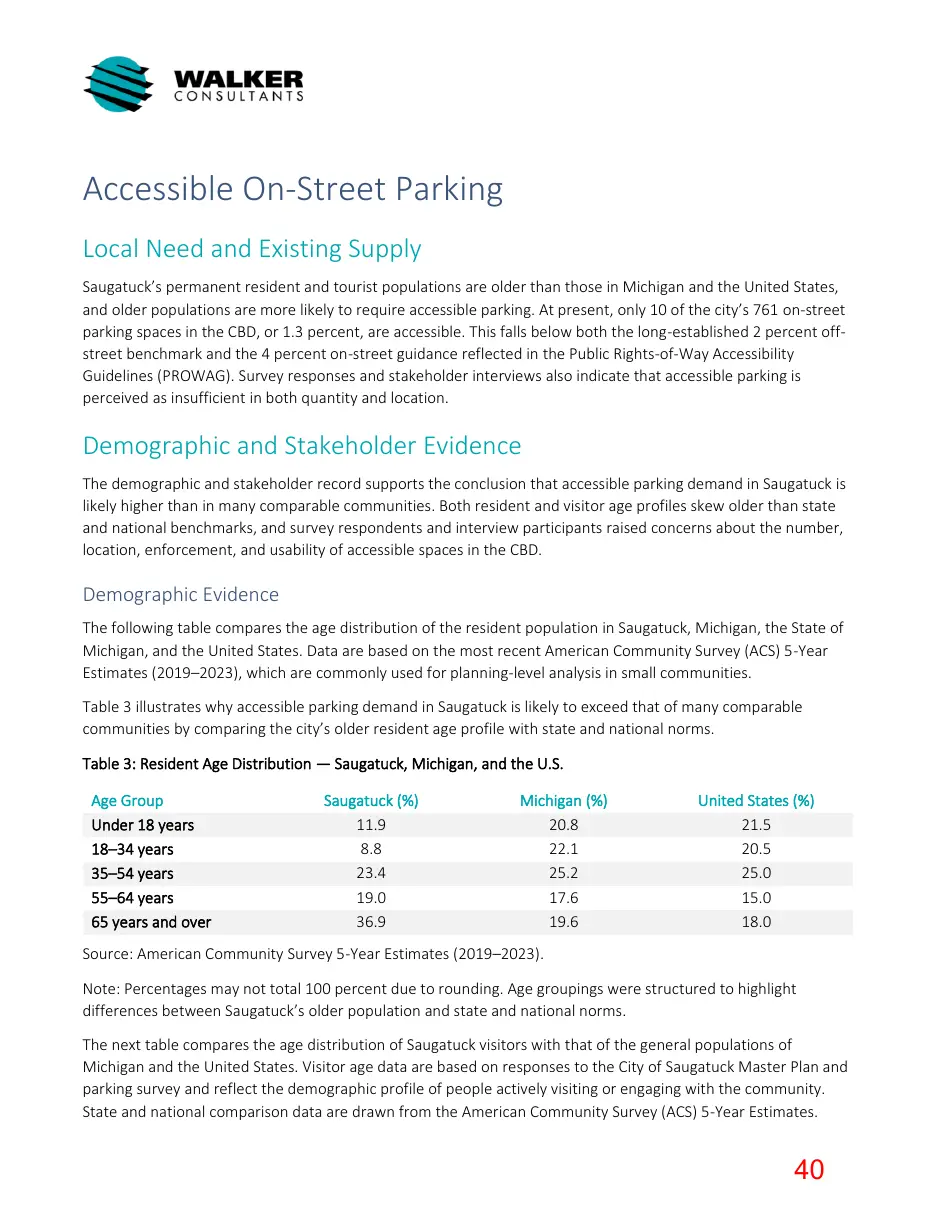
Demographic Evidence The following table compares the age distribution of the resident population in Saugatuck, Michigan, the State of Michigan, and the United States. Data are based on the most recent American Community Survey (ACS) 5-Year Estimates (2019–2023), which are commonly used for planning-level analysis in small communities. Table 3 illustrates why accessible parking demand in Saugatuck is likely to exceed that of many comparable communities by comparing the city’s older resident age profile with state and national norms. Table 3: Resident Age Distribution — Saugatuck, Michigan, and the U.S. Age Group Under 18 years 18–34 years 35–54 years 55–64 years 65 years and over
Saugatuck (%) 11.9 8.8 23.4 19.0 36.9
Michigan (%) 20.8 22.1 25.2 17.6 19.6
United States (%) 21.5 20.5 25.0 15.0 18.0
Source: American Community Survey 5-Year Estimates (2019–2023). Note: Percentages may not total 100 percent due to rounding. Age groupings were structured to highlight differences between Saugatuck’s older population and state and national norms. The next table compares the age distribution of Saugatuck visitors with that of the general populations of Michigan and the United States. Visitor age data are based on responses to the City of Saugatuck Master Plan and parking survey and reflect the demographic profile of people actively visiting or engaging with the community. State and national comparison data are drawn from the American Community Survey (ACS) 5-Year Estimates.
Page 41
Text of page 41
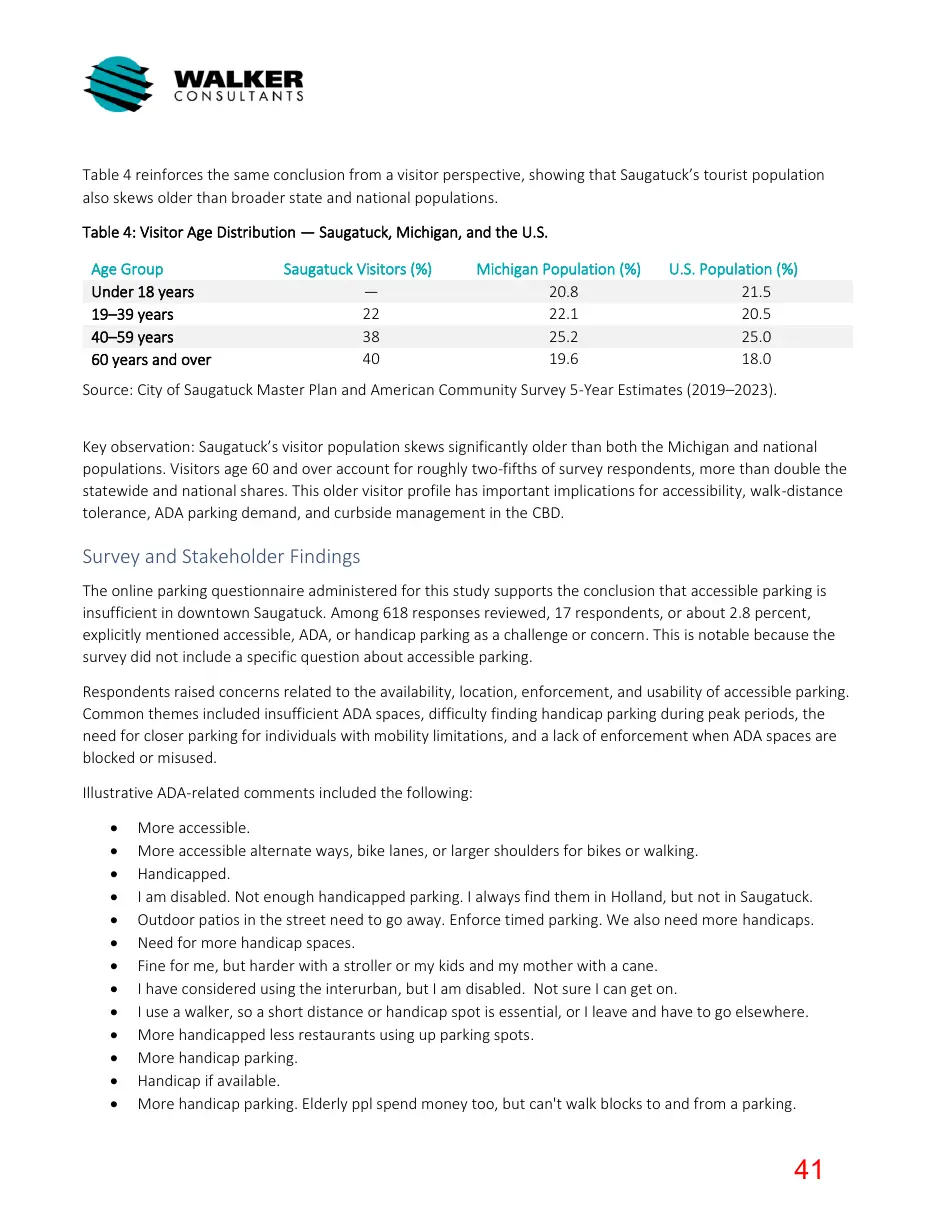
Table 4 reinforces the same conclusion from a visitor perspective, showing that Saugatuck’s tourist population also skews older than broader state and national populations. Table 4: Visitor Age Distribution — Saugatuck, Michigan, and the U.S. Age Group Under 18 years 19–39 years 40–59 years 60 years and over
Saugatuck Visitors (%) — 22 38 40
Michigan Population (%) 20.8 22.1 25.2 19.6
U.S. Population (%) 21.5 20.5 25.0 18.0
Source: City of Saugatuck Master Plan and American Community Survey 5-Year Estimates (2019–2023). Key observation: Saugatuck’s visitor population skews significantly older than both the Michigan and national populations. Visitors age 60 and over account for roughly two-fifths of survey respondents, more than double the statewide and national shares. This older visitor profile has important implications for accessibility, walk-distance tolerance, ADA parking demand, and curbside management in the CBD.
Survey and Stakeholder Findings The online parking questionnaire administered for this study supports the conclusion that accessible parking is insufficient in downtown Saugatuck. Among 618 responses reviewed, 17 respondents, or about 2.8 percent, explicitly mentioned accessible, ADA, or handicap parking as a challenge or concern. This is notable because the survey did not include a specific question about accessible parking. Respondents raised concerns related to the availability, location, enforcement, and usability of accessible parking. Common themes included insufficient ADA spaces, difficulty finding handicap parking during peak periods, the need for closer parking for individuals with mobility limitations, and a lack of enforcement when ADA spaces are blocked or misused. Illustrative ADA-related comments included the following: • • • • • • • • • • • • •
More accessible. More accessible alternate ways, bike lanes, or larger shoulders for bikes or walking. Handicapped. I am disabled. Not enough handicapped parking. I always find them in Holland, but not in Saugatuck. Outdoor patios in the street need to go away. Enforce timed parking. We also need more handicaps. Need for more handicap spaces. Fine for me, but harder with a stroller or my kids and my mother with a cane. I have considered using the interurban, but I am disabled. Not sure I can get on. I use a walker, so a short distance or handicap spot is essential, or I leave and have to go elsewhere. More handicapped less restaurants using up parking spots. More handicap parking. Handicap if available. More handicap parking. Elderly ppl spend money too, but can't walk blocks to and from a parking.
Page 42
Text of page 42
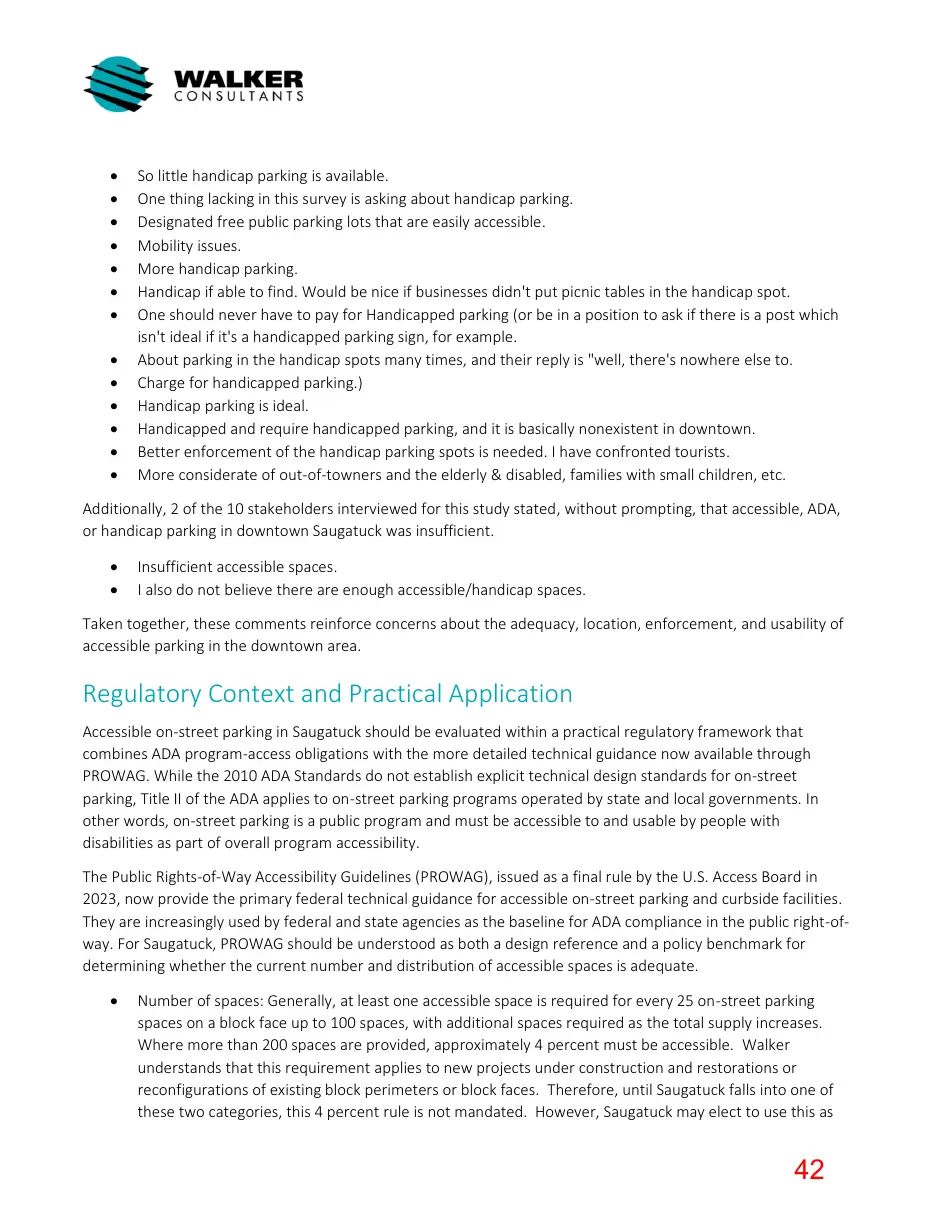
So little handicap parking is available. One thing lacking in this survey is asking about handicap parking. Designated free public parking lots that are easily accessible. Mobility issues. More handicap parking. Handicap if able to find. Would be nice if businesses didn't put picnic tables in the handicap spot. One should never have to pay for Handicapped parking (or be in a position to ask if there is a post which isn't ideal if it's a handicapped parking sign, for example. About parking in the handicap spots many times, and their reply is "well, there's nowhere else to. Charge for handicapped parking.) Handicap parking is ideal. Handicapped and require handicapped parking, and it is basically nonexistent in downtown. Better enforcement of the handicap parking spots is needed. I have confronted tourists. More considerate of out-of-towners and the elderly & disabled, families with small children, etc.
Additionally, 2 of the 10 stakeholders interviewed for this study stated, without prompting, that accessible, ADA, or handicap parking in downtown Saugatuck was insufficient. • •
Insufficient accessible spaces. I also do not believe there are enough accessible/handicap spaces.
Taken together, these comments reinforce concerns about the adequacy, location, enforcement, and usability of accessible parking in the downtown area.
Regulatory Context and Practical Application Accessible on-street parking in Saugatuck should be evaluated within a practical regulatory framework that combines ADA program-access obligations with the more detailed technical guidance now available through PROWAG. While the 2010 ADA Standards do not establish explicit technical design standards for on-street parking, Title II of the ADA applies to on-street parking programs operated by state and local governments. In other words, on-street parking is a public program and must be accessible to and usable by people with disabilities as part of overall program accessibility. The Public Rights-of-Way Accessibility Guidelines (PROWAG), issued as a final rule by the U.S. Access Board in 2023, now provide the primary federal technical guidance for accessible on-street parking and curbside facilities. They are increasingly used by federal and state agencies as the baseline for ADA compliance in the public right-ofway. For Saugatuck, PROWAG should be understood as both a design reference and a policy benchmark for determining whether the current number and distribution of accessible spaces is adequate. •
Number of spaces: Generally, at least one accessible space is required for every 25 on-street parking spaces on a block face up to 100 spaces, with additional spaces required as the total supply increases. Where more than 200 spaces are provided, approximately 4 percent must be accessible. Walker understands that this requirement applies to new projects under construction and restorations or reconfigurations of existing block perimeters or block faces. Therefore, until Saugatuck falls into one of these two categories, this 4 percent rule is not mandated. However, Saugatuck may elect to use this as
Page 43
Text of page 43
guidance. Based on 761 on-street parking spaces in the CBD, 4 percent would be 30 ADA spaces. At present, 10 accessible on-street parking spaces were identified as follows in the CBD: o 100 Block of Hoffman Street (1) o 100 Block of Mary Street (1) o 100 Block of Main Street (1) o 100 Block of Mason Street (1) o 200 Block of Mason Street (1) o 100 Block of Griffith Street (1) o 100 Block of Water Street (2) o 00 Block of Butler Street (2) Design and access: Accessible on-street spaces should be reasonably level and connected to the sidewalk network by a continuous accessible pedestrian route. Where sidewalk width allows (typically 14 feet or more), a street-level access aisle at least 5 feet wide should be provided. Signage and markings: Accessible spaces should be clearly designated using the International Symbol of Accessibility and appropriate pavement markings to discourage encroachment and ensure visibility.
In Michigan, accessible on-street parking is generally implemented through Title II obligations interpreted in conjunction with PROWAG. MDOT and local jurisdictions commonly use PROWAG to guide curbside design while allowing flexibility in older downtowns, historic districts, and resort communities where physical constraints may complicate full retrofit. Even where those constraints exist, the governing principle remains that accessible parking should be provided to the maximum extent feasible and distributed in a way that preserves meaningful access to key destinations.
Recommendation Walker recommends that the city use PROWAG as the guiding framework for expanding accessible on-street parking in the CBD and increase the current supply from 10 spaces to approximately 30 spaces over time. Additional spaces should be distributed across the core business district, including Water, Butler, Main, Hoffman, Mason, and Culver Streets, to improve access to key destinations. This expansion should be paired with regular enforcement, utilization monitoring, and periodic reassessment so the city can refine the program as demand patterns and physical conditions evolve.
Page 44
Text of page 44
Proposed Final Deliverable Framework This document presents the proposed framework for the final parking study deliverable. It is intended to include a comprehensive executive summary and a digital binder organized around the white papers and supporting materials prepared for Parking Improvement Task Force meetings. The outline below identifies the proposed structure and content of the final deliverable. 1. Executive Summary and Recommended Actions a. Refrain from Advancing Paid Parking or Structured Parking at This Time and Why b. Strengthen Enforcement Practices and Ambassador Presence c. Expand Remote Parking, Shared Parking Arrangements, and Interurban Operations d. Improve Signage, Wayfinding, and Public Information 2. Study Purpose and Background a. Scope of Services b. Background 3. Existing Conditions and Key Findings a. Parking Inventory b. Occupancy Study Results c. Questionnaire Results d. Stakeholder Interview Findings e. Peer Community Review f. Framing Parking Challenges in Saugatuck g. Wayfinding, Signage, and Communications Review h. Future Growth and Parking Impacts 4. Alternatives Considered a. Paid Parking Considerations for Saugatuck b. Cost to Build and Operate a Parking Structure in Saugatuck c. Saugatuck Remote Parking, Interurban Expansion, and Shared Parking d. Increased Parking Enforcement and Ambassador Approach f. Employee Parking Management g. Butler Street One-Way Conversion Appendix a. Parking Improvements Task Force Meeting Minutes