
Council Agenda item 9J
Letter of Support, Ox-Bow House Project
City Council, Monday, April 13, 2026
Download these 11 pages, 2.1 MB Whole packet, 260 pages, 46.1 MB
Page 107
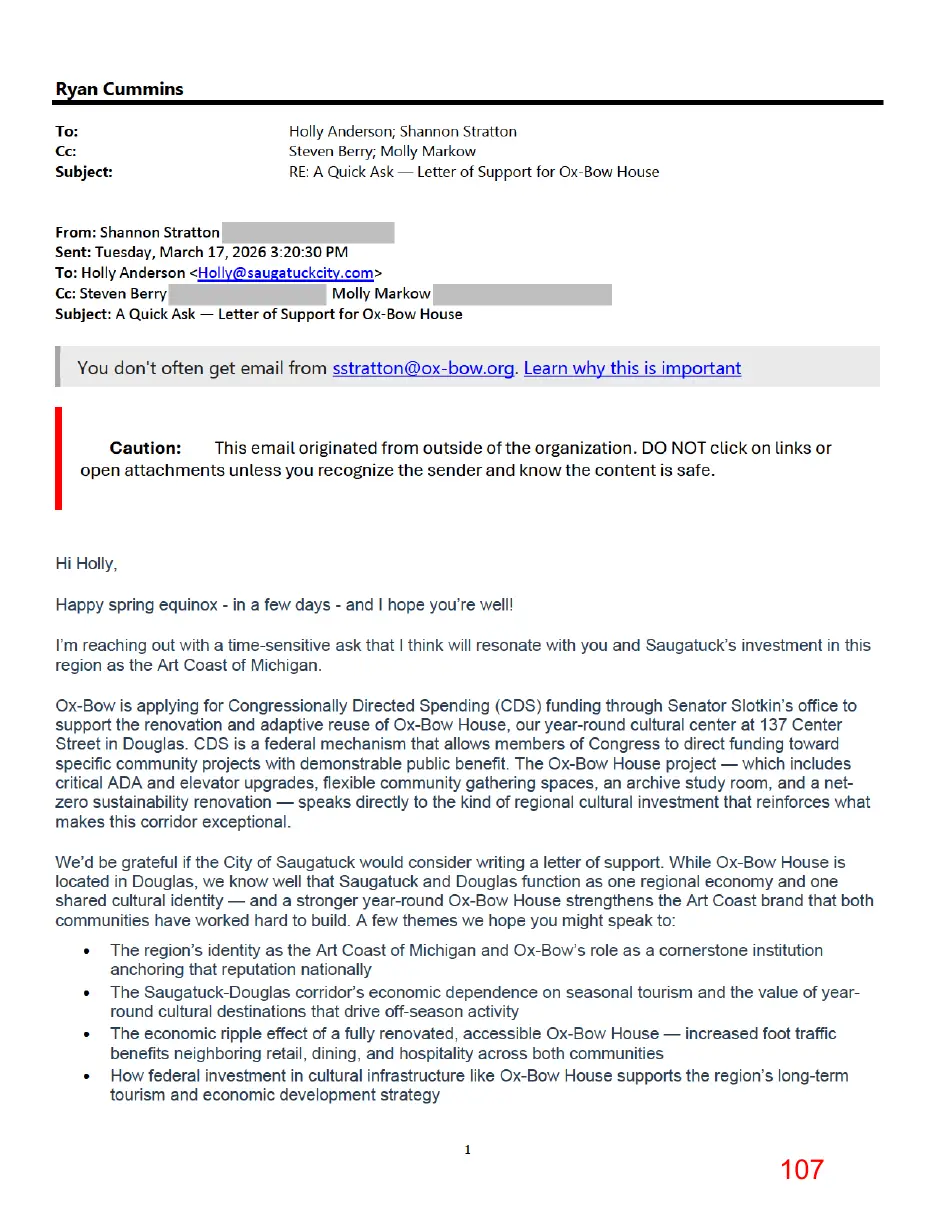
This page is a scanned image with no text layer. The PDF of these pages has it at full resolution.
Page 108
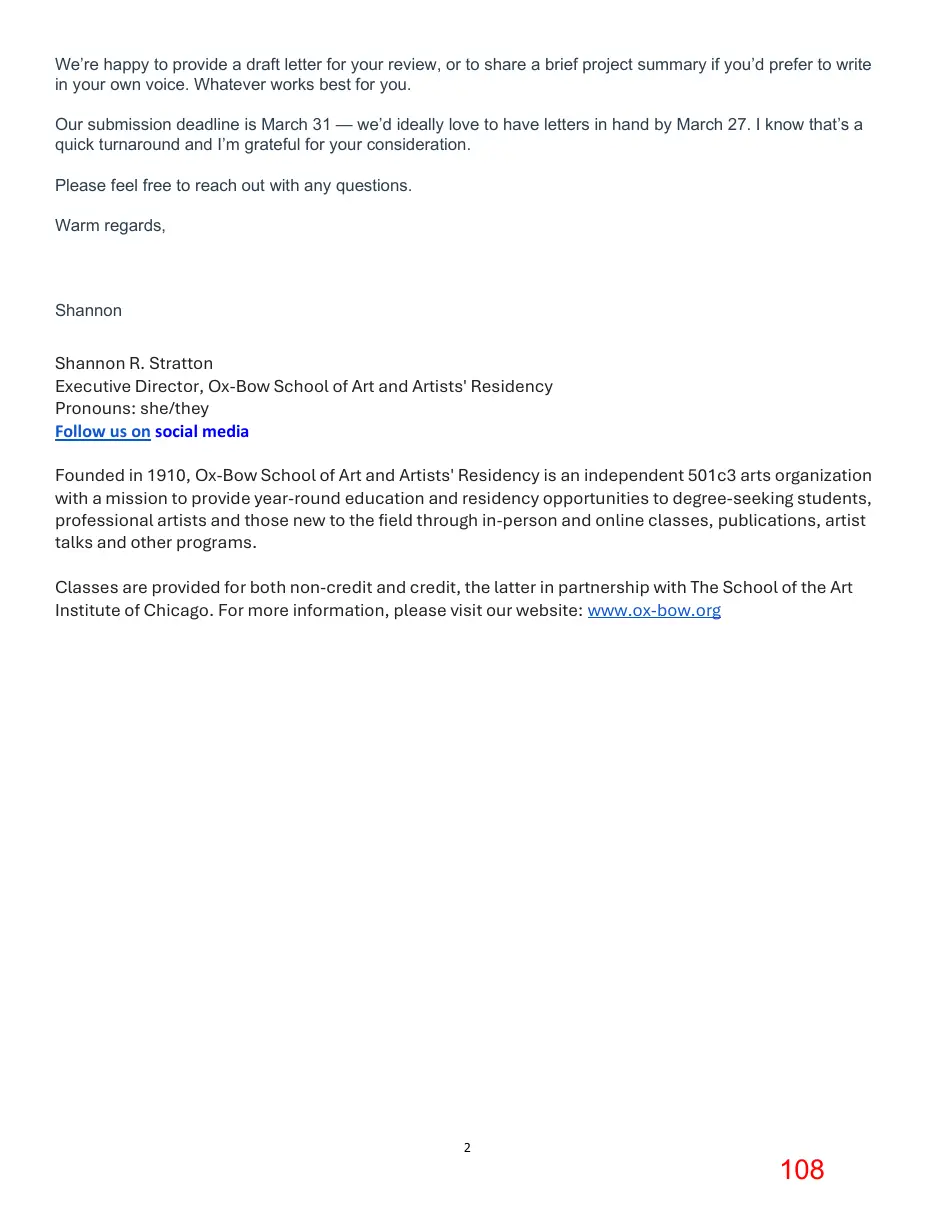
Text of page 108
We’re happy to provide a draft letter for your review, or to share a brief project summary if you’d prefer to write in your own voice. Whatever works best for you. Our submission deadline is March 31 — we’d ideally love to have letters in hand by March 27. I know that’s a quick turnaround and I’m grateful for your consideration. Please feel free to reach out with any questions. Warm regards,
Shannon
Shannon R. Stratton Executive Director, Ox-Bow School of Art and Artists' Residency Pronouns: she/they Follow us on social media Founded in 1910, Ox-Bow School of Art and Artists' Residency is an independent 501c3 arts organization with a mission to provide year-round education and residency opportunities to degree-seeking students, professional artists and those new to the field through in-person and online classes, publications, artist talks and other programs. Classes are provided for both non-credit and credit, the latter in partnership with The School of the Art Institute of Chicago. For more information, please visit our website: www.ox-bow.org
Page 109
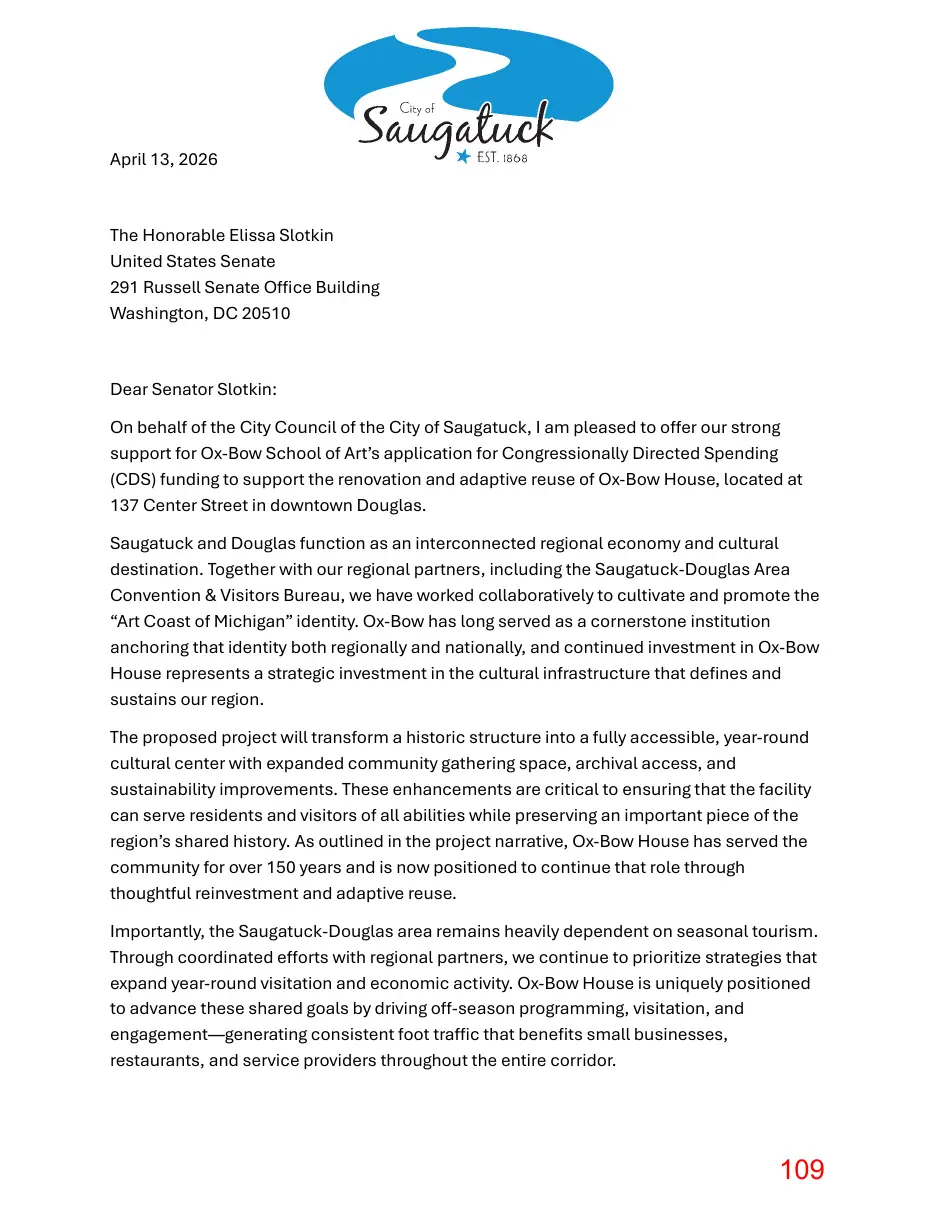
Text of page 109
April 13, 2026
The Honorable Elissa Slotkin United States Senate 291 Russell Senate Office Building Washington, DC 20510
Dear Senator Slotkin: On behalf of the City Council of the City of Saugatuck, I am pleased to offer our strong support for Ox-Bow School of Art’s application for Congressionally Directed Spending (CDS) funding to support the renovation and adaptive reuse of Ox-Bow House, located at 137 Center Street in downtown Douglas. Saugatuck and Douglas function as an interconnected regional economy and cultural destination. Together with our regional partners, including the Saugatuck-Douglas Area Convention & Visitors Bureau, we have worked collaboratively to cultivate and promote the “Art Coast of Michigan” identity. Ox-Bow has long served as a cornerstone institution anchoring that identity both regionally and nationally, and continued investment in Ox-Bow House represents a strategic investment in the cultural infrastructure that defines and sustains our region. The proposed project will transform a historic structure into a fully accessible, year-round cultural center with expanded community gathering space, archival access, and sustainability improvements. These enhancements are critical to ensuring that the facility can serve residents and visitors of all abilities while preserving an important piece of the region’s shared history. As outlined in the project narrative, Ox-Bow House has served the community for over 150 years and is now positioned to continue that role through thoughtful reinvestment and adaptive reuse. Importantly, the Saugatuck-Douglas area remains heavily dependent on seasonal tourism. Through coordinated efforts with regional partners, we continue to prioritize strategies that expand year-round visitation and economic activity. Ox-Bow House is uniquely positioned to advance these shared goals by driving off-season programming, visitation, and engagement—generating consistent foot traffic that benefits small businesses, restaurants, and service providers throughout the entire corridor.
Page 110
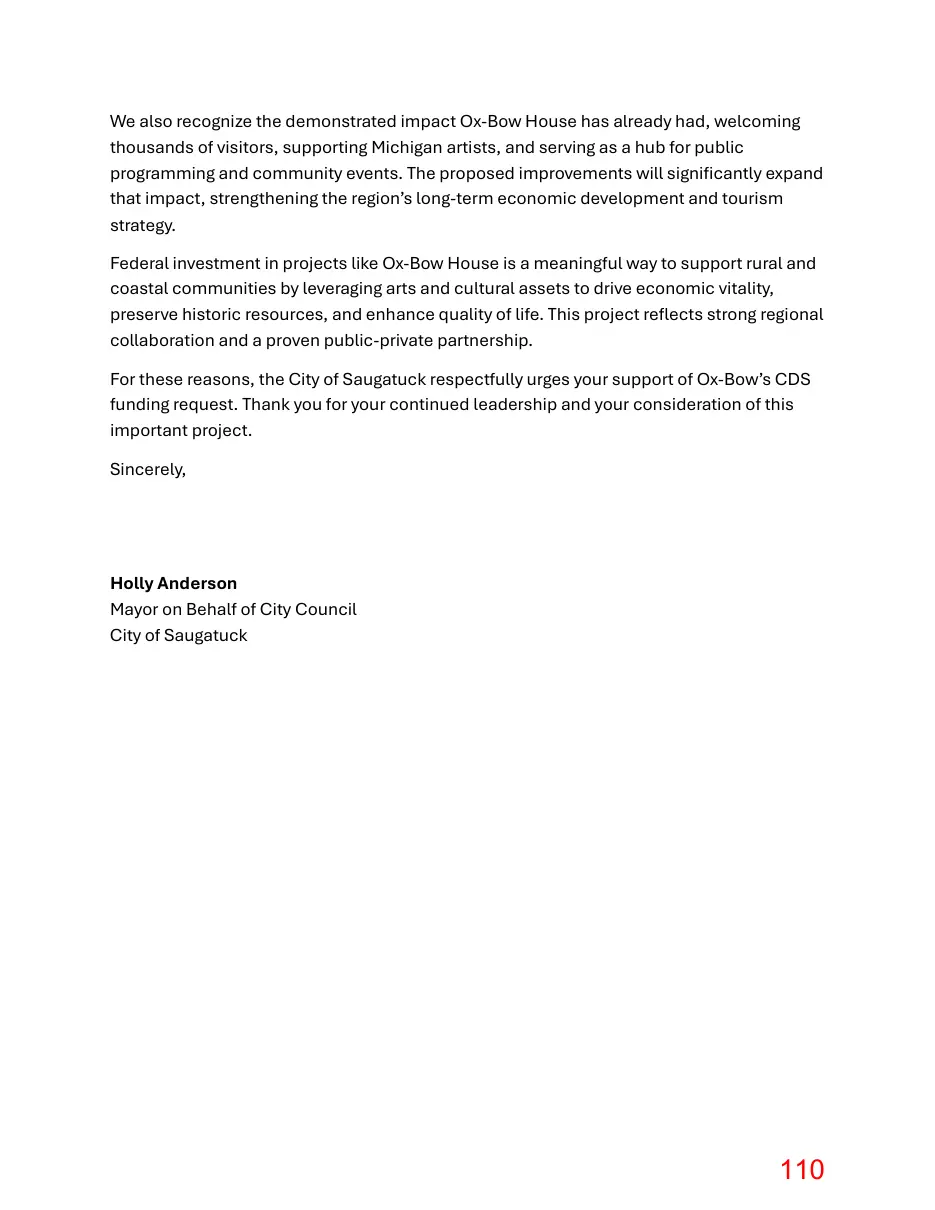
Text of page 110
We also recognize the demonstrated impact Ox-Bow House has already had, welcoming thousands of visitors, supporting Michigan artists, and serving as a hub for public programming and community events. The proposed improvements will significantly expand that impact, strengthening the region’s long-term economic development and tourism strategy. Federal investment in projects like Ox-Bow House is a meaningful way to support rural and coastal communities by leveraging arts and cultural assets to drive economic vitality, preserve historic resources, and enhance quality of life. This project reflects strong regional collaboration and a proven public-private partnership. For these reasons, the City of Saugatuck respectfully urges your support of Ox-Bow’s CDS funding request. Thank you for your continued leadership and your consideration of this important project. Sincerely,
Holly Anderson Mayor on Behalf of City Council City of Saugatuck
Page 111
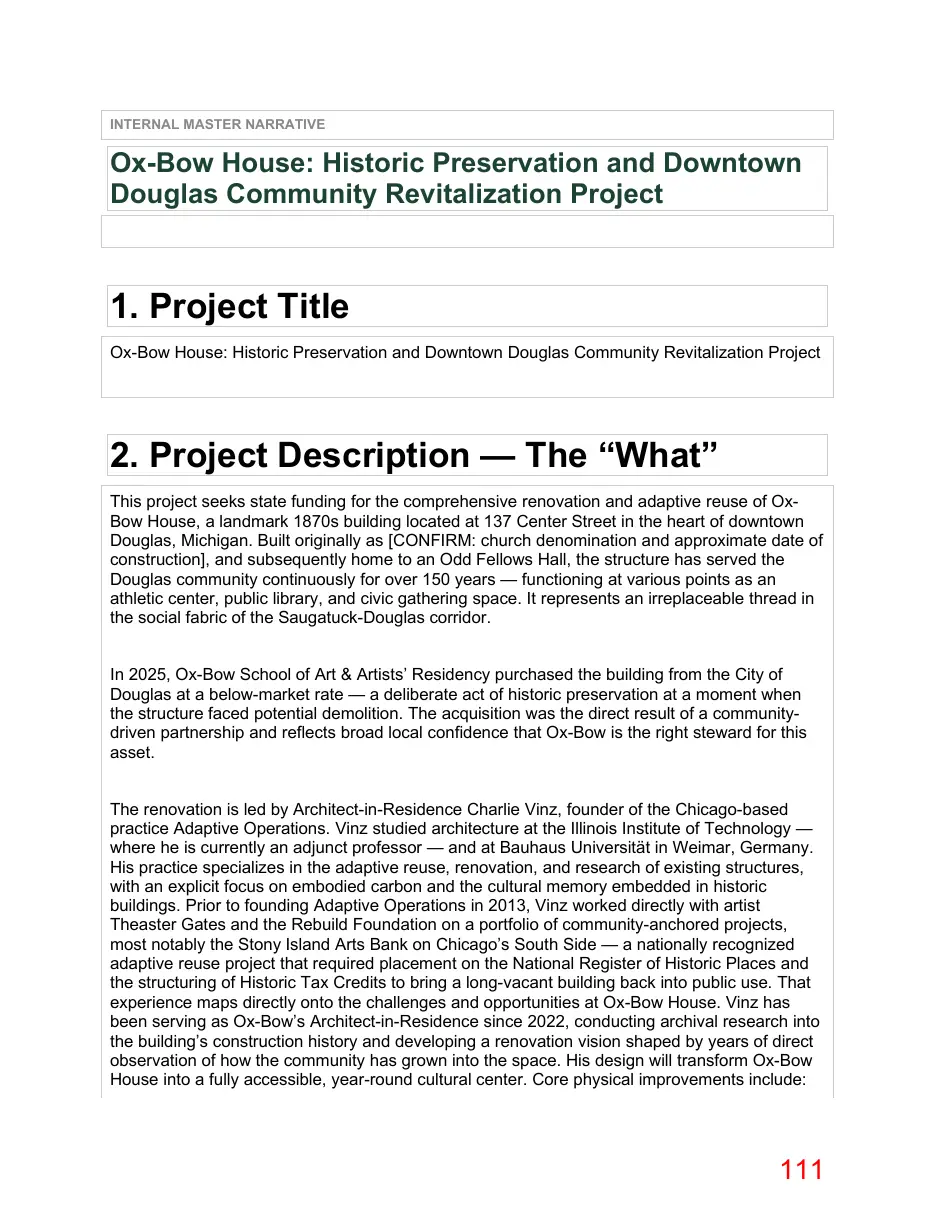
Text of page 111
INTERNAL MASTER NARRATIVE
Ox-Bow House: Historic Preservation and Downtown Douglas Community Revitalization Project
1. Project Title Ox-Bow House: Historic Preservation and Downtown Douglas Community Revitalization Project
2. Project Description — The “What” This project seeks state funding for the comprehensive renovation and adaptive reuse of OxBow House, a landmark 1870s building located at 137 Center Street in the heart of downtown Douglas, Michigan. Built originally as [CONFIRM: church denomination and approximate date of construction], and subsequently home to an Odd Fellows Hall, the structure has served the Douglas community continuously for over 150 years — functioning at various points as an athletic center, public library, and civic gathering space. It represents an irreplaceable thread in the social fabric of the Saugatuck-Douglas corridor. In 2025, Ox-Bow School of Art & Artists’ Residency purchased the building from the City of Douglas at a below-market rate — a deliberate act of historic preservation at a moment when the structure faced potential demolition. The acquisition was the direct result of a communitydriven partnership and reflects broad local confidence that Ox-Bow is the right steward for this asset. The renovation is led by Architect-in-Residence Charlie Vinz, founder of the Chicago-based practice Adaptive Operations. Vinz studied architecture at the Illinois Institute of Technology — where he is currently an adjunct professor — and at Bauhaus Universität in Weimar, Germany. His practice specializes in the adaptive reuse, renovation, and research of existing structures, with an explicit focus on embodied carbon and the cultural memory embedded in historic buildings. Prior to founding Adaptive Operations in 2013, Vinz worked directly with artist Theaster Gates and the Rebuild Foundation on a portfolio of community-anchored projects, most notably the Stony Island Arts Bank on Chicago’s South Side — a nationally recognized adaptive reuse project that required placement on the National Register of Historic Places and the structuring of Historic Tax Credits to bring a long-vacant building back into public use. That experience maps directly onto the challenges and opportunities at Ox-Bow House. Vinz has been serving as Ox-Bow’s Architect-in-Residence since 2022, conducting archival research into the building’s construction history and developing a renovation vision shaped by years of direct observation of how the community has grown into the space. His design will transform Ox-Bow House into a fully accessible, year-round cultural center. Core physical improvements include:
Page 112
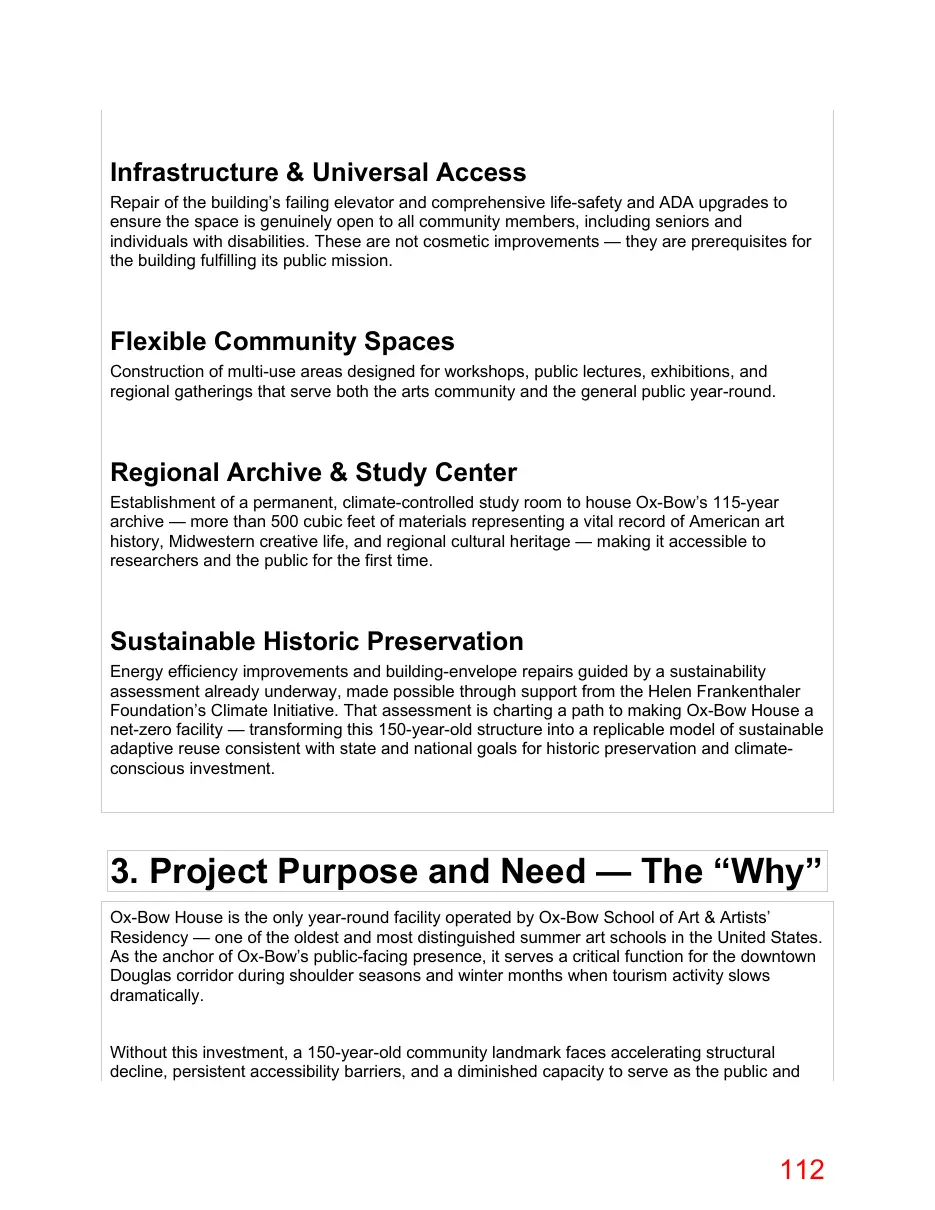
Text of page 112
Infrastructure & Universal Access Repair of the building’s failing elevator and comprehensive life-safety and ADA upgrades to ensure the space is genuinely open to all community members, including seniors and individuals with disabilities. These are not cosmetic improvements — they are prerequisites for the building fulfilling its public mission.
Flexible Community Spaces
Construction of multi-use areas designed for workshops, public lectures, exhibitions, and regional gatherings that serve both the arts community and the general public year-round.
Regional Archive & Study Center
Establishment of a permanent, climate-controlled study room to house Ox-Bow’s 115-year archive — more than 500 cubic feet of materials representing a vital record of American art history, Midwestern creative life, and regional cultural heritage — making it accessible to researchers and the public for the first time.
Sustainable Historic Preservation Energy efficiency improvements and building-envelope repairs guided by a sustainability assessment already underway, made possible through support from the Helen Frankenthaler Foundation’s Climate Initiative. That assessment is charting a path to making Ox-Bow House a net-zero facility — transforming this 150-year-old structure into a replicable model of sustainable adaptive reuse consistent with state and national goals for historic preservation and climateconscious investment.
3. Project Purpose and Need — The “Why” Ox-Bow House is the only year-round facility operated by Ox-Bow School of Art & Artists’ Residency — one of the oldest and most distinguished summer art schools in the United States. As the anchor of Ox-Bow’s public-facing presence, it serves a critical function for the downtown Douglas corridor during shoulder seasons and winter months when tourism activity slows dramatically. Without this investment, a 150-year-old community landmark faces accelerating structural decline, persistent accessibility barriers, and a diminished capacity to serve as the public and
Page 113
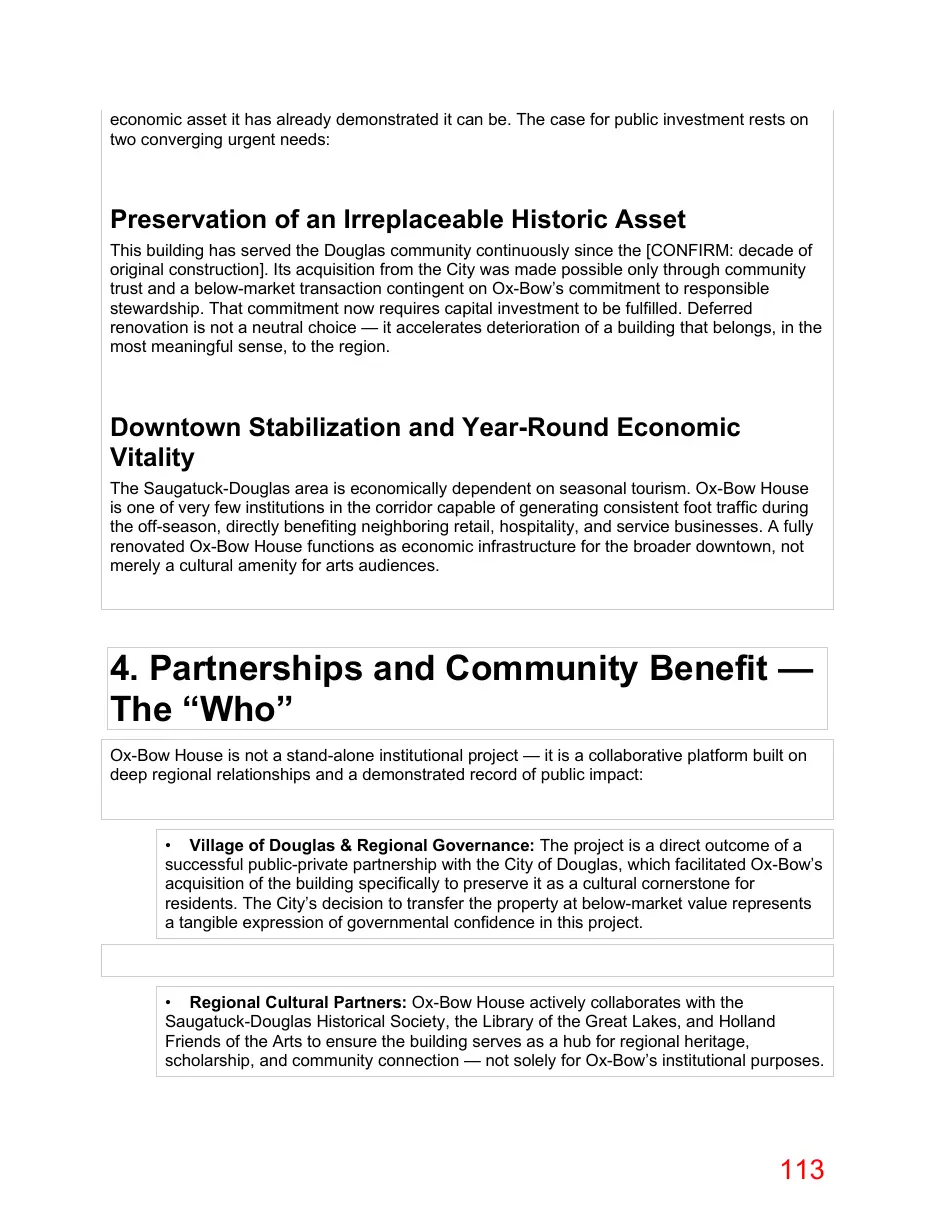
Text of page 113
economic asset it has already demonstrated it can be. The case for public investment rests on two converging urgent needs:
Preservation of an Irreplaceable Historic Asset
This building has served the Douglas community continuously since the [CONFIRM: decade of original construction]. Its acquisition from the City was made possible only through community trust and a below-market transaction contingent on Ox-Bow’s commitment to responsible stewardship. That commitment now requires capital investment to be fulfilled. Deferred renovation is not a neutral choice — it accelerates deterioration of a building that belongs, in the most meaningful sense, to the region.
Downtown Stabilization and Year-Round Economic Vitality
The Saugatuck-Douglas area is economically dependent on seasonal tourism. Ox-Bow House is one of very few institutions in the corridor capable of generating consistent foot traffic during the off-season, directly benefiting neighboring retail, hospitality, and service businesses. A fully renovated Ox-Bow House functions as economic infrastructure for the broader downtown, not merely a cultural amenity for arts audiences.
4. Partnerships and Community Benefit — The “Who” Ox-Bow House is not a stand-alone institutional project — it is a collaborative platform built on deep regional relationships and a demonstrated record of public impact:
• Village of Douglas & Regional Governance: The project is a direct outcome of a successful public-private partnership with the City of Douglas, which facilitated Ox-Bow’s acquisition of the building specifically to preserve it as a cultural cornerstone for residents. The City’s decision to transfer the property at below-market value represents a tangible expression of governmental confidence in this project.
• Regional Cultural Partners: Ox-Bow House actively collaborates with the Saugatuck-Douglas Historical Society, the Library of the Great Lakes, and Holland Friends of the Arts to ensure the building serves as a hub for regional heritage, scholarship, and community connection — not solely for Ox-Bow’s institutional purposes.
Page 114
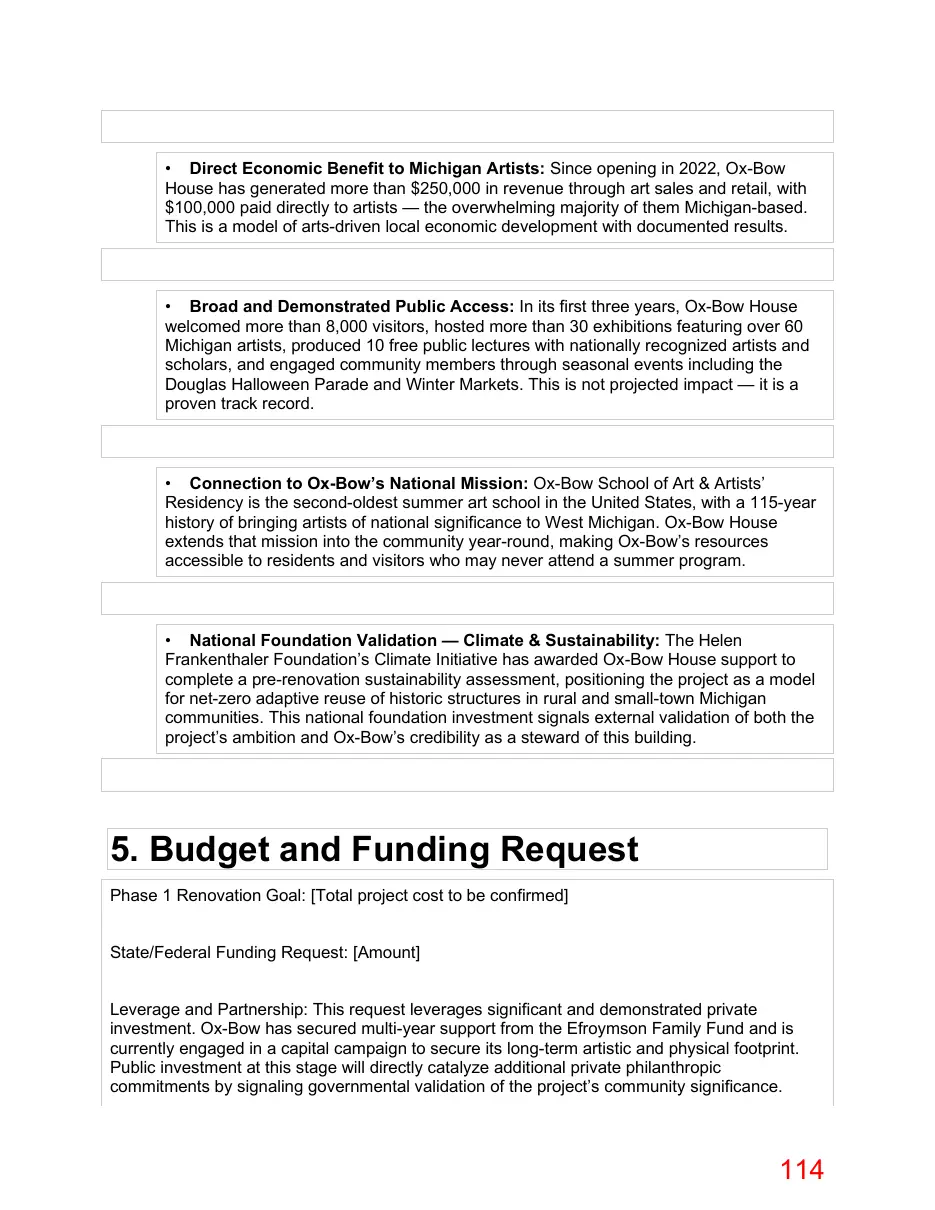
Text of page 114
• Direct Economic Benefit to Michigan Artists: Since opening in 2022, Ox-Bow House has generated more than $250,000 in revenue through art sales and retail, with $100,000 paid directly to artists — the overwhelming majority of them Michigan-based. This is a model of arts-driven local economic development with documented results.
• Broad and Demonstrated Public Access: In its first three years, Ox-Bow House welcomed more than 8,000 visitors, hosted more than 30 exhibitions featuring over 60 Michigan artists, produced 10 free public lectures with nationally recognized artists and scholars, and engaged community members through seasonal events including the Douglas Halloween Parade and Winter Markets. This is not projected impact — it is a proven track record.
• Connection to Ox-Bow’s National Mission: Ox-Bow School of Art & Artists’ Residency is the second-oldest summer art school in the United States, with a 115-year history of bringing artists of national significance to West Michigan. Ox-Bow House extends that mission into the community year-round, making Ox-Bow’s resources accessible to residents and visitors who may never attend a summer program.
• National Foundation Validation — Climate & Sustainability: The Helen Frankenthaler Foundation’s Climate Initiative has awarded Ox-Bow House support to complete a pre-renovation sustainability assessment, positioning the project as a model for net-zero adaptive reuse of historic structures in rural and small-town Michigan communities. This national foundation investment signals external validation of both the project’s ambition and Ox-Bow’s credibility as a steward of this building.
5. Budget and Funding Request Phase 1 Renovation Goal: [Total project cost to be confirmed] State/Federal Funding Request: [Amount] Leverage and Partnership: This request leverages significant and demonstrated private investment. Ox-Bow has secured multi-year support from the Efroymson Family Fund and is currently engaged in a capital campaign to secure its long-term artistic and physical footprint. Public investment at this stage will directly catalyze additional private philanthropic commitments by signaling governmental validation of the project’s community significance.
Page 115
Text of page 115
[NOTE: Insert leverage ratio when confirmed — e.g., “Every $1 of public investment is matched by $X in private support.”]
ITEMS TO CONFIRM BEFORE FINALIZING: (1) Church denomination and approximate date of original construction. (2) Sequential history of building uses between church and current day. (3) National Register of Historic Places status or eligibility — check with Saugatuck-Douglas Historical Society. (4) Total Phase 1 renovation cost. (5) Federal vs. state funding target. (6) Private match / leverage ratio.
Page 116
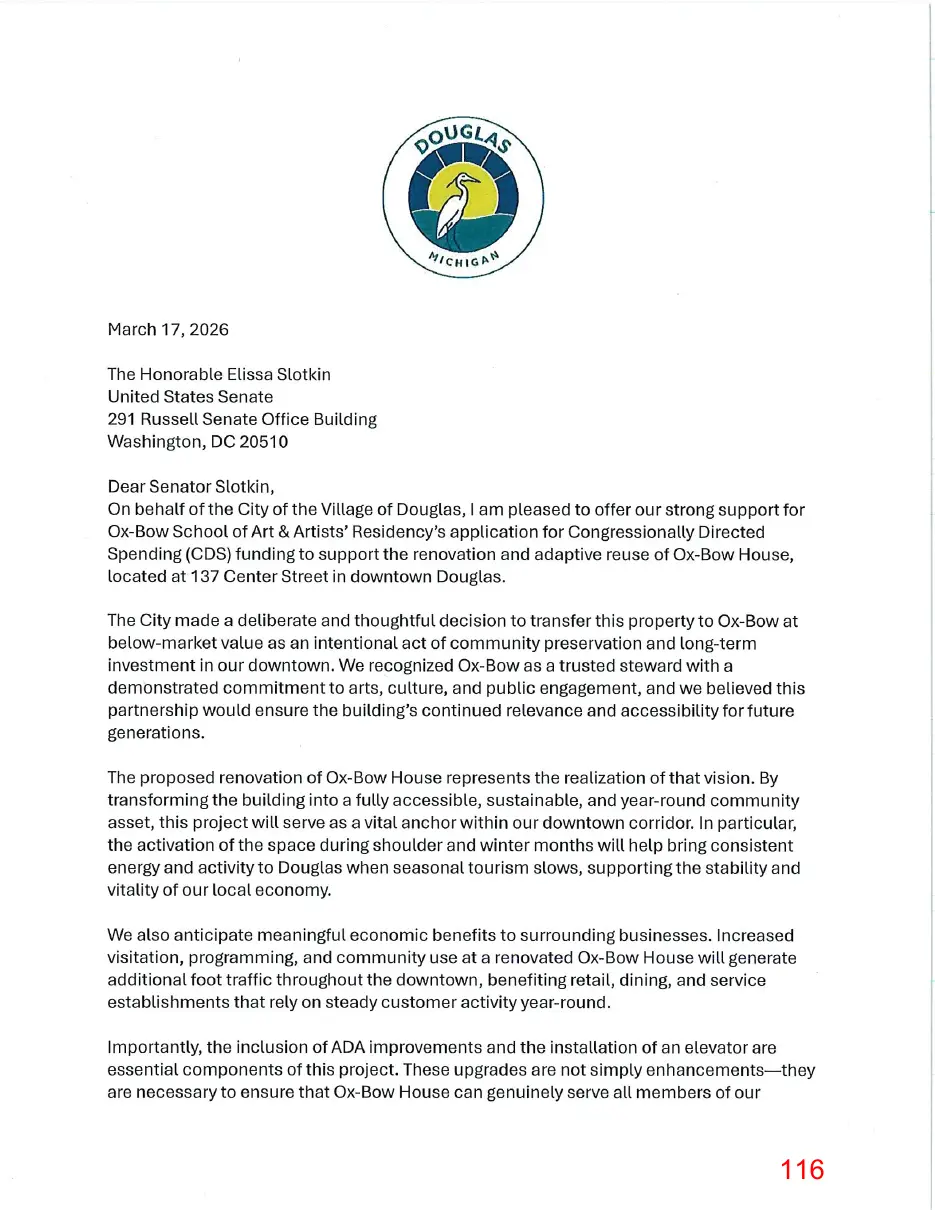
This page is a scanned image with no text layer. The PDF of these pages has it at full resolution.
Page 117
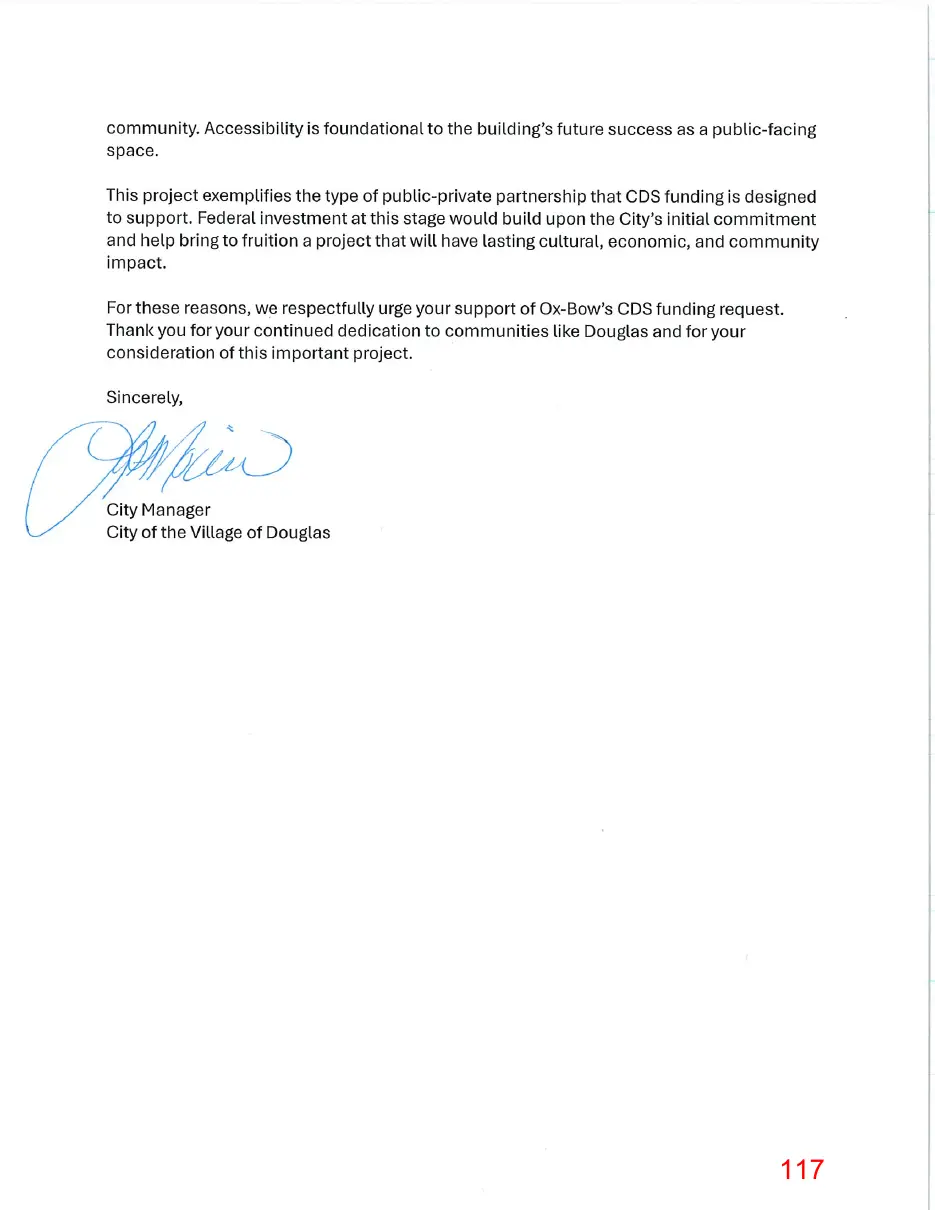
This page is a scanned image with no text layer. The PDF of these pages has it at full resolution.