
Council Agenda item 14C
Updates to Personnel Policies Manual (Roll Call)
City Council, Tuesday, May 27, 2025
Download these 117 pages, 1.5 MB Whole packet, 188 pages, 16.0 MB
Page 61
Text of page 61
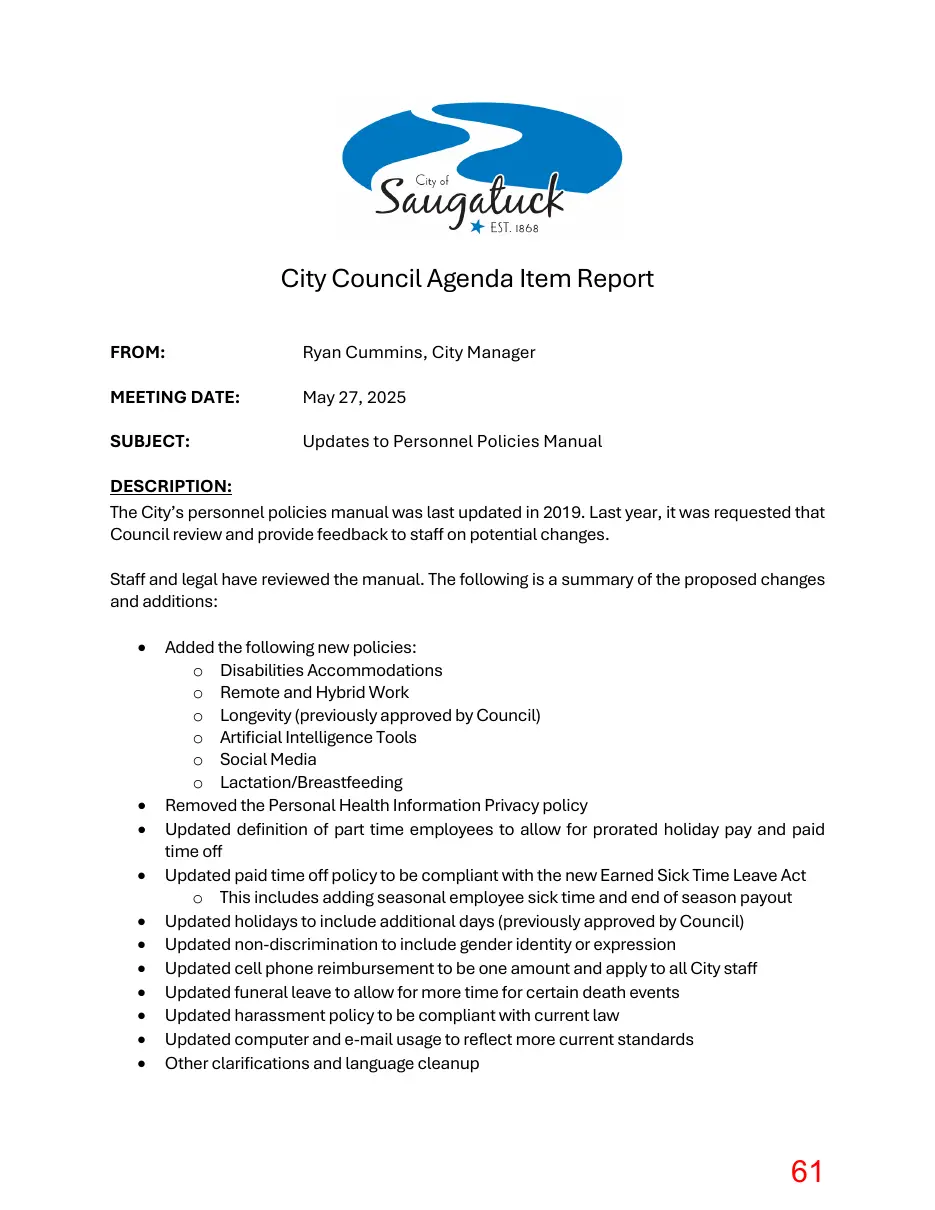
City Council Agenda Item Report FROM:
Ryan Cummins, City Manager
MEETING DATE:
May 27, 2025
SUBJECT:
Updates to Personnel Policies Manual
DESCRIPTION: The City’s personnel policies manual was last updated in 2019. Last year, it was requested that Council review and provide feedback to staff on potential changes. Staff and legal have reviewed the manual. The following is a summary of the proposed changes and additions: •
Added the following new policies: o Disabilities Accommodations o Remote and Hybrid Work o Longevity (previously approved by Council) o Artificial Intelligence Tools o Social Media o Lactation/Breastfeeding Removed the Personal Health Information Privacy policy Updated definition of part time employees to allow for prorated holiday pay and paid time off Updated paid time off policy to be compliant with the new Earned Sick Time Leave Act o This includes adding seasonal employee sick time and end of season payout Updated holidays to include additional days (previously approved by Council) Updated non-discrimination to include gender identity or expression Updated cell phone reimbursement to be one amount and apply to all City staff Updated funeral leave to allow for more time for certain death events Updated harassment policy to be compliant with current law Updated computer and e-mail usage to reflect more current standards Other clarifications and language cleanup
Page 62
Text of page 62
Attached is a copy of the updated personnel policies manual. Since the workshop, Section 1.1 was updated to indicate reports should be made to both the Mayor and Mayor Pro Tem, who will confer with the City Attorney. BUDGET ACTION: None at this time. LEGAL REVIEW: Legal reviewed the personnel policies. Their proposed changes and additions are incorporated. Legal will be at your meeting to answer questions. SAMPLE MOTION: Motion to approve the updated personnel policies manual.
Page 2
Page 63
Text of page 63
PERSONNEL POLICIES AND PROCEDURES MANUAL
EFFECTIVE OCTOBER 15, 2019May , 2025
Page 64
Text of page 64
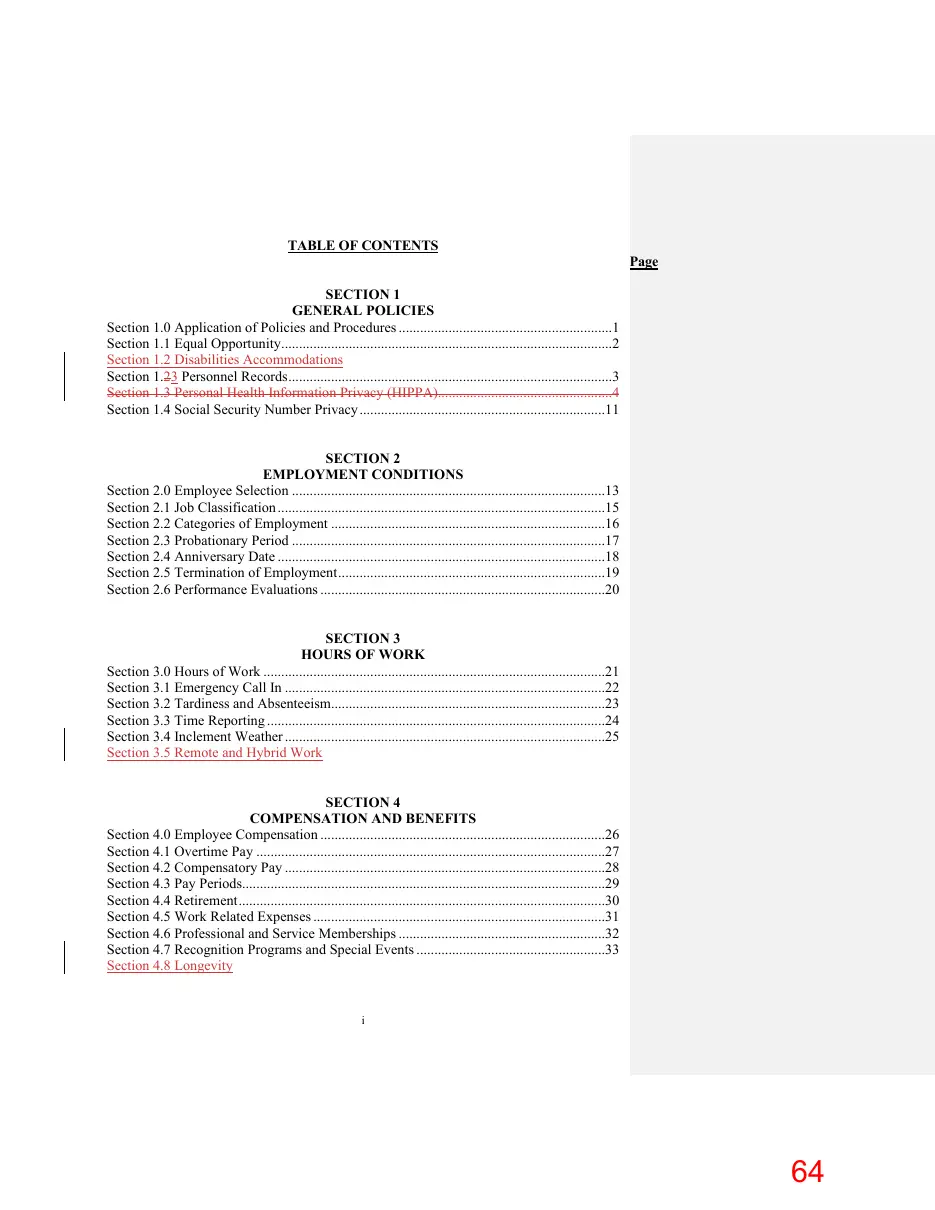
TABLE OF CONTENTS
Page
SECTION 1 GENERAL POLICIES Section 1.0 Application of Policies and Procedures ............................................................1 Section 1.1 Equal Opportunity.............................................................................................2 Section 1.2 Disabilities Accommodations Section 1.23 Personnel Records ...........................................................................................3 Section 1.3 Personal Health Information Privacy (HIPPA).................................................4 Section 1.4 Social Security Number Privacy .....................................................................11 SECTION 2 EMPLOYMENT CONDITIONS Section 2.0 Employee Selection ........................................................................................13 Section 2.1 Job Classification ............................................................................................15 Section 2.2 Categories of Employment .............................................................................16 Section 2.3 Probationary Period ........................................................................................17 Section 2.4 Anniversary Date ............................................................................................18 Section 2.5 Termination of Employment ...........................................................................19 Section 2.6 Performance Evaluations ................................................................................20 SECTION 3 HOURS OF WORK Section 3.0 Hours of Work ................................................................................................21 Section 3.1 Emergency Call In ..........................................................................................22 Section 3.2 Tardiness and Absenteeism.............................................................................23 Section 3.3 Time Reporting ...............................................................................................24 Section 3.4 Inclement Weather ..........................................................................................25 Section 3.5 Remote and Hybrid Work SECTION 4 COMPENSATION AND BENEFITS Section 4.0 Employee Compensation ................................................................................26 Section 4.1 Overtime Pay ..................................................................................................27 Section 4.2 Compensatory Pay ..........................................................................................28 Section 4.3 Pay Periods......................................................................................................29 Section 4.4 Retirement .......................................................................................................30 Section 4.5 Work Related Expenses ..................................................................................31 Section 4.6 Professional and Service Memberships ..........................................................32 Section 4.7 Recognition Programs and Special Events .....................................................33 Section 4.8 Longevity
Page 65
Text of page 65
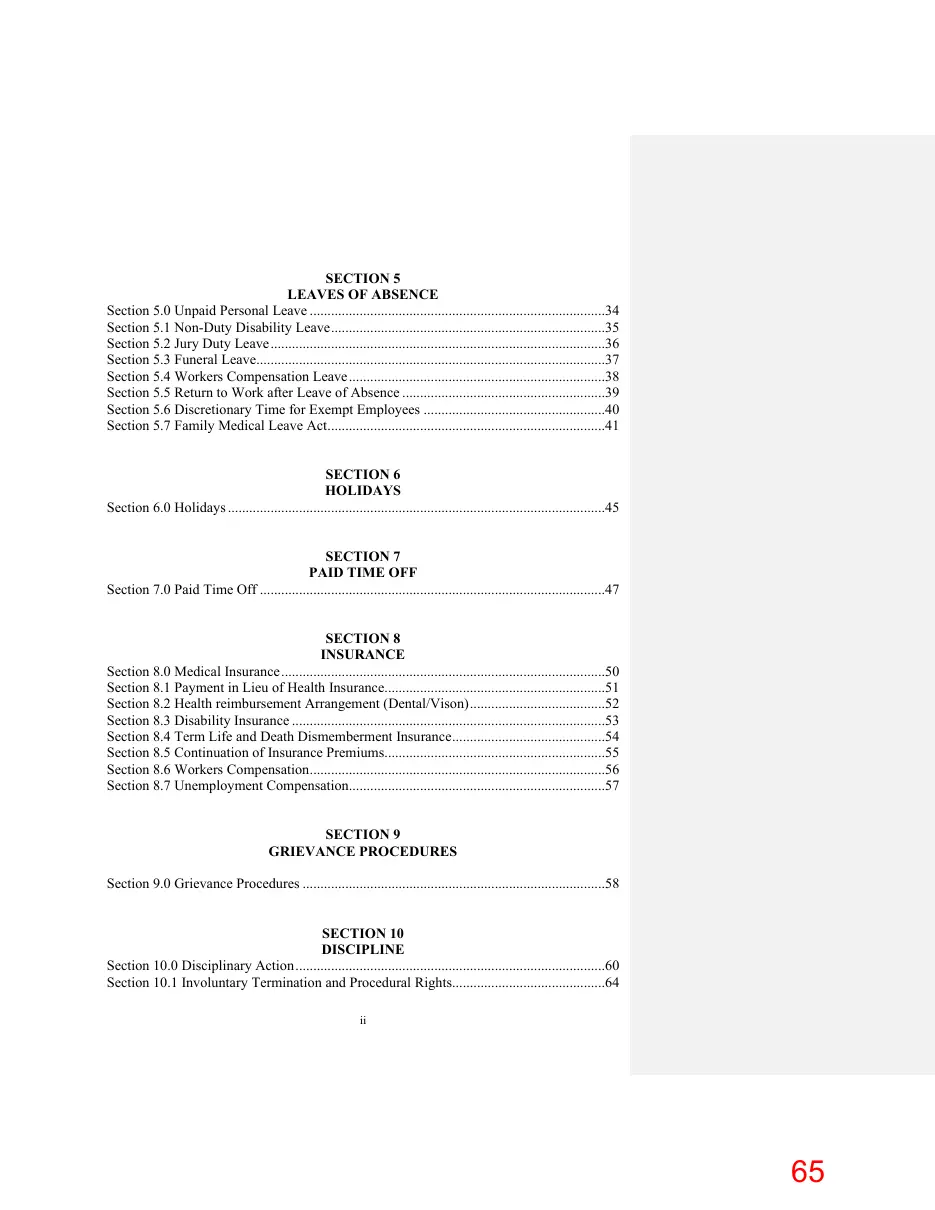
SECTION 5 LEAVES OF ABSENCE Section 5.0 Unpaid Personal Leave ...................................................................................34 Section 5.1 Non-Duty Disability Leave .............................................................................35 Section 5.2 Jury Duty Leave ..............................................................................................36 Section 5.3 Funeral Leave..................................................................................................37 Section 5.4 Workers Compensation Leave ........................................................................38 Section 5.5 Return to Work after Leave of Absence .........................................................39 Section 5.6 Discretionary Time for Exempt Employees ...................................................40 Section 5.7 Family Medical Leave Act..............................................................................41 SECTION 6 HOLIDAYS Section 6.0 Holidays ..........................................................................................................45 SECTION 7 PAID TIME OFF Section 7.0 Paid Time Off .................................................................................................47 SECTION 8 INSURANCE Section 8.0 Medical Insurance ...........................................................................................50 Section 8.1 Payment in Lieu of Health Insurance..............................................................51 Section 8.2 Health reimbursement Arrangement (Dental/Vison) ......................................52 Section 8.3 Disability Insurance ........................................................................................53 Section 8.4 Term Life and Death Dismemberment Insurance ...........................................54 Section 8.5 Continuation of Insurance Premiums..............................................................55 Section 8.6 Workers Compensation ...................................................................................56 Section 8.7 Unemployment Compensation........................................................................57 SECTION 9 GRIEVANCE PROCEDURES Section 9.0 Grievance Procedures .....................................................................................58 SECTION 10 DISCIPLINE Section 10.0 Disciplinary Action .......................................................................................60 Section 10.1 Involuntary Termination and Procedural Rights...........................................64 ii
Page 66
Text of page 66
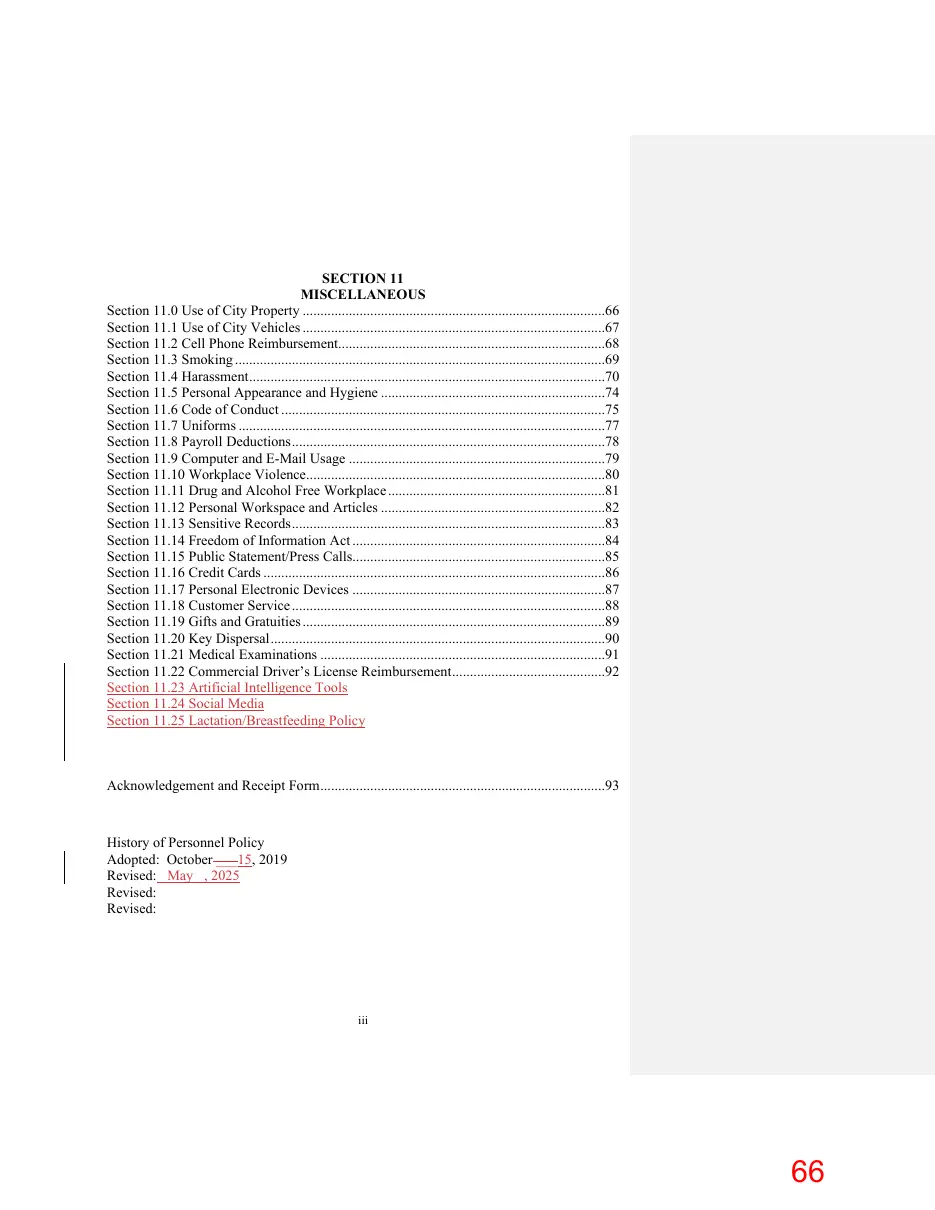
SECTION 11 MISCELLANEOUS Section 11.0 Use of City Property .....................................................................................66 Section 11.1 Use of City Vehicles .....................................................................................67 Section 11.2 Cell Phone Reimbursement...........................................................................68 Section 11.3 Smoking ........................................................................................................69 Section 11.4 Harassment ....................................................................................................70 Section 11.5 Personal Appearance and Hygiene ...............................................................74 Section 11.6 Code of Conduct ...........................................................................................75 Section 11.7 Uniforms .......................................................................................................77 Section 11.8 Payroll Deductions ........................................................................................78 Section 11.9 Computer and E-Mail Usage ........................................................................79 Section 11.10 Workplace Violence....................................................................................80 Section 11.11 Drug and Alcohol Free Workplace .............................................................81 Section 11.12 Personal Workspace and Articles ...............................................................82 Section 11.13 Sensitive Records ........................................................................................83 Section 11.14 Freedom of Information Act .......................................................................84 Section 11.15 Public Statement/Press Calls.......................................................................85 Section 11.16 Credit Cards ................................................................................................86 Section 11.17 Personal Electronic Devices .......................................................................87 Section 11.18 Customer Service ........................................................................................88 Section 11.19 Gifts and Gratuities .....................................................................................89 Section 11.20 Key Dispersal ..............................................................................................90 Section 11.21 Medical Examinations ................................................................................91 Section 11.22 Commercial Driver’s License Reimbursement ...........................................92 Section 11.23 Artificial Intelligence Tools Section 11.24 Social Media Section 11.25 Lactation/Breastfeeding Policy
Acknowledgement and Receipt Form ................................................................................93
History of Personnel Policy Adopted: October ___15, 2019 Revised: May , 2025 Revised: Revised:
iii
Page 67
Text of page 67
SECTION 1.0 APPLICATION OF PERSONNEL POLICIES AND PROCEDURES I.
PURPOSE To establish policies and procedures for personnel employed by the City of Saugatuck
II.
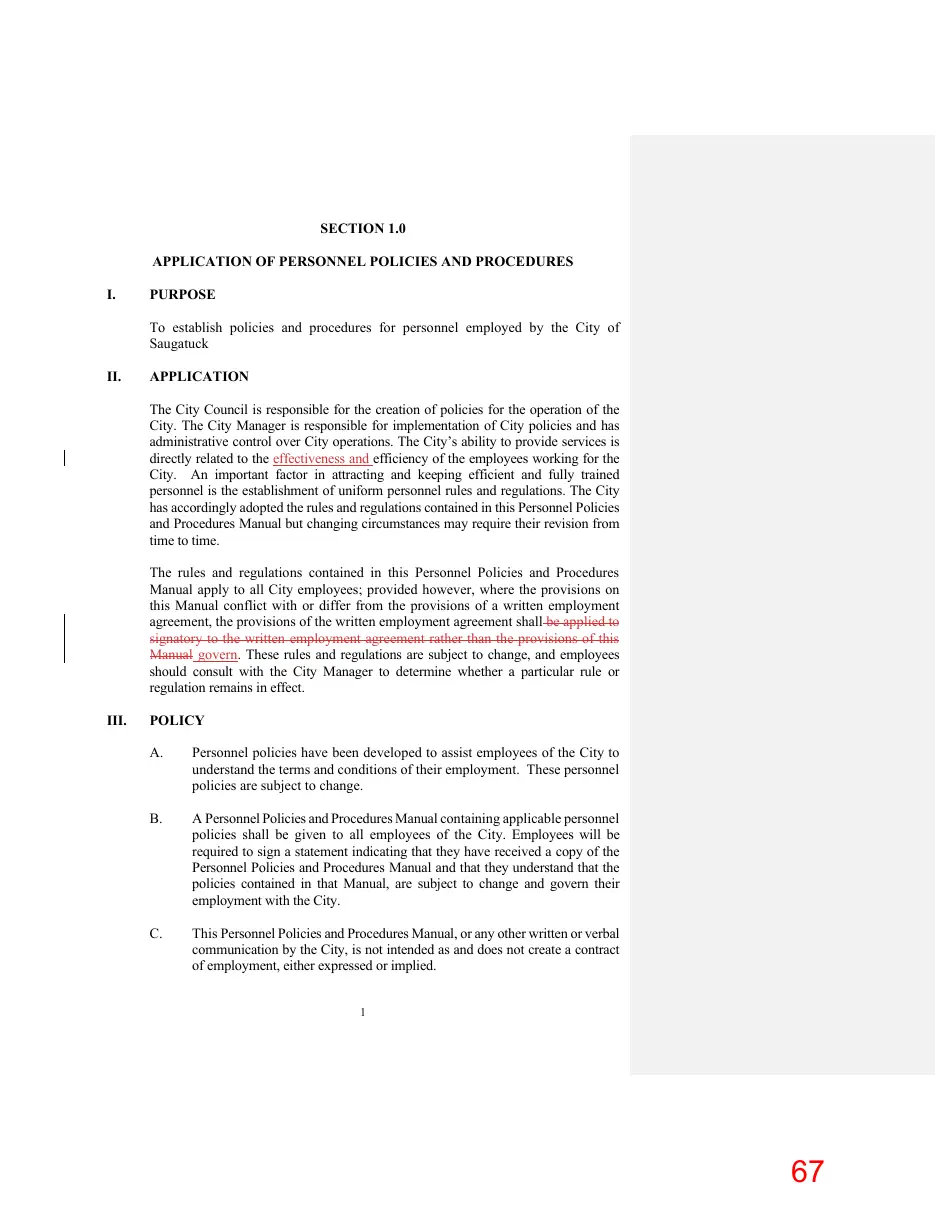
APPLICATION The City Council is responsible for the creation of policies for the operation of the City. The City Manager is responsible for implementation of City policies and has administrative control over City operations. The City’s ability to provide services is directly related to the effectiveness and efficiency of the employees working for the City. An important factor in attracting and keeping efficient and fully trained personnel is the establishment of uniform personnel rules and regulations. The City has accordingly adopted the rules and regulations contained in this Personnel Policies and Procedures Manual but changing circumstances may require their revision from time to time. The rules and regulations contained in this Personnel Policies and Procedures Manual apply to all City employees; provided however, where the provisions on this Manual conflict with or differ from the provisions of a written employment agreement, the provisions of the written employment agreement shall be applied to signatory to the written employment agreement rather than the provisions of this Manual govern. These rules and regulations are subject to change, and employees should consult with the City Manager to determine whether a particular rule or regulation remains in effect.
III.
POLICY A.
Personnel policies have been developed to assist employees of the City to understand the terms and conditions of their employment. These personnel policies are subject to change.
A Personnel Policies and Procedures Manual containing applicable personnel policies shall be given to all employees of the City. Employees will be required to sign a statement indicating that they have received a copy of the Personnel Policies and Procedures Manual and that they understand that the policies contained in that Manual, are subject to change and govern their employment with the City.
This Personnel Policies and Procedures Manual, or any other written or verbal communication by the City, is not intended as and does not create a contract of employment, either expressed or implied. 1
Page 68
Text of page 68
SECTION 1.1 EQUAL OPPORTUNITY POLICY I.
PURPOSE To establish a policy guaranteeing equal opportunity in employment.
II.
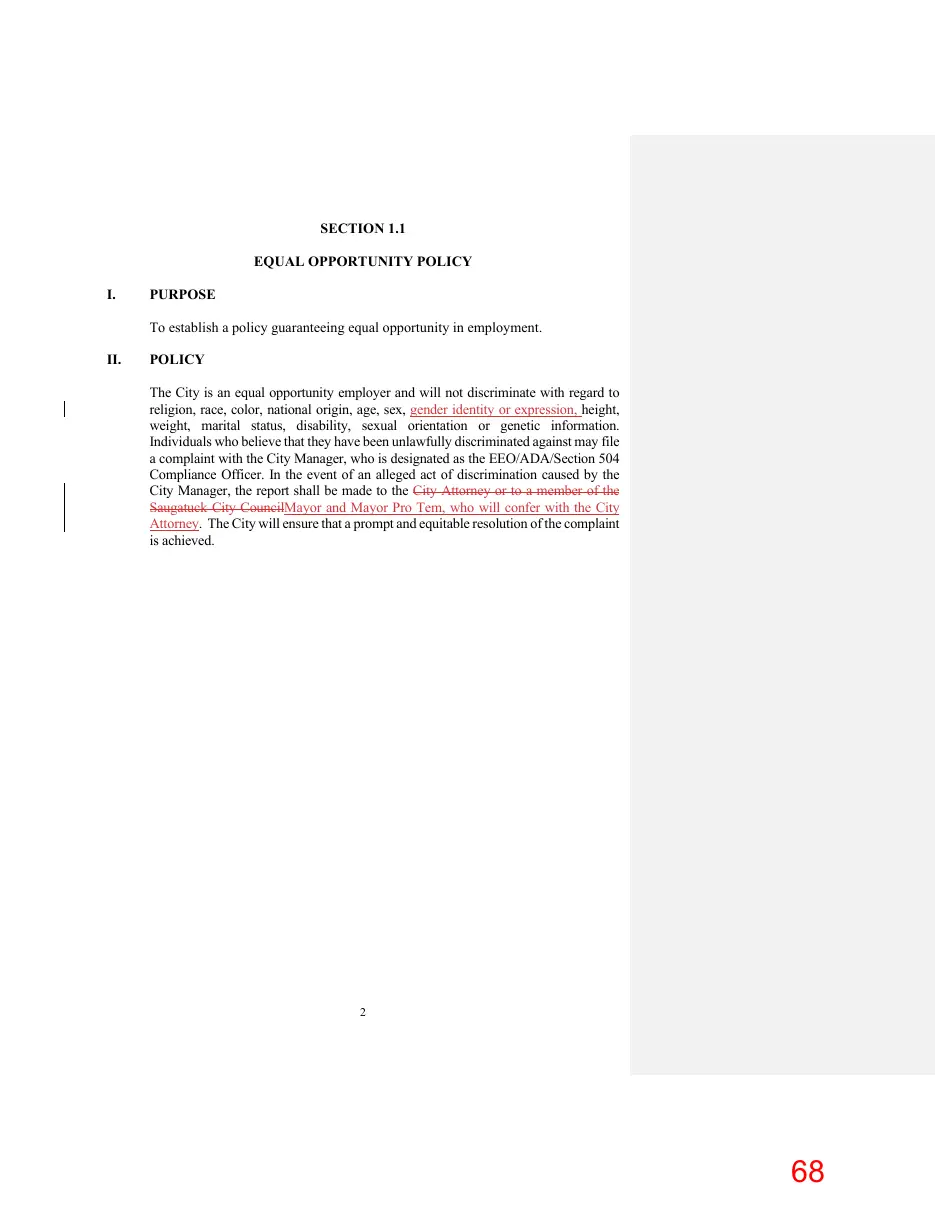
POLICY The City is an equal opportunity employer and will not discriminate with regard to religion, race, color, national origin, age, sex, gender identity or expression, height, weight, marital status, disability, sexual orientation or genetic information. Individuals who believe that they have been unlawfully discriminated against may file a complaint with the City Manager, who is designated as the EEO/ADA/Section 504 Compliance Officer. In the event of an alleged act of discrimination caused by the City Manager, the report shall be made to the City Attorney or to a member of the Saugatuck City CouncilMayor and Mayor Pro Tem, who will confer with the City Attorney. The City will ensure that a prompt and equitable resolution of the complaint is achieved.
Page 69
Text of page 69
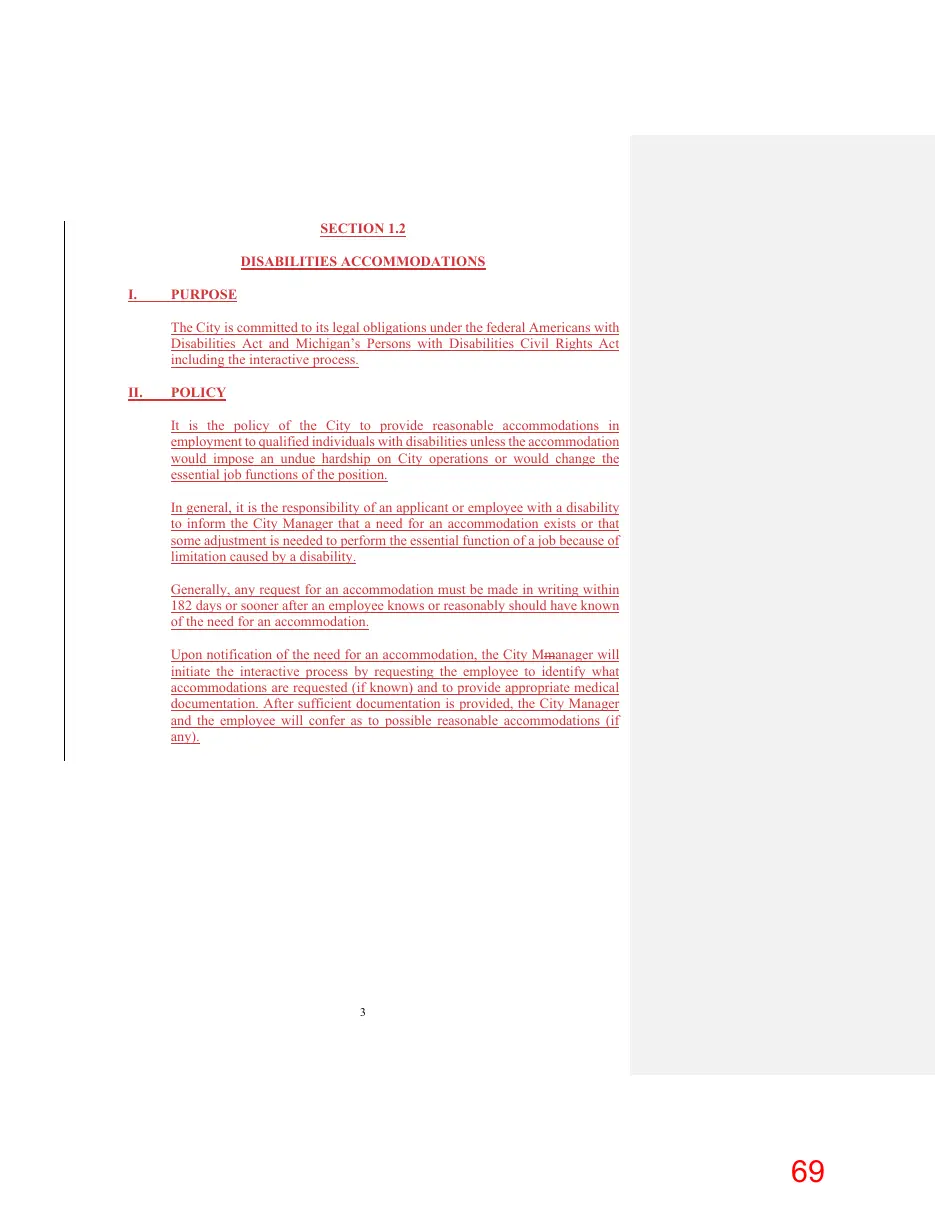
SECTION 1.2 DISABILITIES ACCOMMODATIONS I.
PURPOSE The City is committed to its legal obligations under the federal Americans with Disabilities Act and Michigan’s Persons with Disabilities Civil Rights Act including the interactive process.
II.
POLICY It is the policy of the City to provide reasonable accommodations in employment to qualified individuals with disabilities unless the accommodation would impose an undue hardship on City operations or would change the essential job functions of the position. In general, it is the responsibility of an applicant or employee with a disability to inform the City Manager that a need for an accommodation exists or that some adjustment is needed to perform the essential function of a job because of limitation caused by a disability. Generally, any request for an accommodation must be made in writing within 182 days or sooner after an employee knows or reasonably should have known of the need for an accommodation. Upon notification of the need for an accommodation, the City Mmanager will initiate the interactive process by requesting the employee to identify what accommodations are requested (if known) and to provide appropriate medical documentation. After sufficient documentation is provided, the City Manager and the employee will confer as to possible reasonable accommodations (if any).
Page 70
Text of page 70
SECTION 1.32 PERSONNEL RECORDS I.
PURPOSE To establish policies and procedures regarding personnel records.
II.
POLICY Personnel files are maintained for all employees at City Hall. Employees are required to advise the City Manager in writing of their current address, telephone number, name and marital status as well as any changes in this information. Employees requesting personnel information released to outside parties shall provide a signed authorization to the City Manager. Employees may review the contents of their personnel files upon request to the City Manager but may not remove their personnel file from City Hall. Access to an employee’s personnel file is limited to the City Manager, an employee’s immediate supervisor, the employee and such other agents of the City as deemed necessary by the City Manager and/or the City Council and consistent with state laws.
Page 71
Text of page 71
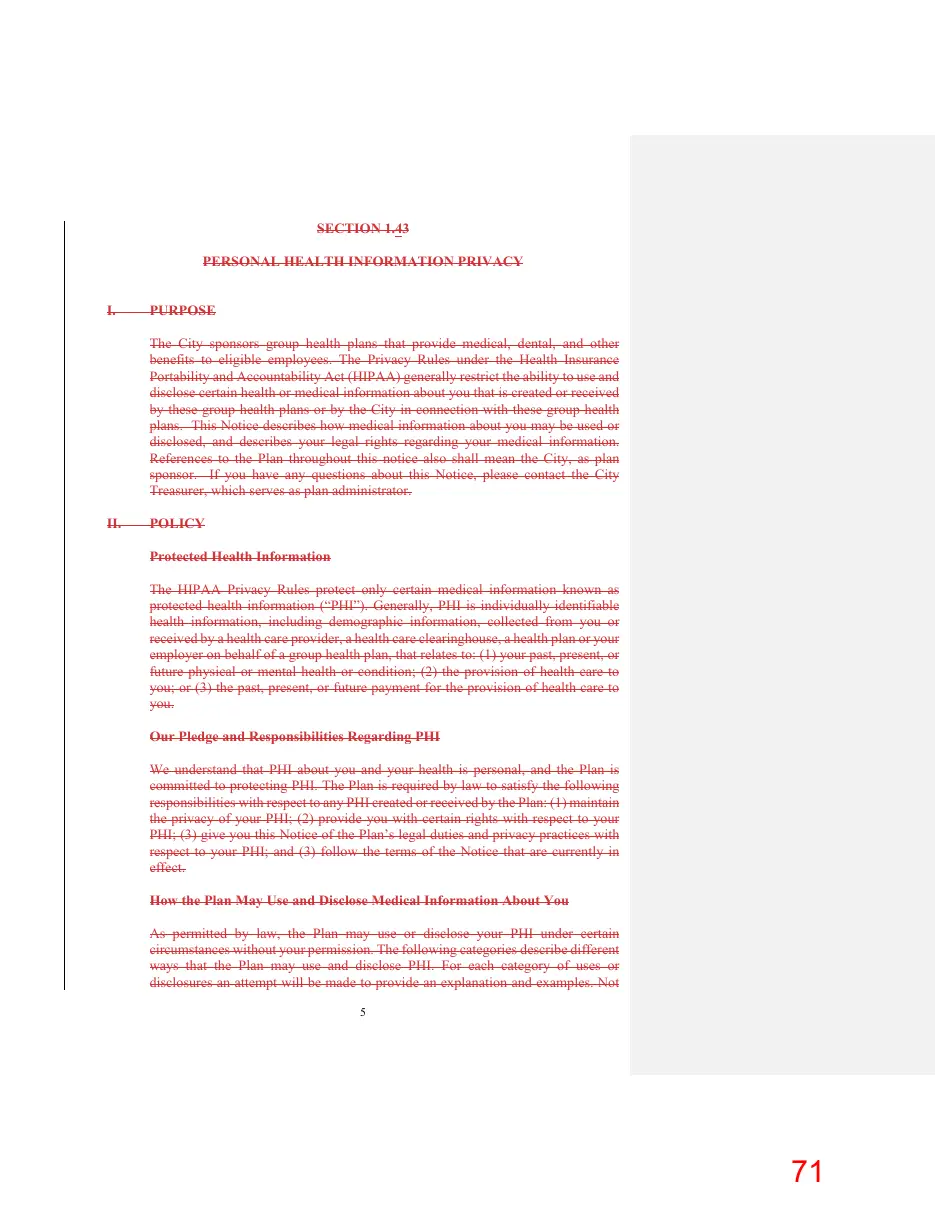
SECTION 1.43 PERSONAL HEALTH INFORMATION PRIVACY I.
PURPOSE The City sponsors group health plans that provide medical, dental, and other benefits to eligible employees. The Privacy Rules under the Health Insurance Portability and Accountability Act (HIPAA) generally restrict the ability to use and disclose certain health or medical information about you that is created or received by these group health plans or by the City in connection with these group health plans. This Notice describes how medical information about you may be used or disclosed, and describes your legal rights regarding your medical information. References to the Plan throughout this notice also shall mean the City, as plan sponsor. If you have any questions about this Notice, please contact the City Treasurer, which serves as plan administrator.
II.
POLICY Protected Health Information The HIPAA Privacy Rules protect only certain medical information known as protected health information (“PHI”). Generally, PHI is individually identifiable health information, including demographic information, collected from you or received by a health care provider, a health care clearinghouse, a health plan or your employer on behalf of a group health plan, that relates to: (1) your past, present, or future physical or mental health or condition; (2) the provision of health care to you; or (3) the past, present, or future payment for the provision of health care to you. Our Pledge and Responsibilities Regarding PHI We understand that PHI about you and your health is personal, and the Plan is committed to protecting PHI. The Plan is required by law to satisfy the following responsibilities with respect to any PHI created or received by the Plan: (1) maintain the privacy of your PHI; (2) provide you with certain rights with respect to your PHI; (3) give you this Notice of the Plan’s legal duties and privacy practices with respect to your PHI; and (3) follow the terms of the Notice that are currently in effect. How the Plan May Use and Disclose Medical Information About You As permitted by law, the Plan may use or disclose your PHI under certain circumstances without your permission. The following categories describe different ways that the Plan may use and disclose PHI. For each category of uses or disclosures an attempt will be made to provide an explanation and examples. Not 5
Page 72
Text of page 72
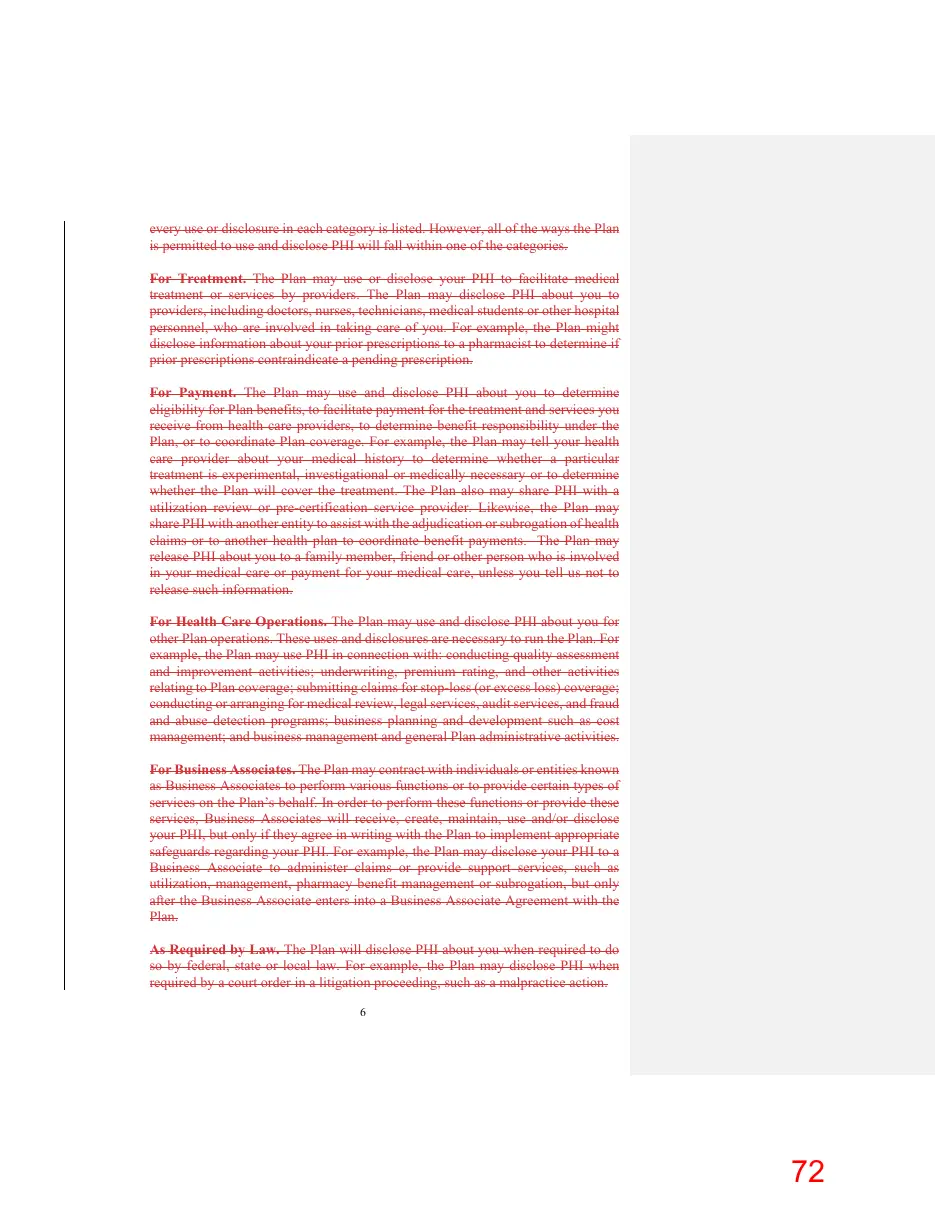
every use or disclosure in each category is listed. However, all of the ways the Plan is permitted to use and disclose PHI will fall within one of the categories. For Treatment. The Plan may use or disclose your PHI to facilitate medical treatment or services by providers. The Plan may disclose PHI about you to providers, including doctors, nurses, technicians, medical students or other hospital personnel, who are involved in taking care of you. For example, the Plan might disclose information about your prior prescriptions to a pharmacist to determine if prior prescriptions contraindicate a pending prescription. For Payment. The Plan may use and disclose PHI about you to determine eligibility for Plan benefits, to facilitate payment for the treatment and services you receive from health care providers, to determine benefit responsibility under the Plan, or to coordinate Plan coverage. For example, the Plan may tell your health care provider about your medical history to determine whether a particular treatment is experimental, investigational or medically necessary or to determine whether the Plan will cover the treatment. The Plan also may share PHI with a utilization review or pre-certification service provider. Likewise, the Plan may share PHI with another entity to assist with the adjudication or subrogation of health claims or to another health plan to coordinate benefit payments. The Plan may release PHI about you to a family member, friend or other person who is involved in your medical care or payment for your medical care, unless you tell us not to release such information. For Health Care Operations. The Plan may use and disclose PHI about you for other Plan operations. These uses and disclosures are necessary to run the Plan. For example, the Plan may use PHI in connection with: conducting quality assessment and improvement activities; underwriting, premium rating, and other activities relating to Plan coverage; submitting claims for stop-loss (or excess loss) coverage; conducting or arranging for medical review, legal services, audit services, and fraud and abuse detection programs; business planning and development such as cost management; and business management and general Plan administrative activities. For Business Associates. The Plan may contract with individuals or entities known as Business Associates to perform various functions or to provide certain types of services on the Plan’s behalf. In order to perform these functions or provide these services, Business Associates will receive, create, maintain, use and/or disclose your PHI, but only if they agree in writing with the Plan to implement appropriate safeguards regarding your PHI. For example, the Plan may disclose your PHI to a Business Associate to administer claims or provide support services, such as utilization, management, pharmacy benefit management or subrogation, but only after the Business Associate enters into a Business Associate Agreement with the Plan. As Required by Law. The Plan will disclose PHI about you when required to do so by federal, state or local law. For example, the Plan may disclose PHI when required by a court order in a litigation proceeding, such as a malpractice action. 6
Page 73
Text of page 73
To Avert a Serious Threat to Health or Safety. The Plan may use and disclose PHI about you when necessary to prevent a serious threat to your health and safety or the health and safety of the public or another person. Any disclosure, however, would only be to someone able to help prevent the threat. For example, the Plan may disclose PHI about you in a proceeding regarding the licensure of a physician. To Plan Sponsor (i.e. The City). For the purpose of administering the Plan, PHI may be disclosed to certain employees of the City. However, those employees will only use or disclose that PHI only as necessary to perform plan administration functions or as otherwise required by HIPAA, unless you have authorized further uses or disclosures. Your PHI cannot be used for employment related purposes without your specific, written authorization. Information also may be disclosed to another health plan maintained by the City for purposes of facilitating claim payments under that health plan. Special Situations. In addition to the above, the following categories describe other possible ways that the Plan may use and disclose your PHI. A.
Organ and Tissue Donation. If you are an organ donor, the Plan may release PHI to organizations that handle organ procurement or organ, eye or tissue transplantation or to an organ donation bank, as necessary to facilitate organ or tissue donation and transplantation.
Military and Veterans. If you are a member of the armed forces, the Plan may release PHI about you as required by military command authorities. The Plan also may release PHI about foreign military personnel to the appropriate foreign military authority.
Workers’ Compensation. The Plan may release PHI about you for worker’s compensation or similar programs. These programs provide benefits for work related injuries or illness.
Public Health Risks. The Plan may disclose PHI about you for public health activities. The activities generally include the following: (1) to prevent or control disease, injury or disability; (2) to report births and deaths; (3) to report child abuse or neglect; (4) to report reactions to medications or problems with products; (5) to notify people of recalls of products they may be using; (6) to notify a person who may have been exposed to a disease or may be at risk for contracting or spreading a disease or condition; and (7) to notify the appropriate government authority if we believe a patient has been the victim of abuse, neglect or domestic violence. The Plan will only make this disclosure if you agree or when required or authorized by law.
Health Oversight Activities. The Plan may disclose PHI to a health oversight agency for activities authorized by law. These oversight 7
Page 74
Text of page 74
activities include, for example, audits, investigations, inspections, and licensure. These activities are necessary for the government to monitor the health care system, government programs, and compliance with civil rights laws. F.
Lawsuits and Disputes. If you are involved in a lawsuit or a dispute, the Plan may disclose PHI about you in response to a court or administrative order. The Plan also may disclose PHI about you in response to a subpoena, discovery request, or other lawful process by someone else involved in the dispute, but only if efforts have been made to tell you about the request or to obtain an order protecting the information requested.
Law Enforcement. The Plan may release PHI if asked to do so by a law enforcement official: (1) in response to a court order, subpoena, warrant, summons or similar process; (2) to identify or locate a suspect, fugitive, material witness, or missing person; (3) about the victim of a crime if, under certain limited circumstances, we are unable to obtain the person’s agreement; (4) about a death we believe may be the result of criminal conduct; and (5) in emergency circumstances to report a crime; the location of the crime or victims; or the identity, description or location of the person who committed the crime.
Coroners, Medical Examiners and Funeral Directors. The Plan may release PHI to a coroner or medical examiner. This may be necessary, for example, to identify a deceased person or determine the cause of death.
National Security and Intelligence Activities. The Plan may release PHI about you to authorized federal officials for intelligence, counterintelligence, and other national security activities authorized by law.
Inmates. If you are an inmate of a correctional institution or under the custody of a law enforcement official, the Plan may release PHI about you to the correctional institution or law enforcement official. This release would be necessary (1) for the institution to provide you with health care; (2) to protect your health and safety or the health and safety of others; or (3) for the safety and security of the correctional institution.
Required Disclosures The following is a description of disclosures of your PHI the Plan is required to make: Government Audits. The Plan is required to disclose your PHI to the Secretary of the United States Department of Health and Human Services when the Secretary is investigating or determining the Plan’s compliance with the HIPAA Privacy rule. 8
Page 75
Text of page 75
Disclosures to You. When requested, the Plan is required to disclose to you the portion of your PHI that contains medical records, billing records, and any other records used to make decisions regarding your health care benefits. The Plan also is required, when requested, to provide you with an accounting of most disclosures of your PHI where the disclosure was for reasons other than for payment, treatment or health care operations, and where the PHI was not disclosed pursuant to your individual authorization. Other Disclosures Personal Representatives. The Plan will discuss your PHI to individuals authorized by you, or to an individual designated as your personal representative, attorney in fact, etc., as long as you provide the Plan with a written notice/authorization and any supporting documents (e.g. durable power of health care attorney). Note that under HIPAA privacy rule, the Plan does not have to disclose PHI to a personal representative if we have a reasonable belief that: (1) you have been, or may be, subjected to domestic violence, abuse or neglect by such person; (2) treating such person as your personal representative could endanger you; or (3) in the exercise or professional judgment, it is not in your best interest to treat the person as your personal representative. Authorizations. Other uses or disclosures of your PHI not described above will only be made with your written authorization. You may revoke written authorization at any time, as long as the revocation is in writing. Once we receive your written revocation, it will only be effective for future uses and disclosures. It will not be effective for any information that may have been used or disclosed in reliance upon the written authorization and prior to receiving your written revocation. Your Rights You have the following rights regarding PHI that the Plan maintains about you: Right to Inspect and Copy. You have the right to inspect and copy PHI that may be used to make decisions about your Plan benefits. To inspect and copy PHI that may be used to make decisions about you, you must submit your request in writing to the Contact Person listed above. If you request a copy of the information, you may be charged a fee for the costs of copying, mailing or other supplies associated with your request. The Plan may deny your request to inspect and copy PHI in certain very limited circumstances. If you are denied access to PHI, you may request that the denial be reviewed by submitting a written request to the Contact Person listed above. Right to Amend. If you believe that PHI the Plan has about you is incorrect or incomplete, you may ask us to amend the information. You have the right to request an amendment for as long as the information is kept by the Plan. To request an 9
Page 76
Text of page 76
amendment, your request must be in writing and submitted to the Contact Person listed above. In addition, you must provide the reason that supports your request. The Plan may deny your request for an amendment if it is not in writing or does not include a reason to support the request. In addition, the Plan may deny your request if you ask us to amend information that: (1) is not part of the PHI kept by the Plan; (2) was not created by the Plan, unless the person or entity that created the information is no longer available to make the amendment; (3) is not part of the information which you would be permitted to inspect and copy; or (4) is already accurate and complete. If the Plan denies your request, you have the right to file a statement of disagreement with the Plan, and any future disclosure of the disputed information will include your statement. Right to an Accounting of Disclosures. You have the right to request an “accounting” of certain disclosures of your PHI. The accounting will not include (1) disclosures made for purposes of treatment, payment or health care operations; (2) disclosures made to you; (3) disclosures made pursuant to your authorization; (4) disclosures made to friends or family in your presence or because of an emergency; (5) disclosures for national security purposes; and (6) disclosures incidental to otherwise permissible disclosures. To request this list of accounting of disclosures, you must submit your request, in writing, to Human Resources. Your request must state a time period which may not be longer than six years and may not include dates before April 14, 2004. Your request should indicate the form you want the list (for example, paper or electronic). The first list you request within a 12 month period will be free of charge. For additional lists, the Plan may charge you for the costs of providing the list. The Plan will notify you of the cost involved, and you may choose to withdraw or modify your request at that time before any costs are incurred. Right to Request Restrictions. You have the right to request a restriction or limitation on the PHI the Plan uses or discloses about you for treatment, payment or health care operations. You also have the right to request a limit on the PHI the Plan discloses about you to someone who is involved in your care or the payment for your care, such as a family member or friend. For example, you could ask that we not use or disclose information about a surgery you had. The Plan is not required to agree to your request. To request restrictions, you must make your request in writing to Human Resources. In your request, you must tell us what information you want to limit; whether you want to limit our use, disclosure or both; and to whom you want the limits to apply, for example, disclosures to your spouse. Right to Request Confidential Communications. You have the right to request that the Plan communicate with you about medical matters in a certain way or at a certain location. For example, you can ask that we only contact you at work or by mail. To request confidential communications, you must make your request in writing to 10
Page 77
Text of page 77
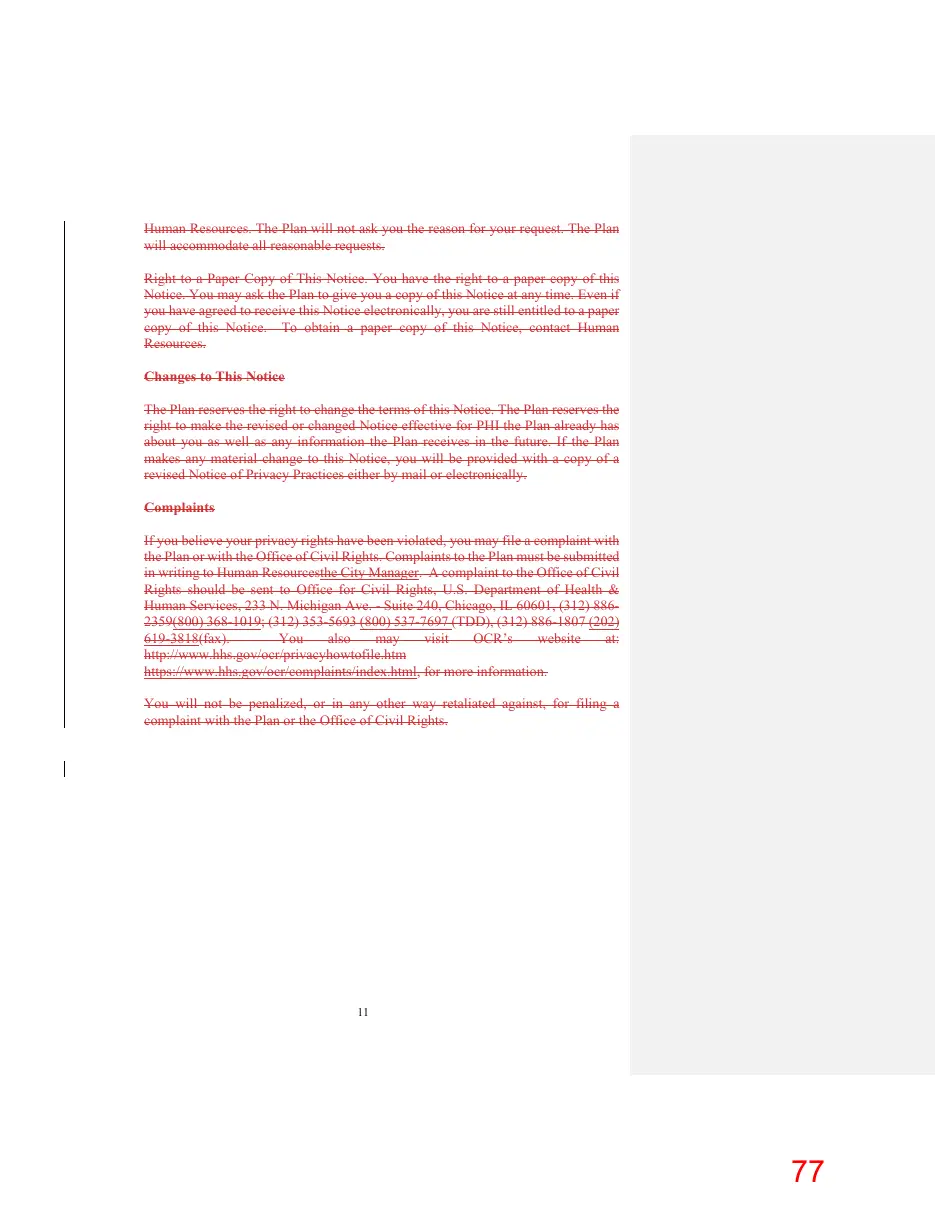
Human Resources. The Plan will not ask you the reason for your request. The Plan will accommodate all reasonable requests. Right to a Paper Copy of This Notice. You have the right to a paper copy of this Notice. You may ask the Plan to give you a copy of this Notice at any time. Even if you have agreed to receive this Notice electronically, you are still entitled to a paper copy of this Notice. To obtain a paper copy of this Notice, contact Human Resources. Changes to This Notice The Plan reserves the right to change the terms of this Notice. The Plan reserves the right to make the revised or changed Notice effective for PHI the Plan already has about you as well as any information the Plan receives in the future. If the Plan makes any material change to this Notice, you will be provided with a copy of a revised Notice of Privacy Practices either by mail or electronically. Complaints If you believe your privacy rights have been violated, you may file a complaint with the Plan or with the Office of Civil Rights. Complaints to the Plan must be submitted in writing to Human Resourcesthe City Manager. A complaint to the Office of Civil Rights should be sent to Office for Civil Rights, U.S. Department of Health & Human Services, 233 N. Michigan Ave. - Suite 240, Chicago, IL 60601, (312) 8862359(800) 368-1019; (312) 353-5693 (800) 537-7697 (TDD), (312) 886-1807 (202) 619-3818(fax). You also may visit OCR’s website at: http://www.hhs.gov/ocr/privacyhowtofile.htm https://www.hhs.gov/ocr/complaints/index.html, for more information. You will not be penalized, or in any other way retaliated against, for filing a complaint with the Plan or the Office of Civil Rights.
Page 78
Text of page 78
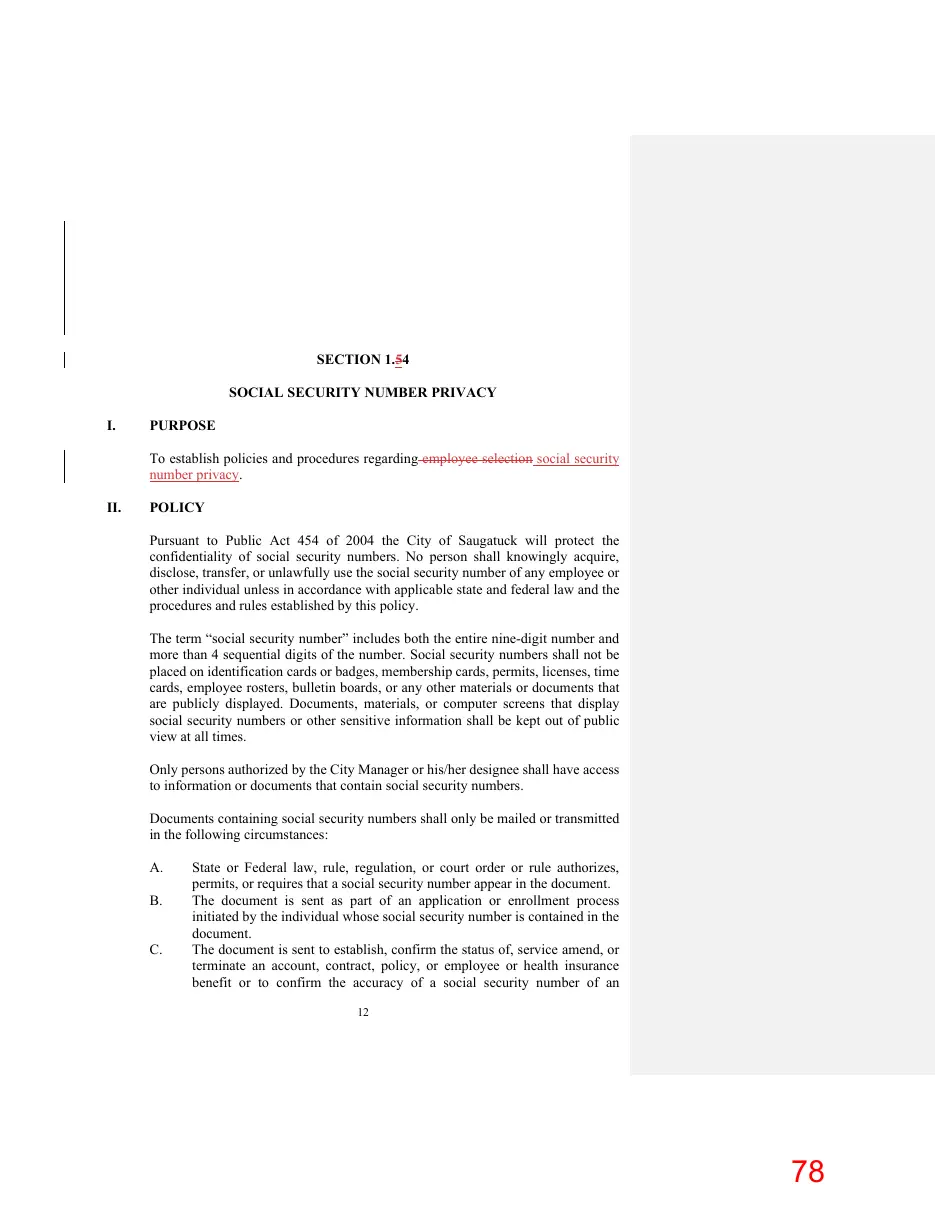
SECTION 1.54 SOCIAL SECURITY NUMBER PRIVACY I.
PURPOSE To establish policies and procedures regarding employee selection social security number privacy.
II.
POLICY Pursuant to Public Act 454 of 2004 the City of Saugatuck will protect the confidentiality of social security numbers. No person shall knowingly acquire, disclose, transfer, or unlawfully use the social security number of any employee or other individual unless in accordance with applicable state and federal law and the procedures and rules established by this policy. The term “social security number” includes both the entire nine-digit number and more than 4 sequential digits of the number. Social security numbers shall not be placed on identification cards or badges, membership cards, permits, licenses, time cards, employee rosters, bulletin boards, or any other materials or documents that are publicly displayed. Documents, materials, or computer screens that display social security numbers or other sensitive information shall be kept out of public view at all times. Only persons authorized by the City Manager or his/her designee shall have access to information or documents that contain social security numbers. Documents containing social security numbers shall only be mailed or transmitted in the following circumstances: A. B. C.
State or Federal law, rule, regulation, or court order or rule authorizes, permits, or requires that a social security number appear in the document. The document is sent as part of an application or enrollment process initiated by the individual whose social security number is contained in the document. The document is sent to establish, confirm the status of, service amend, or terminate an account, contract, policy, or employee or health insurance benefit or to confirm the accuracy of a social security number of an 12
Page 79
Text of page 79
D. E. F.
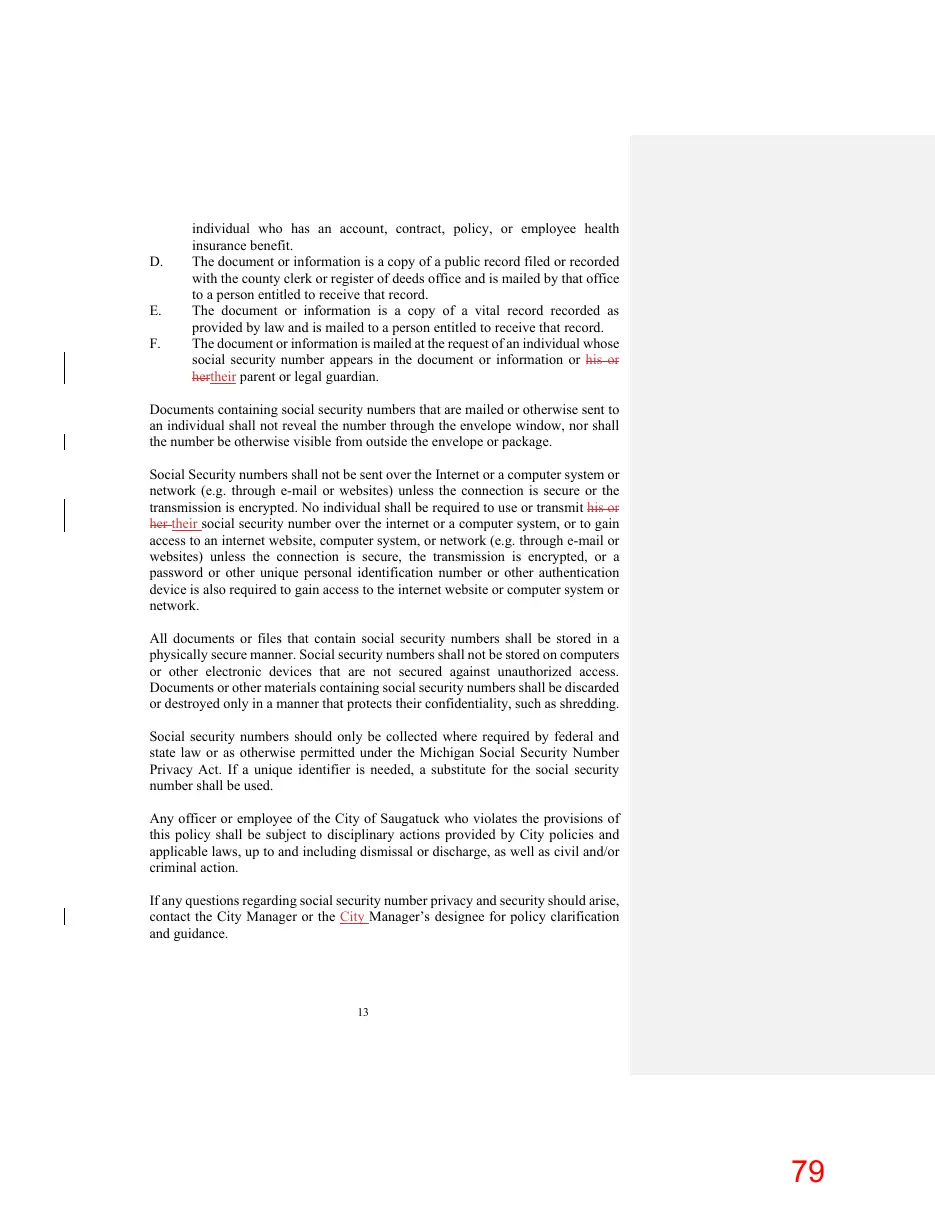
individual who has an account, contract, policy, or employee health insurance benefit. The document or information is a copy of a public record filed or recorded with the county clerk or register of deeds office and is mailed by that office to a person entitled to receive that record. The document or information is a copy of a vital record recorded as provided by law and is mailed to a person entitled to receive that record. The document or information is mailed at the request of an individual whose social security number appears in the document or information or his or hertheir parent or legal guardian.
Documents containing social security numbers that are mailed or otherwise sent to an individual shall not reveal the number through the envelope window, nor shall the number be otherwise visible from outside the envelope or package. Social Security numbers shall not be sent over the Internet or a computer system or network (e.g. through e-mail or websites) unless the connection is secure or the transmission is encrypted. No individual shall be required to use or transmit his or her their social security number over the internet or a computer system, or to gain access to an internet website, computer system, or network (e.g. through e-mail or websites) unless the connection is secure, the transmission is encrypted, or a password or other unique personal identification number or other authentication device is also required to gain access to the internet website or computer system or network. All documents or files that contain social security numbers shall be stored in a physically secure manner. Social security numbers shall not be stored on computers or other electronic devices that are not secured against unauthorized access. Documents or other materials containing social security numbers shall be discarded or destroyed only in a manner that protects their confidentiality, such as shredding. Social security numbers should only be collected where required by federal and state law or as otherwise permitted under the Michigan Social Security Number Privacy Act. If a unique identifier is needed, a substitute for the social security number shall be used. Any officer or employee of the City of Saugatuck who violates the provisions of this policy shall be subject to disciplinary actions provided by City policies and applicable laws, up to and including dismissal or discharge, as well as civil and/or criminal action. If any questions regarding social security number privacy and security should arise, contact the City Manager or the City Manager’s designee for policy clarification and guidance.
Page 80
Text of page 80
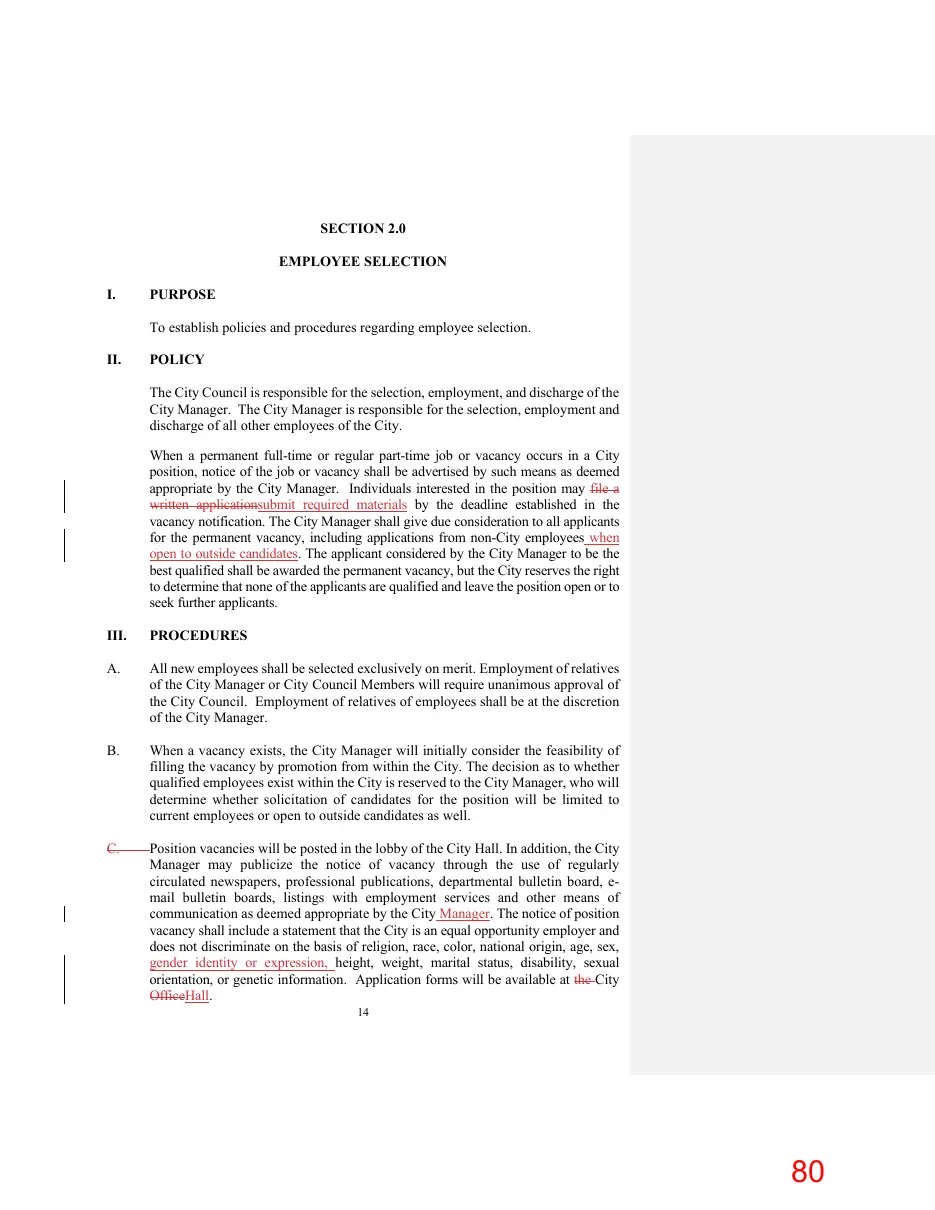
SECTION 2.0 EMPLOYEE SELECTION I.
PURPOSE To establish policies and procedures regarding employee selection.
II.
POLICY The City Council is responsible for the selection, employment, and discharge of the City Manager. The City Manager is responsible for the selection, employment and discharge of all other employees of the City. When a permanent full-time or regular part-time job or vacancy occurs in a City position, notice of the job or vacancy shall be advertised by such means as deemed appropriate by the City Manager. Individuals interested in the position may file a written applicationsubmit required materials by the deadline established in the vacancy notification. The City Manager shall give due consideration to all applicants for the permanent vacancy, including applications from non-City employees when open to outside candidates. The applicant considered by the City Manager to be the best qualified shall be awarded the permanent vacancy, but the City reserves the right to determine that none of the applicants are qualified and leave the position open or to seek further applicants.
III.
PROCEDURES
All new employees shall be selected exclusively on merit. Employment of relatives of the City Manager or City Council Members will require unanimous approval of the City Council. Employment of relatives of employees shall be at the discretion of the City Manager.
When a vacancy exists, the City Manager will initially consider the feasibility of filling the vacancy by promotion from within the City. The decision as to whether qualified employees exist within the City is reserved to the City Manager, who will determine whether solicitation of candidates for the position will be limited to current employees or open to outside candidates as well.
Position vacancies will be posted in the lobby of the City Hall. In addition, the City Manager may publicize the notice of vacancy through the use of regularly circulated newspapers, professional publications, departmental bulletin board, email bulletin boards, listings with employment services and other means of communication as deemed appropriate by the City Manager. The notice of position vacancy shall include a statement that the City is an equal opportunity employer and does not discriminate on the basis of religion, race, color, national origin, age, sex, gender identity or expression, height, weight, marital status, disability, sexual orientation, or genetic information. Application forms will be available at the City OfficeHall. 14
Page 81
Text of page 81
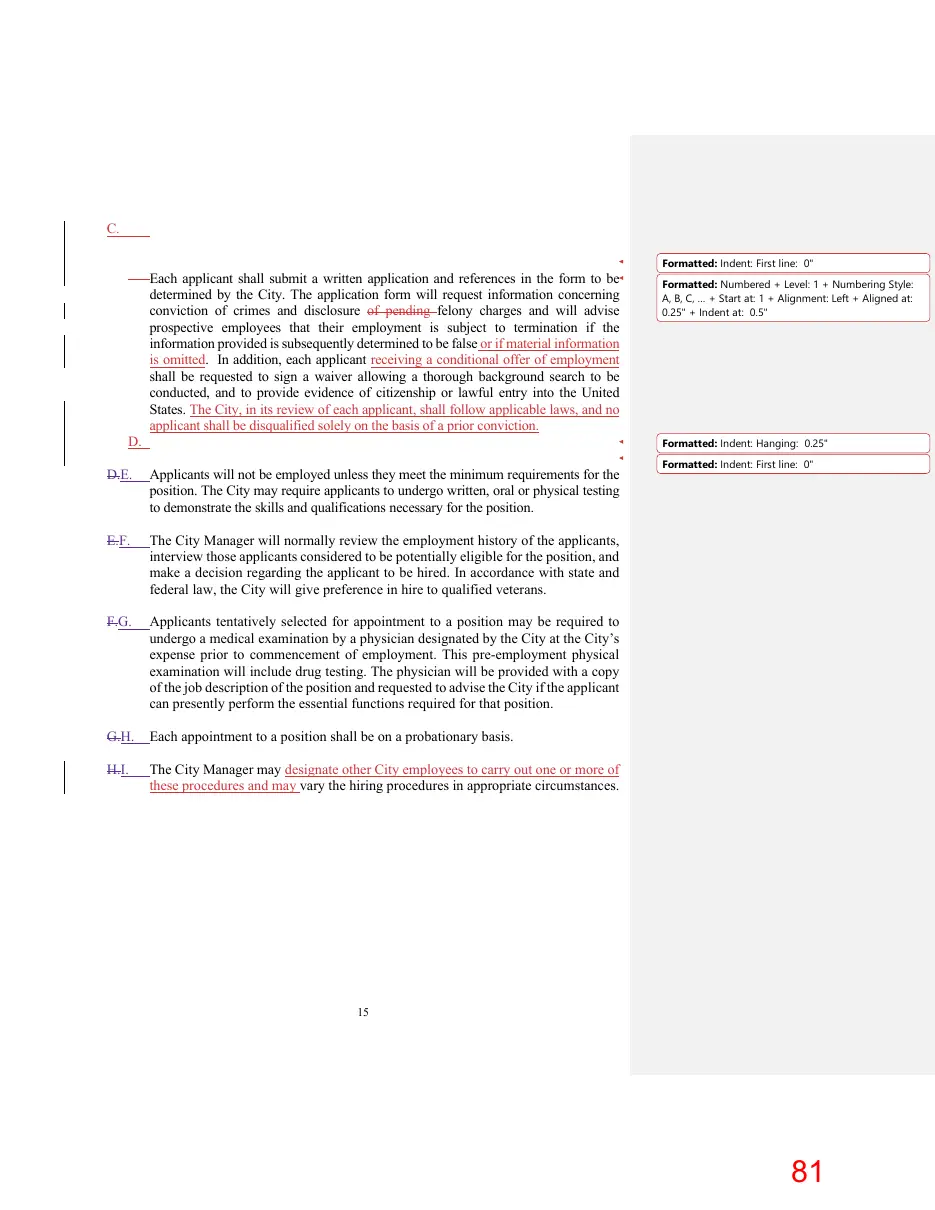
Each applicant shall submit a written application and references in the form to be determined by the City. The application form will request information concerning conviction of crimes and disclosure of pending felony charges and will advise prospective employees that their employment is subject to termination if the information provided is subsequently determined to be false or if material information is omitted. In addition, each applicant receiving a conditional offer of employment shall be requested to sign a waiver allowing a thorough background search to be conducted, and to provide evidence of citizenship or lawful entry into the United States. The City, in its review of each applicant, shall follow applicable laws, and no applicant shall be disqualified solely on the basis of a prior conviction.
D.E.
Applicants will not be employed unless they meet the minimum requirements for the position. The City may require applicants to undergo written, oral or physical testing to demonstrate the skills and qualifications necessary for the position.
E.F.
The City Manager will normally review the employment history of the applicants, interview those applicants considered to be potentially eligible for the position, and make a decision regarding the applicant to be hired. In accordance with state and federal law, the City will give preference in hire to qualified veterans.
F.G.
Applicants tentatively selected for appointment to a position may be required to undergo a medical examination by a physician designated by the City at the City’s expense prior to commencement of employment. This pre-employment physical examination will include drug testing. The physician will be provided with a copy of the job description of the position and requested to advise the City if the applicant can presently perform the essential functions required for that position.
G.H.
Each appointment to a position shall be on a probationary basis.
H.I.
The City Manager may designate other City employees to carry out one or more of these procedures and may vary the hiring procedures in appropriate circumstances.
Formatted: Indent: First line: 0" Formatted: Numbered + Level: 1 + Numbering Style: A, B, C, … + Start at: 1 + Alignment: Left + Aligned at: 0.25" + Indent at: 0.5"
Formatted: Indent: Hanging: 0.25" Formatted: Indent: First line: 0"
Page 82
Text of page 82
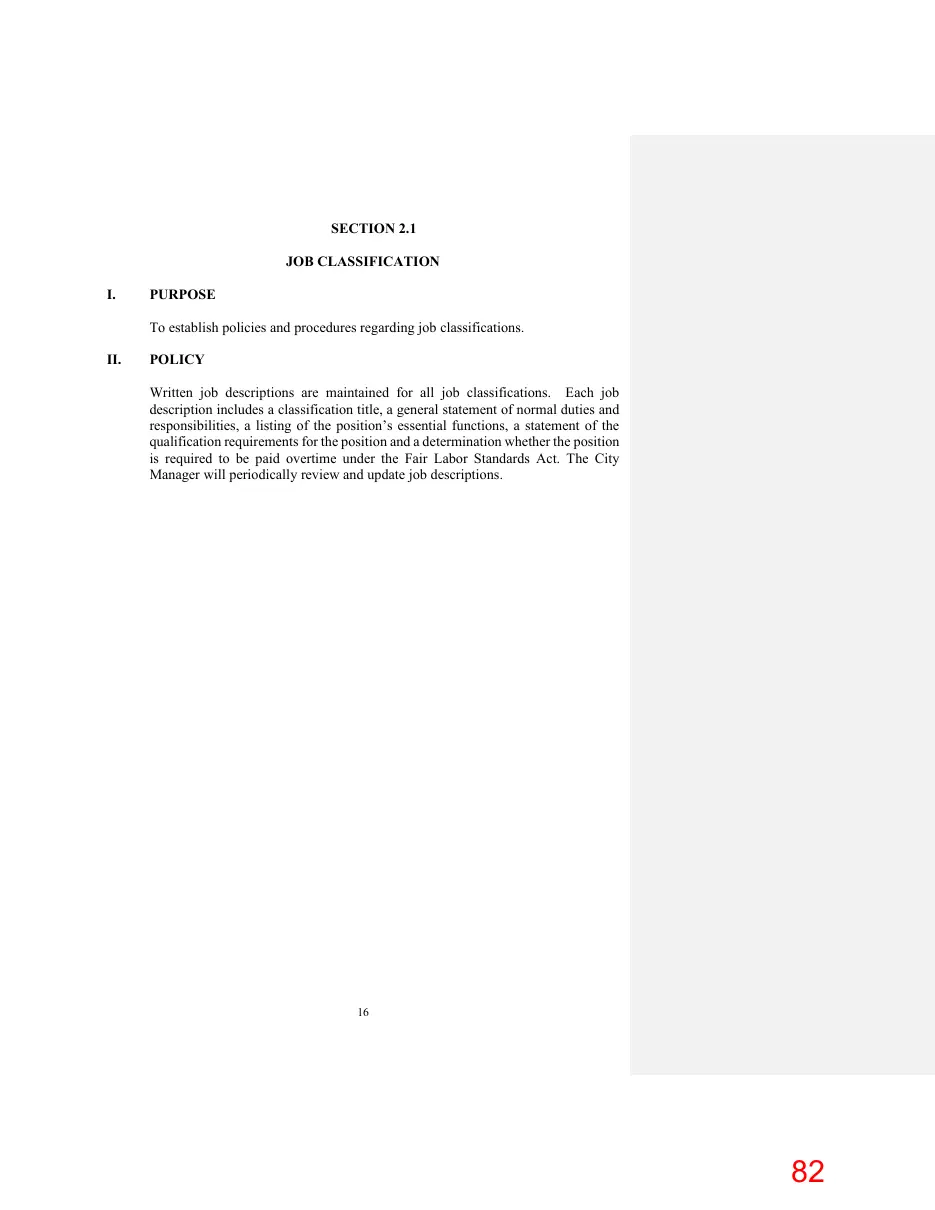
SECTION 2.1 JOB CLASSIFICATION I.
PURPOSE To establish policies and procedures regarding job classifications.
II.
POLICY Written job descriptions are maintained for all job classifications. Each job description includes a classification title, a general statement of normal duties and responsibilities, a listing of the position’s essential functions, a statement of the qualification requirements for the position and a determination whether the position is required to be paid overtime under the Fair Labor Standards Act. The City Manager will periodically review and update job descriptions.
Page 83
Text of page 83
SECTION 2.2 CATEGORIES OF EMPLOYMENT I.
PURPOSE To establish policies and procedures regarding categories of employment.
II.
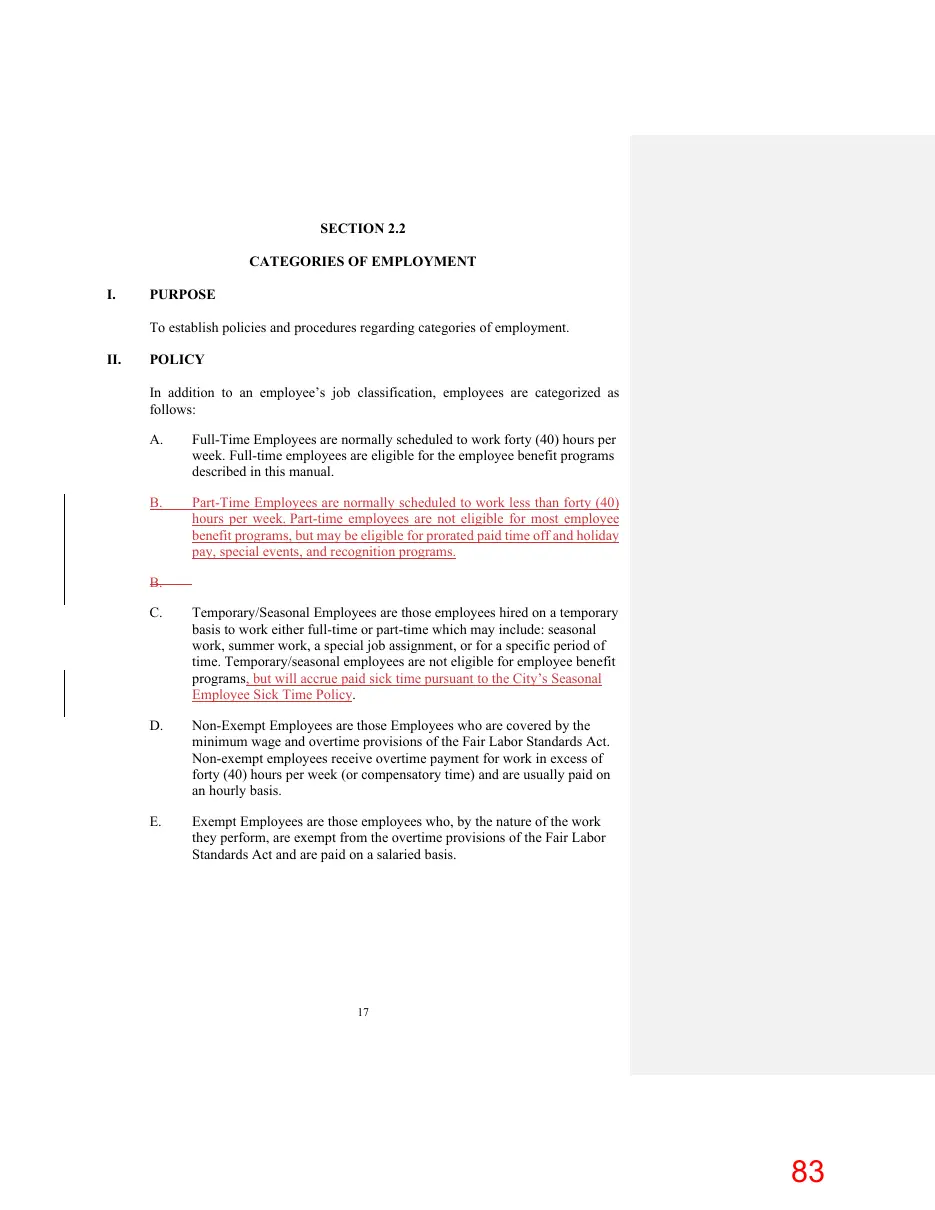
POLICY In addition to an employee’s job classification, employees are categorized as follows: A.
Full-Time Employees are normally scheduled to work forty (40) hours per week. Full-time employees are eligible for the employee benefit programs described in this manual.
Part-Time Employees are normally scheduled to work less than forty (40) hours per week. Part-time employees are not eligible for most employee benefit programs, but may be eligible for prorated paid time off and holiday pay, special events, and recognition programs.
B. C.
Temporary/Seasonal Employees are those employees hired on a temporary basis to work either full-time or part-time which may include: seasonal work, summer work, a special job assignment, or for a specific period of time. Temporary/seasonal employees are not eligible for employee benefit programs, but will accrue paid sick time pursuant to the City’s Seasonal Employee Sick Time Policy.
Non-Exempt Employees are those Employees who are covered by the minimum wage and overtime provisions of the Fair Labor Standards Act. Non-exempt employees receive overtime payment for work in excess of forty (40) hours per week (or compensatory time) and are usually paid on an hourly basis.
Exempt Employees are those employees who, by the nature of the work they perform, are exempt from the overtime provisions of the Fair Labor Standards Act and are paid on a salaried basis.
Page 84
Text of page 84
SECTION 2.3 PROBATIONARY PERIOD I.
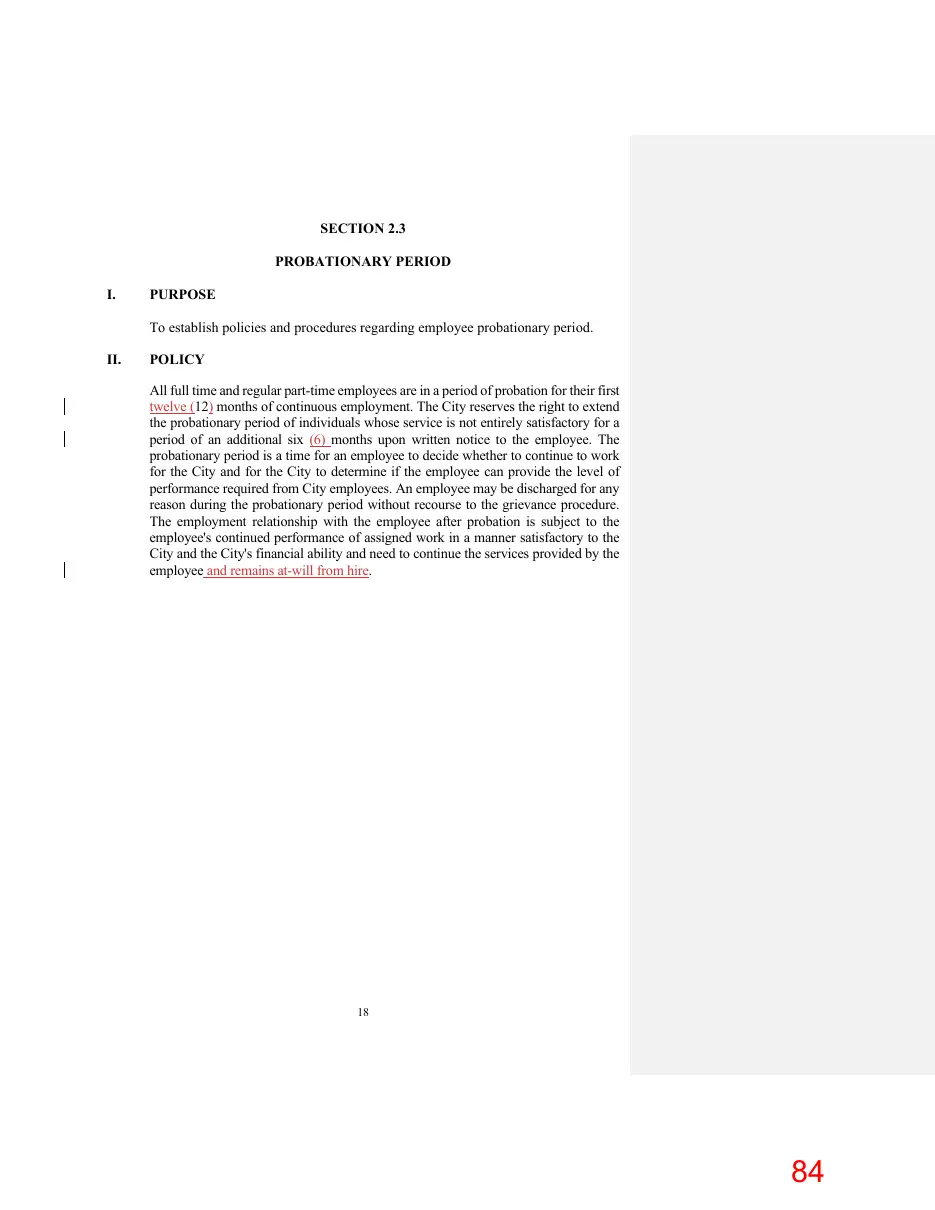
PURPOSE To establish policies and procedures regarding employee probationary period.
II.
POLICY All full time and regular part-time employees are in a period of probation for their first twelve (12) months of continuous employment. The City reserves the right to extend the probationary period of individuals whose service is not entirely satisfactory for a period of an additional six (6) months upon written notice to the employee. The probationary period is a time for an employee to decide whether to continue to work for the City and for the City to determine if the employee can provide the level of performance required from City employees. An employee may be discharged for any reason during the probationary period without recourse to the grievance procedure. The employment relationship with the employee after probation is subject to the employee's continued performance of assigned work in a manner satisfactory to the City and the City's financial ability and need to continue the services provided by the employee and remains at-will from hire.
Page 85
Text of page 85
SECTION 2.4 ANNIVERSARY DATE I.
PURPOSE To establish policies and procedures regarding employee anniversary dates.
II.
POLICY An employee’s anniversary date is the most recent date upon which the employee commenced work for the City, and the same date thereafter in succeeding years.
Page 86
Text of page 86
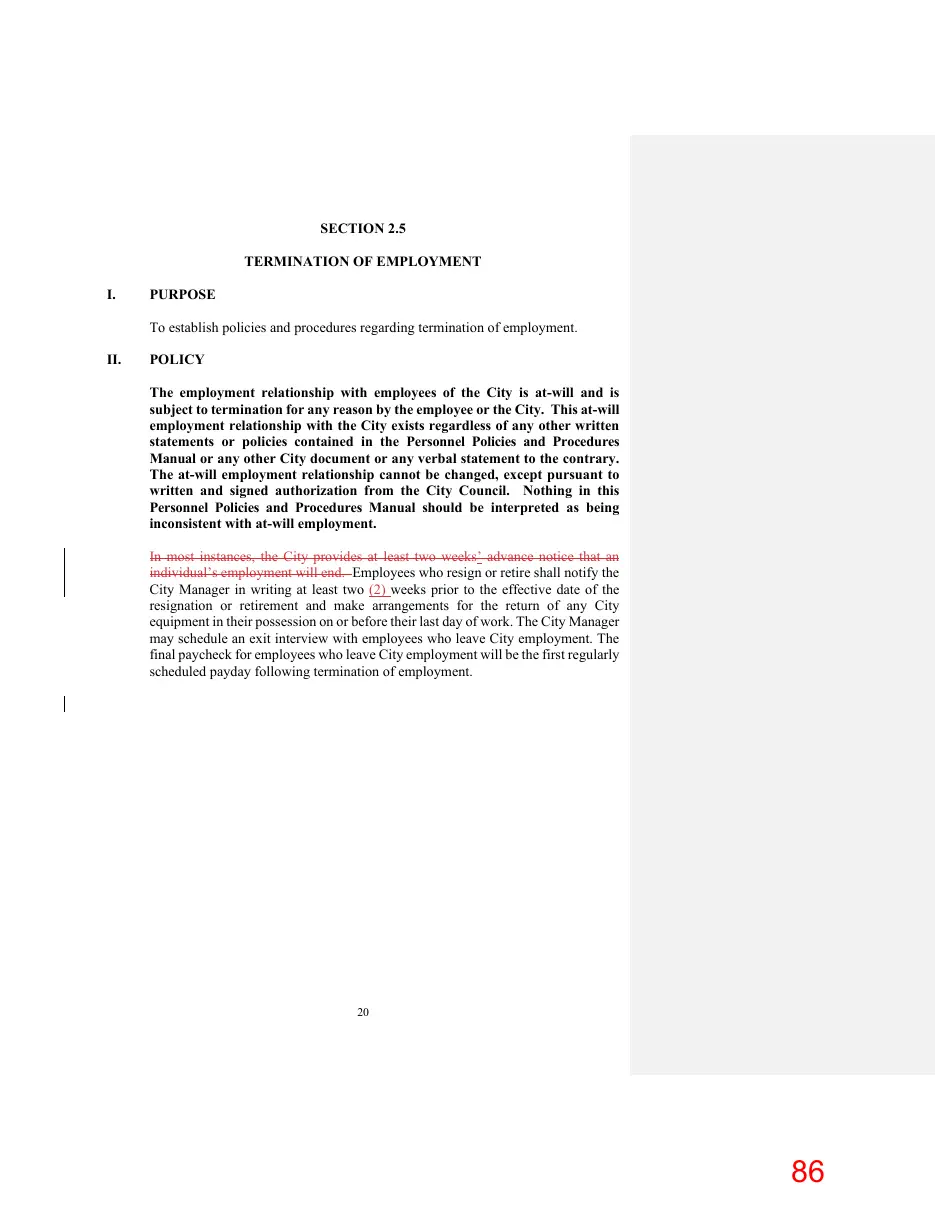
SECTION 2.5 TERMINATION OF EMPLOYMENT I.
PURPOSE To establish policies and procedures regarding termination of employment.
II.
POLICY The employment relationship with employees of the City is at-will and is subject to termination for any reason by the employee or the City. This at-will employment relationship with the City exists regardless of any other written statements or policies contained in the Personnel Policies and Procedures Manual or any other City document or any verbal statement to the contrary. The at-will employment relationship cannot be changed, except pursuant to written and signed authorization from the City Council. Nothing in this Personnel Policies and Procedures Manual should be interpreted as being inconsistent with at-will employment. In most instances, the City provides at least two weeks’ advance notice that an individual’s employment will end. Employees who resign or retire shall notify the City Manager in writing at least two (2) weeks prior to the effective date of the resignation or retirement and make arrangements for the return of any City equipment in their possession on or before their last day of work. The City Manager may schedule an exit interview with employees who leave City employment. The final paycheck for employees who leave City employment will be the first regularly scheduled payday following termination of employment.
Page 87
Text of page 87
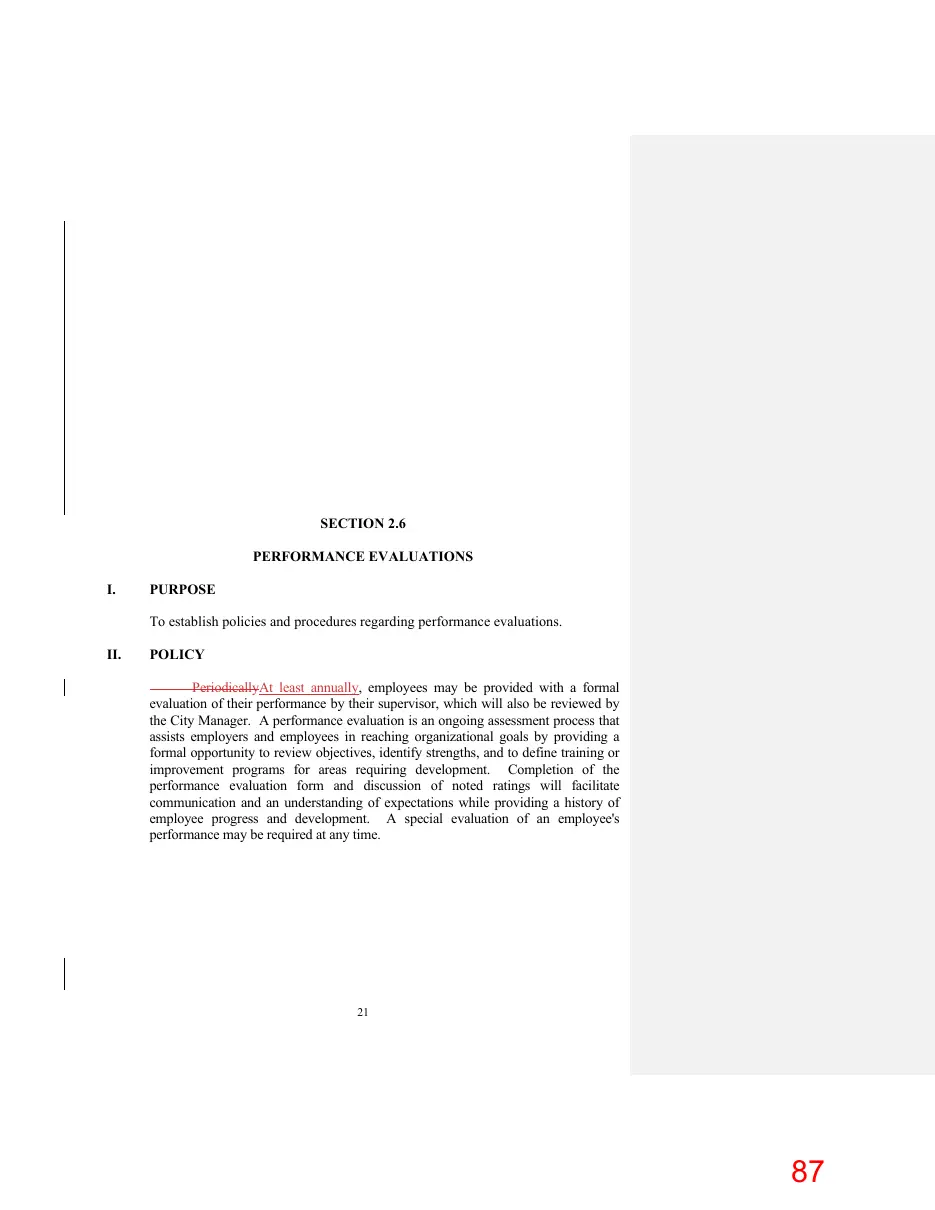
SECTION 2.6 PERFORMANCE EVALUATIONS I.
PURPOSE To establish policies and procedures regarding performance evaluations.
II.
POLICY PeriodicallyAt least annually, employees may be provided with a formal evaluation of their performance by their supervisor, which will also be reviewed by the City Manager. A performance evaluation is an ongoing assessment process that assists employers and employees in reaching organizational goals by providing a formal opportunity to review objectives, identify strengths, and to define training or improvement programs for areas requiring development. Completion of the performance evaluation form and discussion of noted ratings will facilitate communication and an understanding of expectations while providing a history of employee progress and development. A special evaluation of an employee's performance may be required at any time.
Page 88

This page is a scanned image with no text layer. The PDF of these pages has it at full resolution.
Page 89
Text of page 89
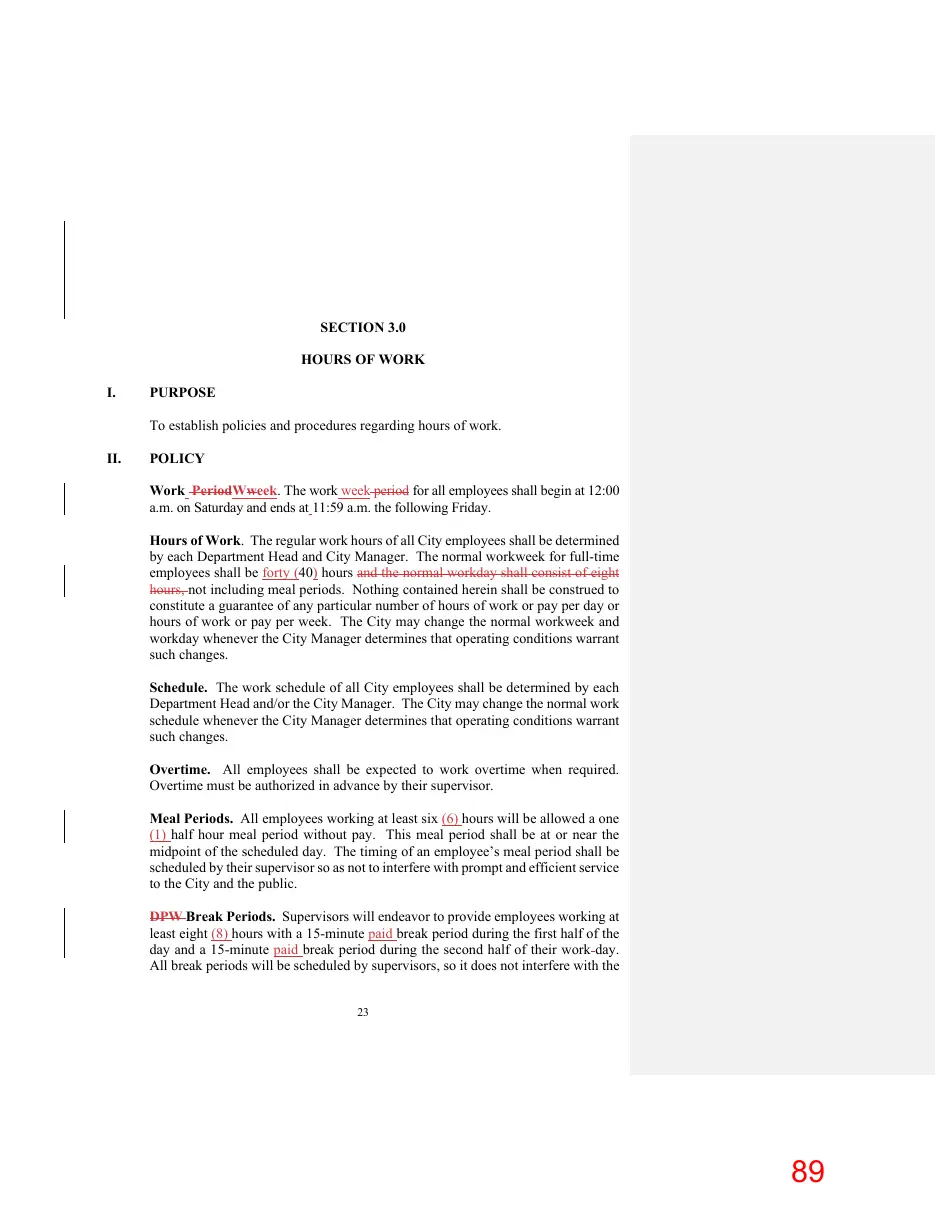
SECTION 3.0 HOURS OF WORK I.
PURPOSE To establish policies and procedures regarding hours of work.
II.
POLICY Work PeriodWweek. The work week period for all employees shall begin at 12:00 a.m. on Saturday and ends at 11:59 a.m. the following Friday. Hours of Work. The regular work hours of all City employees shall be determined by each Department Head and City Manager. The normal workweek for full-time employees shall be forty (40) hours and the normal workday shall consist of eight hours, not including meal periods. Nothing contained herein shall be construed to constitute a guarantee of any particular number of hours of work or pay per day or hours of work or pay per week. The City may change the normal workweek and workday whenever the City Manager determines that operating conditions warrant such changes. Schedule. The work schedule of all City employees shall be determined by each Department Head and/or the City Manager. The City may change the normal work schedule whenever the City Manager determines that operating conditions warrant such changes. Overtime. All employees shall be expected to work overtime when required. Overtime must be authorized in advance by their supervisor. Meal Periods. All employees working at least six (6) hours will be allowed a one (1) half hour meal period without pay. This meal period shall be at or near the midpoint of the scheduled day. The timing of an employee’s meal period shall be scheduled by their supervisor so as not to interfere with prompt and efficient service to the City and the public. DPW Break Periods. Supervisors will endeavor to provide employees working at least eight (8) hours with a 15-minute paid break period during the first half of the day and a 15-minute paid break period during the second half of their work day. All break periods will be scheduled by supervisors, so it does not interfere with the 23
Page 90

Text of page 90
prompt and efficient service to the City and the public. During these periods, the employee remains on active duty and must take appropriate actions if necessary.
Page 91
Text of page 91
SECTION 3.1 EMERGENCY CALL IN I.
PURPOSE To establish policies and procedures regarding emergency call in.
II.
POLICY Non-Exempt Eemployees who are called in to work at times other than their regularly scheduled shift shall be paid for two (2) hours at time and one half their regular straight time rate or for the time actually worked at time and one half their regular straight time rate, whichever is greater. Employees are not required to remain at work for the entire two-hour overtime pay guarantee period if the project for which they are called in is completed sooner, but any additional call in that occurs during the guarantee period will be considered a continuation of the original call rather than a new call. This pay guarantee shall only apply to a physical requirement to appear at City premises. Employees who are called by phone at home and are not physically required to appear at work shall be paid in 15-minute increments dependent on the nature and longevity of the phone call but pay for this phone call that occurs during the guarantee period will not result in additional compensation. Call-in pay is not applicable in instances where theif an employee is called in to work prior to the start of their regularly scheduled shift and continues to work through the start of their regularly scheduled shift;, continues to work past the end of the regularly scheduled shift, or; is called-in within thirty (30) minutes of the end of their regularly scheduled shift.
Page 92
Text of page 92
SECTION 3.2 TARDINESS AND ABSENTEEISM I.
PURPOSE To establish policies and procedures regarding tardiness and absenteeism.
II.
POLICY Employees shall report promptly for work and remain at work until the end of the work schedule. If an employee is unable to report for work, they must notify their supervisor as soon as possible prior to the beginning of the normal workday, unless doing so is not practicable due to emergency or extenuating circumstances. In the case of unexpected need for delayed arrival or missed work, employees are expected to notify their supervisor as soon as possible.
Page 93
Text of page 93
SECTION 3.3 TIME REPORTING I.
PURPOSE To establish policies and procedures regarding time reporting.
II.
POLICY Hourly employees are required to record their hours of work through the utilization of the appropriate time sheet. Salaried employees are required to report any deviation from their regular hours and the type of leave to be utilized for the period of absence. Employees are required to sign the time sheet prior to its submission to the City. An employee’s signature is a certification that the time sheet accurately and completely reflects all time worked during the period in question and that the employee did not work any hours that are not reflected on the time sheet.
Page 94
Text of page 94
SECTION 3.4 INCLEMENT WEATHER I.
PURPOSE To establish policies and procedures regarding inclement weather.
II.
POLICY City services remain operational during severe weather periods, and employees are expected to report for and remain at work unless City operations are officially closed by the City Manager. In severe weather conditions when the City Manager declares all or part of the City operations closed, or when City operations remain open but the employees report for work late or leave work early, the employee may: (a) elect to use accrued paid personal leave time off to maintain their normal pay for that day, or (b) with permission of the City Manager, may work remotely, or (c) elect to take unpaid leave for the time missed. Employees prevented from reporting for work at their scheduled time due to severe weather conditions must notify their supervisor as soon as possible.
Page 95
Text of page 95
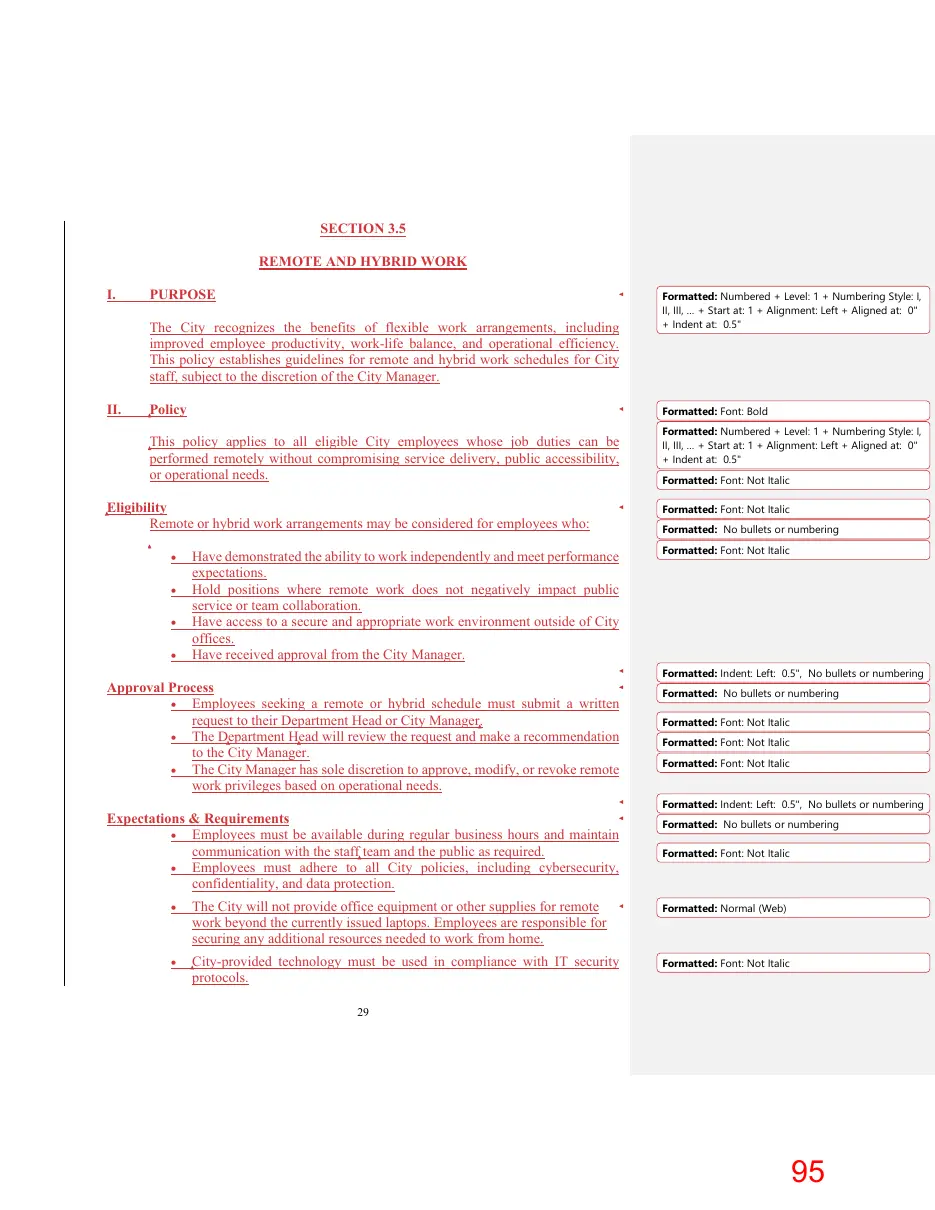
SECTION 3.5 REMOTE AND HYBRID WORK I.
PURPOSE The City recognizes the benefits of flexible work arrangements, including improved employee productivity, work-life balance, and operational efficiency. This policy establishes guidelines for remote and hybrid work schedules for City staff, subject to the discretion of the City Manager.
II.
Policy
Formatted: Font: Bold
This policy applies to all eligible City employees whose job duties can be performed remotely without compromising service delivery, public accessibility, or operational needs. Eligibility Remote or hybrid work arrangements may be considered for employees who: • • • •
Formatted: Numbered + Level: 1 + Numbering Style: I, II, III, … + Start at: 1 + Alignment: Left + Aligned at: 0" + Indent at: 0.5"
Have demonstrated the ability to work independently and meet performance expectations. Hold positions where remote work does not negatively impact public service or team collaboration. Have access to a secure and appropriate work environment outside of City offices. Have received approval from the City Manager.
Approval Process • Employees seeking a remote or hybrid schedule must submit a written request to their Department Head or City Manager. • The Department Head will review the request and make a recommendation to the City Manager. • The City Manager has sole discretion to approve, modify, or revoke remote work privileges based on operational needs. Expectations & Requirements • Employees must be available during regular business hours and maintain communication with the staff team and the public as required. • Employees must adhere to all City policies, including cybersecurity, confidentiality, and data protection.
Formatted: Numbered + Level: 1 + Numbering Style: I, II, III, … + Start at: 1 + Alignment: Left + Aligned at: 0" + Indent at: 0.5" Formatted: Font: Not Italic Formatted: Font: Not Italic Formatted: No bullets or numbering Formatted: Font: Not Italic
Formatted: Indent: Left: 0.5", No bullets or numbering Formatted: No bullets or numbering Formatted: Font: Not Italic Formatted: Font: Not Italic Formatted: Font: Not Italic Formatted: Indent: Left: 0.5", No bullets or numbering Formatted: No bullets or numbering Formatted: Font: Not Italic
The City will not provide office equipment or other supplies for remote work beyond the currently issued laptops. Employees are responsible for securing any additional resources needed to work from home.
Formatted: Normal (Web)
City-provided technology must be used in compliance with IT security protocols.
Formatted: Font: Not Italic
Page 96
Text of page 96
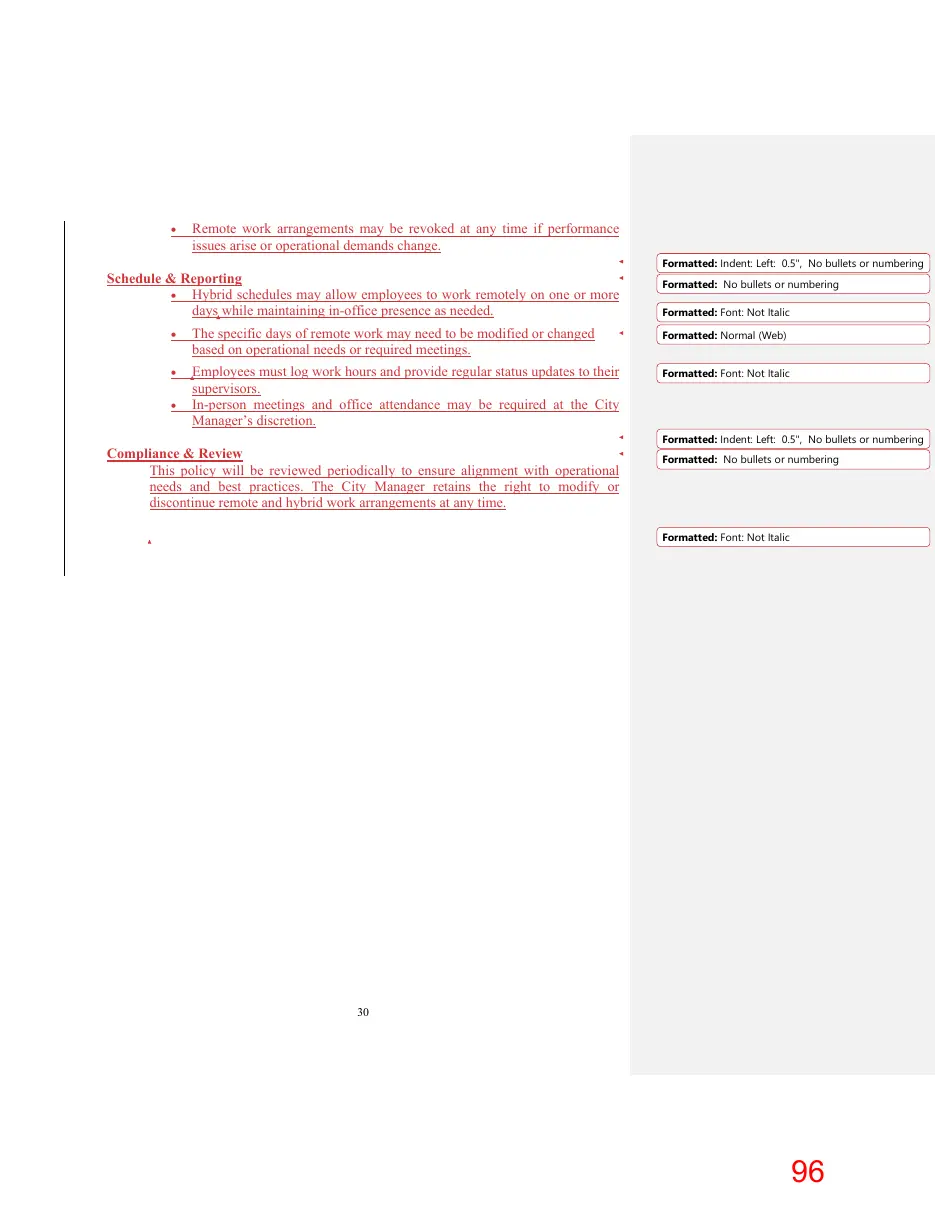
Remote work arrangements may be revoked at any time if performance issues arise or operational demands change.
Schedule & Reporting • Hybrid schedules may allow employees to work remotely on one or more days while maintaining in-office presence as needed.
Formatted: Indent: Left: 0.5", No bullets or numbering Formatted: No bullets or numbering Formatted: Font: Not Italic
The specific days of remote work may need to be modified or changed based on operational needs or required meetings.
Formatted: Normal (Web)
Employees must log work hours and provide regular status updates to their supervisors. In-person meetings and office attendance may be required at the City Manager’s discretion.
Formatted: Font: Not Italic
Compliance & Review This policy will be reviewed periodically to ensure alignment with operational needs and best practices. The City Manager retains the right to modify or discontinue remote and hybrid work arrangements at any time.
Formatted: Indent: Left: 0.5", No bullets or numbering Formatted: No bullets or numbering
Formatted: Font: Not Italic
Page 97
Text of page 97
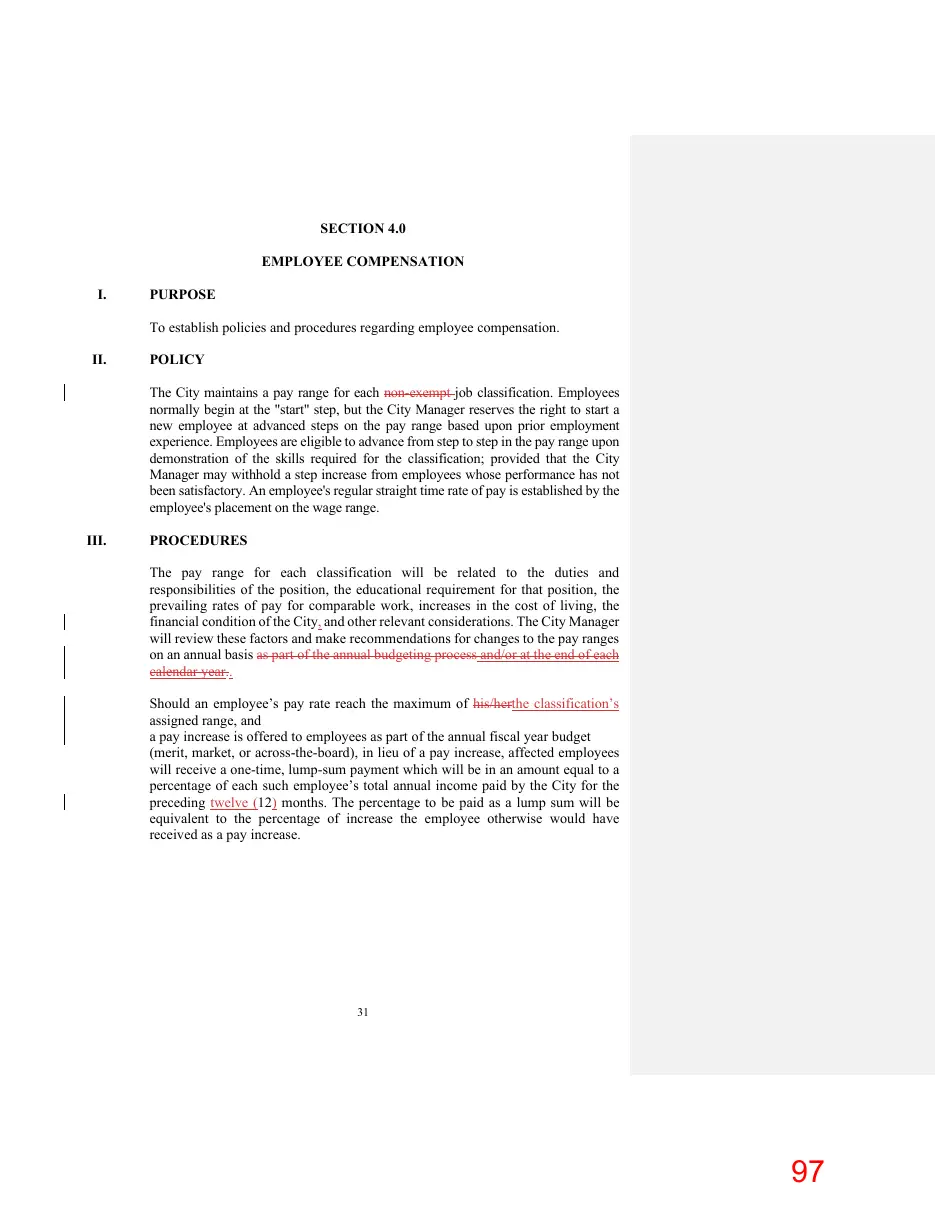
SECTION 4.0 EMPLOYEE COMPENSATION I.
PURPOSE To establish policies and procedures regarding employee compensation.
II.
POLICY The City maintains a pay range for each non-exempt job classification. Employees normally begin at the "start" step, but the City Manager reserves the right to start a new employee at advanced steps on the pay range based upon prior employment experience. Employees are eligible to advance from step to step in the pay range upon demonstration of the skills required for the classification; provided that the City Manager may withhold a step increase from employees whose performance has not been satisfactory. An employee's regular straight time rate of pay is established by the employee's placement on the wage range.
III.
PROCEDURES The pay range for each classification will be related to the duties and responsibilities of the position, the educational requirement for that position, the prevailing rates of pay for comparable work, increases in the cost of living, the financial condition of the City, and other relevant considerations. The City Manager will review these factors and make recommendations for changes to the pay ranges on an annual basis as part of the annual budgeting process and/or at the end of each calendar year.. Should an employee’s pay rate reach the maximum of his/herthe classification’s assigned range, and a pay increase is offered to employees as part of the annual fiscal year budget (merit, market, or across-the-board), in lieu of a pay increase, affected employees will receive a one-time, lump-sum payment which will be in an amount equal to a percentage of each such employee’s total annual income paid by the City for the preceding twelve (12) months. The percentage to be paid as a lump sum will be equivalent to the percentage of increase the employee otherwise would have received as a pay increase.
Page 98
Text of page 98
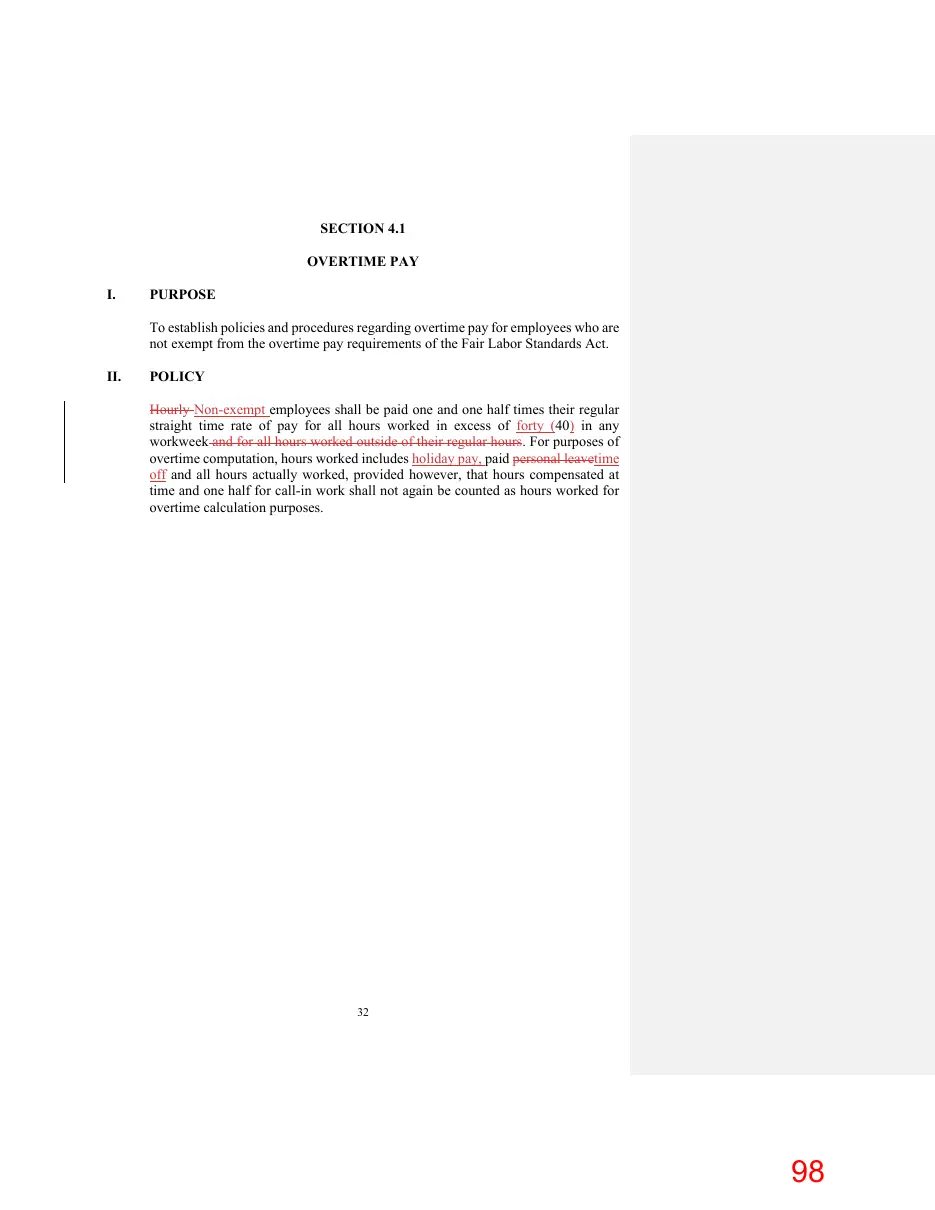
SECTION 4.1 OVERTIME PAY I.
PURPOSE To establish policies and procedures regarding overtime pay for employees who are not exempt from the overtime pay requirements of the Fair Labor Standards Act.
II.
POLICY Hourly Non-exempt employees shall be paid one and one half times their regular straight time rate of pay for all hours worked in excess of forty (40) in any workweek and for all hours worked outside of their regular hours. For purposes of overtime computation, hours worked includes holiday pay, paid personal leavetime off and all hours actually worked, provided however, that hours compensated at time and one half for call-in work shall not again be counted as hours worked for overtime calculation purposes.
Page 99
Text of page 99
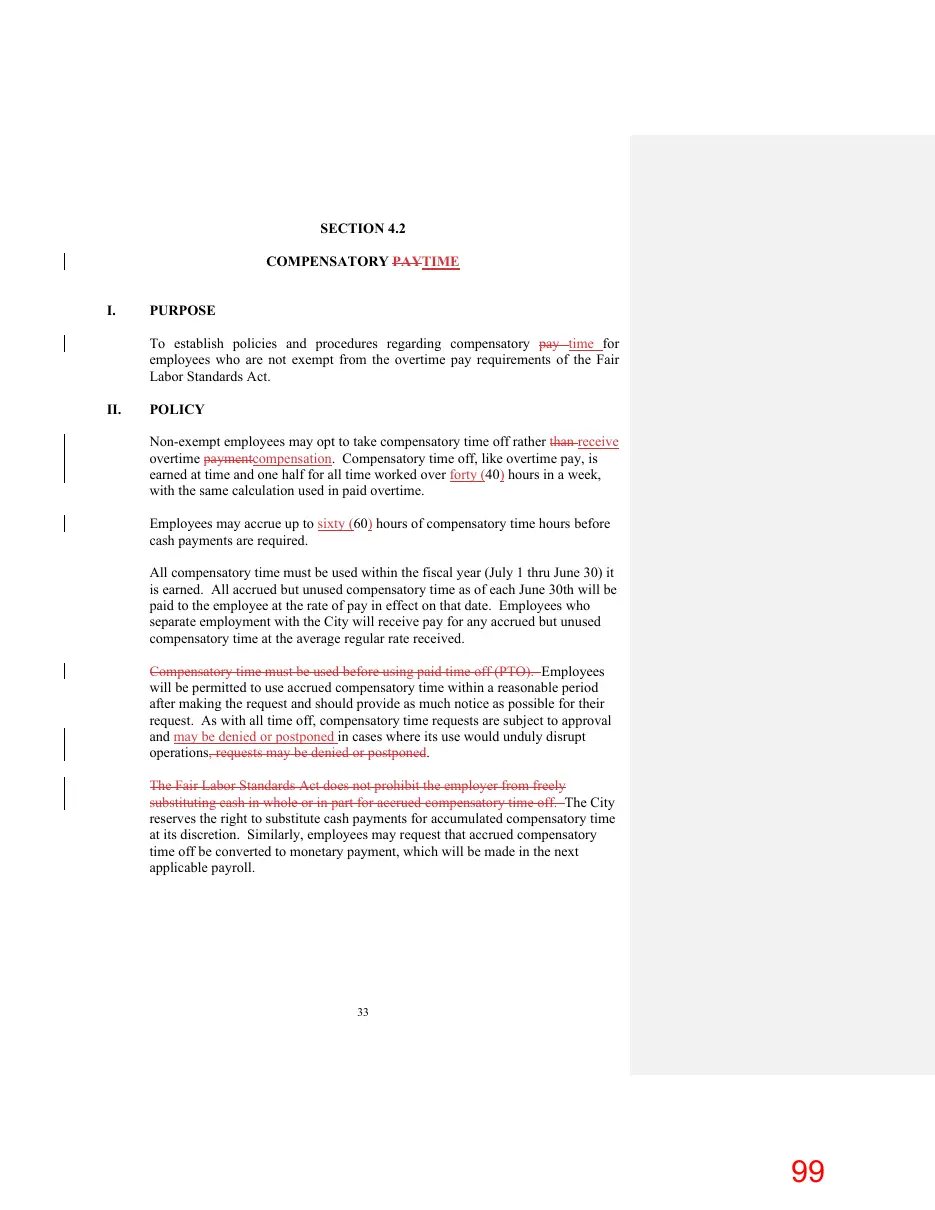
SECTION 4.2 COMPENSATORY PAYTIME I.
PURPOSE To establish policies and procedures regarding compensatory pay time for employees who are not exempt from the overtime pay requirements of the Fair Labor Standards Act.
II.
POLICY Non-exempt employees may opt to take compensatory time off rather than receive overtime paymentcompensation. Compensatory time off, like overtime pay, is earned at time and one half for all time worked over forty (40) hours in a week, with the same calculation used in paid overtime. Employees may accrue up to sixty (60) hours of compensatory time hours before cash payments are required. All compensatory time must be used within the fiscal year (July 1 thru June 30) it is earned. All accrued but unused compensatory time as of each June 30th will be paid to the employee at the rate of pay in effect on that date. Employees who separate employment with the City will receive pay for any accrued but unused compensatory time at the average regular rate received. Compensatory time must be used before using paid time off (PTO). Employees will be permitted to use accrued compensatory time within a reasonable period after making the request and should provide as much notice as possible for their request. As with all time off, compensatory time requests are subject to approval and may be denied or postponed in cases where its use would unduly disrupt operations, requests may be denied or postponed. The Fair Labor Standards Act does not prohibit the employer from freely substituting cash in whole or in part for accrued compensatory time off. The City reserves the right to substitute cash payments for accumulated compensatory time at its discretion. Similarly, employees may request that accrued compensatory time off be converted to monetary payment, which will be made in the next applicable payroll.
Page 100
Text of page 100
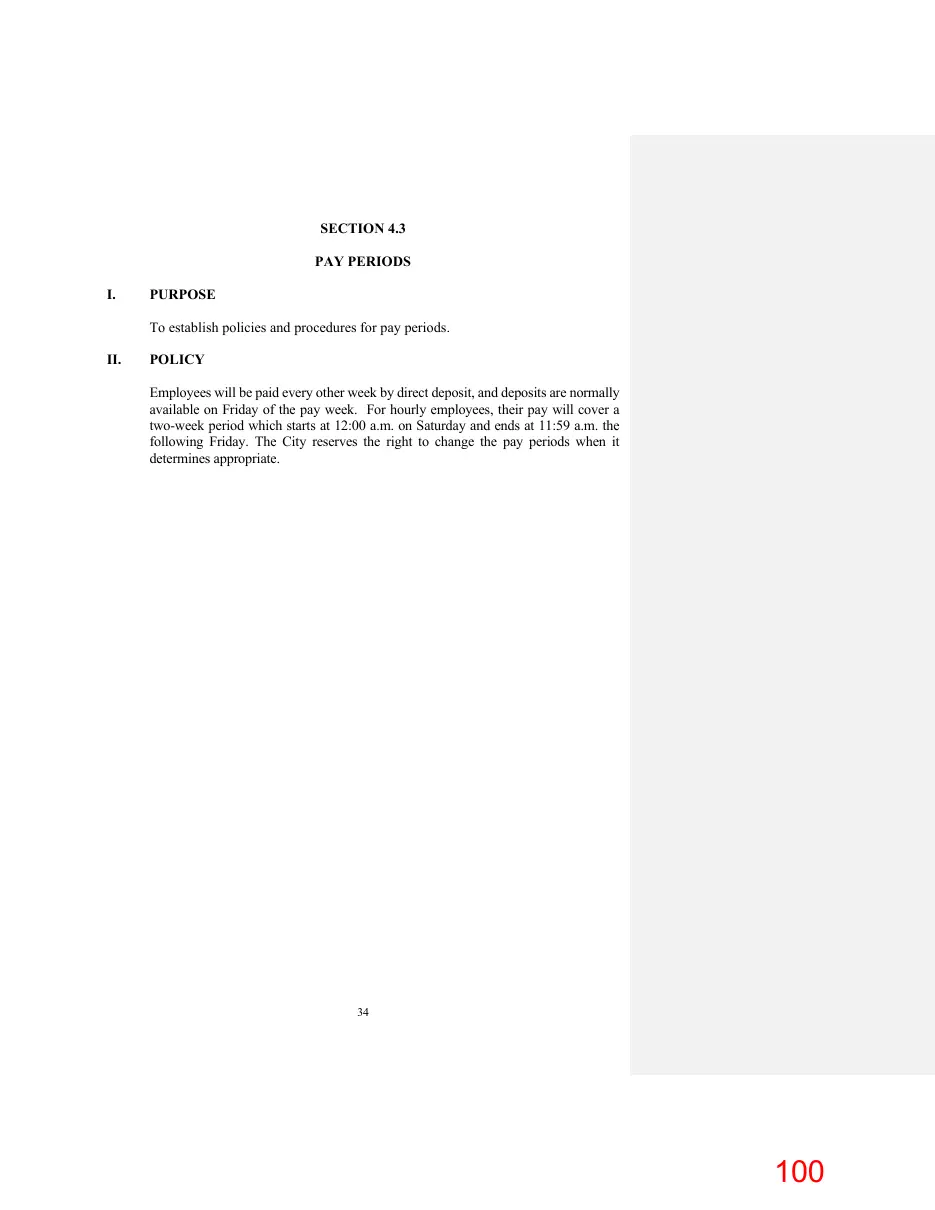
SECTION 4.3 PAY PERIODS I.
PURPOSE To establish policies and procedures for pay periods.
II.
POLICY Employees will be paid every other week by direct deposit, and deposits are normally available on Friday of the pay week. For hourly employees, their pay will cover a two-week period which starts at 12:00 a.m. on Saturday and ends at 11:59 a.m. the following Friday. The City reserves the right to change the pay periods when it determines appropriate.
Page 101
Text of page 101
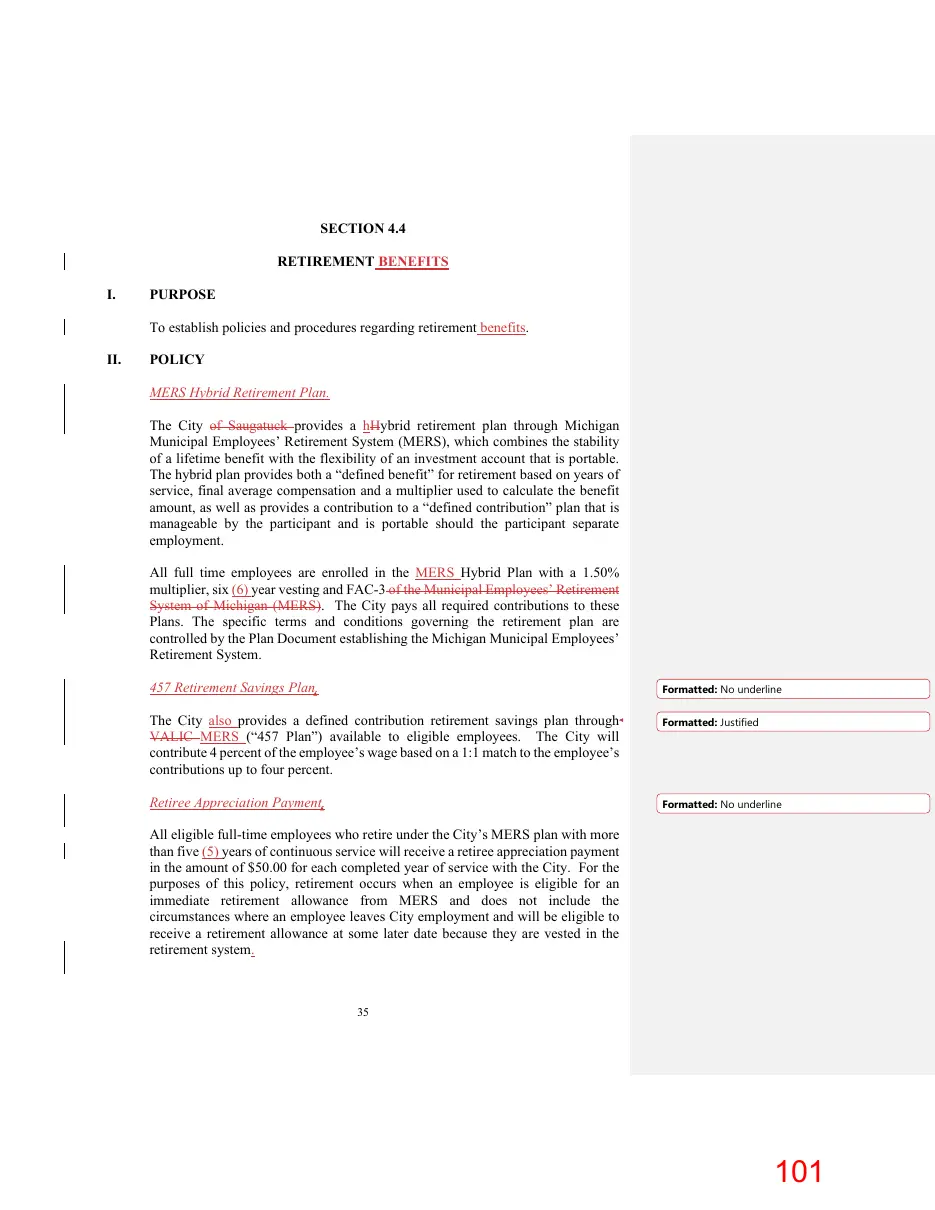
SECTION 4.4 RETIREMENT BENEFITS I.
PURPOSE To establish policies and procedures regarding retirement benefits.
II.
POLICY MERS Hybrid Retirement Plan. The City of Saugatuck provides a hHybrid retirement plan through Michigan Municipal Employees’ Retirement System (MERS), which combines the stability of a lifetime benefit with the flexibility of an investment account that is portable. The hybrid plan provides both a “defined benefit” for retirement based on years of service, final average compensation and a multiplier used to calculate the benefit amount, as well as provides a contribution to a “defined contribution” plan that is manageable by the participant and is portable should the participant separate employment. All full time employees are enrolled in the MERS Hybrid Plan with a 1.50% multiplier, six (6) year vesting and FAC-3 of the Municipal Employees’ Retirement System of Michigan (MERS). The City pays all required contributions to these Plans. The specific terms and conditions governing the retirement plan are controlled by the Plan Document establishing the Michigan Municipal Employees’ Retirement System. 457 Retirement Savings Plan.
Formatted: No underline
The City also provides a defined contribution retirement savings plan through VALIC MERS (“457 Plan”) available to eligible employees. The City will contribute 4 percent of the employee’s wage based on a 1:1 match to the employee’s contributions up to four percent.
Formatted: Justified
Retiree Appreciation Payment.
Formatted: No underline
All eligible full-time employees who retire under the City’s MERS plan with more than five (5) years of continuous service will receive a retiree appreciation payment in the amount of $50.00 for each completed year of service with the City. For the purposes of this policy, retirement occurs when an employee is eligible for an immediate retirement allowance from MERS and does not include the circumstances where an employee leaves City employment and will be eligible to receive a retirement allowance at some later date because they are vested in the retirement system.
Page 102
Text of page 102
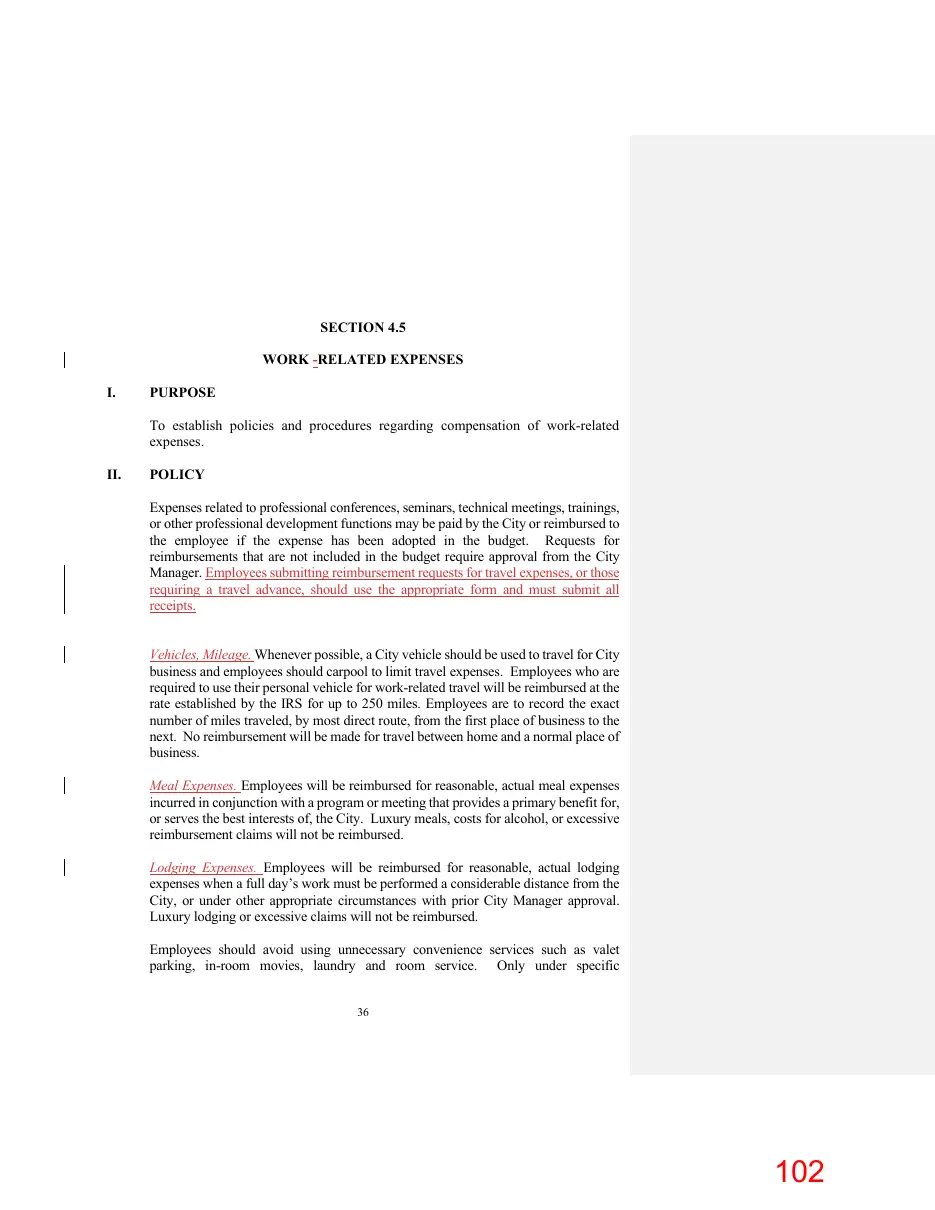
SECTION 4.5 WORK -RELATED EXPENSES I.
PURPOSE To establish policies and procedures regarding compensation of work-related expenses.
II.
POLICY Expenses related to professional conferences, seminars, technical meetings, trainings, or other professional development functions may be paid by the City or reimbursed to the employee if the expense has been adopted in the budget. Requests for reimbursements that are not included in the budget require approval from the City Manager. Employees submitting reimbursement requests for travel expenses, or those requiring a travel advance, should use the appropriate form and must submit all receipts. Vehicles, Mileage. Whenever possible, a City vehicle should be used to travel for City business and employees should carpool to limit travel expenses. Employees who are required to use their personal vehicle for work-related travel will be reimbursed at the rate established by the IRS for up to 250 miles. Employees are to record the exact number of miles traveled, by most direct route, from the first place of business to the next. No reimbursement will be made for travel between home and a normal place of business. Meal Expenses. Employees will be reimbursed for reasonable, actual meal expenses incurred in conjunction with a program or meeting that provides a primary benefit for, or serves the best interests of, the City. Luxury meals, costs for alcohol, or excessive reimbursement claims will not be reimbursed. Lodging Expenses. Employees will be reimbursed for reasonable, actual lodging expenses when a full day’s work must be performed a considerable distance from the City, or under other appropriate circumstances with prior City Manager approval. Luxury lodging or excessive claims will not be reimbursed. Employees should avoid using unnecessary convenience services such as valet parking, in-room movies, laundry and room service. Only under specific 36
Page 103
Text of page 103
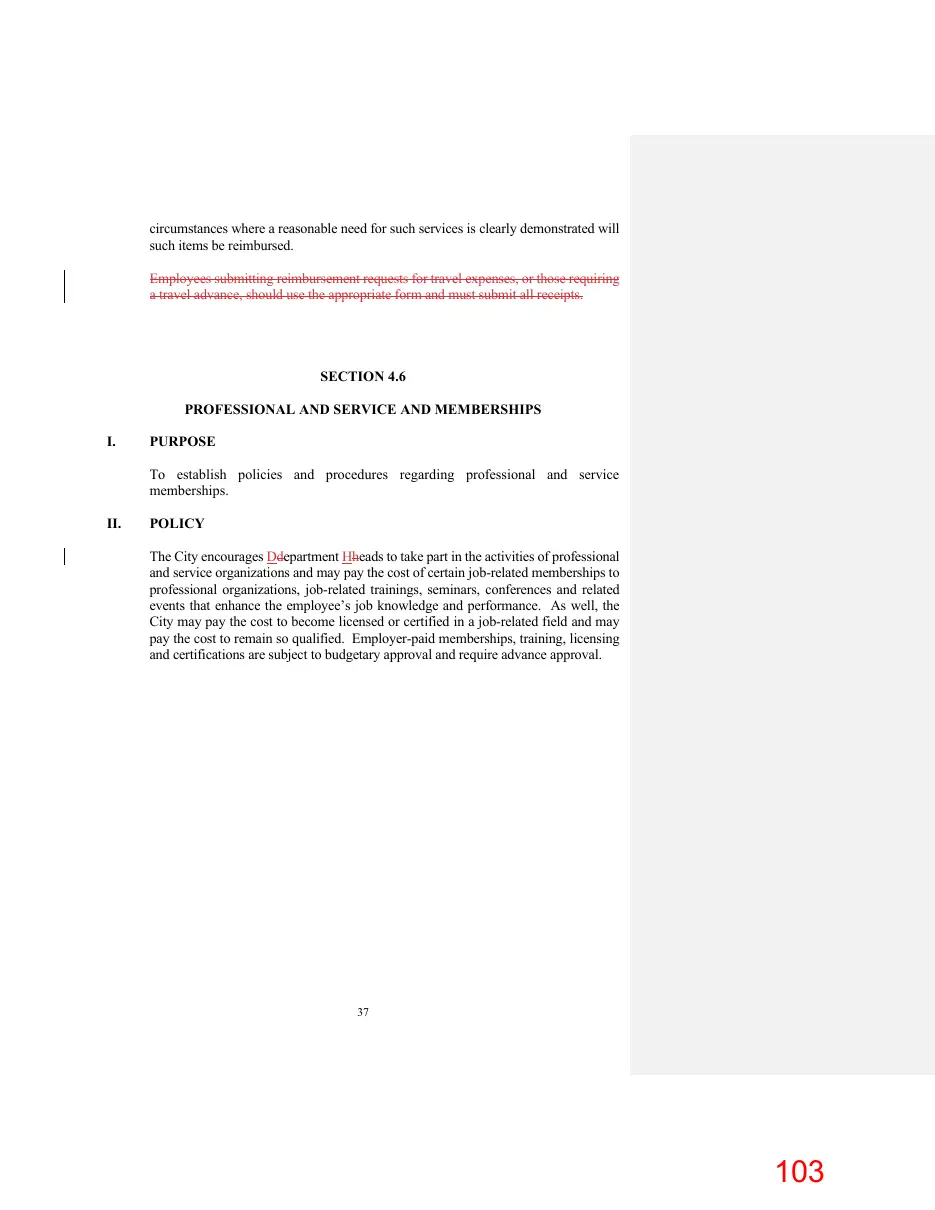
circumstances where a reasonable need for such services is clearly demonstrated will such items be reimbursed. Employees submitting reimbursement requests for travel expenses, or those requiring a travel advance, should use the appropriate form and must submit all receipts.
SECTION 4.6 PROFESSIONAL AND SERVICE AND MEMBERSHIPS I.
PURPOSE To establish policies and procedures regarding professional and service memberships.
II.
POLICY The City encourages Ddepartment Hheads to take part in the activities of professional and service organizations and may pay the cost of certain job-related memberships to professional organizations, job-related trainings, seminars, conferences and related events that enhance the employee’s job knowledge and performance. As well, the City may pay the cost to become licensed or certified in a job-related field and may pay the cost to remain so qualified. Employer-paid memberships, training, licensing and certifications are subject to budgetary approval and require advance approval.
Page 104
Text of page 104
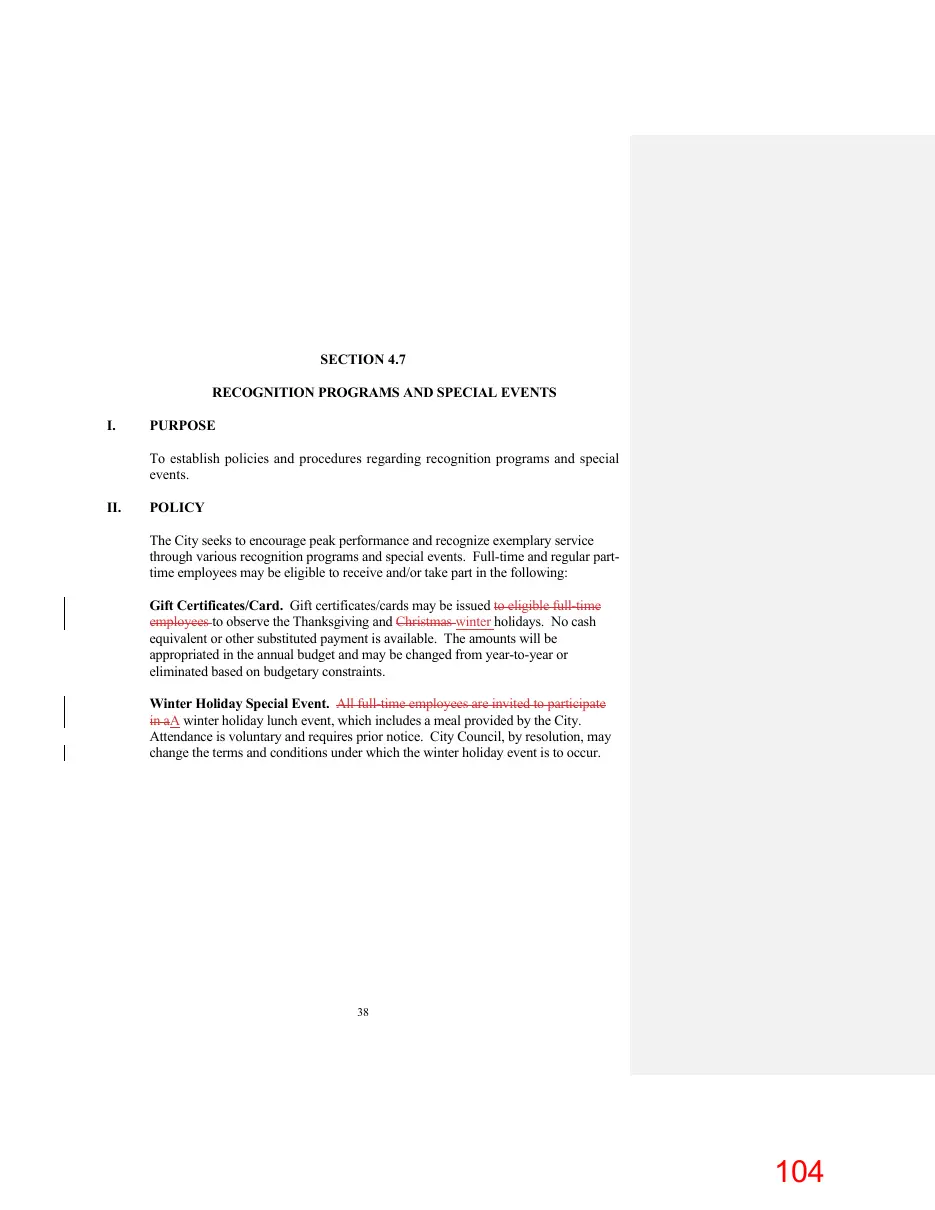
SECTION 4.7 RECOGNITION PROGRAMS AND SPECIAL EVENTS I.
PURPOSE To establish policies and procedures regarding recognition programs and special events.
II.
POLICY The City seeks to encourage peak performance and recognize exemplary service through various recognition programs and special events. Full-time and regular parttime employees may be eligible to receive and/or take part in the following: Gift Certificates/Card. Gift certificates/cards may be issued to eligible full-time employees to observe the Thanksgiving and Christmas winter holidays. No cash equivalent or other substituted payment is available. The amounts will be appropriated in the annual budget and may be changed from year-to-year or eliminated based on budgetary constraints. Winter Holiday Special Event. All full-time employees are invited to participate in aA winter holiday lunch event, which includes a meal provided by the City. Attendance is voluntary and requires prior notice. City Council, by resolution, may change the terms and conditions under which the winter holiday event is to occur.
Page 105
Text of page 105
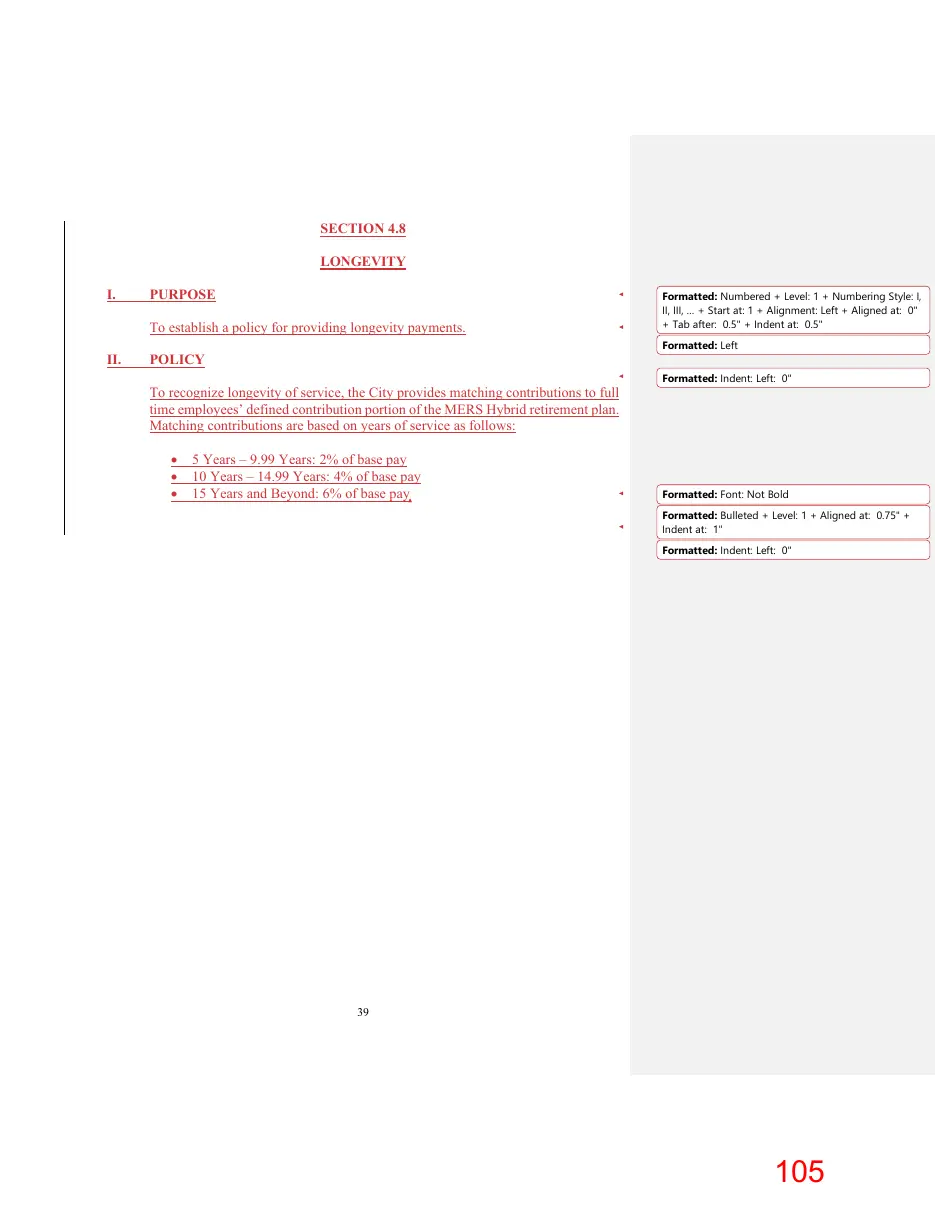
SECTION 4.8 LONGEVITY I.
PURPOSE To establish a policy for providing longevity payments.
II.
POLICY To recognize longevity of service, the City provides matching contributions to full time employees’ defined contribution portion of the MERS Hybrid retirement plan. Matching contributions are based on years of service as follows: • • •
5 Years – 9.99 Years: 2% of base pay 10 Years – 14.99 Years: 4% of base pay 15 Years and Beyond: 6% of base pay
Formatted: Numbered + Level: 1 + Numbering Style: I, II, III, … + Start at: 1 + Alignment: Left + Aligned at: 0" + Tab after: 0.5" + Indent at: 0.5" Formatted: Left Formatted: Indent: Left: 0"
Formatted: Font: Not Bold Formatted: Bulleted + Level: 1 + Aligned at: 0.75" + Indent at: 1" Formatted: Indent: Left: 0"
Page 106
Text of page 106
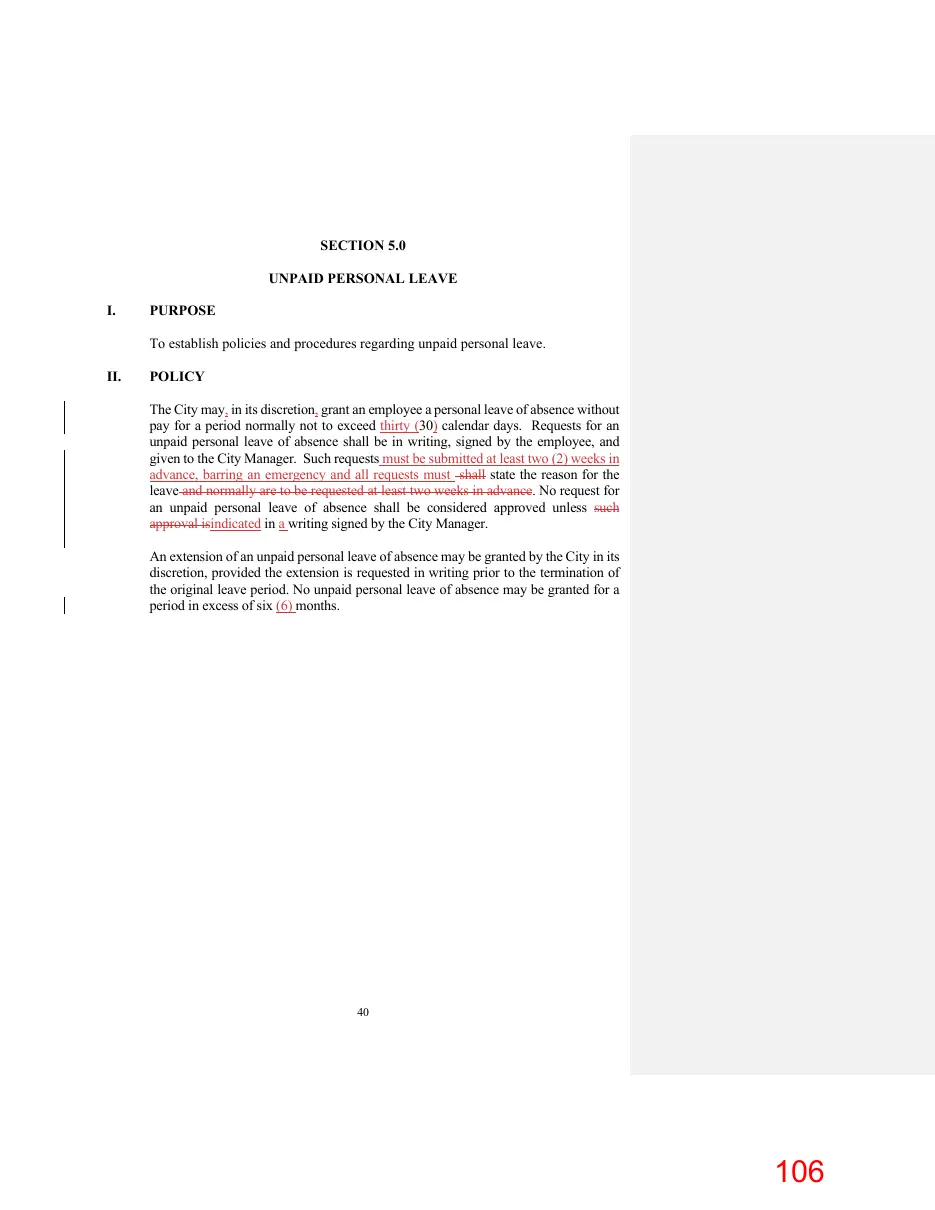
SECTION 5.0 UNPAID PERSONAL LEAVE I.
PURPOSE To establish policies and procedures regarding unpaid personal leave.
II.
POLICY The City may, in its discretion, grant an employee a personal leave of absence without pay for a period normally not to exceed thirty (30) calendar days. Requests for an unpaid personal leave of absence shall be in writing, signed by the employee, and given to the City Manager. Such requests must be submitted at least two (2) weeks in advance, barring an emergency and all requests must shall state the reason for the leave and normally are to be requested at least two weeks in advance. No request for an unpaid personal leave of absence shall be considered approved unless such approval isindicated in a writing signed by the City Manager. An extension of an unpaid personal leave of absence may be granted by the City in its discretion, provided the extension is requested in writing prior to the termination of the original leave period. No unpaid personal leave of absence may be granted for a period in excess of six (6) months.
Page 107
Text of page 107
SECTION 5.1 NON-DUTY DISABILITY LEAVE I.
PURPOSE To establish policies and procedures regarding non-duty disability leave.
II.
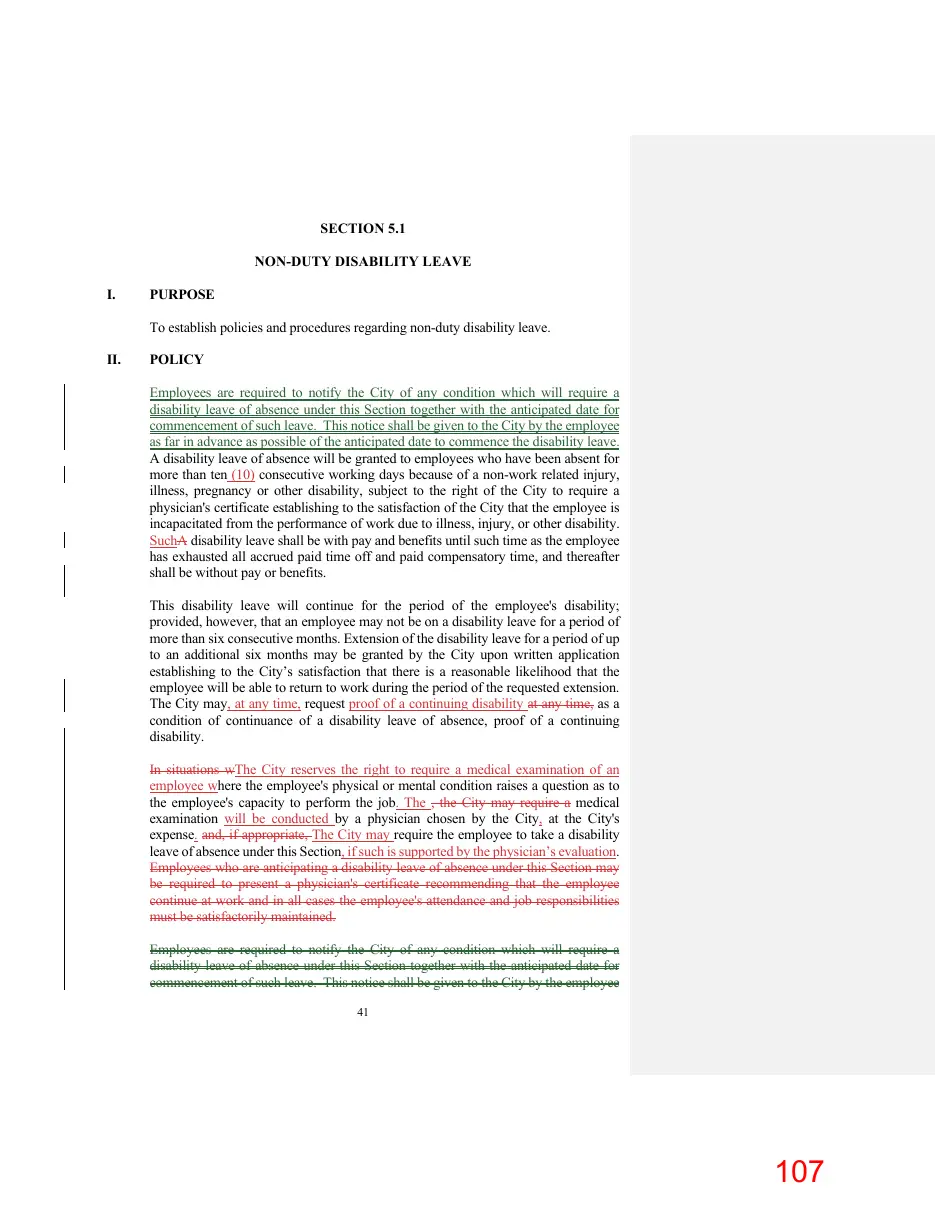
POLICY Employees are required to notify the City of any condition which will require a disability leave of absence under this Section together with the anticipated date for commencement of such leave. This notice shall be given to the City by the employee as far in advance as possible of the anticipated date to commence the disability leave. A disability leave of absence will be granted to employees who have been absent for more than ten (10) consecutive working days because of a non-work related injury, illness, pregnancy or other disability, subject to the right of the City to require a physician's certificate establishing to the satisfaction of the City that the employee is incapacitated from the performance of work due to illness, injury, or other disability. SuchA disability leave shall be with pay and benefits until such time as the employee has exhausted all accrued paid time off and paid compensatory time, and thereafter shall be without pay or benefits. This disability leave will continue for the period of the employee's disability; provided, however, that an employee may not be on a disability leave for a period of more than six consecutive months. Extension of the disability leave for a period of up to an additional six months may be granted by the City upon written application establishing to the City’s satisfaction that there is a reasonable likelihood that the employee will be able to return to work during the period of the requested extension. The City may, at any time, request proof of a continuing disability at any time, as a condition of continuance of a disability leave of absence, proof of a continuing disability. In situations wThe City reserves the right to require a medical examination of an employee where the employee's physical or mental condition raises a question as to the employee's capacity to perform the job. The , the City may require a medical examination will be conducted by a physician chosen by the City, at the City's expense. and, if appropriate, The City may require the employee to take a disability leave of absence under this Section, if such is supported by the physician’s evaluation. Employees who are anticipating a disability leave of absence under this Section may be required to present a physician's certificate recommending that the employee continue at work and in all cases the employee's attendance and job responsibilities must be satisfactorily maintained. Employees are required to notify the City of any condition which will require a disability leave of absence under this Section together with the anticipated date for commencement of such leave. This notice shall be given to the City by the employee 41
Page 108

Text of page 108
as far in advance as possible of the anticipated date to commence the disability leave. All employees returning to work from a disability leave of absence must present a physician's certificate satisfactory to the City indicating the employee is medically able to return to work.
Page 109
Text of page 109
SECTION 5.2 JURY DUTY LEAVE I.
PURPOSE To establish policies and procedures regarding jury duty leave.
II.
POLICY Employees summoned by a court to serve as jurors shall be given a jury leave of absence for the period of their jury duty. For each day, up to a maximum of ten (10) days per year, that an eligible employee serves as juror when the employee otherwise would have worked, the employee shall receive the difference between the employee’s regular rate of pay for the employee’s regularly scheduled hours and the amount the employee received from the court, exclusive of mileage and meal reimbursement. In order to be eligible to receive jury duty pay from the City, an employee must: A.
Be a full-time employee;
Provide the City reasonable advanced notice of the time that the employee is required to report for jury duty;
Provide satisfactory evidence that the employee served as a juror at the summons of the court on the day that the employee claims to be entitled to jury duty pay; and
Return to work promptly after being excused from jury duty service.
Page 110
Text of page 110
SECTION 5.3 FUNERAL LEAVE I.
PURPOSE To establish policies and procedures regarding funeral leave.
II.
POLICY Employees shall be entitled to take up to three consecutive days of funeral leave in the event that a death occurs to a member of the employee’s immediate family. “Immediate family” shall mean the employee’s current spouse, child, father, mother, sister, brother, father-in-law, mother-in-law, grandparent or grandchild. This leave is intended to allow the employee to attend the funeral and attend to family matters. Employees who lose work from their regularly scheduled hours as a result of funeral leave shall receive their regular rate for such lost time. Employees are expected to report the need for funeral leave to the City Manager prior to their designated starting time. For purposes of this section, an employee’s mother, father, sister, brother and child include natural, step and adopted. Employees needing additional time may request to utilize accrued paid time off. Employees shall be entitled to take up to five (5) consecutive scheduled workdays of funeral leave in the event of the death of their current spouse, domestic partner, child, grandchild, father, or mother.
Formatted: Font: Not Bold
For the death of a sibling, grandparent, father-in-law, or mother-in-law, employees may take up to three (3) consecutive days of funeral leave.
Formatted: Font: Not Bold
For the death of a niece, nephew, aunt, or uncle employees may take up to one (1) day of funeral leave. This leave is intended to allow the employee to attend the funeral and manage family matters. Employees who lose work from their regularly scheduled hours due to funeral leave shall receive their regular rate for such lost time. Employees are expected to report the need for funeral leave to the City Manager prior to their designated starting time. Employees needing additional time may request to utilize accrued paid time off. For purposes of this section, an employee’s mother, father, sister, brother, child and grandchild include natural, step, and adopted relationships. Employees needing additional time may request to utilize accrued paid time off.
Formatted: Font: Not Bold Formatted: Font: Not Bold Formatted: Font: Not Bold Formatted: Font: Not Bold Formatted: Font: Not Bold Formatted: Font: Not Bold Formatted: Font: Not Bold
Formatted: Font: Not Bold
Page 111
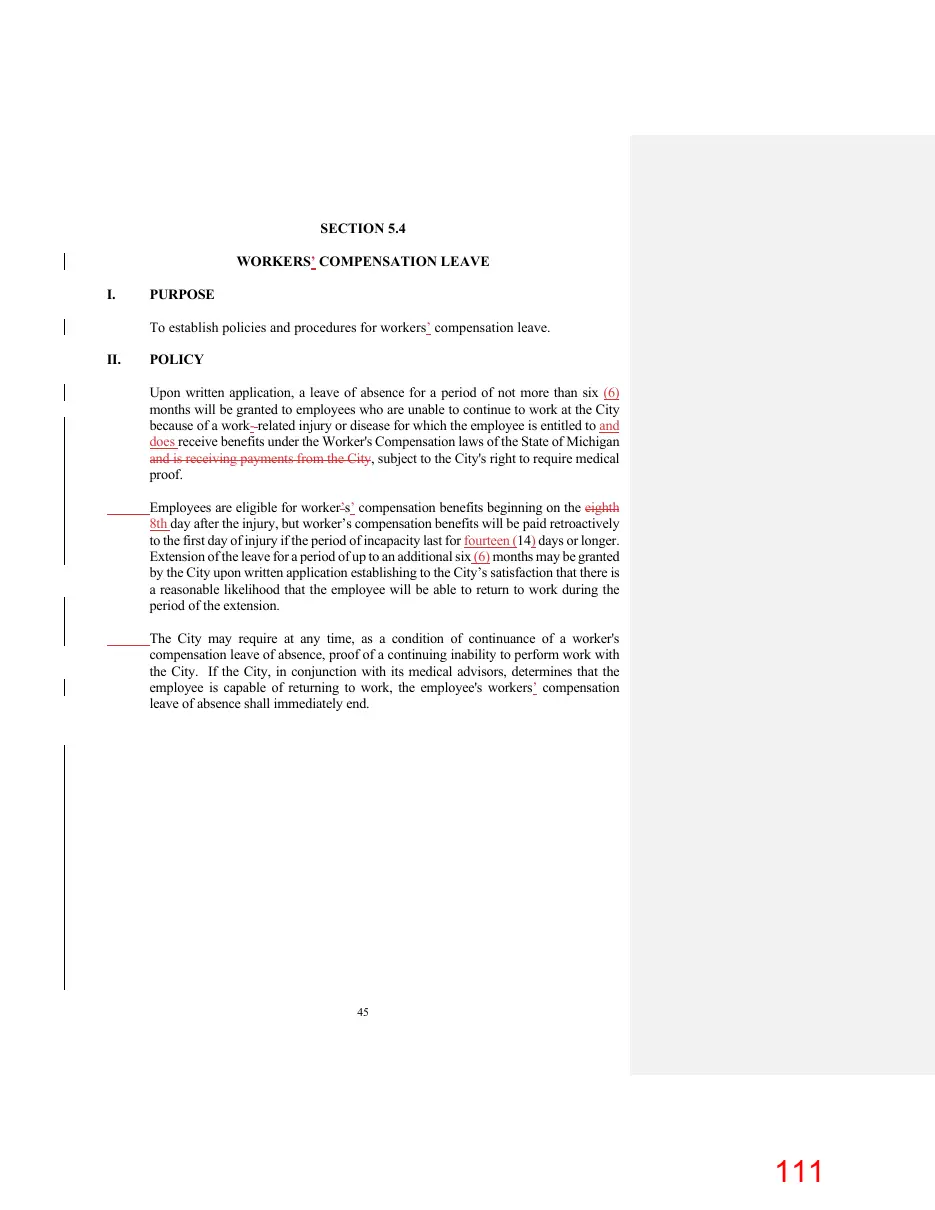
Text of page 111
SECTION 5.4 WORKERS’ COMPENSATION LEAVE I.
PURPOSE To establish policies and procedures for workers’ compensation leave.
II.
POLICY Upon written application, a leave of absence for a period of not more than six (6) months will be granted to employees who are unable to continue to work at the City because of a workrelated injury or disease for which the employee is entitled to and does receive benefits under the Worker's Compensation laws of the State of Michigan and is receiving payments from the City, subject to the City's right to require medical proof. Employees are eligible for worker’s’ compensation benefits beginning on the eighth 8th day after the injury, but worker’s compensation benefits will be paid retroactively to the first day of injury if the period of incapacity last for fourteen (14) days or longer. Extension of the leave for a period of up to an additional six (6) months may be granted by the City upon written application establishing to the City’s satisfaction that there is a reasonable likelihood that the employee will be able to return to work during the period of the extension. The City may require at any time, as a condition of continuance of a worker's compensation leave of absence, proof of a continuing inability to perform work with the City. If the City, in conjunction with its medical advisors, determines that the employee is capable of returning to work, the employee's workers’ compensation leave of absence shall immediately end.
Page 112

This page is a scanned image with no text layer. The PDF of these pages has it at full resolution.
Page 113
Text of page 113
SECTION 5.5 RETURN TO WORK AFTER LEAVE OF ABSENCE I.
PURPOSE To establish policies and procedures regarding return to work after leave of absence.
II.
POLICY Employees returning from approved leaves of absence will be reinstated to their former job classification, provided the classification remains an active position in the City. The provisions of the foregoing notwithstanding, the City reserves the right not to reinstate to their former job classification any employee who no longer has the necessary qualifications, skill and ability to perform the work.
Page 114
Text of page 114
SECTION 5.6 DISCRETIONARY TIME FOR EXEMPT EMPLOYEES I.
PURPOSE To establish policies and procedures regarding discretionary time for exempt employees.
II.
POLICY Exempt employees may be required to work more than forty (40) hours in a workweek to satisfy work demands or to attend evening meetings. In these instances, exempt employees may take discretionary time off provided such time does not adversely impact operations. Discretionary time off for exempt employees is provided as a professional courtesy and is not an entitlement, nor is it to be viewed as an hour-for-hour offset to hours worked in excess of forty (40) hours. Exempt employees should expect that, from time-to-time, more than forty (40) hours is required of their position. Exempt employees should coordinate their use of discretionary time with the City Manager to ensure proper coverage and recognize that, in some cases, operational needs may not allow the use of discretionary time off. Discretionary time is not intended to be used to take a full day off; rather it provides flexibility from time to time. It is in no way to be construed as “overtime” compensation; it is not tracked, accrued, banked or in any way owed to the employee.
Page 115
Text of page 115
SECTION 5.7 FAMILY MEDICAL LEAVE ACT (FLLMA) I.
PURPOSE To establish policies and procedures regarding the Family Medical Leave Act (FMLA).
II.
POLICY The City of Saugatuck complies with all statutory requirements of the Family and Medical Leave Act (“FMLA”). The FMLA provides eligible employees up to twelve (12) weeks of unpaid, job-protected leave in a 12month period: (1) for the birth or care of a child; (2) to care for a child after placement through adoption or foster care; (3) to care for a close family member (spouse, parent, son or daughter) with a serious health condition; (4) for the employee’s own serious health condition which makes the employee unable to perform his or hetheir job; (5) for “qualifying exigencies” arising from military service of a covered service member. FMLA also allows up to twenty-six (26) weeks of leave within a 12-month period for an employee to care for a covered military service member with a serious illness or injury. In some cases, FMLA allows an employee to take intermittent leave or to work a reduced schedule for a limited time period. Spouses employed by the City are jointly entitled to a combined total of twelve (12) weeks for the birth and care of a newborn, placement of a child by adoption or foster care or to care for a family member with a serious health condition. Eligibility To be eligible for leave under FMLA, an employee must have worked at least 1,250 hours over the previous twelve (12) months and must have worked for the City for a total of at least twelve (12) months (does not need to be consecutive months). Only hours actually worked will count toward calculating 1,250 hours over previous twelve (12) months for FMLA eligibility, NOT vacation, holidays, personal days, sick leave, etc. For purposes of calculating FMLA eligibility, an employee on USERRA protected military leave will be given credit for time worked as if he/she had not taken the military leave and had worked continuously during that time.
Page 116
Text of page 116
Rolling Year The City uses a rolling year for calculating leave under FMLA, meaning eligible employees may use up to a total of twelve (12) weeks FMLA time in the 12month period following the commencement of any FMLA qualified leave. FMLA leave may be taken in a single 12week period, or, when certified as medically necessary, on an intermittent basis such as blocks of time or work week reduction. Prior approval from the City Manager is required where intermittent leave is sought for the birth and care of a newborn or placement of a child through adoption or foster care. Coordination with Other Leaves and/or Paid Time Off Plans The City requires employees to draw down accrued paid leave while on FMLA leave. The City will designate any leave that qualifies as both FMLA and another type of leave as running concurrently (i.e. disability leave, worker’s compensation.) Accrued paid leave must be used to make up the difference in pay if on FMLA and receiving partial pay through some other means. When the City and employee agree, employees must use accrued compensatory time off concurrent with FMLA leave. When a holiday falls within a designated FMLA leave, and the employee is actively drawing down accrual banks, the employee will be paid for the holiday. In the event the holiday falls within an unpaid portion of an FMLA leave because leave banks are exhausted, the holiday will not be paid. Health and Other Benefits The City will continue to provide health, dental and optical benefits as if the leave had not been taken. The employee must continue to pay their portion of the premium(s) if normally required, and the City will recoup the cost of premiums paid on the employee’s behalf if the employee fails to return after FMLA leave. The City will also continue other benefits, including unconditional pay increases, that otherwise would occur while the employee is on FMLA. Employees will continue to accrue paid time off while on FMLA leave if they otherwise would earn it. Military Personnel and Families FMLA extends leave protection and other rights for military personnel and their families in need of leave for “qualifying exigencies” related to call-up or military service or to care for a family member recuperating from a serious illness or injury (a more expansive definition than the typical “serious medical condition applies”). 50
Page 117
Text of page 117
Who Qualifies The act defines “covered service members” as members of the armed forces, including the National Guard or Reserves, or who are undergoing medical treatment, recuperation, therapy, or who are otherwise on outpatient status or on temporary disability retired list for a serious injury or illness. The definition of “family member” for military personnel is more expansive and includes not only “parent, spouse or child,” but also encompasses “next of kin,” as designated by the service member. When not specifically designated, “next of kin” may include multiple individuals. Further, an employee can take FMLA leave to care for a son or daughter who is a service member even if the son or daughter is an adult and does not meet the self-care and disability tests typically prescribed for non-military FMLA leave related to care for an adult child. FMLA Leave to Care for a Service Member FMLA allows up to twenty-six (26) weeks of service member caregiver leave within a 12month period for an employee to care for a covered service member with a serious illness or injury. An employee may qualify for more than twenty-six (26) weeks to care for additional service members or to provide care for a subsequent injury or illness. The 12month period must be a rolling year beginning on the first day of leave. A serious injury or illness is incurred in the line of duty on active duty that may render the service member medically unfit to perform the duties of his/her office, grade, rank or rating. This includes a covered service member who: (1) is on the temporary disability retired list, a covered service member; (2) is undergoing medical treatment, recuperation, or therapy for a serious illness or injury or; (3) is assigned to a military medical treatment facility as an outpatient or is otherwise receiving outpatient care at a unit established for the armed forces. FMLA leave does NOT apply to care for former members of the armed forces who are on the permanent disability retired list. FMLA Leave for Qualifying Exigencies FMLA allows up to twelve (12) weeks of leave within the normal FMLA 12month period to address qualifying exigencies that arise as the result of a covered service member’s military service including: (1) short-notice deployment (seven days or less); (2) rest and recuperation (limited to five days per military visit); (3) military events and activities (support groups, briefings, etc.); (4) childcare and school activities (make child care arrangements, attend school meetings, provide emergency childcare, etc.); (5) financial and legal arrangements; (6) counseling; (7) post-deployment activities (ceremonies, briefings, etc.); (8) additional activities (other purposes as agreed to by the employer and employee). 51
Page 118
Text of page 118
Notifications and Certifications The City will provide sufficient information for an employee to determine that a leave is protected by FMLA, which may be as simple as verbal notice. If the City has reason to believe a leave qualifies as FMLA, it may designate it as such and provide notification to the employee to that effect. Employees should provide at least thirty (30) days advance notice when the need for leave under FMLA is foreseeable, and as much notice as possible in other cases. Medical certification to support the request may be required, and the City may, at its own expense, require second or third opinions. Medical certification of fitness for duty is required prior to return to work. Job Restoration and Protection FMLA requires that, upon return from FMLA leave, an employee is returned to his/herthe employee’s same position or an equivalent position with equivalent benefits, pay and other terms and conditions of employment. The FMLA prohibits discrimination or retaliation against employees who assert FMLA rights or who charge an employer with an FMLA violation. Under specific and limited circumstances, certain “key employees” (those among the highest paid 10% of employees) may be denied job restoration. In this event, the “key employee” will be given a reasonable opportunity to return to work from FMLA leave.
Page 119
Text of page 119
SECTION 6.0
Formatted: Justified, Indent: Left: 0", Hanging: 0.5"
HOLIDAYS I.
PURPOSE To establish policies and procedures regarding holidays.
II.
POLICY Recognized Holidays. The following holidays shall be recognized as holidays for employees of the City: New Year’s Day, Martin Luther King Jr. Day, Good Friday, Memorial Day, Independence Day, Labor Day, Indigenous Peoples’ Day, Veterans Day, Thanksgiving Day, Day after Thanksgiving, Christmas Eve Day, Christmas Day, New Year’s Eve. It is understood that employees may be required to work on holidays in accordance with normal scheduling procedures. Holiday Observation. Employees working in seven (7) day a week operations observe each holiday on its actual day. When New Year’s Day, Independence Day, Veterans’ Day, Christmas Eve, and Christmas Day on a Saturday or a Sunday, employees working a Monday through Friday schedule will celebrate those holidays on the dates determined by the employer. Holiday Eligibility. Full-time and part time employees are eligible for holiday pay if they satisfy all the following conditions and qualifications: 53
Page 120
Text of page 120
The employee must have worked their scheduled hours of work on the their scheduled workday preceding the holiday and also on the their scheduled workday following the holiday; provided, however, that absence due to approved paid leaves of absence or paid time off will not disqualify an employee for holiday pay.
The employee must be on the active payroll as of the date of the holiday. For purposes of this section, a person is not on the active payroll of the City during unpaid leaves of absence, layoffs, when receiving workers compensation or during a disciplinary suspension.
Employees scheduled to report for work on a holiday, but who fail to report for and perform such work, shall not be entitled to any holiday pay. Holiday Pay for Hourly Employees. Eligible hourly employees required to work on a recognized City holiday shall be paid time and one-half times their regular straight time hourly rate for the hours actually worked on a holiday. For the purpose of this section, a holiday is defined as a 24-hour period beginning at 12:01 a.m. of the holiday. Eligible full-time hourly employees who are not required to work on a recognized City holiday shall be paid eight hours of holiday pay. Eligible regular part-time hourly employees who are not required to work on a recognized City holiday shall be paid eight hours of holiday pay based on their average hours worked per week, prorated over a 40-hour workweek. Holiday Pay for Salaried Employees. Eligible salaried employees are not normally required to work on holidays but shall continue to receive their salaries. Eligible salaried employees on paid time off during a period which includes a day that a holiday is observed will not be charged for a day of paid time off on the holiday.
Page 121
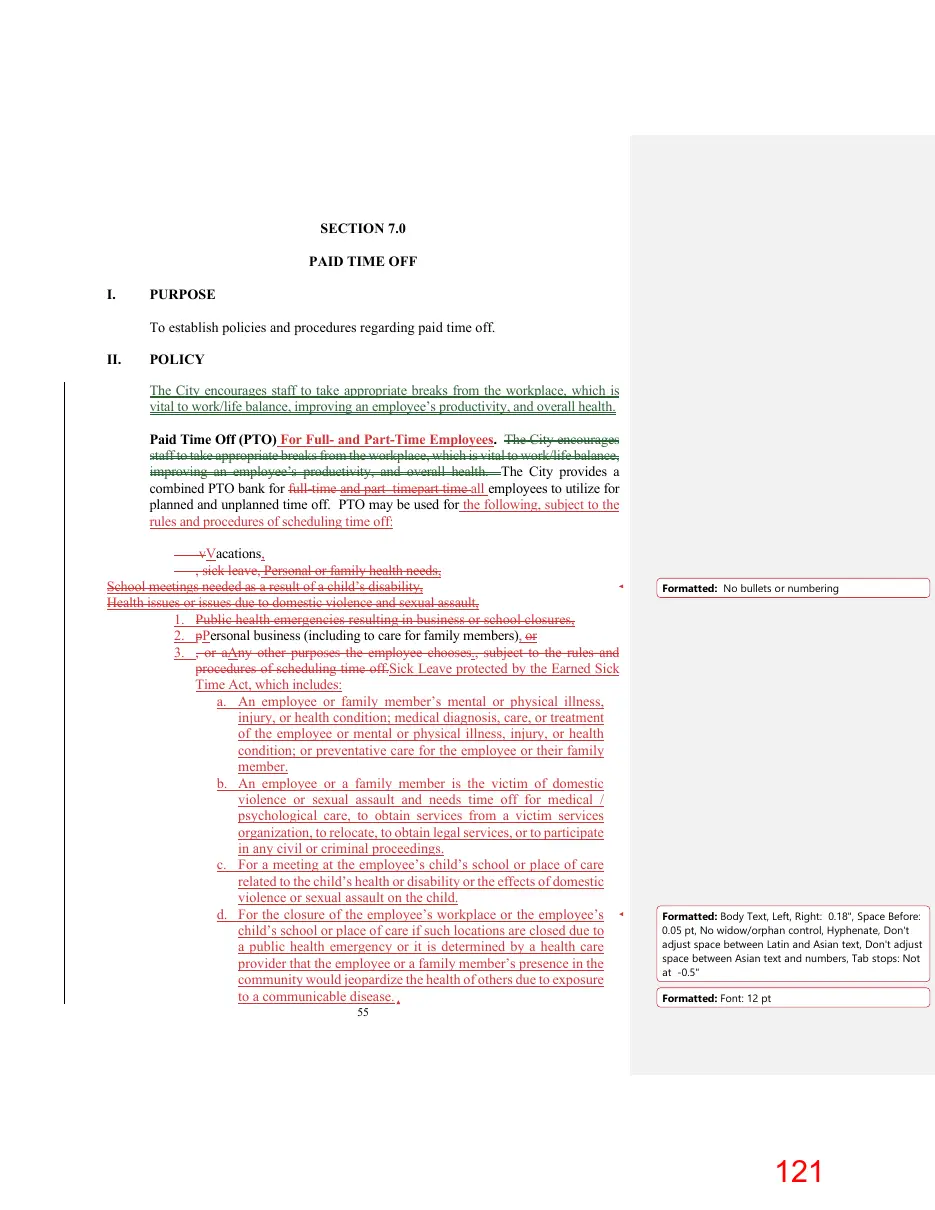
Text of page 121
SECTION 7.0 PAID TIME OFF I.
PURPOSE To establish policies and procedures regarding paid time off.
II.
POLICY The City encourages staff to take appropriate breaks from the workplace, which is vital to work/life balance, improving an employee’s productivity, and overall health. Paid Time Off (PTO) For Fulland Part-Time Employees. The City encourages staff to take appropriate breaks from the workplace, which is vital to work/life balance, improving an employee’s productivity, and overall health. The City provides a combined PTO bank for full-time and part timepart time all employees to utilize for planned and unplanned time off. PTO may be used for the following, subject to the rules and procedures of scheduling time off:
vVacations, , sick leave, Personal or family health needs, School meetings needed as a result of a child’s disability, Health issues or issues due to domestic violence and sexual assault, 1. Public health emergencies resulting in business or school closures, 2. pPersonal business (including to care for family members), or 3. , or aAny other purposes the employee chooses., subject to the rules and procedures of scheduling time off.Sick Leave protected by the Earned Sick Time Act, which includes: a. An employee or family member’s mental or physical illness, injury, or health condition; medical diagnosis, care, or treatment of the employee or mental or physical illness, injury, or health condition; or preventative care for the employee or their family member. b. An employee or a family member is the victim of domestic violence or sexual assault and needs time off for medical / psychological care, to obtain services from a victim services organization, to relocate, to obtain legal services, or to participate in any civil or criminal proceedings. c. For a meeting at the employee’s child’s school or place of care related to the child’s health or disability or the effects of domestic violence or sexual assault on the child. d. For the closure of the employee’s workplace or the employee’s child’s school or place of care if such locations are closed due to a public health emergency or it is determined by a health care provider that the employee or a family member’s presence in the community would jeopardize the health of others due to exposure to a communicable disease. 55
Formatted: No bullets or numbering
Formatted: Body Text, Left, Right: 0.18", Space Before: 0.05 pt, No widow/orphan control, Hyphenate, Don't adjust space between Latin and Asian text, Don't adjust space between Asian text and numbers, Tab stops: Not at -0.5" Formatted: Font: 12 pt
Page 122
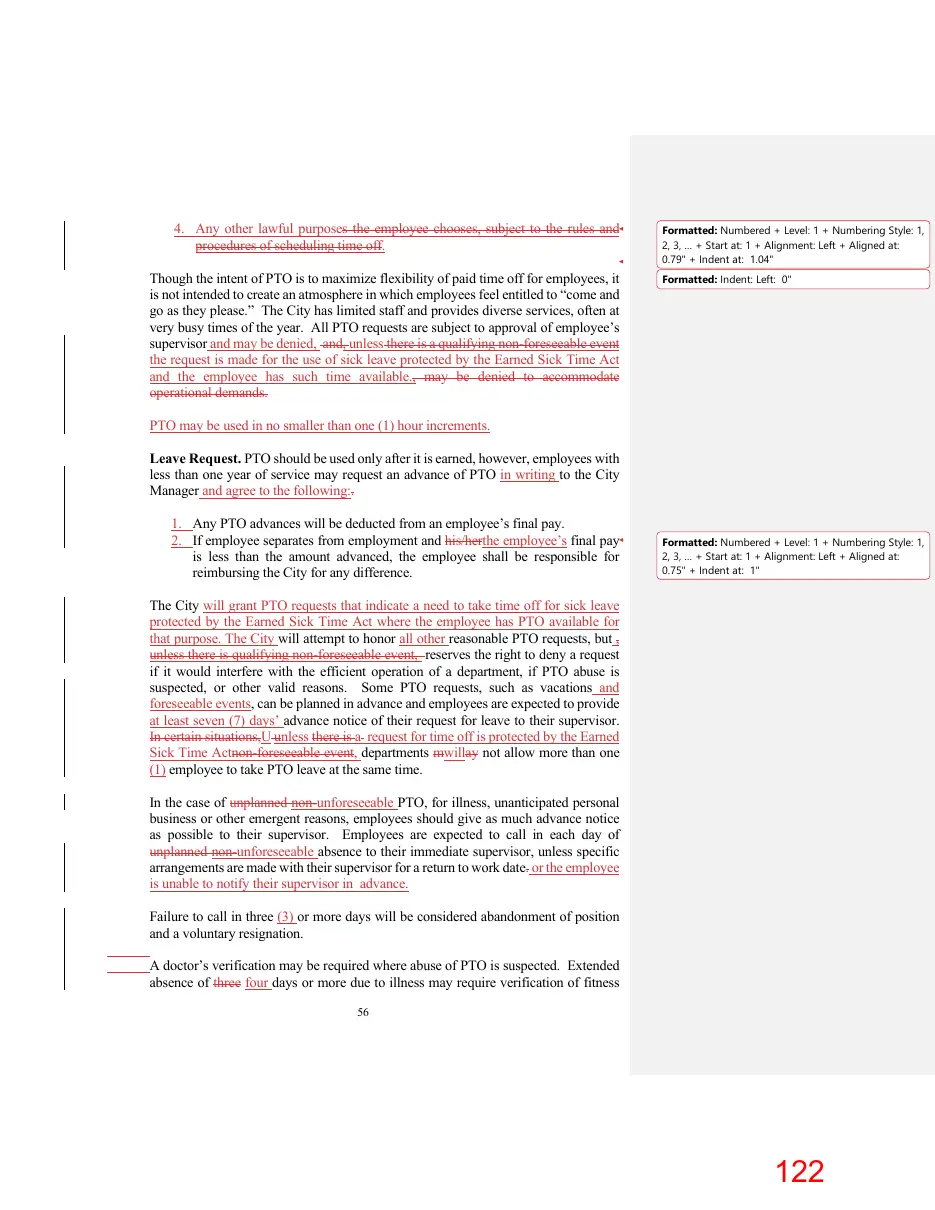
Text of page 122
4. Any other lawful purposes the employee chooses, subject to the rules and procedures of scheduling time off. Though the intent of PTO is to maximize flexibility of paid time off for employees, it is not intended to create an atmosphere in which employees feel entitled to “come and go as they please.” The City has limited staff and provides diverse services, often at very busy times of the year. All PTO requests are subject to approval of employee’s supervisor and may be denied, and, unless there is a qualifying non-foreseeable event the request is made for the use of sick leave protected by the Earned Sick Time Act and the employee has such time available., may be denied to accommodate operational demands.
Formatted: Numbered + Level: 1 + Numbering Style: 1, 2, 3, … + Start at: 1 + Alignment: Left + Aligned at: 0.79" + Indent at: 1.04" Formatted: Indent: Left: 0"
PTO may be used in no smaller than one (1) hour increments. Leave Request. PTO should be used only after it is earned, however, employees with less than one year of service may request an advance of PTO in writing to the City Manager and agree to the following:. 1. Any PTO advances will be deducted from an employee’s final pay. 2. If employee separates from employment and his/herthe employee’s final pay is less than the amount advanced, the employee shall be responsible for reimbursing the City for any difference.
Formatted: Numbered + Level: 1 + Numbering Style: 1, 2, 3, … + Start at: 1 + Alignment: Left + Aligned at: 0.75" + Indent at: 1"
The City will grant PTO requests that indicate a need to take time off for sick leave protected by the Earned Sick Time Act where the employee has PTO available for that purpose. The City will attempt to honor all other reasonable PTO requests, but , unless there is qualifying non-foreseeable event, reserves the right to deny a request if it would interfere with the efficient operation of a department, if PTO abuse is suspected, or other valid reasons. Some PTO requests, such as vacations and foreseeable events, can be planned in advance and employees are expected to provide at least seven (7) days’ advance notice of their request for leave to their supervisor. In certain situations,U unless there is a request for time off is protected by the Earned Sick Time Actnon-foreseeable event, departments mwillay not allow more than one (1) employee to take PTO leave at the same time. In the case of unplanned non-unforeseeable PTO, for illness, unanticipated personal business or other emergent reasons, employees should give as much advance notice as possible to their supervisor. Employees are expected to call in each day of unplanned non-unforeseeable absence to their immediate supervisor, unless specific arrangements are made with their supervisor for a return to work date. or the employee is unable to notify their supervisor in advance. Failure to call in three (3) or more days will be considered abandonment of position and a voluntary resignation. A doctor’s verification may be required where abuse of PTO is suspected. Extended absence of three four days or more due to illness may require verification of fitness 56
Page 123
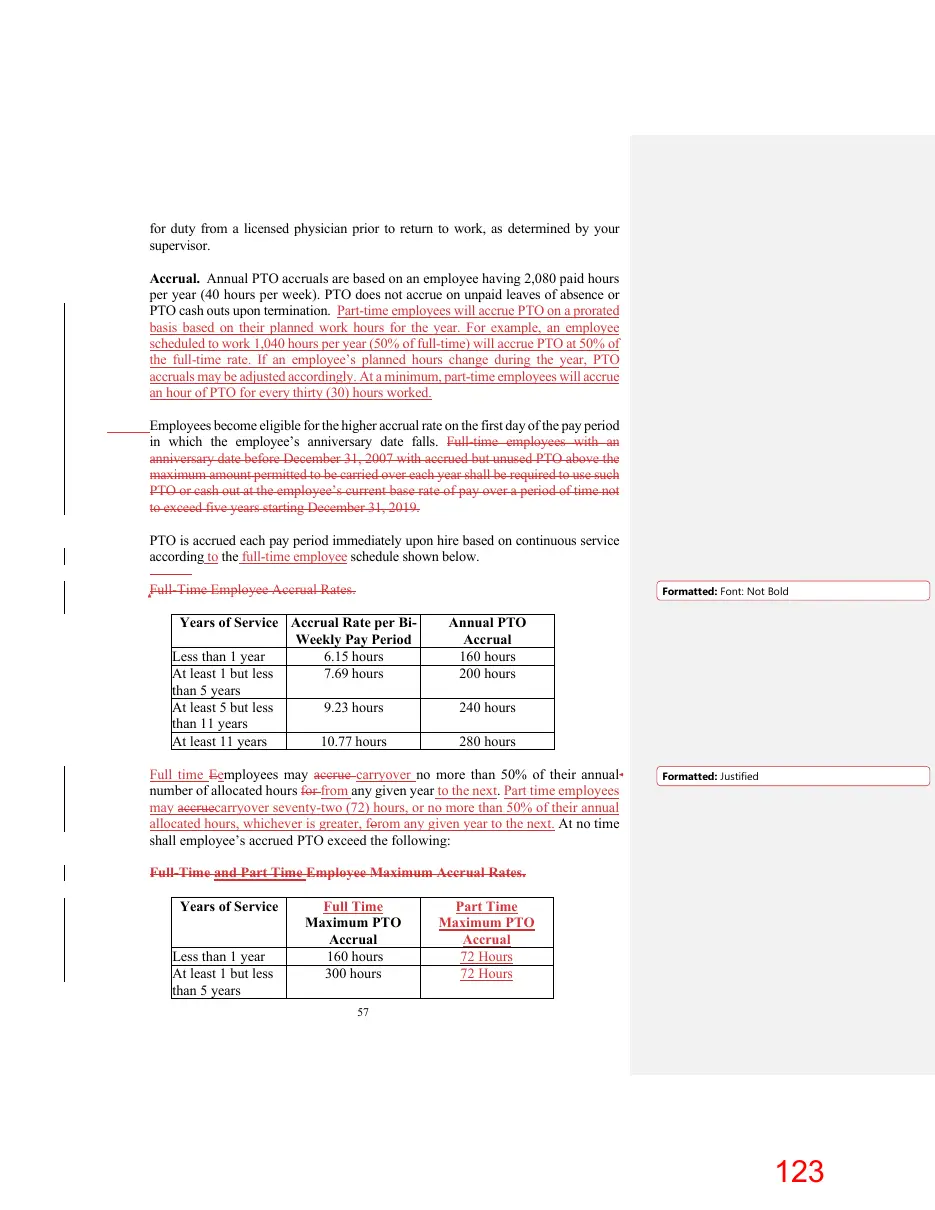
Text of page 123
for duty from a licensed physician prior to return to work, as determined by your supervisor. Accrual. Annual PTO accruals are based on an employee having 2,080 paid hours per year (40 hours per week). PTO does not accrue on unpaid leaves of absence or PTO cash outs upon termination. Part-time employees will accrue PTO on a prorated basis based on their planned work hours for the year. For example, an employee scheduled to work 1,040 hours per year (50% of full-time) will accrue PTO at 50% of the full-time rate. If an employee’s planned hours change during the year, PTO accruals may be adjusted accordingly. At a minimum, part-time employees will accrue an hour of PTO for every thirty (30) hours worked. Employees become eligible for the higher accrual rate on the first day of the pay period in which the employee’s anniversary date falls. Full-time employees with an anniversary date before December 31, 2007 with accrued but unused PTO above the maximum amount permitted to be carried over each year shall be required to use such PTO or cash out at the employee’s current base rate of pay over a period of time not to exceed five years starting December 31, 2019. PTO is accrued each pay period immediately upon hire based on continuous service according to the full-time employee schedule shown below. Full-Time Employee Accrual Rates.
Formatted: Font: Not Bold
Years of Service Accrual Rate per BiWeekly Pay Period Less than 1 year 6.15 hours At least 1 but less 7.69 hours than 5 years At least 5 but less 9.23 hours than 11 years At least 11 years 10.77 hours
Annual PTO Accrual 160 hours 200 hours 240 hours 280 hours
Full time Eemployees may accrue carryover no more than 50% of their annual number of allocated hours for from any given year to the next. Part time employees may accruecarryover seventy-two (72) hours, or no more than 50% of their annual allocated hours, whichever is greater, forom any given year to the next. At no time shall employee’s accrued PTO exceed the following:
Formatted: Justified
Full-Time and Part Time Employee Maximum Accrual Rates. Years of Service Less than 1 year At least 1 but less than 5 years
Full Time Maximum PTO Accrual 160 hours 300 hours
Part Time Maximum PTO Accrual 72 Hours 72 Hours
Page 124
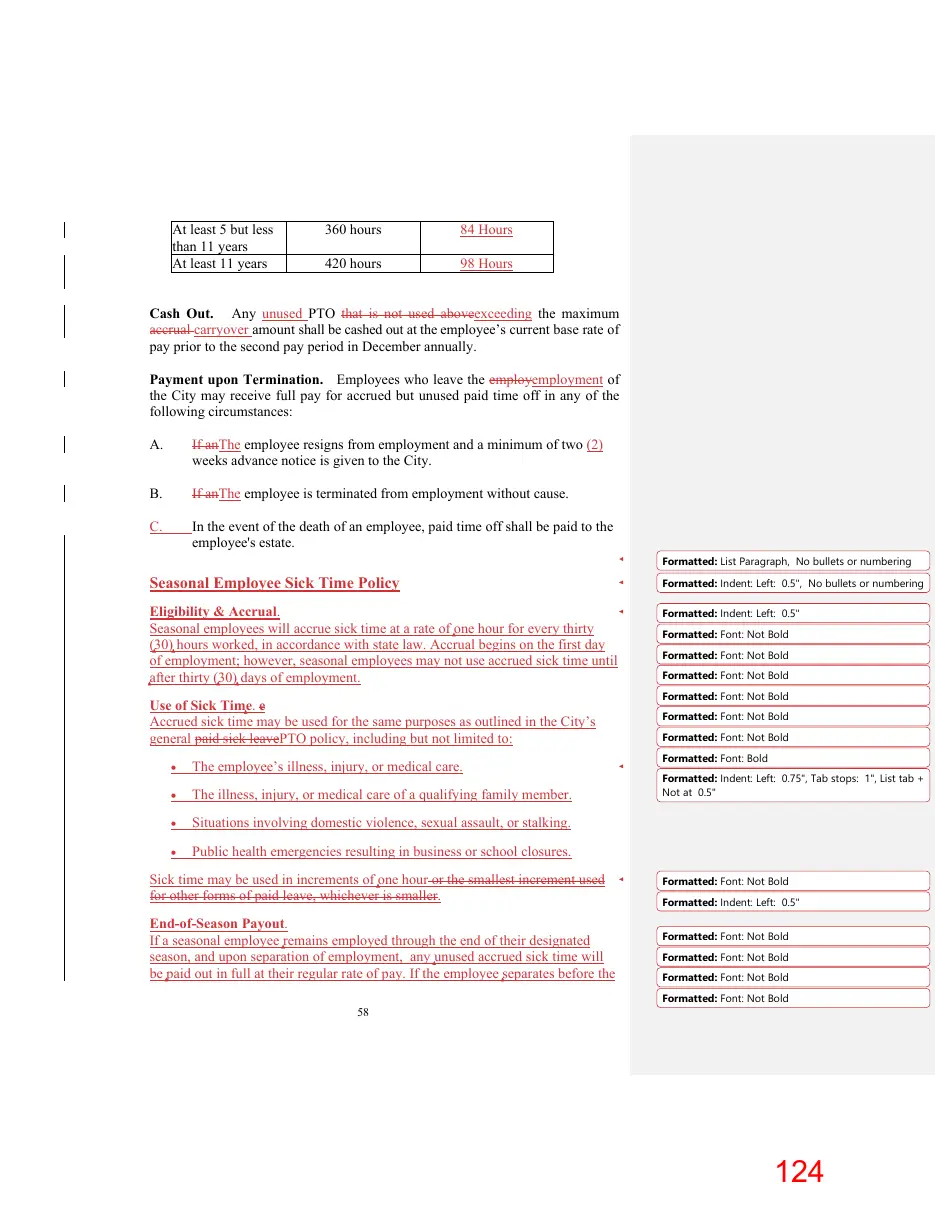
Text of page 124
At least 5 but less than 11 years At least 11 years
360 hours
84 Hours
420 hours
98 Hours
Cash Out. Any unused PTO that is not used aboveexceeding the maximum accrual carryover amount shall be cashed out at the employee’s current base rate of pay prior to the second pay period in December annually. Payment upon Termination. Employees who leave the employemployment of the City may receive full pay for accrued but unused paid time off in any of the following circumstances: A.
If anThe employee resigns from employment and a minimum of two (2) weeks advance notice is given to the City.
If anThe employee is terminated from employment without cause.
In the event of the death of an employee, paid time off shall be paid to the employee's estate.
Formatted: List Paragraph, No bullets or numbering
Seasonal Employee Sick Time Policy
Formatted: Indent: Left: 0.5", No bullets or numbering
Eligibility & Accrual. Seasonal employees will accrue sick time at a rate of one hour for every thirty (30) hours worked, in accordance with state law. Accrual begins on the first day of employment; however, seasonal employees may not use accrued sick time until after thirty (30) days of employment.
Formatted: Indent: Left: 0.5"
Use of Sick Time. e Accrued sick time may be used for the same purposes as outlined in the City’s general paid sick leavePTO policy, including but not limited to: •
The employee’s illness, injury, or medical care.
The illness, injury, or medical care of a qualifying family member.
Situations involving domestic violence, sexual assault, or stalking.
Public health emergencies resulting in business or school closures.
Sick time may be used in increments of one hour or the smallest increment used for other forms of paid leave, whichever is smaller. End-of-Season Payout. If a seasonal employee remains employed through the end of their designated season, and upon separation of employment, any unused accrued sick time will be paid out in full at their regular rate of pay. If the employee separates before the 58
Formatted: Font: Not Bold Formatted: Font: Not Bold Formatted: Font: Not Bold Formatted: Font: Not Bold Formatted: Font: Not Bold Formatted: Font: Not Bold Formatted: Font: Bold Formatted: Indent: Left: 0.75", Tab stops: 1", List tab + Not at 0.5"
Formatted: Font: Not Bold Formatted: Indent: Left: 0.5" Formatted: Font: Not Bold Formatted: Font: Not Bold Formatted: Font: Not Bold Formatted: Font: Not Bold
Page 125
Text of page 125
end of the season, any remaining unused sick time will not be paid out, unless required by law. Additional Provisions •
Formatted: Font: Bold
Seasonal employees are not required to find a replacement for their shift when using sick time.
Accrued but unused sick time does not carry over to future seasonal terms of employment where two (2) months or more passes between seasonal terms of employment.
Requests for sick time should be made in accordance with the City’s general PTO leave request policies.
Formatted: Font: Not Bold Formatted: Indent: Left: 0.75", Tab stops: 1", List tab + Not at 0.5"
Formatted: No bullets or numbering
Page 126
Text of page 126
SECTION 8.0 MEDICAL INSURANCE I.
PURPOSE To establish policies and procedures regarding group medical insurance coverage.
II.
POLICY The City provides a group health care plan covering certain hospitalization, surgical and medical expenses for participating full-time employees and their eligible dependents. The City pays will pay at least 80%, and up to 100%, of the monthly premium costs for single subscriber, two person and family coverage for eligible fulltime employees who elect to participate in the group medical insurance plan. The City’s liability shall be limited to these payments. Summary descriptions of the plan are available in the City Treasurer’s Office. The specific terms and conditions governing the group insurance plan are set forth in detail in the master policy or policies governing the plan as issued by the carrier or carriers. The City reserves the right to modify the coverage provided under the insurance plan, to select the insurance carrier or carriers, to become a self-insurer either wholly or partially, and to select the administrator of such self-insurance plans. Full-time employees are eligible to participate in the group insurance plan no earlier than the first day of the premium month following the commencement of employment with the City in a full-time position or at a date thereafter that may be established by the insurance carrier. Employees electing to participate in the group insurance plan shall advise the City in writing of this intent and shall make arrangements satisfactory to the City for the payment of the required monthly premium, if any.
Page 127
Text of page 127
SECTION 8.1 PAYMENT IN LIEU OF HEALTH INSURANCE I.
PURPOSE To establish policies and procedures regarding payment in lieu of coverage under the group medical insurance plan.
II.
POLICY Each full‐time employee will be given the option of accepting a payment in lieu of participating in the City’s health insurance plan. Payments will be 30% of the hard cap contribution limits under the Publicly Funded Health Insurance Contribution Act and the employee’s eligible status (single/double/family). In order to obtain this payment, the employee must make his/her an election by June of each fiscal year. Should the employee elect to waive his/herthe insurance and obtain the payment, he/shethe employee shall not be eligible to participate in the City’s health insurance program for that premium year unless a qualifying event per state law. This payment is not available to City employees who are married to another City employee. Employees electing to opt out of the group medical insurance plan must present proof of other insurance. The payment made to eligible employees who elect not to participate in the City’s health insurance program will be distributed in equal monthly increments
Page 128
Text of page 128
SECTION 8.2 HEALTH REIMBURSEMENT ARRANGEMENT (HRA) I.
PURPOSE To establish policies and procedures regarding employee dental and vision health reimbursement arrangements.
II.
POLICY The City offers an employer-funded health reimbursement arrangement (HRA) to reimburse employees for qualified dental and vision expenses. The City offers a fixed amount per calendar year available to each full-time employee based on the employee’s eligible status (single/double/family) for reimbursement of vision and dental related expenses. The amount of the annual reimbursement caps shall be determined through the annual budget process. Questions regarding this allotment and what is reimbursable under this HRA should be directed to the City Treasurer.
Page 129
Text of page 129
SECTION 8.3 DISABILITY INSURANCE I.
PURPOSE To establish policies and procedures regarding disability insurance coverage plan.
II.
POLICY The City provides group short-term disability insurance to full-time employees. Benefits are payable from the first day of disability due to accidental bodily injury or from the 8th day of disability due to sickness, for a period not to exceed twentysix (26) weeks for any one period of disability. Check with the City Treasurer for plan documents and additional detail.
Page 130
Text of page 130
SECTION 8.4 TERM LIFE AND DEATH DISMEMBERMENT INSURANCE I.
PURPOSE To establish policies and procedures regarding life insurance.
II.
POLICY All full-time employees shall be eligible for group term life insurance policy coverage in the amount of at least $25,000 and for group accidental death and dismemberment policy in the amount of at least $25,000. The specific terms and conditions governing the term life insurance coverage are set forth in detail in the master policy or policies issued by the carrier or carriers. The City pays the required monthly premium for eligible employees. Coverage begins on the first day of the following month after employment.
Page 131
Text of page 131
SECTION 8.5 CONTINUATION OF INSURANCE PREMIUMS I.
PURPOSE To establish policies and procedures regarding continuation of insurance premiums.
II.
POLICY In the event that an employee eligible for insurance coverage is discharged, retires, resigns, is laid off, or commences an unpaid leave of absence, the City shall have no obligation or liability whatsoever for making any insurance premium payment for any such employee or their lawful dependents beyond the month in which the discharge, retirement, resignation, layoff, or unpaid leave of absence commences. Employees on City approved unpaid leaves of absence may continue insurance benefits on a month-by-month basis by paying to the City, in advance, the amount of the next month's premium for that employee and/or their lawful dependents, subject to the approval of the insurance program. The City shall resume payment of insurance premiums for eligible employees who return to work from layoff or unpaid leaves of absence as of the first day of the premium month following the date of the employee's return to work. The provisions of this section notwithstanding, the City shall continue the payment of health insurance premiums for a period of up to six (6) months for employees on workers compensation leave or who are receiving sickness and accident insurance payments.
Page 132
Text of page 132
SECTION 8.6 WORKERS COMPENSATION I.
PURPOSE To establish policies and procedures regarding workers compensation.
II.
POLICY The City provides workers compensation coverage for all its employees. Employees are required to report any job-related injury or occupational disease to the City Manager as soon as possible, but no longer than twenty-four (24) hours after the accident or injury occurs or the disease is diagnosed. Failure to report a job-related accident, injury or disease may result in a denial of compensation benefits.
III.
PROCEDURE The City Manager shall ensure that workers compensation coverage, either through insurance policies or participation in group liability pools is provided for all employees.
Page 133
Text of page 133
SECTION 8.7 UNEMPLOYMENT COMPENSATION I.
PURPOSE To establish policies and procedures regarding unemployment compensation.
II.
POLICY All employees are covered under Michigan’s unemployment compensation system.
III.
PROCEDURE The City Manager shall maintain the City as a reimbursing employer.
Page 134
Text of page 134
SECTION 9.0 GRIEVANCE PROCEDURES I.
PURPOSE To establish policies and procedures regarding grievance resolution.
II.
POLICY Grievances. The City intends to provide a constructive, positive work environment in which employees are empowered to contribute to the continuous improvement in the operations and services provided by the City. To this end a formal grievance procedure is available to help resolve complaints of employees who believe they are not receiving fair treatment in the workplace. STEP 1: Verbal Communication with Supervisor Employees are encouraged to share their suggestions, as well as discuss any complaints or issues that may arise related to their employment and work environment with their immediate supervisor within five (5) working days from the time of the occurrence. The supervisor will try to provide a verbal response to the complainant within five (5) working days of the discussion with the employee. STEP 2: Written Communication with Department Head Should an employee not find adequate resolution through verbal discussion with their immediate supervisor, the complaint should be made in writing to the employee’s Ddepartment Hhead within five (5) working days from the oral response in Step 1. The employee will submit the employee’shis/her written grievance to their Ddepartment Hhead which must include: a. Date of incident b. Description of incident c. Summary of previous discussion(s) with supervisor regarding the incident d. Desired resolution e. Employee’s printed name, signature and date of submission The Ddepartment Hhead will provide a written response to the employee within five (5) working days of the receipt of the grievance. STEP 3: Written Communication with City Manager If the grievance is not resolved in the first two (2) steps, the employee may request a meeting with the City Manager. This request must be in writing, dated and submitted within five (5) working days after receiving the response from Step 2. The Ddepartment Hhead shall be copied on the request. 68
Page 135
Text of page 135
The meeting with the City Manager and the employee will occur within ten (10) working days of receipt of the request to meet, or on a date mutually convenient for all parties. At the City Manager’s discretion this meeting may include the Ddepartment Hhead and/or supervisor, and/or other City representatives as appropriate. At the employee’s option, the meeting may include a fellow employee or other representative of the employee’s choosing. The City Manager, or designated representative, will provide a written response to the employee within ten (10) working days of the meeting. The City Manager’s response to the grievance is final.
Page 136
Text of page 136
SECTION 10.0 DISCIPLINARY ACTION I.
PURPOSE To establish policies and procedures regarding Disciplinary Action.
II.
POLICY It is the intention of the City to utilize disciplinary action in a constructive manner to motivate the employee toward proper conduct in the future. Situations of a minor nature are expected to be handled informally by the employee’s immediate supervisor and may result in a verbal warning which may be documented and retained in the employee’s personnel file. Habitual minor offenses shall be considered serious and shall be entered into the personnel file. Formal disciplinary action will be administered by the Department Head in coordination with the City Manager. Suspensions and discharges are officially administered by the City Manager.
III.
PROCEDURES Disciplinary actions may include any or all the following, which are not necessarily administered in order, nor are all types of disciplinary action required prior to discharge. The City may immediately discharge an employee in its discretion. Oral Reprimand. A verbal notice to an employee that his/herthe employee’s behavior or performance must be improved or corrected. A written record of the oral reprimand will be placed in the employee's personnel file and a copy provided to the employee. Written Reprimand. A written notice to an employee that his/herthe employee’s behavior or performance must be improved or corrected. Written reprimands will be placed in the employee's personnel file and furnished to the employee. Suspension. The temporary removal of an employee from duty, with or without pay. Suspensions will vary in length depending upon the seriousness of the offense or frequency of occurrence. Suspensions will be documented and placed in the employee's personnel file. Discharge. The removal of an employee from the employ of the City (also may be referred to as Dismissal or Involuntary Termination). Employees may submit written explanations or responses to disciplinary actions to their personnel file. In some cases, particularly discharge, an employee may have certain additional due process rights. 70
Page 137
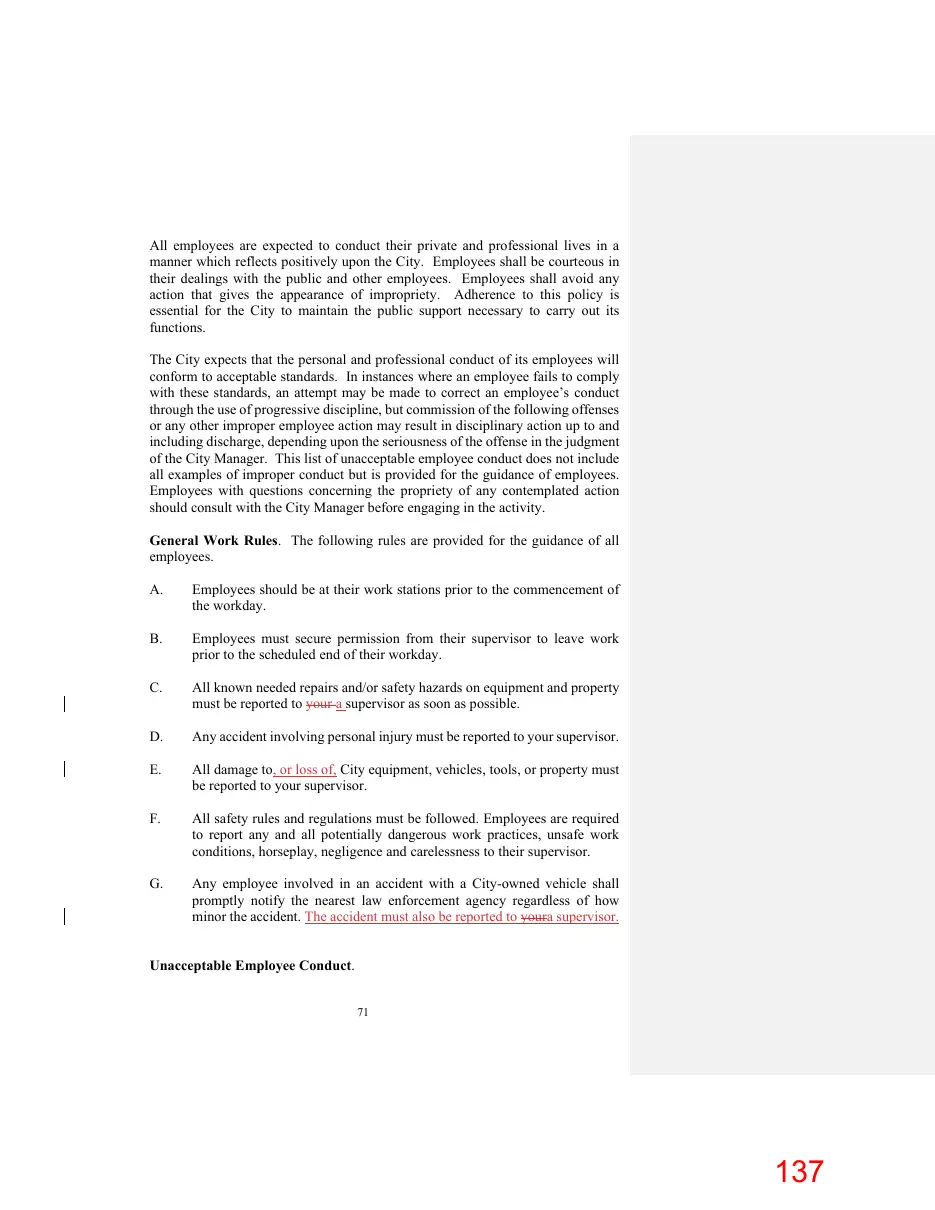
Text of page 137
All employees are expected to conduct their private and professional lives in a manner which reflects positively upon the City. Employees shall be courteous in their dealings with the public and other employees. Employees shall avoid any action that gives the appearance of impropriety. Adherence to this policy is essential for the City to maintain the public support necessary to carry out its functions. The City expects that the personal and professional conduct of its employees will conform to acceptable standards. In instances where an employee fails to comply with these standards, an attempt may be made to correct an employee’s conduct through the use of progressive discipline, but commission of the following offenses or any other improper employee action may result in disciplinary action up to and including discharge, depending upon the seriousness of the offense in the judgment of the City Manager. This list of unacceptable employee conduct does not include all examples of improper conduct but is provided for the guidance of employees. Employees with questions concerning the propriety of any contemplated action should consult with the City Manager before engaging in the activity. General Work Rules. The following rules are provided for the guidance of all employees. A.
Employees should be at their work stations prior to the commencement of the workday.
Employees must secure permission from their supervisor to leave work prior to the scheduled end of their workday.
All known needed repairs and/or safety hazards on equipment and property must be reported to your a supervisor as soon as possible.
Any accident involving personal injury must be reported to your supervisor.
All damage to, or loss of, City equipment, vehicles, tools, or property must be reported to your supervisor.
All safety rules and regulations must be followed. Employees are required to report any and all potentially dangerous work practices, unsafe work conditions, horseplay, negligence and carelessness to their supervisor.
Any employee involved in an accident with a City-owned vehicle shall promptly notify the nearest law enforcement agency regardless of how minor the accident. The accident must also be reported to youra supervisor.
Unacceptable Employee Conduct. 71
Page 138
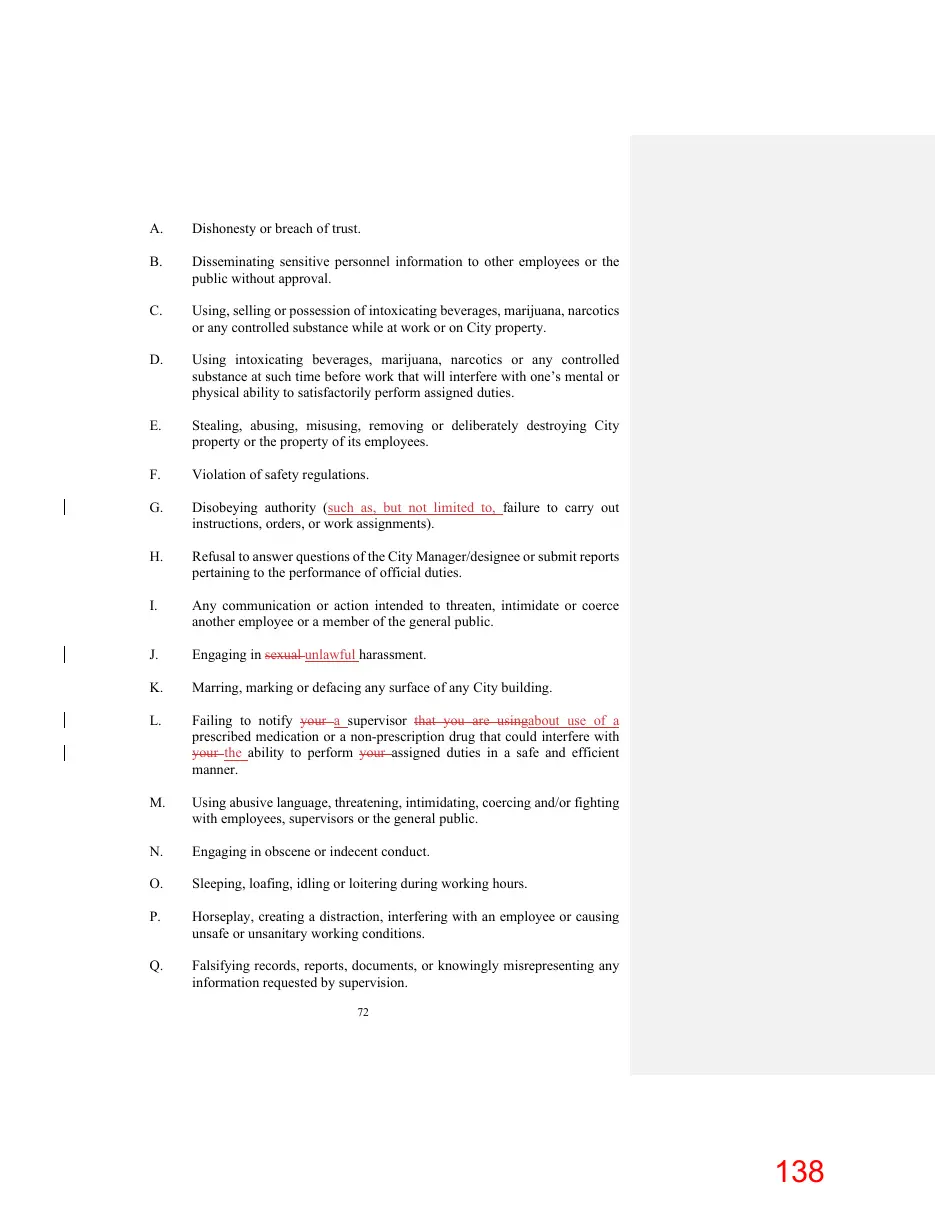
Text of page 138
Dishonesty or breach of trust.
Disseminating sensitive personnel information to other employees or the public without approval.
Using, selling or possession of intoxicating beverages, marijuana, narcotics or any controlled substance while at work or on City property.
Using intoxicating beverages, marijuana, narcotics or any controlled substance at such time before work that will interfere with one’s mental or physical ability to satisfactorily perform assigned duties.
Stealing, abusing, misusing, removing or deliberately destroying City property or the property of its employees.
Violation of safety regulations.
Disobeying authority (such as, but not limited to, failure to carry out instructions, orders, or work assignments).
Refusal to answer questions of the City Manager/designee or submit reports pertaining to the performance of official duties.
Any communication or action intended to threaten, intimidate or coerce another employee or a member of the general public.
Engaging in sexual unlawful harassment.
Marring, marking or defacing any surface of any City building.
Failing to notify your a supervisor that you are usingabout use of a prescribed medication or a non-prescription drug that could interfere with your the ability to perform your assigned duties in a safe and efficient manner.
Using abusive language, threatening, intimidating, coercing and/or fighting with employees, supervisors or the general public.
Engaging in obscene or indecent conduct.
Sleeping, loafing, idling or loitering during working hours.
Horseplay, creating a distraction, interfering with an employee or causing unsafe or unsanitary working conditions.
Falsifying records, reports, documents, or knowingly misrepresenting any information requested by supervision. 72
Page 139
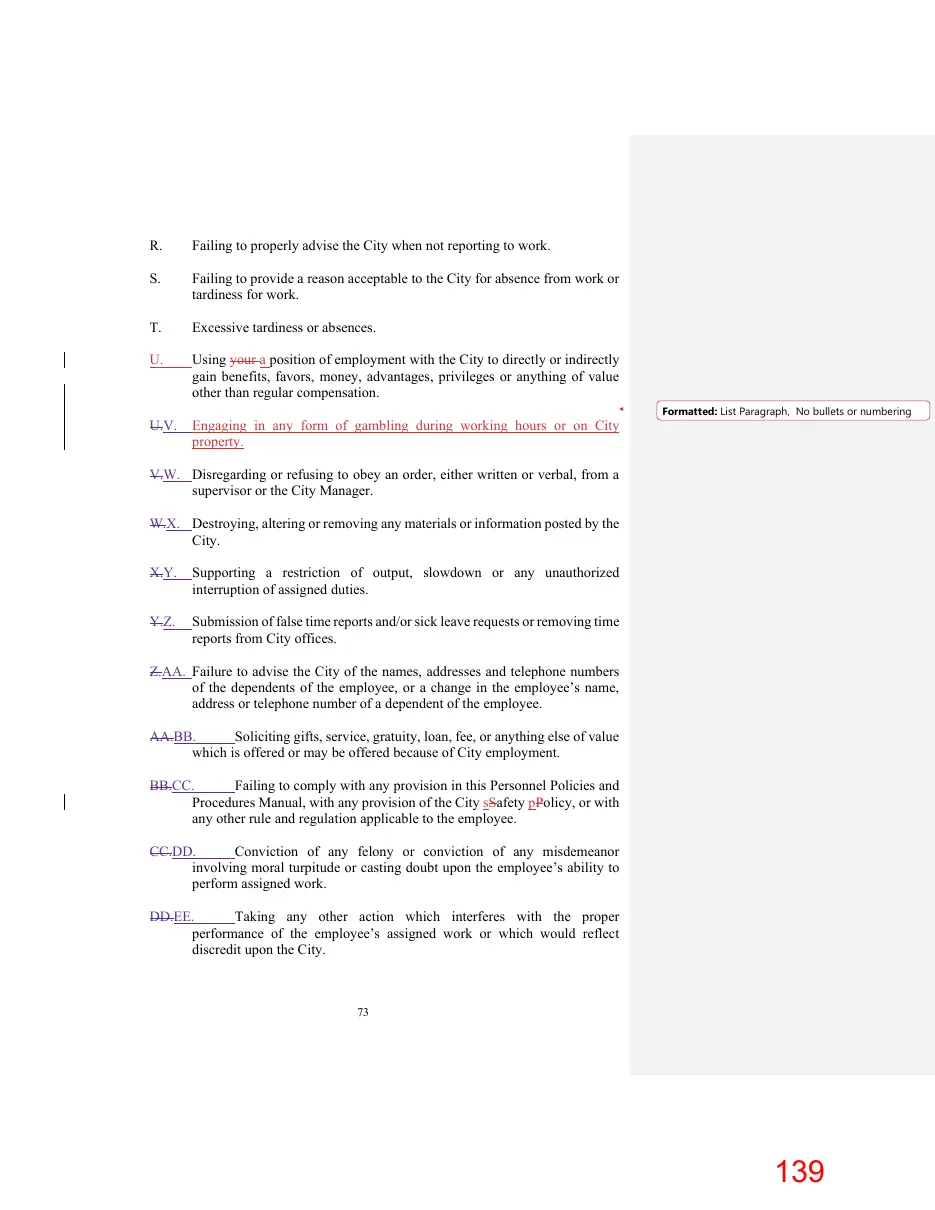
Text of page 139
Failing to properly advise the City when not reporting to work.
Failing to provide a reason acceptable to the City for absence from work or tardiness for work.
Excessive tardiness or absences.
Using your a position of employment with the City to directly or indirectly gain benefits, favors, money, advantages, privileges or anything of value other than regular compensation.
U.V.
Engaging in any form of gambling during working hours or on City property.
Formatted: List Paragraph, No bullets or numbering
V.W. Disregarding or refusing to obey an order, either written or verbal, from a supervisor or the City Manager. W.X. Destroying, altering or removing any materials or information posted by the City. X.Y.
Supporting a restriction of output, slowdown or any unauthorized interruption of assigned duties.
Y.Z.
Submission of false time reports and/or sick leave requests or removing time reports from City offices.
Z.AA. Failure to advise the City of the names, addresses and telephone numbers of the dependents of the employee, or a change in the employee’s name, address or telephone number of a dependent of the employee. AA.BB. Soliciting gifts, service, gratuity, loan, fee, or anything else of value which is offered or may be offered because of City employment. BB.CC. Failing to comply with any provision in this Personnel Policies and Procedures Manual, with any provision of the City sSafety pPolicy, or with any other rule and regulation applicable to the employee. CC.DD. Conviction of any felony or conviction of any misdemeanor involving moral turpitude or casting doubt upon the employee’s ability to perform assigned work. DD.EE. Taking any other action which interferes with the proper performance of the employee’s assigned work or which would reflect discredit upon the City.
Page 140
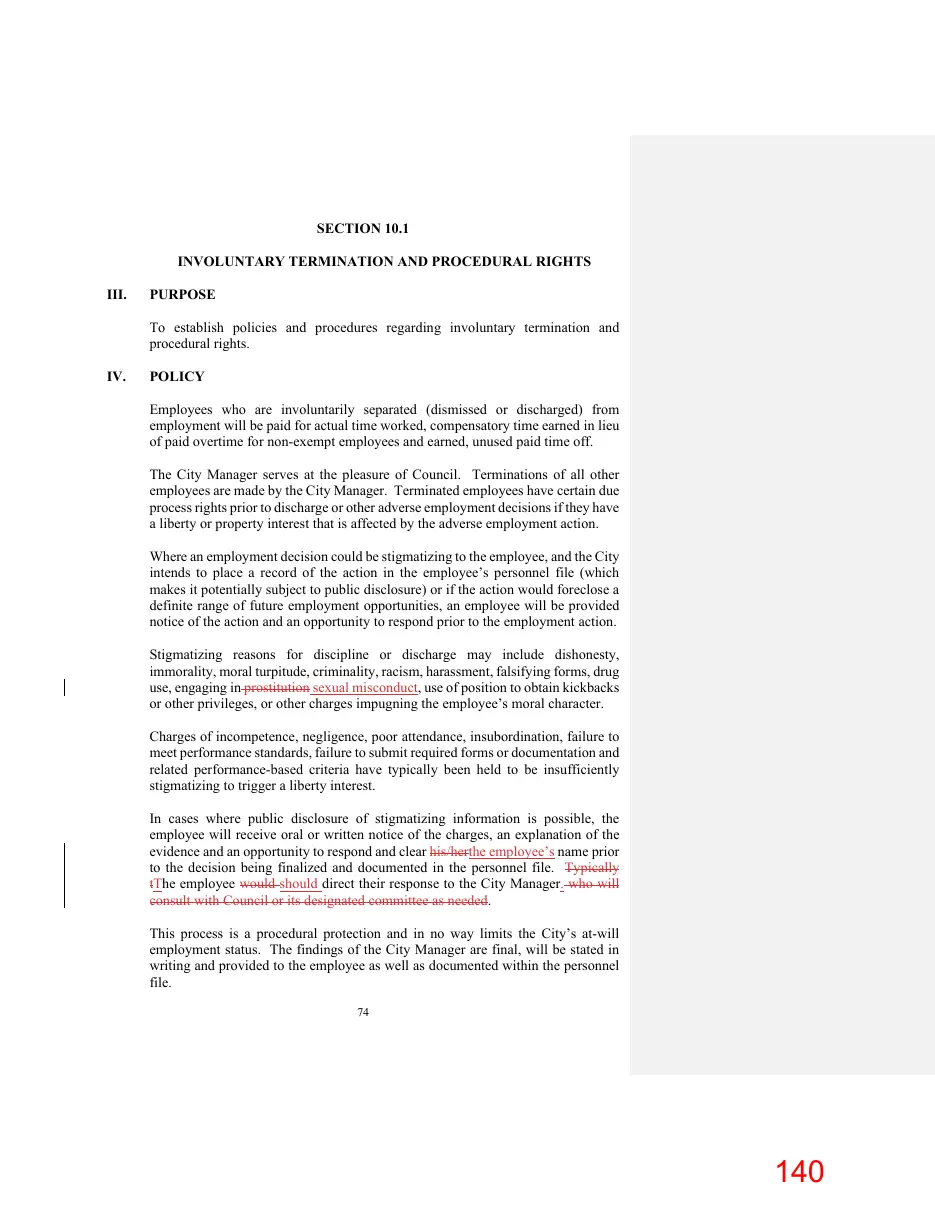
Text of page 140
SECTION 10.1 INVOLUNTARY TERMINATION AND PROCEDURAL RIGHTS III.
PURPOSE To establish policies and procedures regarding involuntary termination and procedural rights.
IV.
POLICY Employees who are involuntarily separated (dismissed or discharged) from employment will be paid for actual time worked, compensatory time earned in lieu of paid overtime for non-exempt employees and earned, unused paid time off. The City Manager serves at the pleasure of Council. Terminations of all other employees are made by the City Manager. Terminated employees have certain due process rights prior to discharge or other adverse employment decisions if they have a liberty or property interest that is affected by the adverse employment action. Where an employment decision could be stigmatizing to the employee, and the City intends to place a record of the action in the employee’s personnel file (which makes it potentially subject to public disclosure) or if the action would foreclose a definite range of future employment opportunities, an employee will be provided notice of the action and an opportunity to respond prior to the employment action. Stigmatizing reasons for discipline or discharge may include dishonesty, immorality, moral turpitude, criminality, racism, harassment, falsifying forms, drug use, engaging in prostitution sexual misconduct, use of position to obtain kickbacks or other privileges, or other charges impugning the employee’s moral character. Charges of incompetence, negligence, poor attendance, insubordination, failure to meet performance standards, failure to submit required forms or documentation and related performance-based criteria have typically been held to be insufficiently stigmatizing to trigger a liberty interest. In cases where public disclosure of stigmatizing information is possible, the employee will receive oral or written notice of the charges, an explanation of the evidence and an opportunity to respond and clear his/herthe employee’s name prior to the decision being finalized and documented in the personnel file. Typically tThe employee would should direct their response to the City Manager. who will consult with Council or its designated committee as needed. This process is a procedural protection and in no way limits the City’s at-will employment status. The findings of the City Manager are final, will be stated in writing and provided to the employee as well as documented within the personnel file. 74
Page 141

This page is a scanned image with no text layer. The PDF of these pages has it at full resolution.
Page 142
Text of page 142
SECTION 11.0 USE OF CITY PROPERTY I.
PURPOSE To establish policies and procedures regarding personal use of City property.
II.
POLICY No property belonging to the City may be borrowed for personal use by employees. Any City property provided to an employee for use while a City employee must be returned upon termination of employment. Employees are expected to exercise sound judgment and proper care in the use of City property, provided in support of their job function. Waste and damage caused by neglect or inappropriate use may lead to disciplinary action up to and including discharge.
Page 143
Text of page 143
SECTION 11.1 USE OF CITY VEHICLES I.
PURPOSE To establish policies and procedures regarding use of City vehicles.
II.
POLICY The use of City-owned vehicles is confined to that necessary to conduct official City business. Vehicles shall be driven in a manner to conform to all posted speed limits, state traffic rules and regulations, City ordinances and maintain the security of the vehicle and its contents. The City does not permit employees to text while driving City vehicles, using a hand-held cell phone or other electronic device. Drivers are responsible for any driving infractions or fines that result from their driving and must report them to their supervisor. Employees shall be responsible for the proper care and use of City vehicles and shall report promptly and malfunction so that repairs may be made. Employees are required to lock City vehicles when absent from the vehicle and not within sight of the vehicle. When appropriate, vehicles should not be left running when not in use. Persons other than City employees shall not be authorized to drive or ride in City vehicles unless authorized by the City Manager, and then only for official City business. All employees using City vehicles must have a valid Michigan driver’s license and a satisfactory driving record. Any restrictions on, or revocation of, an employee’s legal right to drive must be immediately reported to the appropriate Ddepartment Hhead.
Page 144
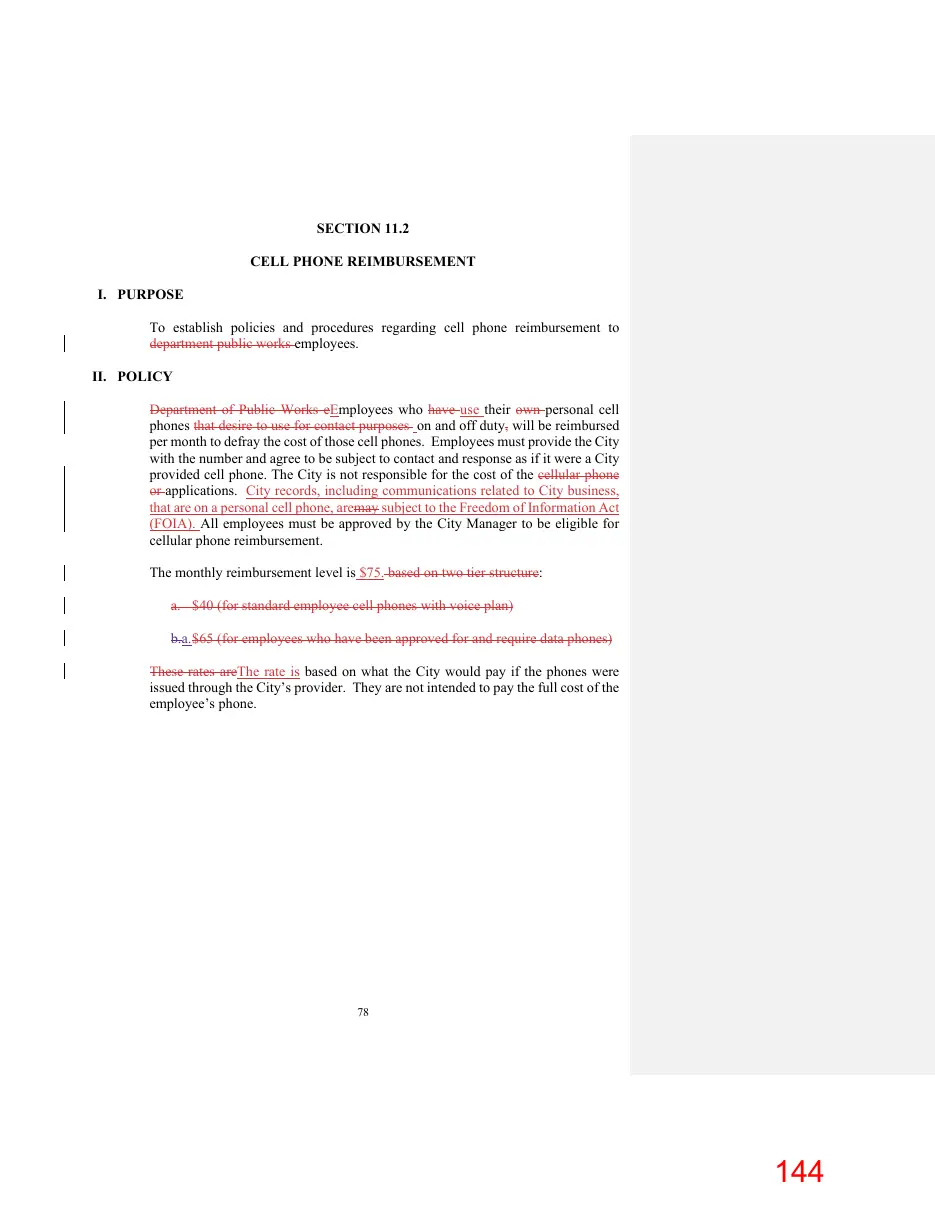
Text of page 144
SECTION 11.2 CELL PHONE REIMBURSEMENT I. PURPOSE To establish policies and procedures regarding cell phone reimbursement to department public works employees. II. POLICY Department of Public Works eEmployees who have use their own personal cell phones that desire to use for contact purposes on and off duty, will be reimbursed per month to defray the cost of those cell phones. Employees must provide the City with the number and agree to be subject to contact and response as if it were a City provided cell phone. The City is not responsible for the cost of the cellular phone or applications. City records, including communications related to City business, that are on a personal cell phone, aremay subject to the Freedom of Information Act (FOIA). All employees must be approved by the City Manager to be eligible for cellular phone reimbursement. The monthly reimbursement level is $75. based on two tier structure: a. $40 (for standard employee cell phones with voice plan) b.a. $65 (for employees who have been approved for and require data phones) These rates areThe rate is based on what the City would pay if the phones were issued through the City’s provider. They are not intended to pay the full cost of the employee’s phone.
Page 145
Text of page 145
SECTION 11.3 SMOKING I.
PURPOSE The City is a tobacco-free and smoke-free work place for the health, safety and wellbeing of all of its employees, residents and visitors.
II.
POLICY No tobacco, smoking or use of e-cigarettes (vaping) or other electronic nicotine delivery systems will be allowed anywhere in City buildings and or vehicles controlled by the City or anywhere an employee is actively working for the City. Electronic cigarettes or e-cigarettes are defined as any device that is designed to mimic cigarettes by vaporizing a liquid that is inhaled by the user.
Page 146
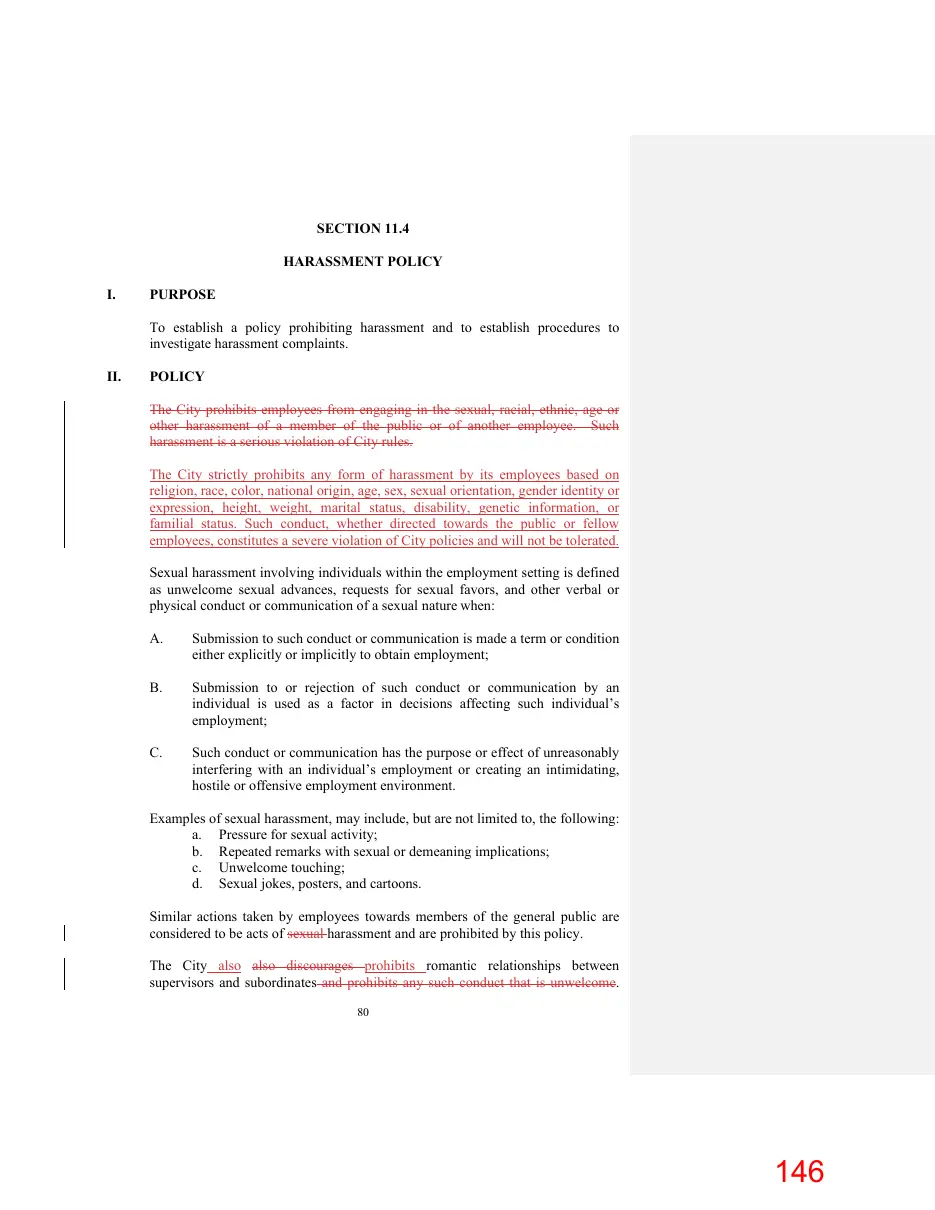
Text of page 146
SECTION 11.4 HARASSMENT POLICY I.
PURPOSE To establish a policy prohibiting harassment and to establish procedures to investigate harassment complaints.
II.
POLICY The City prohibits employees from engaging in the sexual, racial, ethnic, age or other harassment of a member of the public or of another employee. Such harassment is a serious violation of City rules. The City strictly prohibits any form of harassment by its employees based on religion, race, color, national origin, age, sex, sexual orientation, gender identity or expression, height, weight, marital status, disability, genetic information, or familial status. Such conduct, whether directed towards the public or fellow employees, constitutes a severe violation of City policies and will not be tolerated. Sexual harassment involving individuals within the employment setting is defined as unwelcome sexual advances, requests for sexual favors, and other verbal or physical conduct or communication of a sexual nature when: A.
Submission to such conduct or communication is made a term or condition either explicitly or implicitly to obtain employment;
Submission to or rejection of such conduct or communication by an individual is used as a factor in decisions affecting such individual’s employment;
Such conduct or communication has the purpose or effect of unreasonably interfering with an individual’s employment or creating an intimidating, hostile or offensive employment environment.
Examples of sexual harassment, may include, but are not limited to, the following: a. Pressure for sexual activity; b. Repeated remarks with sexual or demeaning implications; c. Unwelcome touching; d. Sexual jokes, posters, and cartoons. Similar actions taken by employees towards members of the general public are considered to be acts of sexual harassment and are prohibited by this policy. The City also also discourages prohibits romantic relationships between supervisors and subordinates and prohibits any such conduct that is unwelcome. 80
Page 147
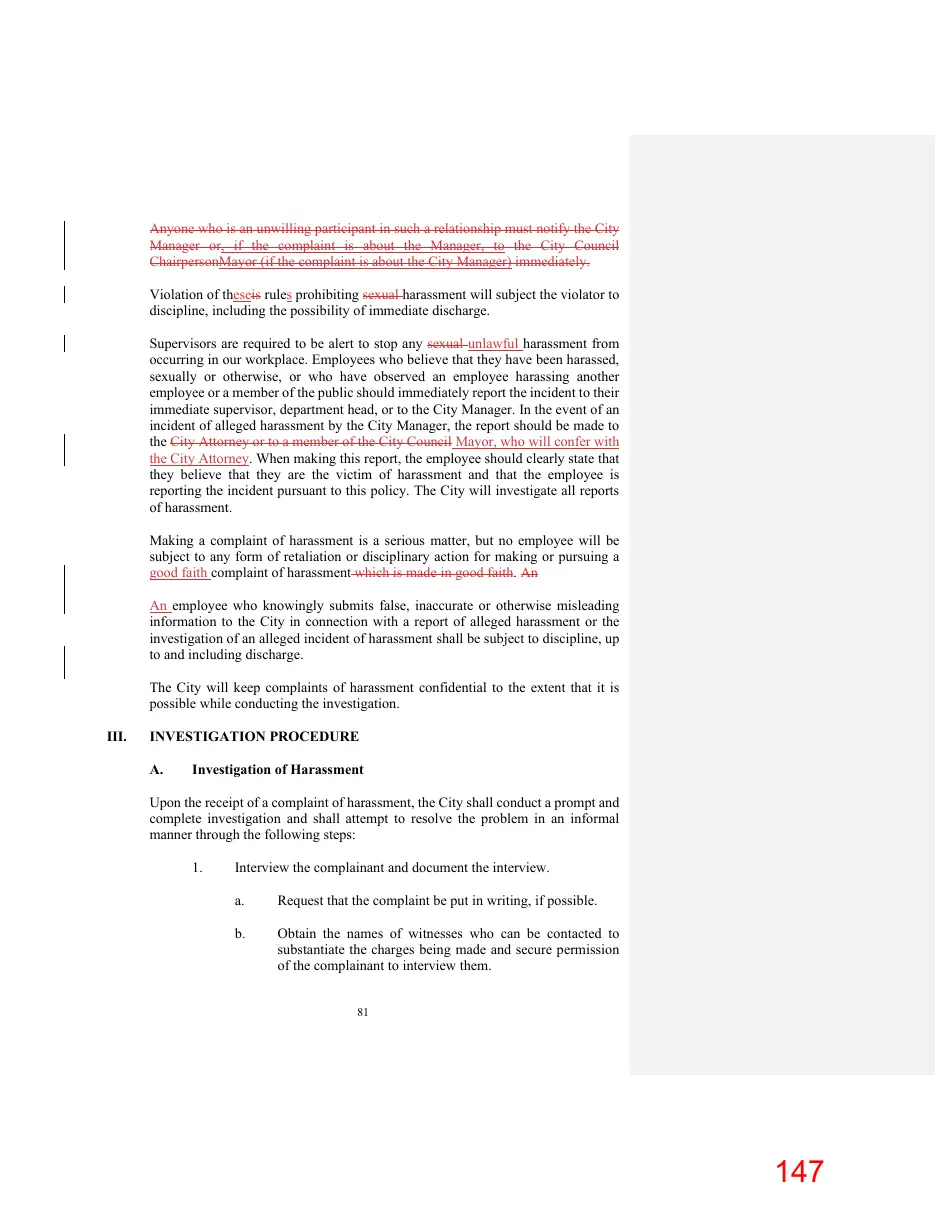
Text of page 147
Anyone who is an unwilling participant in such a relationship must notify the City Manager or, if the complaint is about the Manager, to the City Council ChairpersonMayor (if the complaint is about the City Manager) immediately. Violation of theseis rules prohibiting sexual harassment will subject the violator to discipline, including the possibility of immediate discharge. Supervisors are required to be alert to stop any sexual unlawful harassment from occurring in our workplace. Employees who believe that they have been harassed, sexually or otherwise, or who have observed an employee harassing another employee or a member of the public should immediately report the incident to their immediate supervisor, department head, or to the City Manager. In the event of an incident of alleged harassment by the City Manager, the report should be made to the City Attorney or to a member of the City Council Mayor, who will confer with the City Attorney. When making this report, the employee should clearly state that they believe that they are the victim of harassment and that the employee is reporting the incident pursuant to this policy. The City will investigate all reports of harassment. Making a complaint of harassment is a serious matter, but no employee will be subject to any form of retaliation or disciplinary action for making or pursuing a good faith complaint of harassment which is made in good faith. An An employee who knowingly submits false, inaccurate or otherwise misleading information to the City in connection with a report of alleged harassment or the investigation of an alleged incident of harassment shall be subject to discipline, up to and including discharge. The City will keep complaints of harassment confidential to the extent that it is possible while conducting the investigation. III.
INVESTIGATION PROCEDURE A.
Investigation of Harassment
Upon the receipt of a complaint of harassment, the City shall conduct a prompt and complete investigation and shall attempt to resolve the problem in an informal manner through the following steps: 1.
Interview the complainant and document the interview. a.
Request that the complaint be put in writing, if possible.
Obtain the names of witnesses who can be contacted to substantiate the charges being made and secure permission of the complainant to interview them. 81
Page 148
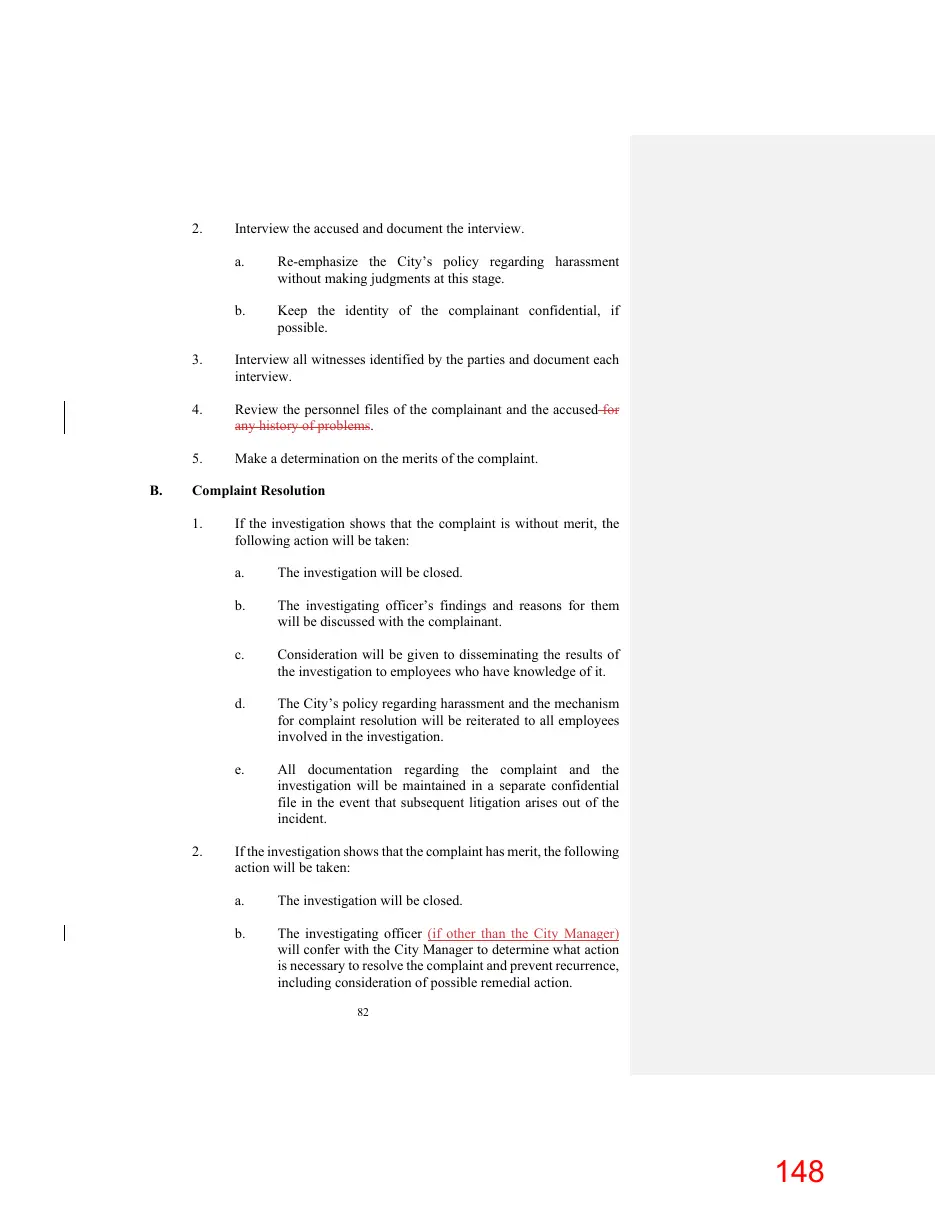
Text of page 148
Interview the accused and document the interview. a.
Re-emphasize the City’s policy regarding harassment without making judgments at this stage.
Keep the identity of the complainant confidential, if possible.
Interview all witnesses identified by the parties and document each interview.
Review the personnel files of the complainant and the accused for any history of problems.
Make a determination on the merits of the complaint.
Complaint Resolution 1.
If the investigation shows that the complaint is without merit, the following action will be taken: a.
The investigation will be closed.
The investigating officer’s findings and reasons for them will be discussed with the complainant.
Consideration will be given to disseminating the results of the investigation to employees who have knowledge of it.
The City’s policy regarding harassment and the mechanism for complaint resolution will be reiterated to all employees involved in the investigation.
All documentation regarding the complaint and the investigation will be maintained in a separate confidential file in the event that subsequent litigation arises out of the incident.
If the investigation shows that the complaint has merit, the following action will be taken: a.
The investigation will be closed.
The investigating officer (if other than the City Manager) will confer with the City Manager to determine what action is necessary to resolve the complaint and prevent recurrence, including consideration of possible remedial action. 82
Page 149
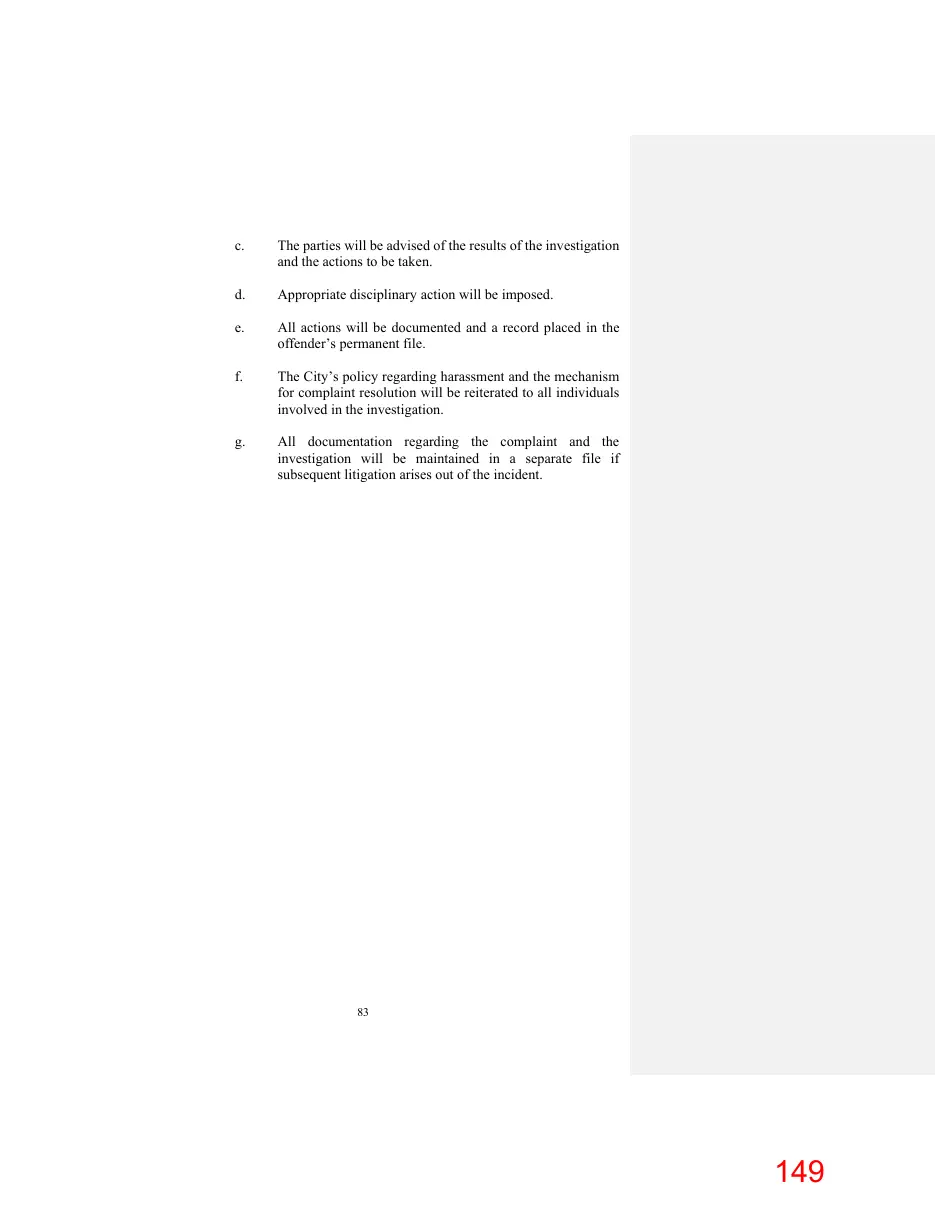
Text of page 149
The parties will be advised of the results of the investigation and the actions to be taken.
Appropriate disciplinary action will be imposed.
All actions will be documented and a record placed in the offender’s permanent file.
The City’s policy regarding harassment and the mechanism for complaint resolution will be reiterated to all individuals involved in the investigation.
All documentation regarding the complaint and the investigation will be maintained in a separate file if subsequent litigation arises out of the incident.
Page 150
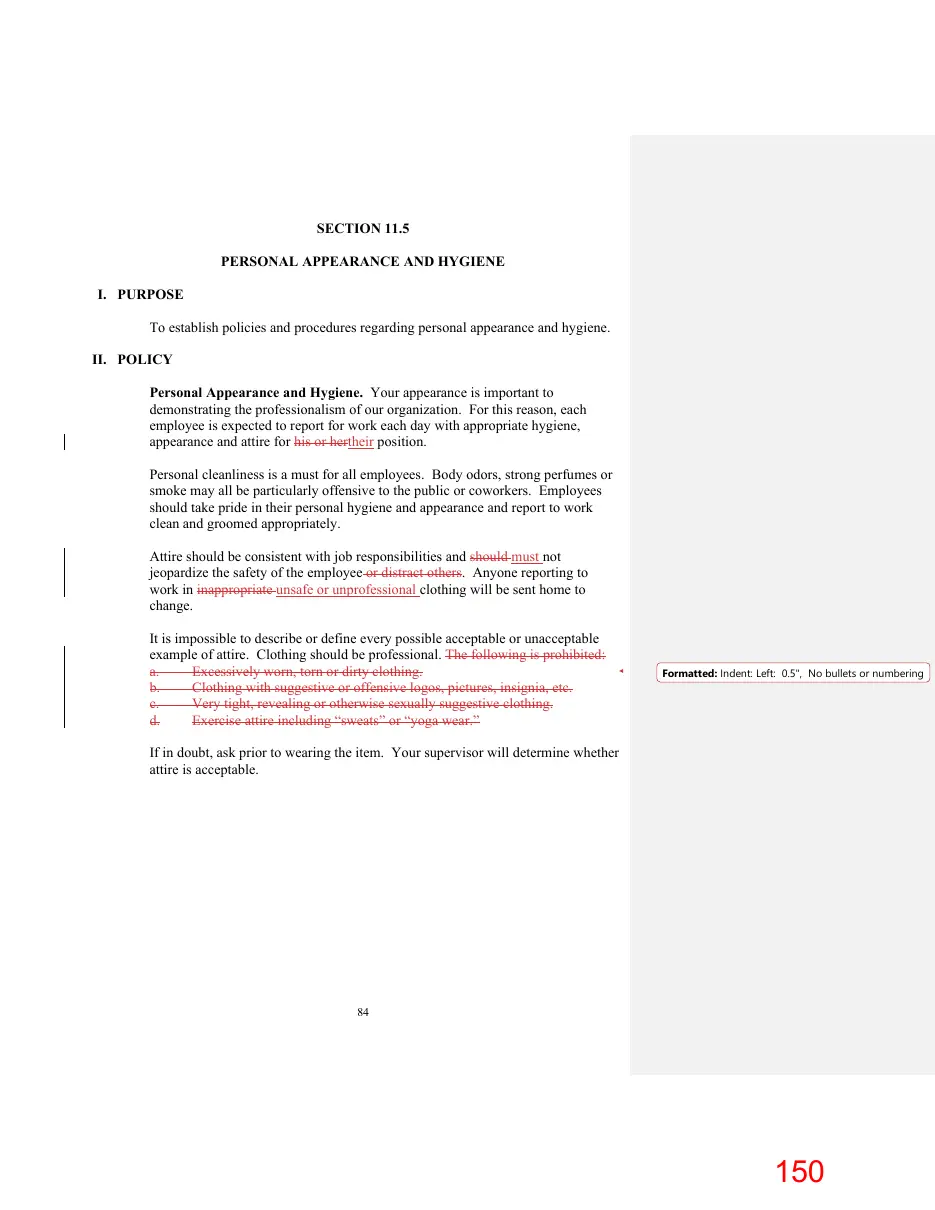
Text of page 150
SECTION 11.5 PERSONAL APPEARANCE AND HYGIENE I. PURPOSE To establish policies and procedures regarding personal appearance and hygiene. II. POLICY Personal Appearance and Hygiene. Your appearance is important to demonstrating the professionalism of our organization. For this reason, each employee is expected to report for work each day with appropriate hygiene, appearance and attire for his or hertheir position. Personal cleanliness is a must for all employees. Body odors, strong perfumes or smoke may all be particularly offensive to the public or coworkers. Employees should take pride in their personal hygiene and appearance and report to work clean and groomed appropriately. Attire should be consistent with job responsibilities and should must not jeopardize the safety of the employee or distract others. Anyone reporting to work in inappropriate unsafe or unprofessional clothing will be sent home to change. It is impossible to describe or define every possible acceptable or unacceptable example of attire. Clothing should be professional. The following is prohibited: a. Excessively worn, torn or dirty clothing. b. Clothing with suggestive or offensive logos, pictures, insignia, etc. c. Very tight, revealing or otherwise sexually suggestive clothing. d. Exercise attire including “sweats” or “yoga wear.”
Formatted: Indent: Left: 0.5", No bullets or numbering
If in doubt, ask prior to wearing the item. Your supervisor will determine whether attire is acceptable.
Page 151
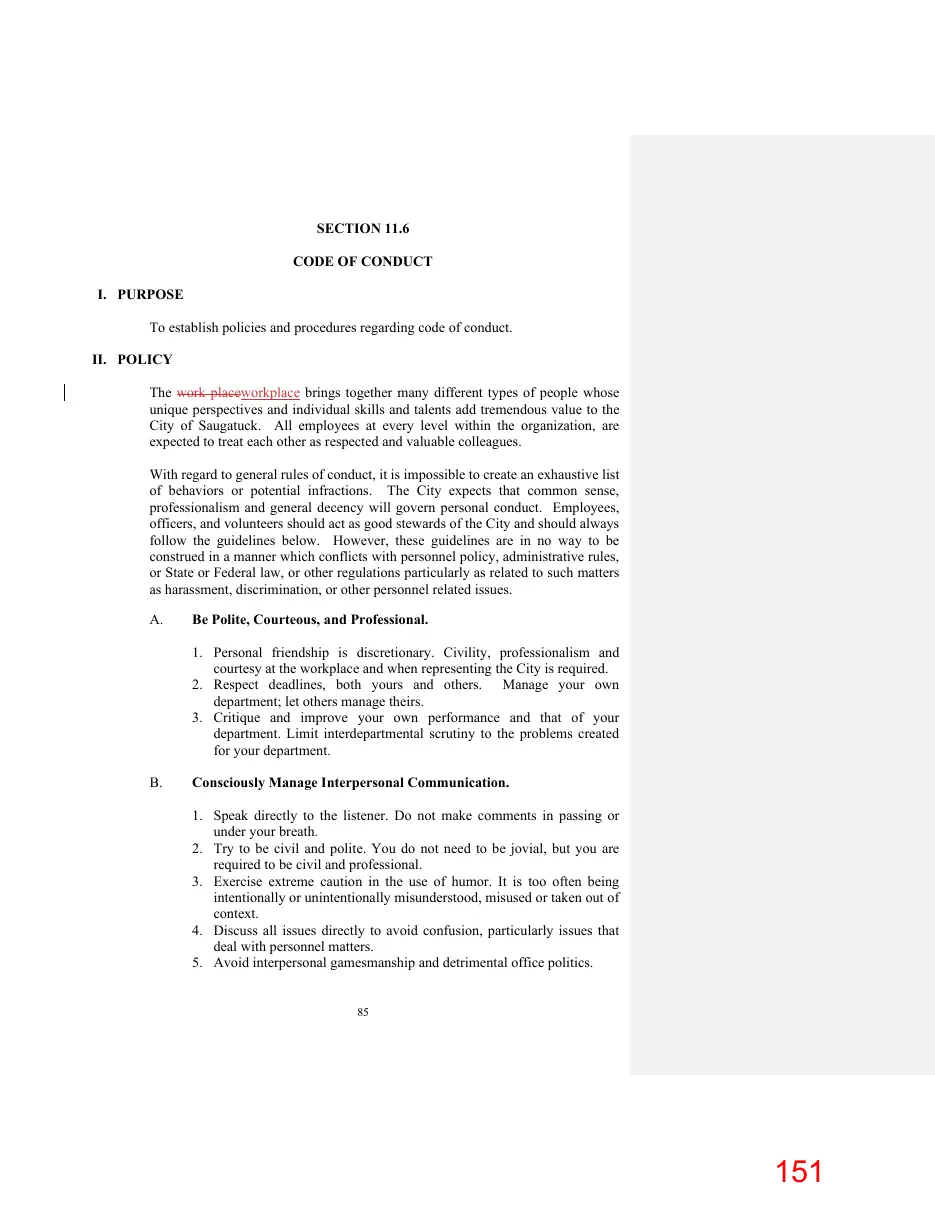
Text of page 151
SECTION 11.6 CODE OF CONDUCT I. PURPOSE To establish policies and procedures regarding code of conduct. II. POLICY The work placeworkplace brings together many different types of people whose unique perspectives and individual skills and talents add tremendous value to the City of Saugatuck. All employees at every level within the organization, are expected to treat each other as respected and valuable colleagues. With regard to general rules of conduct, it is impossible to create an exhaustive list of behaviors or potential infractions. The City expects that common sense, professionalism and general decency will govern personal conduct. Employees, officers, and volunteers should act as good stewards of the City and should always follow the guidelines below. However, these guidelines are in no way to be construed in a manner which conflicts with personnel policy, administrative rules, or State or Federal law, or other regulations particularly as related to such matters as harassment, discrimination, or other personnel related issues. A.
Be Polite, Courteous, and Professional. 1. Personal friendship is discretionary. Civility, professionalism and courtesy at the workplace and when representing the City is required. 2. Respect deadlines, both yours and others. Manage your own department; let others manage theirs. 3. Critique and improve your own performance and that of your department. Limit interdepartmental scrutiny to the problems created for your department.
Consciously Manage Interpersonal Communication. 1. Speak directly to the listener. Do not make comments in passing or under your breath. 2. Try to be civil and polite. You do not need to be jovial, but you are required to be civil and professional. 3. Exercise extreme caution in the use of humor. It is too often being intentionally or unintentionally misunderstood, misused or taken out of context. 4. Discuss all issues directly to avoid confusion, particularly issues that deal with personnel matters. 5. Avoid interpersonal gamesmanship and detrimental office politics. 85
Page 152
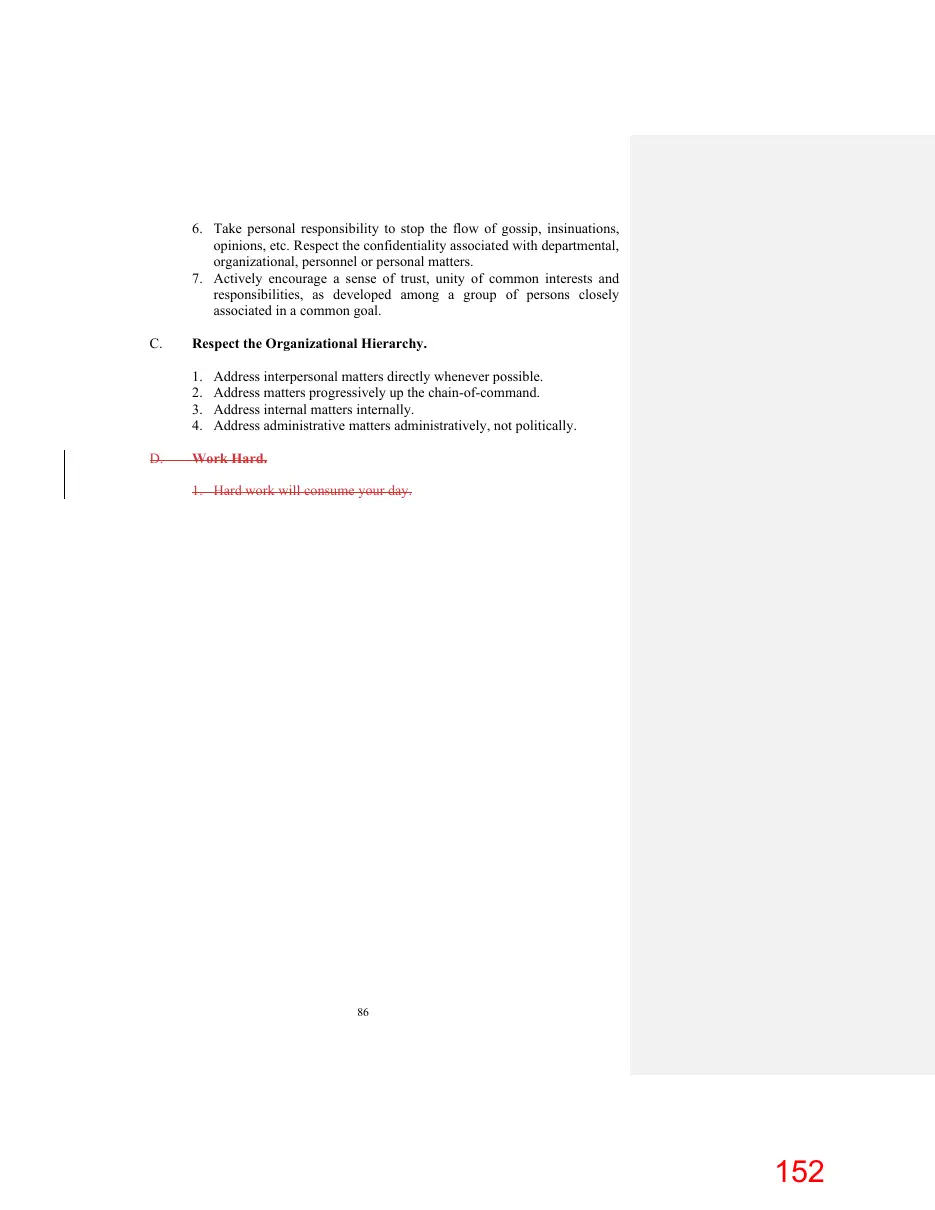
Text of page 152
6. Take personal responsibility to stop the flow of gossip, insinuations, opinions, etc. Respect the confidentiality associated with departmental, organizational, personnel or personal matters. 7. Actively encourage a sense of trust, unity of common interests and responsibilities, as developed among a group of persons closely associated in a common goal. C.
Respect the Organizational Hierarchy. 1. 2. 3. 4.
Address interpersonal matters directly whenever possible. Address matters progressively up the chain‐of‐command. Address internal matters internally. Address administrative matters administratively, not politically.
Work Hard. 1. Hard work will consume your day.
Page 153
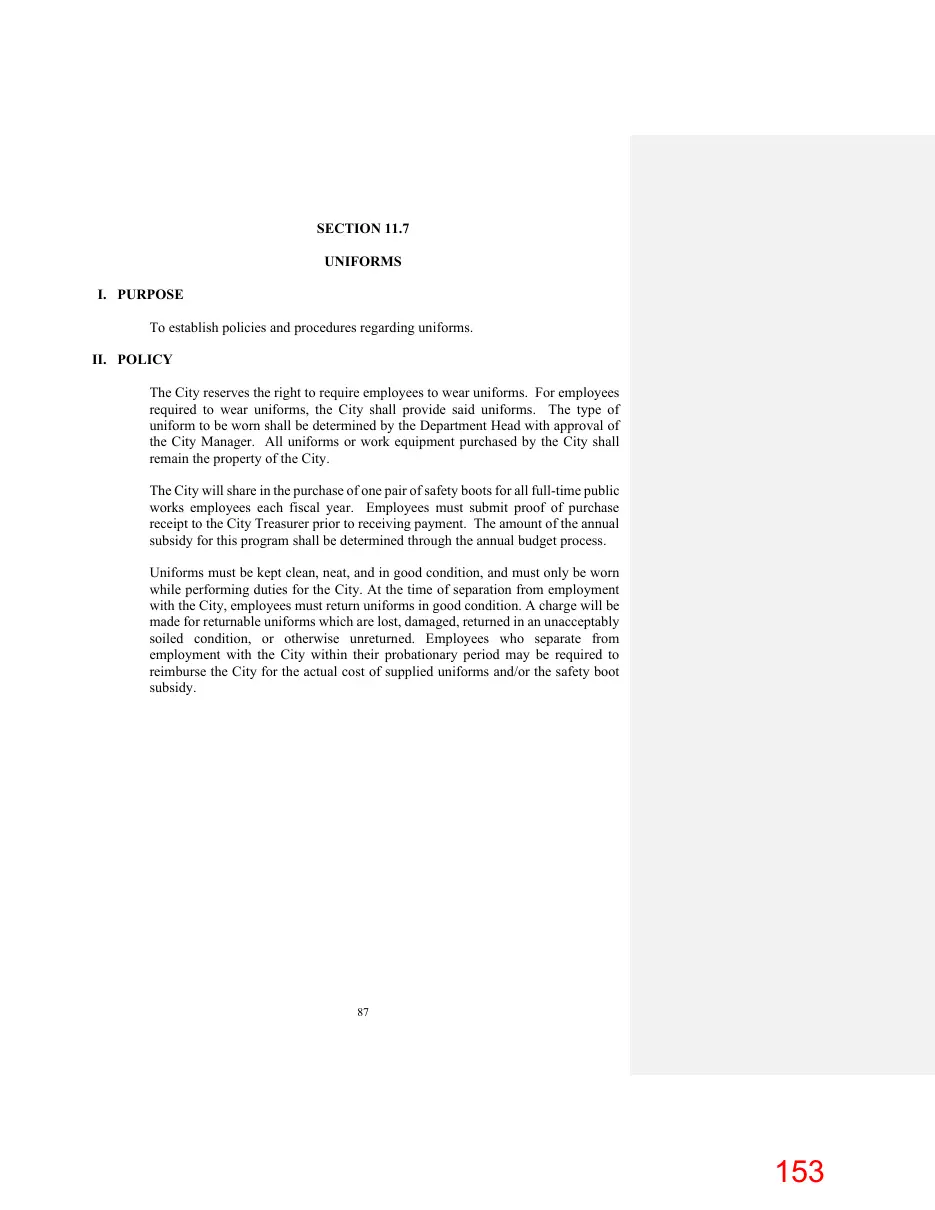
Text of page 153
SECTION 11.7 UNIFORMS I. PURPOSE To establish policies and procedures regarding uniforms. II. POLICY The City reserves the right to require employees to wear uniforms. For employees required to wear uniforms, the City shall provide said uniforms. The type of uniform to be worn shall be determined by the Department Head with approval of the City Manager. All uniforms or work equipment purchased by the City shall remain the property of the City. The City will share in the purchase of one pair of safety boots for all full-time public works employees each fiscal year. Employees must submit proof of purchase receipt to the City Treasurer prior to receiving payment. The amount of the annual subsidy for this program shall be determined through the annual budget process. Uniforms must be kept clean, neat, and in good condition, and must only be worn while performing duties for the City. At the time of separation from employment with the City, employees must return uniforms in good condition. A charge will be made for returnable uniforms which are lost, damaged, returned in an unacceptably soiled condition, or otherwise unreturned. Employees who separate from employment with the City within their probationary period may be required to reimburse the City for the actual cost of supplied uniforms and/or the safety boot subsidy.
Page 154
Text of page 154
SECTION 11.8 PAYROLL DEDUCTIONS I.
PURPOSE To establish policies and procedures regarding payroll deduction.
II.
POLICY The City withholds Federal Income Tax, State Income Tax, Federal Social Security Tax, Medicare Tax, employee contributions to the City Retirement Plan if applicable, court-ordered garnishments and child support payments from employee paychecks in the amount and manner prescribed by state and federal law. In addition, the City will withhold voluntarily authorized deductions from an employee’s paycheck for other programs approved by the City. The starting and changing of voluntary deductions must be requested on a form provided by the office of the City ManagerTreasurer.
Page 155
Text of page 155
SECTION 11.9 COMPUTER AND E-MAIL USAGE I.
PURPOSE To establish policies and procedures regarding computer and E-mail usage.
II.
POLICY Computers, computer files, and E-mail system, and software furnished to employees are City property intended for official, City purposes. Employees should not use a password, access a file, or retrieve any stored communication without authorization. To ensure compliance with this policy, computer and E-mail usage may be monitored, and employees should be aware that such uses may be subject to disclosure under state law. The City strives to maintain a workplace free of harassment and sensitive to the diversity of its employees, prohibits the use of computers and any E-mail system in ways that are disruptive, offensive to others, or harmful to morale. For example, the display or transmission of sexually explicit images, messages, and cartoons is not allowed. Other such misuse includes, but is not limited to ethnic slurs, racial comments, off-color jokes, or anything that may be construed as harassment or showing disrespect for others. E-mail may not be used to solicit others for commercial ventures or religious causes, outside organizations, or other non-business matters. The City purchases and licenses the use of various computer software for business purposes and does not own the copyright to this software or its related documentation. Unless authorized the software developer, the City does not have the right to reproduce such software for use on more than one computer. Employees may only use software on local area networks or on multiple machines according to the software license agreement. The City prohibits the illegal duplication of software and its related documentation. Personal use of computers is authorized within reasonable limits as long as it does not interfere with or conflict with City business. Employees are responsible for exercising good judgment regarding the reasonableness of personal use. In case of doubt, employees should consult their Department Head or the City Manager.
Computer and Email Usage Policy
Formatted: No bullets or numbering
City computers, files, email systems, and software are City property and must be used for official City purposes only.
Employees must not: o
Use a password, access a file, or retrieve stored communication without authorization.
Use computers or email in ways that are disruptive, offensive, or harmful to workplace morale. 89
Page 156
Text of page 156
Display or transmit sexually explicit images, messages, cartoons, ethnic slurs, racial comments, off-color jokes, or any content that may be considered harassment or disrespectful.
Use City email to solicit others for commercial ventures, religious causes, external organizations, or non-business matters.
Monitoring and Compliance: o
The City may monitor computer and email usage to ensure compliance.
Employees should be aware that computer and email activity may be subject to disclosure under state law.
Software Usage and Licensing: o
The City purchases and licenses software for business purposes but does not own the copyrights.
Employees may only use software according to licensing agreements and must not duplicate or install unauthorized copies.
Personal Use: o
Reasonable personal use of City computers is permitted as long as it does not interfere with City business.
Employees are responsible for exercising good judgment regarding personal use. If unsure, employees should consult their Department Head or the City Manager.
Cybersecurity and Data Protection
Formatted: No bullets or numbering
Employees are responsible for ensuring the security of City computer systems, networks, and data. Employees must: •
Use strong, unique passwords and update them regularly.
Refrain from sharing passwords or login credentials.
Be cautious when opening email attachments or clicking on links from unknown sources to prevent phishing and malware threats.
Lock computers when leaving their workstation unattended.
Report any suspected security breaches, unauthorized access, or cybersecurity threats immediately to their Department Head or the City Manager.
Remote Access and Mobile Device Use
Formatted: Indent: Left: 0.5"
Formatted: No bullets or numbering
Page 157
Text of page 157
Employees who access City systems remotely or via mobile devices must follow security protocols, including: •
Using only City-approved and properly secured devices when accessing City systems.
Utilizing a Virtual Private Network (VPN) or other authorized secure connection when working remotely.
Enabling multi-factor authentication (MFA) when accessing City email or systems.
Avoiding the use of public or unsecured Wi-Fi networks for City business unless a secure connection is used.
Reporting lost or stolen devices immediately to the appropriate department.
Retention and Deletion of Emails
Formatted: Indent: Left: 0.5"
Formatted: No bullets or numbering
Emails sent or received through the City’s email system may be subject to retention policies and public records requests under state law. Employees must: •
Retain emails in accordance with City records retention policies.
Ensure that official City business conducted via email is properly archived when necessary.
Avoid using personal email accounts for City business, as these may not be properly retained or secured.
Formatted: Indent: Left: 0.5"
Page 158
Text of page 158
SECTION 11.10 WORKPLACE VIOLENCE I.
PURPOSE To establish policies and procedures regarding workplace violence.
II.
POLICY The City of Saugatuck is committed to reducing the potential for workplace violence. In this regard, it is the policy of the City to prohibit acts or threats of violence by any party, directed toward employees, citizens, elected officials, and visitors to the City’s facilities or others. The City is committed to providing a safe and healthfulhealthy work environment, consistent with health and safety rules and will take prompt remedial action, up to and including discharge or criminal prosecution, against any employee who engages in threatening behavior or acts of violence. The City will take appropriate action against any non-employee who engages in threatening behavior including former employees and visitors to City facilities, up to and including criminal prosecution. Employees who display a tendency to engage in violent, abusive or threatening behavior will be referred to the City’s health plan for counseling or other appropriate treatment. Such employees will also be subject to disciplinary action, up to and including immediate discharge. Additionally, it is the responsibility of City employees to assist in identifying problematic behavior of other employees. The City Manager should be immediately notified of situations or incidents involving threats, acts of violence, aggressive behavior, threatening or offensive comments and similar acts. Employee reports made pursuant to this policy will be held in confidence to the maximum possible extent. The City will not tolerate retaliation against any employee reporting a violation of this policy.
Page 159
Text of page 159
SECTION 11.11 DRUG AND ALCOHOL-FREE WORKPLACE I.
PURPOSE The City of Saugatuck is committed to creating a drugand alcohol-free working environment for its work force. The use of alcohol and/or drugs in the workplace jeopardizes safety, lowers productivity and undermines public confidence.
II.
POLICY All the City of Saugatuck premises, including work sites and all City of Saugatuck vehicles, are declared to be drug/alcohol-free work placesworkplaces. City of Saugatuck employees are prohibited from unlawfully manufacturing, distributing, dispensing, possessing, or using controlled substances and/or alcohol in the workplace. Employees who are taking prescription medication that may impair their ability to drive and/or operate equipment/machinery shall notify their supervisor prior to engaging in that activity for an alternative assignment. Employees found to be in violation of this policy will be subject to appropriate personnel/disciplinary action up to and including termination for the first offense, and/or other remedial measures as the individual circumstances warrant. Employees required to maintain a Commercial Driver’s License as a condition of their employment are subject to state and federal provisions regarding Department of Transportation (“DOT”) drug testing.
Page 160
Text of page 160
SECTION 11.12 PERSONAL WORKSPACE AND ARTICLES I.
PURPOSE To establish policies and procedures regarding personal workspace and articles.
II.
POLICY The City is not responsible for lost or damaged personal articles brought into the workplace. All property belonging to the City, including City vehicles, computers, phones, desks, file cabinets, lockers and other storage areas, is subject to inspection or search at any time without notice to retrieve work-related materials or to investigate a violation of workplace rules. Employees should not have any expectation to privacy with regard to City premises. Personal workspace is also considered property of the City and is oftentimes accessible and viewable by co-workers and the public. Minimal tasteful displays of a nonpolitical nature such as personal pictures and related items are acceptable. However, any personal displays that violate harassment, code of conduct, or other policies will be addressed as a violation according to those procedures. Your department head and/or the City Manager have the final authority to determine what is acceptable.
Page 161
Text of page 161
SECTION 11.13 SENSITIVE RECORDS I.
PURPOSE To establish policies and procedures regarding sensitive records.
II.
POLICY Employees may have access to sensitive or confidential information or records not intended for or required to be publicly released or shared with other employees in the organization. Though much of the information handled by the City is public information, in some instances a Freedom of Information Request (“FOIA”) is required. City employees are not to share or disclose any sensitive or confidential information with other employees or the public without approval of the City Manager and should only discuss sensitive or confidential information when necessary to carry out job duties. In addition, employees should not attempt to acquire sensitive or confidential information that is not germane to their employment. Under no circumstance may an employee remove documents, photos, reports, personal or personnel information or any sensitive material that is the property of the City. Employees found to be in violation of this policy may be disciplined, up to and including discharge.
Page 162
Text of page 162
SECTION 11.14 FREEDOM OF INFORMATION ACT (FOIA) I.
PURPOSE To establish policies and procedures regarding Freedom of Information Act.
II.
POLICY It is the policy of the City of Saugatuck to fully comply with the Freedom of Information Act (“FOIA”). All individuals are entitled to certain and specific information regarding the affairs of government and the actions of public officials and public employees. All FOIA requests are to be immediately directed to and processed by the City Clerk or his/hertheir designee.
Page 163
Text of page 163
SECTION 11.15 PUBLIC STATEMENTS/PRESS CALLS I.
PURPOSE To establish policies and procedures regarding public statements/press calls.
II.
POLICY Unless otherwise delegated, the City Manager is the official designated spokesperson for City staff. Employees should refer all requests for formal statements, interviews, and related activities to the City Manager. Employees may not make formal statements on behalf of the City, except in cases of sharing routine, factual information, without prior authorization.
Page 164
Text of page 164
SECTION 11.16 CREDIT CARDS I.
PURPOSE To establish policies and procedures regarding use of City issued credit cards.
II.
POLICY The City recognizes that in certain instances, it is in its best interest to issue a City credit card to certain employees. City credit cards are limited to employees in positions that demonstrate that having a credit card will assist them in performing their assigned responsibilities. Any issuance of a City credit card must first be authorized by the City Manager. The credit card may only be used for the purchase of goods or services related to the official business of the City. It is not to be used for any personal business. Any employee that is issued a City credit card is responsible for the card’s protection and custody and shall immediately notify the City Treasurer if the card is lost or stolen. The issuance of a City credit card is a privilege that may be revoked at any time. Any card holder found in violation of this policy may be forced to surrender the card and may be subject to discipline. Employees shall surrender their City credit card upon request, including at the time of termination.
Page 165
Text of page 165
SECTION 11.17 PERSONAL ELECTRONIC DEVICES I.
PURPOSE To establish policies and procedures regarding the use of personal electronic devices (cell phones, I-pads, etc.) in the workplace.
II.
POLICY During work time, employees should limit the use of their personal electronic devices as to not interfere with their assigned duties. Employees in an office setting should set personal cell phones to vibrate or a low volume ring mode during work hours to avoid disrupting official business or disturbing those working around them.
SECTION 11.18 99
Page 166
Text of page 166
CUSTOMER SERVICE I.
PURPOSE To establish policies and procedures regarding to customer service.
II.
POLICY The City of Saugatuck requires employees to represent the City in a positive manner and treat members of the public (customers) with courtesy and respect. Employees should be prepared to listen patiently to inquires or complaints and deal with them in a helpful, professional manner. All employees should engage in behavior to deescalate matters of potential conflict when dealing with the public rather than escalating matters. Members of the public who become unreasonable, abusive or harassing should be referred to the employee’s supervisor or Department Head.
SECTION 11.19 100
Page 167
Text of page 167
GIFTS AND GRATUITIES I.
PURPOSE To establish policies and procedures regarding gifts and gratuities.
II.
POLICY As public servants, services must be rendered, and business contracts awarded without favoritism or the suggestion that gifts and/or gratuities are expected in return. The City Manager may approve the acceptance of gifts presented for the benefit of the City as a whole, its employees and the public (such as a food basket that can be set out for general consumption). If a situation should arise that an employee considers inappropriate, they should promptly report it to the City Manager.
Page 168
Text of page 168
SECTION 11.20 KEY DISPERSAL I.
PURPOSE To establish policies and procedures regarding key dispersal.
II.
POLICY Keys to City buildings, facilities, vehicles or equipment may be issued to employees. Keys are never to be duplicated, given or lent to anyone else, including a fellow employee. Lost or stolen items must be immediately reported to the City Manager.
Page 169
Text of page 169
SECTION 11.21 MEDICAL EXAMINATIONS I.
PURPOSE To establish policies and procedures regarding medical examination.
II.
POLICY The City may require an employee to submit to a medical or psychological exam to determine fitness for duty provided the examinations are job related and consistent with business necessity. Tests for alcohol or illegal drug use are not considered medical examinations, nor are physical agility tests. Fitness for duty exams will be conducted by a licensed professional designated by the City and will be paid for by the City. The City will comply with all requirements of the Americans with Disabilities Act (“ADA”), Family Medical Leave Act (“FMLA”), Michigan Persons with Disabilities Civil Rights Act, Worker’s Compensation and related laws and guidelines in addressing circumstances where an employee is found to be unfit to perform some or all of their essential job functions. This policy in no way shall be construed to limit employees’ rights under any federal or state law. Employees determined to be unfit for duty and requiring associated leave, may access accrued leave banks and other paid or unpaid leave time consistent with the policies contained within this manual and state and federal laws. Light duty or modified return-to-work arrangements are not guaranteed and would not indicate continued employment if provided.
Page 170
Text of page 170
SECTION 11.22 COMMERCIAL DRIVERS LICENSE REIMBURSEMENT I. PURPOSE To establish policies and procedures regarding commercial driver’s license reimbursement to department public works employees. II. POLICY All full-time department of public works employees are required to have a valid State of Michigan commercial driver’s license with the proper endorsement(s) to perform their duties. Employees are eligible to receive a reimbursement above the cost of the standard Michigan driver’s license upon renewal. Employees must submit proof of payment for their license renewal from the Michigan Secretary of State to the City Treasurer in order to be eligible for the reimbursement.
Page 171
Text of page 171
Formatted
Formatted
Formatted
SECTION 11.23 ARTIFICIAL INTELLIGENCE TOOLS
Formatted
Formatted
Formatted
Formatted
Formatted
Formatted
I. PURPOSE
Formatted
The City recognizes the potential benefits of Artificial Intelligence (AI) tools in enhancing productivity, efficiency, and decision-making. This policy provides guidelines for the appropriate use of AI tools by City employees while ensuring that human expertise, professional judgment, and fact-checking remain central to all processes. II. POLICY
Formatted
Formatted
Formatted
Formatted
Formatted
Formatted
This policy applies to all City employees who utilize AI tools in the course of their duties. AI as a Support Tool: • AI tools may be used to assist with research, drafting communications, analyzing data, generating reports, and other administrative tasks. • AI-generated outputs should be reviewed and refined by employees before use. Human Oversight and Judgment: • Employees must apply their professional experience, education, and judgment to all AI-assisted work. • AI tools should not replace critical thinking, decision-making, or professional discretion. Fact-Checking and Accuracy: • All information generated by AI tools must be verified for accuracy and reliability before being used or shared.
Formatted
Formatted
Formatted
Formatted
Formatted
Formatted
Formatted
Formatted
Formatted
Formatted
Formatted
Formatted
Formatted
Formatted
Employees should be aware of the potential for bias in AI-generated content.
Formatted
Employees are responsible for ensuring that AI-assisted work aligns with applicable laws, policies, and ethical standards.
Formatted
Confidentiality and Security: • Employees must not input sensitive, confidential, or personally identifiable information into AI tools unless explicitly authorized by their supervisor. • AI tools must be used in accordance with the City's cybsersecuritycybersecurity policies and data protection guidelines.
Formatted
Formatted
Formatted
Formatted
Formatted
Formatted
Formatted
Formatted
Formatted
Accountability: 105
Formatted
Page 172
Text of page 172
Employees are ultimately responsible for the quality, accuracy, and appropriateness of AI-assisted outputs. Any errors or issues arising from AI-generated content are the responsibility of the employee using the tool. The City Manager may audit and monitor the use of AI tools by employees to ensure compliance with this policy and applicable laws.
Prohibited Uses: • AI should not be used to make final recommendations or decisions in policy matters, personnel actions, legal determinations, or financial transactions. • AI tools should not be used in ways that violate any City policies, regulations, or ethical standards. Training and Awareness: • Employees are encouraged to stay informed about AI capabilities, limitations, and best practices. • The City may provide training on the effective and responsible use of AI tools. This policy will be reviewed periodically to ensure alignment with evolving AI technologies and best practices. Employees with questions regarding AI use should consult their supervisor or the City Manager.
Formatted: Font: 12 pt, Not Italic Formatted: Body Text Indent, Space After: 0 pt, Line spacing: single, Bulleted + Level: 1 + Aligned at: 0.75" + Indent at: 1" Formatted: Font: 12 pt Formatted: Font: 12 pt, Not Italic Formatted: Normal (Web), Space After: 0 pt, Line spacing: single, Bulleted + Level: 1 + Aligned at: 0.75" + Indent at: 1" Formatted: Font: 12 pt, Not Italic Formatted: Font: 12 pt, Bold Formatted: Body Text Indent, Space After: 0 pt, Line spacing: single, No bullets or numbering Formatted: Font: 12 pt, Not Italic Formatted: Font: 12 pt, Not Italic Formatted: Font: 12 pt, Not Italic Formatted: Body Text Indent, Space After: 0 pt, Line spacing: single, Bulleted + Level: 1 + Aligned at: 0.75" + Indent at: 1" Formatted: Font: 12 pt Formatted: Font: 12 pt, Not Italic Formatted: Font: 12 pt Formatted: Font: 12 pt, Not Italic Formatted: Font: 12 pt, Bold Formatted: Body Text Indent, Space After: 0 pt, Line spacing: single, No bullets or numbering Formatted: Font: 12 pt, Not Italic Formatted: Body Text Indent, Space After: 0 pt, Line spacing: single, Bulleted + Level: 1 + Aligned at: 0.75" + Indent at: 1" Formatted: Font: 12 pt Formatted: Font: 12 pt, Not Italic Formatted: Font: 12 pt Formatted: Font: 12 pt, Not Italic Formatted: Body Text Indent, Space After: 0 pt, Line spacing: single Formatted: Font: 12 pt
Page 173
Text of page 173
SECTION 11.24 SOCIAL MEDIA I. PURPOSE The City recognizes the importance of social media as a means of communication and self-expression. This policy is intended to provide guidance to City employees on appropriate social media use while balancing their First Amendment rights with their responsibilities as public employees. II. POLICY This policy applies to all employees of the City when using social media, whether in an official or personal capacity, in a manner that relates to their employment with the City. Personal Speech: •
Employees are free to engage in personal social media activity, including expressing opinions on matters of public concern, so long as they do so in a manner that is clearly personal and not in an official capacity. Employees should clarify that their views are their own and do not represent the City. If an employee discusses City-related matters on a personal account, they should make it clear that they are speaking in their personal capacity and not on behalf of the City. A disclaimer such as “The views expressed here are my own and do not represent those of the City of Saugatuck” is recommended.
Formatted: Centered, Indent: Left: 0", Tab stops: 0.06", Left Formatted: Numbered + Level: 1 + Numbering Style: I, II, III, … + Start at: 1 + Alignment: Right + Aligned at: 0" + Indent at: 0.13"
Formatted: Indent: Left: 0.5" Formatted: Numbered + Level: 1 + Numbering Style: I, II, III, … + Start at: 1 + Alignment: Right + Aligned at: 0" + Indent at: 0.13"
Formatted: Indent: Left: 0.5" Formatted: Indent: First line: 0.5" Formatted: Font: 12 pt, Not Bold, Not Italic
Formatted: Body Text Indent, Left, Outline numbered + Level: 2 + Numbering Style: Bullet + Aligned at: 0.75" + Indent at: 1" Formatted: Font: Bold
Official Speech & Job-Related Content • •
Employees speaking on matters within the scope of their official duties are engaging in government speech and may be subject to reasonable restrictions. Employees should not use their personal social media accounts to conduct official City business or represent City positions unless authorized to do so.
Formatted: Font: 12 pt, Not Italic
Formatted: Font: 12 pt, Not Italic
Official Social Media Accounts: •
Authorized Users o Only employees designated by the City Manager may create, manage, or post content on official City social media accounts. o Login credentials and account access must be securely maintained, with administrative oversight by the City Manager. Content Standards and Approval Process
Formatted: Font: Not Bold, Not Italic Formatted: Font: Not Italic Formatted: Indent: Left: 1.19" Formatted: Indent: Left: 1.44", No bullets or numbering
Page 174
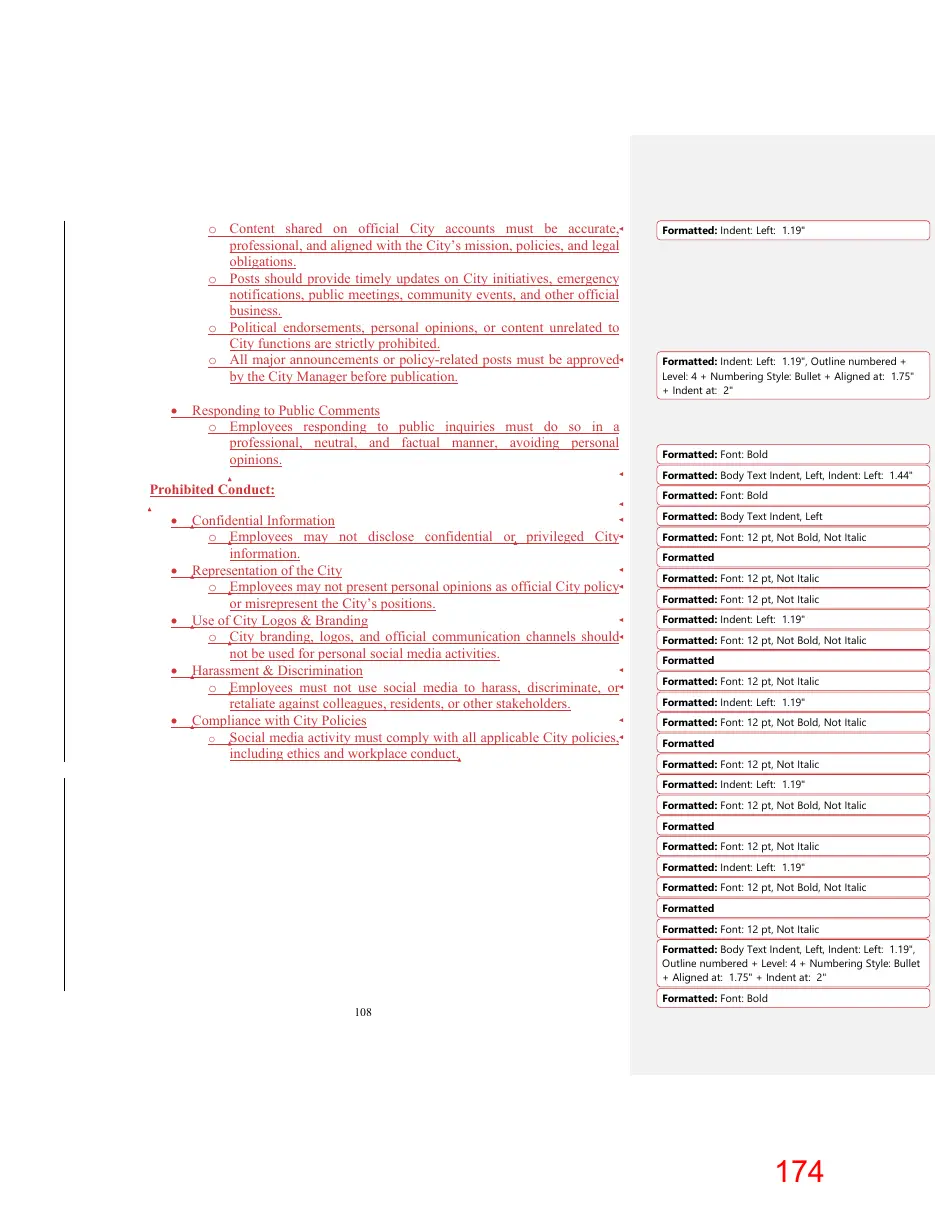
Text of page 174
o Content shared on official City accounts must be accurate, professional, and aligned with the City’s mission, policies, and legal obligations. o Posts should provide timely updates on City initiatives, emergency notifications, public meetings, community events, and other official business. o Political endorsements, personal opinions, or content unrelated to City functions are strictly prohibited. o All major announcements or policy-related posts must be approved by the City Manager before publication. •
Responding to Public Comments o Employees responding to public inquiries must do so in a professional, neutral, and factual manner, avoiding personal opinions.
Prohibited Conduct: • • • • •
Formatted: Indent: Left: 1.19"
Formatted: Indent: Left: 1.19", Outline numbered + Level: 4 + Numbering Style: Bullet + Aligned at: 1.75" + Indent at: 2"
Formatted: Font: Bold Formatted: Body Text Indent, Left, Indent: Left: 1.44" Formatted: Font: Bold
Confidential Information o Employees may not disclose confidential or privileged City information. Representation of the City o Employees may not present personal opinions as official City policy or misrepresent the City’s positions. Use of City Logos & Branding o City branding, logos, and official communication channels should not be used for personal social media activities. Harassment & Discrimination o Employees must not use social media to harass, discriminate, or retaliate against colleagues, residents, or other stakeholders. Compliance with City Policies o Social media activity must comply with all applicable City policies, including ethics and workplace conduct.
Formatted: Body Text Indent, Left Formatted: Font: 12 pt, Not Bold, Not Italic Formatted Formatted: Font: 12 pt, Not Italic Formatted: Font: 12 pt, Not Italic Formatted: Indent: Left: 1.19" Formatted: Font: 12 pt, Not Bold, Not Italic Formatted Formatted: Font: 12 pt, Not Italic Formatted: Indent: Left: 1.19" Formatted: Font: 12 pt, Not Bold, Not Italic Formatted Formatted: Font: 12 pt, Not Italic Formatted: Indent: Left: 1.19" Formatted: Font: 12 pt, Not Bold, Not Italic Formatted Formatted: Font: 12 pt, Not Italic Formatted: Indent: Left: 1.19" Formatted: Font: 12 pt, Not Bold, Not Italic Formatted Formatted: Font: 12 pt, Not Italic Formatted: Body Text Indent, Left, Indent: Left: 1.19", Outline numbered + Level: 4 + Numbering Style: Bullet + Aligned at: 1.75" + Indent at: 2"
Formatted: Font: Bold
Page 175

This page is a scanned image with no text layer. The PDF of these pages has it at full resolution.
Page 176
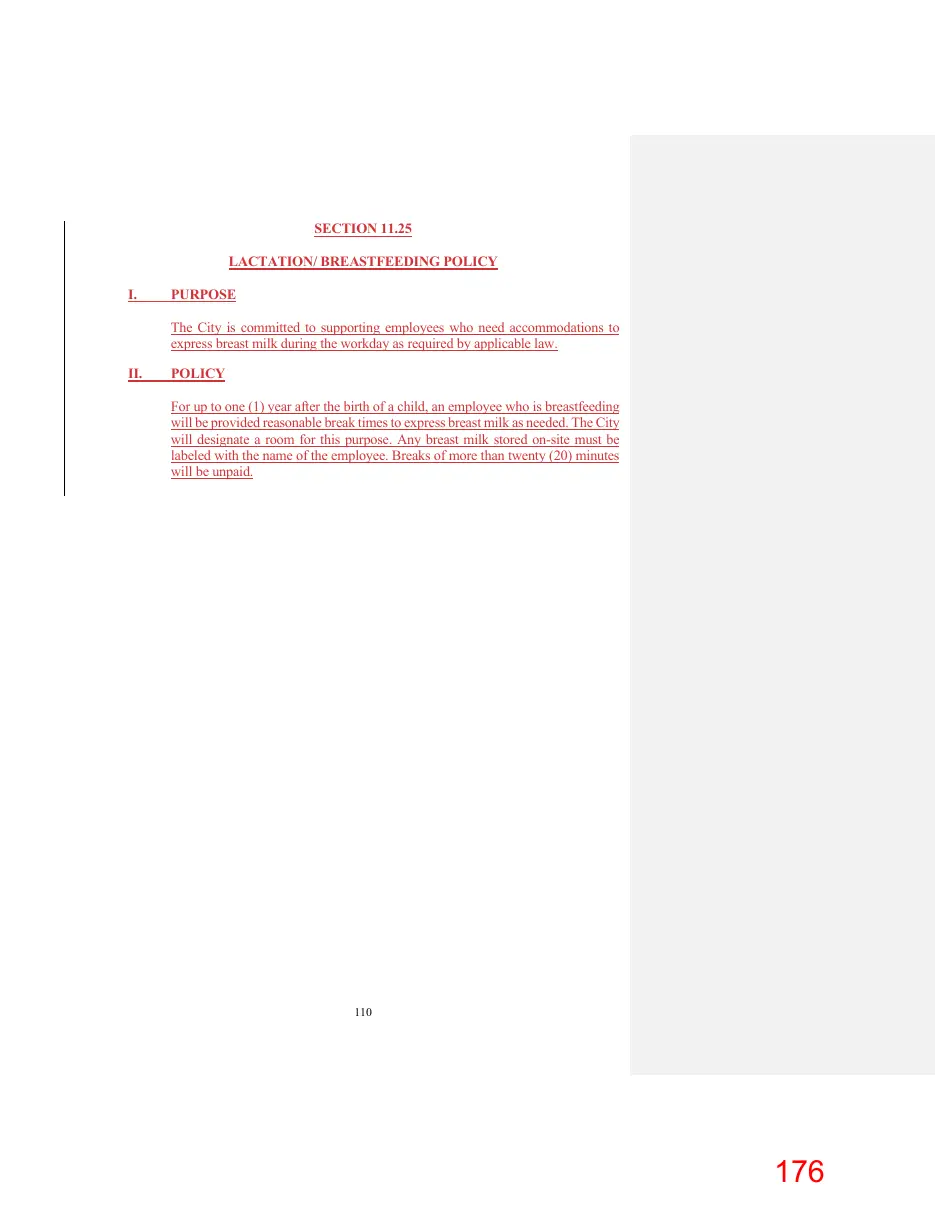
Text of page 176
SECTION 11.25 LACTATION/ BREASTFEEDING POLICY I.
PURPOSE The City is committed to supporting employees who need accommodations to express breast milk during the workday as required by applicable law.
II.
POLICY For up to one (1) year after the birth of a child, an employee who is breastfeeding will be provided reasonable break times to express breast milk as needed. The City will designate a room for this purpose. Any breast milk stored on-site must be labeled with the name of the employee. Breaks of more than twenty (20) minutes will be unpaid.
Page 177
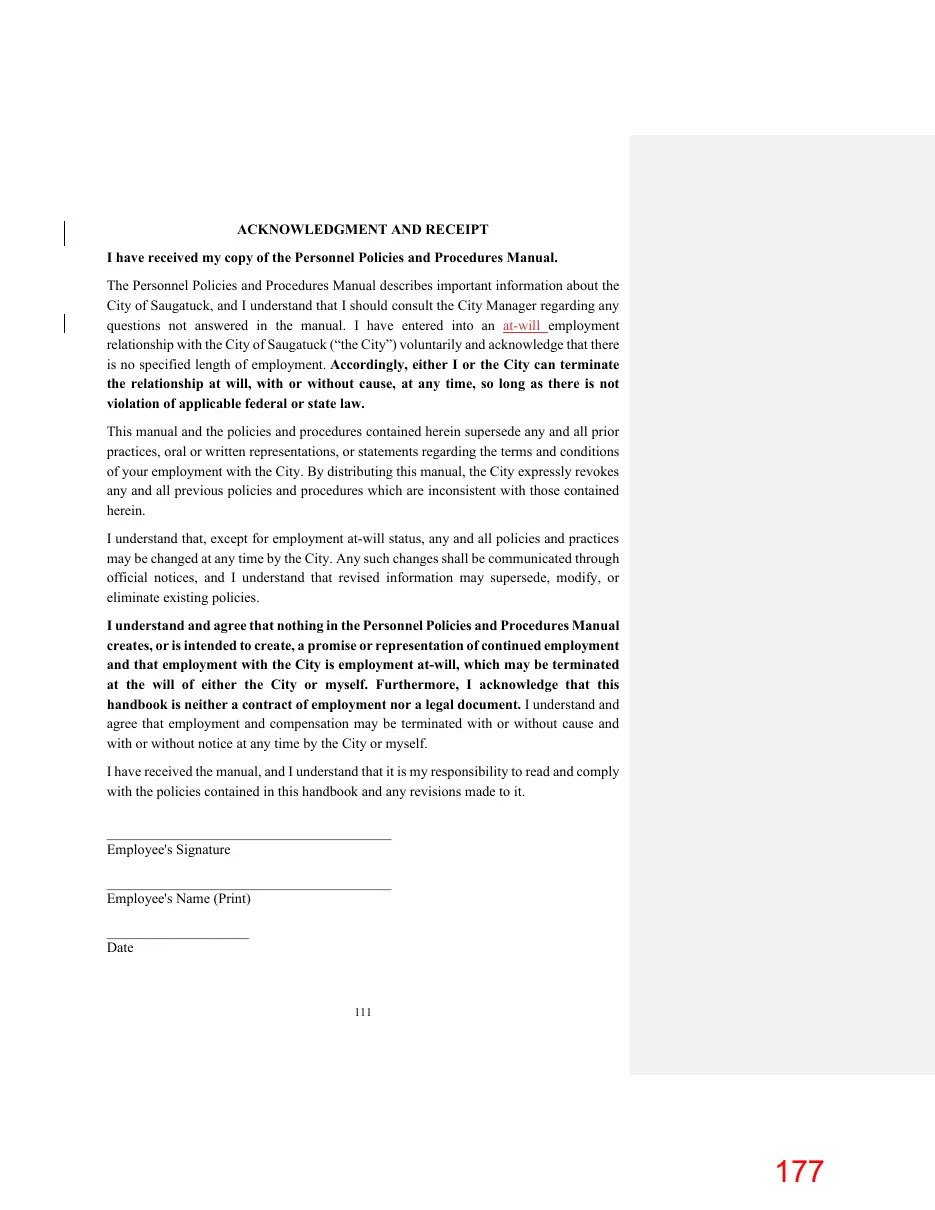
Text of page 177
ACKNOWLEDGMENT AND RECEIPT I have received my copy of the Personnel Policies and Procedures Manual. The Personnel Policies and Procedures Manual describes important information about the City of Saugatuck, and I understand that I should consult the City Manager regarding any questions not answered in the manual. I have entered into an at-will employment relationship with the City of Saugatuck (“the City”) voluntarily and acknowledge that there is no specified length of employment. Accordingly, either I or the City can terminate the relationship at will, with or without cause, at any time, so long as there is not violation of applicable federal or state law. This manual and the policies and procedures contained herein supersede any and all prior practices, oral or written representations, or statements regarding the terms and conditions of your employment with the City. By distributing this manual, the City expressly revokes any and all previous policies and procedures which are inconsistent with those contained herein. I understand that, except for employment at-will status, any and all policies and practices may be changed at any time by the City. Any such changes shall be communicated through official notices, and I understand that revised information may supersede, modify, or eliminate existing policies. I understand and agree that nothing in the Personnel Policies and Procedures Manual creates, or is intended to create, a promise or representation of continued employment and that employment with the City is employment at-will, which may be terminated at the will of either the City or myself. Furthermore, I acknowledge that this handbook is neither a contract of employment nor a legal document. I understand and agree that employment and compensation may be terminated with or without cause and with or without notice at any time by the City or myself. I have received the manual, and I understand that it is my responsibility to read and comply with the policies contained in this handbook and any revisions made to it. ________________________________________ Employee's Signature ________________________________________ Employee's Name (Print) ____________________ Date